Page 80 of 395
2-17 Trunk Lock Release
To unlock the trunk from the outside, insert the master
key and turn it.
Remote Trunk Release
Press the TRUNK button located to the left of the
steering column to release the trunk lid.
The trunk will open if the transaxle is in PARK (P) or
NEUTRAL (N) and the trunk release lockout is in the
unlocked position.
The remote keyless entry system will also unlock your
trunk if the ignition is off, or if the ignition is on and the
transaxle is in PARK (P).
Remote Trunk Release Lockout
The remote trunk release lockout button allows you to
secure items in the trunk.
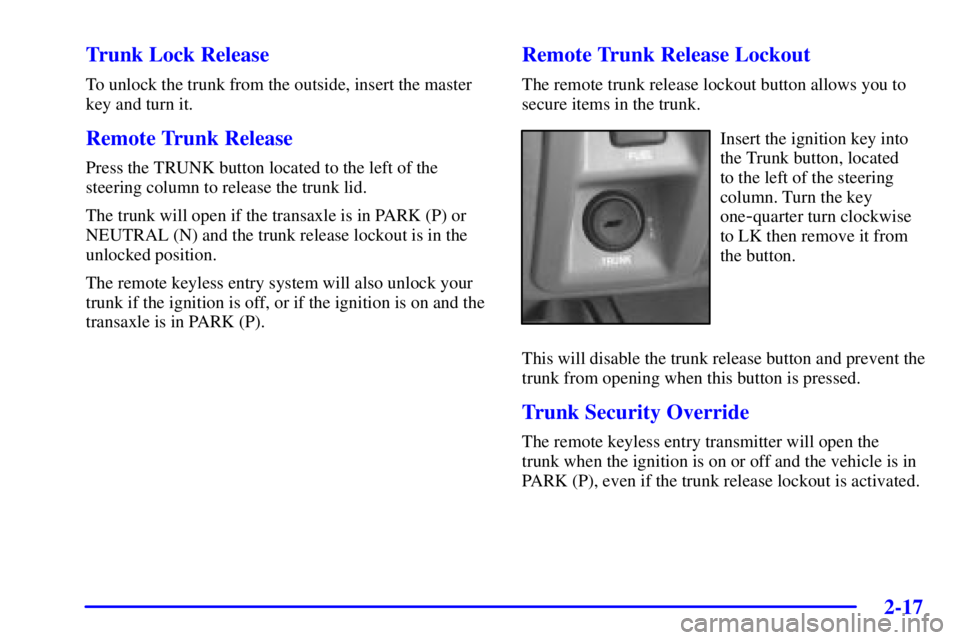
Insert the ignition key into
the Trunk button, located
to the left of the steering
column. Turn the key
one
-quarter turn clockwise
to LK then remove it from
the button.
This will disable the trunk release button and prevent the
trunk from opening when this button is pressed.
Trunk Security Override
The remote keyless entry transmitter will open the
trunk when the ignition is on or off and the vehicle is in
PARK (P), even if the trunk release lockout is activated.
Page 82 of 395

2-19
Theft
Vehicle theft is big business, especially in some cities.
Although your vehicle has a number of theft
-deterrent
features, we know that nothing we put on it can make it
impossible to steal. However, there are ways you
can help.
Key in the Ignition
If you leave your vehicle with the keys inside, it's an
easy target for joy riders or professional thieves
-- so
don't do it.
With the ignition off and the driver's door open, you'll
hear a chime reminding you to remove your key from
the ignition and take it with you. Always do this. Your
ignition and transaxle will be locked. And remember to
lock the doors.
Parking at Night
Park in a lighted spot, close all windows and lock your
vehicle. Remember to keep your valuables out of sight.
Put them in a storage area, or take them with you.
Parking Lots
Even if you park in a lot where someone will be
watching your vehicle, it's still best to lock it up and
take your keys. But what if you have to leave your
ignition key?
�If possible, park in a busy, well
-lit area.
�Put your valuables in a storage area, like your trunk
or glove box.
�Be sure to close and lock the storage area.
�Close all windows.
�Insert the master key into the Trunk button and turn
it to LK (lock).
�Lock the glove box.
�Lock all doors except the driver's.
�Give the valet key to the valet. Then take the master
key with you.
Page 83 of 395

2-20
Content Theft-Deterrent System
Your vehicle is equipped
with a content
theft
-deterrent alarm
system. With this system,
the SECURITY light will
flash as you open the door
(if your ignition is off).
This light reminds you to activate the theft
-deterrent
system. Here's how to do it:
1. Open the door.
2. Lock the door with the power door lock switch or the
remote keyless entry transmitter (if equipped). The
SECURITY light should come on and stay on.
3. Close all doors. The SECURITY light should go
off after approximately 30 seconds. The alarm is not
armed until the SECURITY light goes off.
If a door is opened without the key or the remote
keyless entry transmitter, the alarm will go off. Your
vehicle's lamps will flash and the horn will sound for
30 seconds. The lamps and horn will then turn off to
save battery power.Remember, the theft
-deterrent system won't activate if
you lock the doors with a key or use the manual door
lock. It activates only if you use a power door lock
switch with the door open, or with the remote keyless
entry transmitter. You should also remember that you
can start your vehicle with the correct ignition key if the
alarm has been set off.
Here's how to avoid setting off the alarm by accident:
�If you don't want to activate the theft
-deterrent
system, the vehicle should be locked with the door
key after the doors are closed.
�Always unlock a door with a key, or use the remote
keyless entry transmitter. Unlocking a door any other
way will set off the alarm.
If you set off the alarm by accident, unlock any door
with your key. You can also turn off the alarm by
pressing the button with the unlock symbol on the
remote keyless entry transmitter. The alarm won't stop
if you try to unlock a door any other way.
Page 84 of 395
2-21 Testing the Alarm
The alarm can be tested by following these steps:
1. From inside the vehicle, roll down the driver's
window and open the driver's door.
2. Activate the system by locking the doors using the
power door lock switch while the door is open, or
using the remote keyless entry transmitter.
3. Get out of the car, close the door and wait for the
SECURITY light to go out.
4. Then reach in through the window, unlock the door
with the manual door lock and open the door. This
should set off the alarm.
If the alarm does not sound when it should, but the
vehicle's lamps flash, check to see if the horn works.
The horn fuse may be blown. To replace the fuse, see
ªFuses and Circuit Breakersº in the Index.
If the alarm does not sound or the vehicle's lamps do not
flash, the vehicle should be serviced by an authorized
service center.
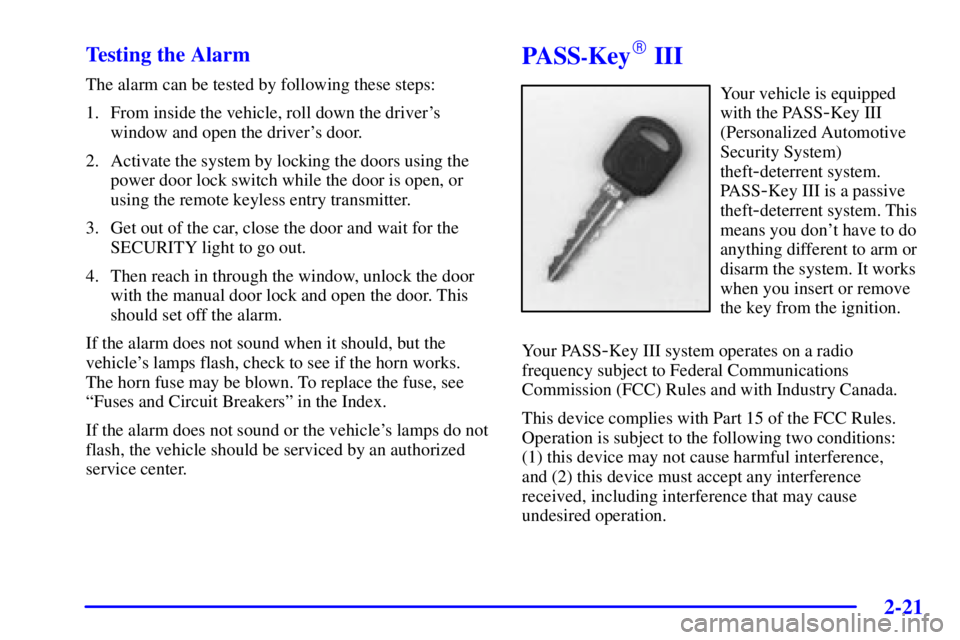
PASS-Key� III
Your vehicle is equipped
with the PASS
-Key III
(Personalized Automotive
Security System)
theft
-deterrent system.
PASS
-Key III is a passive
theft
-deterrent system. This
means you don't have to do
anything different to arm or
disarm the system. It works
when you insert or remove
the key from the ignition.
Your PASS
-Key III system operates on a radio
frequency subject to Federal Communications
Commission (FCC) Rules and with Industry Canada.
This device complies with Part 15 of the FCC Rules.
Operation is subject to the following two conditions:
(1) this device may not cause harmful interference,
and (2) this device must accept any interference
received, including interference that may cause
undesired operation.
Page 87 of 395
2-24
Ignition Positions
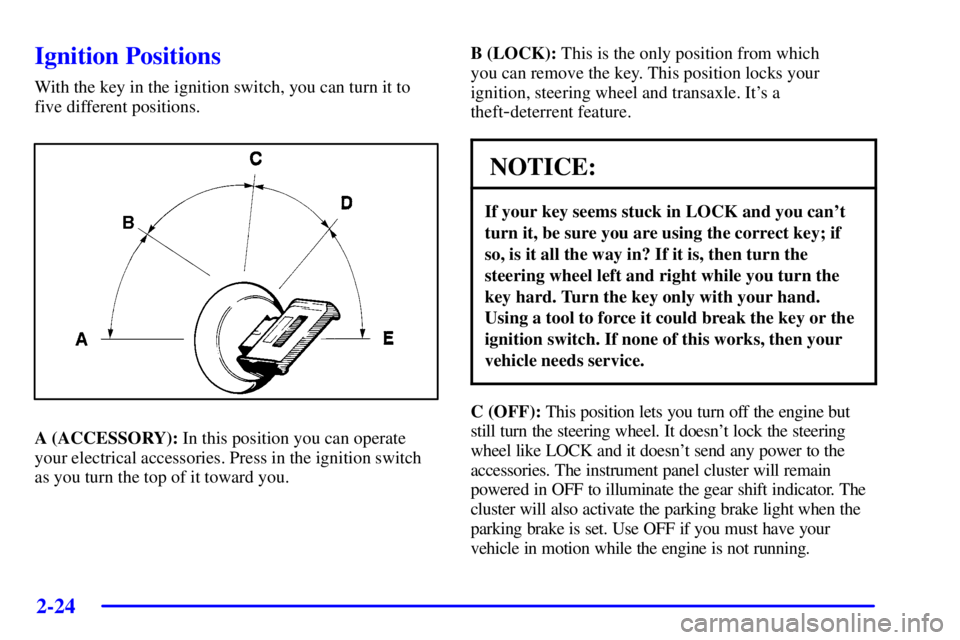
With the key in the ignition switch, you can turn it to
five different positions.
A (ACCESSORY): In this position you can operate
your electrical accessories. Press in the ignition switch
as you turn the top of it toward you.B (LOCK): This is the only position from which
you can remove the key. This position locks your
ignition, steering wheel and transaxle. It's a
theft
-deterrent feature.
NOTICE:
If your key seems stuck in LOCK and you can't
turn it, be sure you are using the correct key; if
so, is it all the way in? If it is, then turn the
steering wheel left and right while you turn the
key hard. Turn the key only with your hand.
Using a tool to force it could break the key or the
ignition switch. If none of this works, then your
vehicle needs service.
C (OFF): This position lets you turn off the engine but
still turn the steering wheel. It doesn't lock the steering
wheel like LOCK and it doesn't send any power to the
accessories. The instrument panel cluster will remain
powered in OFF to illuminate the gear shift indicator. The
cluster will also activate the parking brake light when the
parking brake is set. Use OFF if you must have your
vehicle in motion while the engine is not running.
Page 91 of 395
2-28
Automatic Transaxle Operation
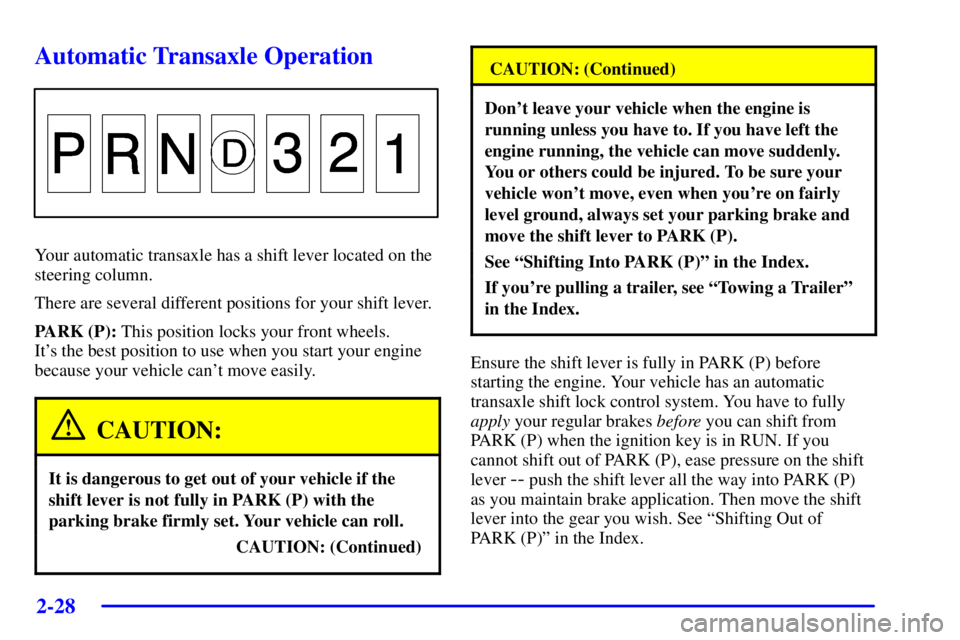
Your automatic transaxle has a shift lever located on the
steering column.
There are several different positions for your shift lever.
PARK (P): This position locks your front wheels.
It's the best position to use when you start your engine
because your vehicle can't move easily.
CAUTION:
It is dangerous to get out of your vehicle if the
shift lever is not fully in PARK (P) with the
parking brake firmly set. Your vehicle can roll.
CAUTION: (Continued)
CAUTION: (Continued)
Don't leave your vehicle when the engine is
running unless you have to. If you have left the
engine running, the vehicle can move suddenly.
You or others could be injured. To be sure your
vehicle won't move, even when you're on fairly
level ground, always set your parking brake and
move the shift lever to PARK (P).
See ªShifting Into PARK (P)º in the Index.
If you're pulling a trailer, see ªTowing a Trailerº
in the Index.
Ensure the shift lever is fully in PARK (P) before
starting the engine. Your vehicle has an automatic
transaxle shift lock control system. You have to fully
apply your regular brakes before you can shift from
PARK (P) when the ignition key is in RUN. If you
cannot shift out of PARK (P), ease pressure on the shift
lever
-- push the shift lever all the way into PARK (P)
as you maintain brake application. Then move the shift
lever into the gear you wish. See ªShifting Out of
PARK (P)º in the Index.
Page 96 of 395
2-33
1. Hold the brake pedal down with your right foot and
set the parking brake.
2. Move the shift lever into PARK (P) as follows:
�Pull the lever toward you.
�Move the lever up as far as it will go.
3. Move the ignition key to LOCK.
4. Remove the ignition key and take it with you. If you
can leave your vehicle with the ignition key in your
hand, your vehicle is in PARK (P).
Page 97 of 395
2-34
Leaving Your Vehicle With the
Engine Running
CAUTION:
It can be dangerous to leave your vehicle with the
engine running. Your vehicle could move
suddenly if the shift lever is not fully in PARK (P)
with the parking brake firmly set. And, if you
leave the vehicle with the engine running, it could
overheat and even catch fire. You or others could
be injured. Don't leave your vehicle with the
engine running unless you have to.
If you have to leave your vehicle with the engine
running, be sure your vehicle is in PARK (P) and your
parking brake is firmly set before you leave it. After
you've moved the shift lever into PARK (P), hold the
regular brake pedal down. Then, see if you can move the
shift lever away from PARK (P) without first pulling it
toward you. If you can, it means that the shift lever
wasn't fully locked into PARK (P).
Torque Lock
If you are parking on a hill and you don't shift your
transaxle into PARK (P) properly, the weight of the
vehicle may put too much force on the parking pawl in
the transaxle. You may find it difficult to pull the shift
lever out of PARK (P). This is called ªtorque lock.º
To prevent torque lock, set the parking brake and
then shift into PARK (P) properly before you leave
the driver's seat. To find out how, see ªShifting Into
PARK (P)º in the Index.
When you are ready to drive, move the shift lever out of
PARK (P) before you release the parking brake.
If torque lock does occur, you may need to have another
vehicle push yours a little uphill to take some of the
pressure from the parking pawl in the transaxle, so you
can pull the shift lever out of PARK (P).
