Page 146 of 357

3-2
Comfort Controls
Dual ComforTemp� Climate Control
With this system, the driver and passenger can maintain
separate temperatures in their seating areas. The system
works best if you keep your windows closed while
using it.
FAN:
The left knob labeled FAN controls the fan speed.
Turn the knob clockwise toward HI to increase fan
speed and counterclockwise toward LO to decrease
fan speed. The fan must be turned on for the air
conditioning compressor to operate.If the airflow seems very low when the fan is adjusted
to the highest setting regardless of the mode setting,
your passenger compartment air filter may need to be
replaced. See ªMaintenance Scheduleº or ªPassenger
Compartment Air Filterº in the Index.
OFF: To turn off the fan turn the knob all the way
counterclockwise to OFF.
DRIVER (Driver's Side Temperature):
The lever on the left adjusts the air temperature on
the driver's side outlets independent of the temperature
set by the passenger. Slide the lever up to raise
the temperature. Slide the lever down to lower
the temperature.
PASSENGER (Passenger's Side Temperature):
The lever on the right adjusts the air temperature on the
passenger's side independent of the temperature set by
the driver. Slide the lever up to raise the temperature.
Slide the lever down to lower the temperature.
Page 153 of 357
3-9 Ventilation System
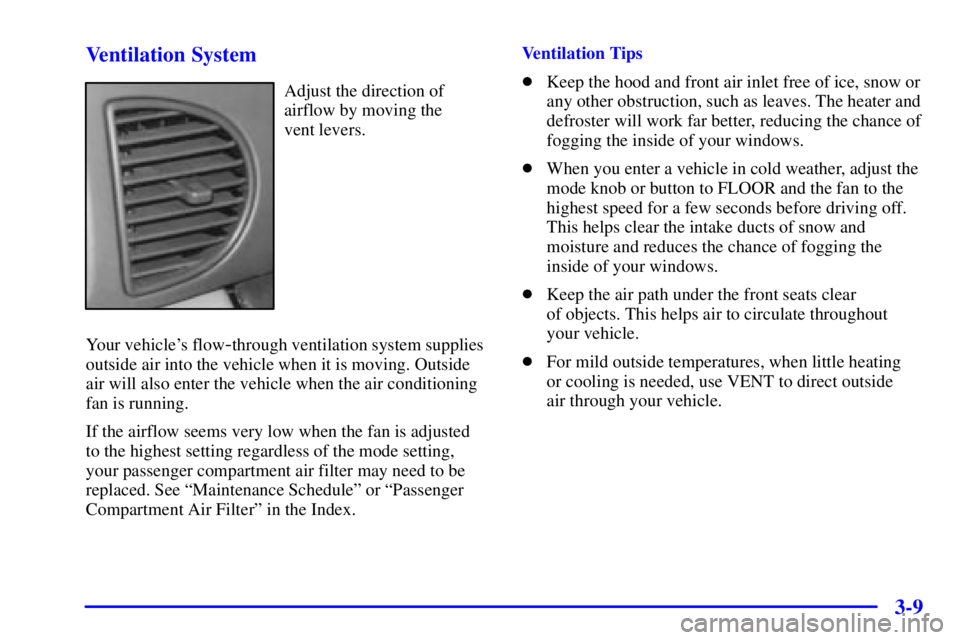
Adjust the direction of
airflow by moving the
vent levers.
Your vehicle's flow
-through ventilation system supplies
outside air into the vehicle when it is moving. Outside
air will also enter the vehicle when the air conditioning
fan is running.
If the airflow seems very low when the fan is adjusted
to the highest setting regardless of the mode setting,
your passenger compartment air filter may need to be
replaced. See ªMaintenance Scheduleº or ªPassenger
Compartment Air Filterº in the Index.Ventilation Tips
�Keep the hood and front air inlet free of ice, snow or
any other obstruction, such as leaves. The heater and
defroster will work far better, reducing the chance of
fogging the inside of your windows.
�When you enter a vehicle in cold weather, adjust the
mode knob or button to FLOOR and the fan to the
highest speed for a few seconds before driving off.
This helps clear the intake ducts of snow and
moisture and reduces the chance of fogging the
inside of your windows.
�Keep the air path under the front seats clear
of objects. This helps air to circulate throughout
your vehicle.
�For mild outside temperatures, when little heating
or cooling is needed, use VENT to direct outside
air through your vehicle.
Page 218 of 357

4-41 When You Are Ready to Leave After
Parking on a Hill
1. Apply your regular brakes and hold the pedal down
while you:
�start your engine,
�shift into a gear, and
�release the parking brake.
2. Let up on the brake pedal.
3. Drive slowly until the trailer is clear of the chocks.
4. Stop and have someone pick up and store the chocks.
Maintenance When Trailer Towing
Your vehicle will need service more often when you're
pulling a trailer. See the Maintenance Schedule for more
on this. Things that are especially important in trailer
operation are automatic transaxle fluid (don't overfill),
engine oil, drive belt, cooling system and brake system.
Each of these is covered in this manual, and the Index
will help you find them quickly. If you're trailering,
it's a good idea to review this information before you
start your trip.
Check periodically to see that all hitch nuts and
bolts are tight.
Engine Cooling When Trailer Towing
Your cooling system may temporarily overheat during
severe operating conditions. See ªEngine Overheatingº
in the Index.
Page 266 of 357
6-16
Engine Air Cleaner/Filter
The engine air cleaner/filter is located underneath a
diagonal brace in the engine compartment on the driver's
side of the vehicle. See ªEngine Compartment Overviewº
in the Index for more information on location.
To check or replace the engine air cleaner/filter,
do the following:
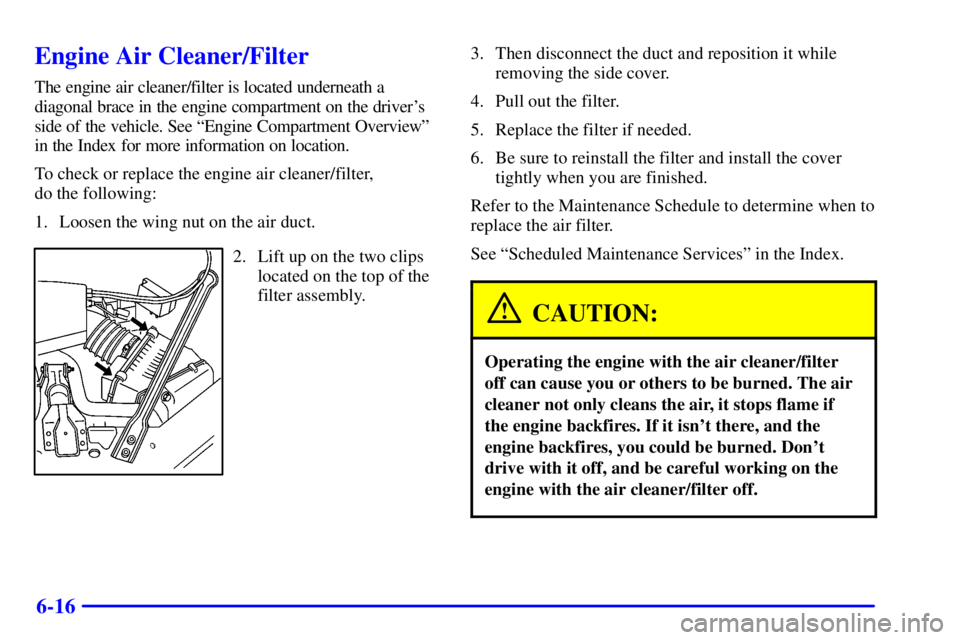
1. Loosen the wing nut on the air duct.
2. Lift up on the two clips
located on the top of the
filter assembly.3. Then disconnect the duct and reposition it while
removing the side cover.
4. Pull out the filter.
5. Replace the filter if needed.
6. Be sure to reinstall the filter and install the cover
tightly when you are finished.
Refer to the Maintenance Schedule to determine when to
replace the air filter.
See ªScheduled Maintenance Servicesº in the Index.
CAUTION:
Operating the engine with the air cleaner/filter
off can cause you or others to be burned. The air
cleaner not only cleans the air, it stops flame if
the engine backfires. If it isn't there, and the
engine backfires, you could be burned. Don't
drive with it off, and be careful working on the
engine with the air cleaner/filter off.
Page 267 of 357
6-17
NOTICE:
If the air cleaner/filter is off, a backfire can
cause a damaging engine fire. And, dirt can
easily get into your engine, which will damage it.
Always have the air cleaner/filter in place when
you're driving.
Passenger Compartment Air Filter
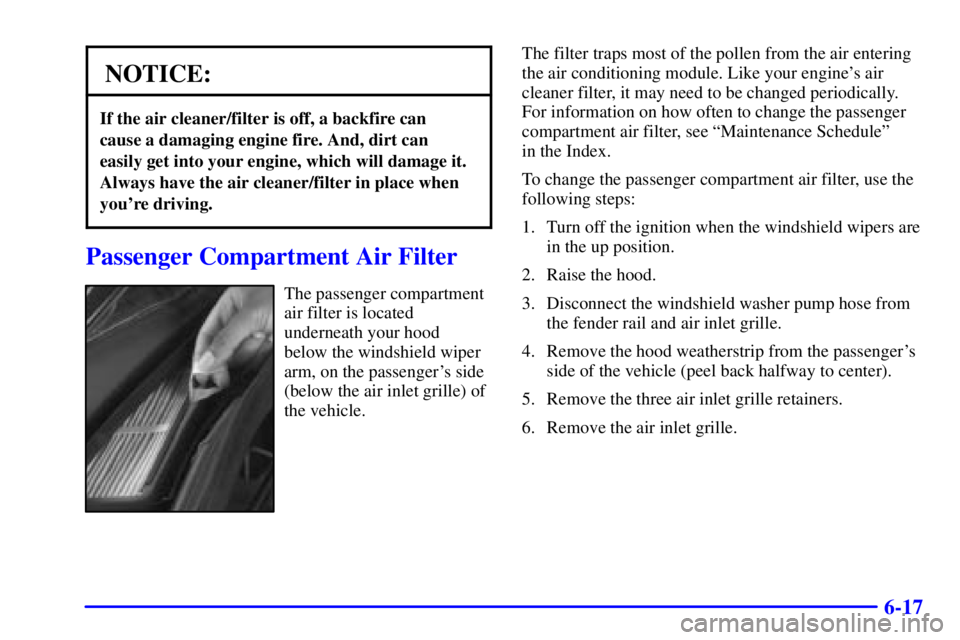
The passenger compartment
air filter is located
underneath your hood
below the windshield wiper
arm, on the passenger's side
(below the air inlet grille) of
the vehicle.The filter traps most of the pollen from the air entering
the air conditioning module. Like your engine's air
cleaner filter, it may need to be changed periodically.
For information on how often to change the passenger
compartment air filter, see ªMaintenance Scheduleº
in the Index.
To change the passenger compartment air filter, use the
following steps:
1. Turn off the ignition when the windshield wipers are
in the up position.
2. Raise the hood.
3. Disconnect the windshield washer pump hose from
the fender rail and air inlet grille.
4. Remove the hood weatherstrip from the passenger's
side of the vehicle (peel back halfway to center).
5. Remove the three air inlet grille retainers.
6. Remove the air inlet grille.
Page 268 of 357
6-18
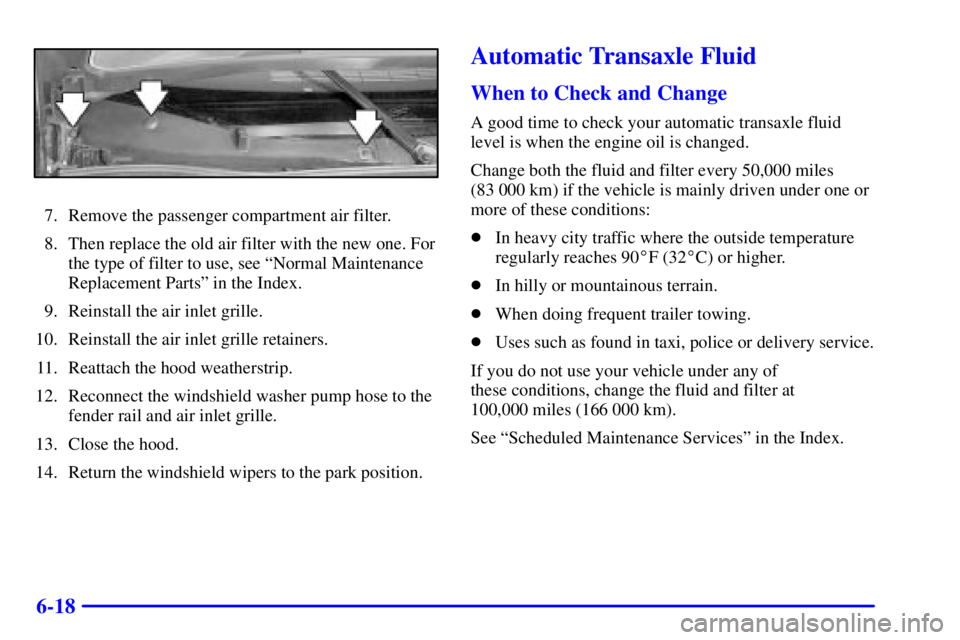
7. Remove the passenger compartment air filter.
8. Then replace the old air filter with the new one. For
the type of filter to use, see ªNormal Maintenance
Replacement Partsº in the Index.
9. Reinstall the air inlet grille.
10. Reinstall the air inlet grille retainers.
11. Reattach the hood weatherstrip.
12. Reconnect the windshield washer pump hose to the
fender rail and air inlet grille.
13. Close the hood.
14. Return the windshield wipers to the park position.
Automatic Transaxle Fluid
When to Check and Change
A good time to check your automatic transaxle fluid
level is when the engine oil is changed.
Change both the fluid and filter every 50,000 miles
(83 000 km) if the vehicle is mainly driven under one or
more of these conditions:
�In heavy city traffic where the outside temperature
regularly reaches 90�F (32�C) or higher.
�In hilly or mountainous terrain.
�When doing frequent trailer towing.
�Uses such as found in taxi, police or delivery service.
If you do not use your vehicle under any of
these conditions, change the fluid and filter at
100,000 miles (166 000 km).
See ªScheduled Maintenance Servicesº in the Index.
Page 271 of 357
6-21
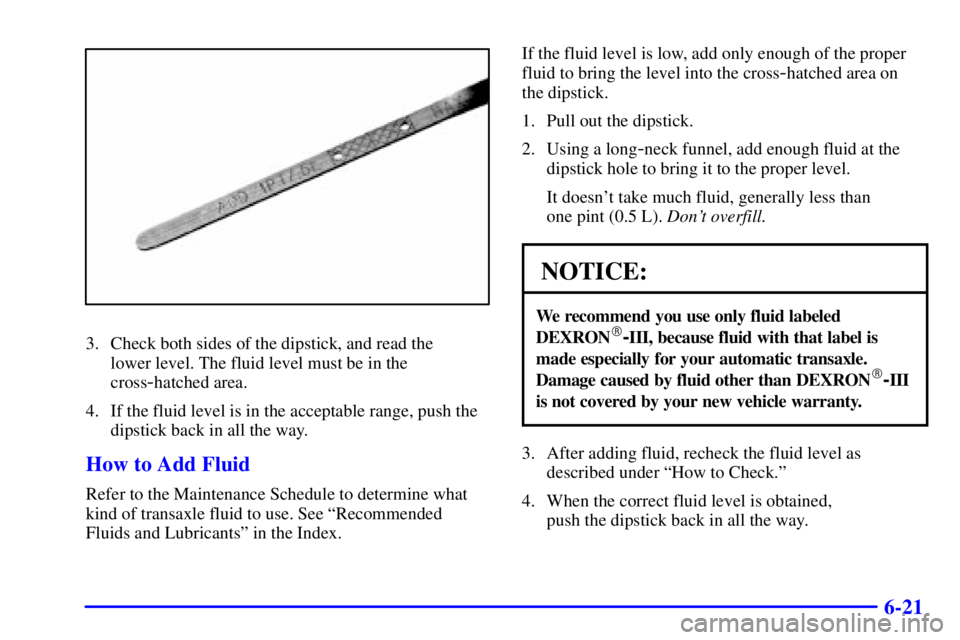
3. Check both sides of the dipstick, and read the
lower level. The fluid level must be in the
cross
-hatched area.
4. If the fluid level is in the acceptable range, push the
dipstick back in all the way.
How to Add Fluid
Refer to the Maintenance Schedule to determine what
kind of transaxle fluid to use. See ªRecommended
Fluids and Lubricantsº in the Index.If the fluid level is low, add only enough of the proper
fluid to bring the level into the cross
-hatched area on
the dipstick.
1. Pull out the dipstick.
2. Using a long
-neck funnel, add enough fluid at the
dipstick hole to bring it to the proper level.
It doesn't take much fluid, generally less than
one pint (0.5 L). Don't overfill.
NOTICE:
We recommend you use only fluid labeled
DEXRON�-III, because fluid with that label is
made especially for your automatic transaxle.
Damage caused by fluid other than DEXRON
�-III
is not covered by your new vehicle warranty.
3. After adding fluid, recheck the fluid level as
described under ªHow to Check.º
4. When the correct fluid level is obtained,
push the dipstick back in all the way.
Page 294 of 357

6-44
To reset (calibrate) the system:
1. Turn the ignition to RUN.
2. Locate the red RESET button inside of your
instrument panel fuse block.
The fuse block is located under the cover labeled
FUSES, which is at the end of the instrument panel on
the passenger's side of the vehicle. The RESET button
is the first button in the top row of the fuse block.
3. Press and hold the RESET button for about
five seconds.
The LOW TIRE light will come on and flash three
times. Then it will go off. If the light doesn't go off,
see your dealer for service.
The system completes the calibration process during driving.
The system normally takes 15 to 20 minutes of driving in
each of three speed ranges to ªlearnº tire pressures. The
speed ranges are 15 to 40 mph (25 to 65 km/h), 40 to
65 mph (65 to 105 km/h) and above 65 mph (105 km/h).
When learning is complete, the system will alert you after
two to eight minutes if a tire is 12 psi (83 kPa) different
from the other three tires. Detection thresholds may be
higher and detection times may be longer on rough roads,
curves and at high speeds. The system is not capable of
detection at speeds greater than 70 mph (110 km/h).Tire Inspection and Rotation
Tires should be rotated every 6,000 to 8,000 miles
(10 000 to 13 000 km). Any time you notice unusual
wear, rotate your tires as soon as possible and check
wheel alignment. Also check for damaged tires or wheels.
See ªWhen It's Time for New Tiresº and ªWheel
Replacementº later in this section for more information.
The purpose of regular rotation is to achieve more
uniform wear for all tires on the vehicle. The first
rotation is the most important. See ªScheduled
Maintenance Servicesº in the Index for scheduled
rotation intervals.
When rotating your tires, always use the correct rotation
pattern shown here.