Page 127 of 357
2-63
The main components of the instrument panel are the following:
A. Exterior Lamps Control
B. Turn Signal/Multifunction Lever
C. Instrument Panel Cluster
D. Audio Steering Wheel Controls (If Equipped)
E. Gear Shift Lever
F. Vents
G. Side Window Defogger VentH. Hood Release
I. Tilt Wheel Lever
J. Horn
K. Audio System
L. Ashtray
M. Climate Controls
N. Glove Box
O. Instrument Panel Fuse Block
Page 259 of 357
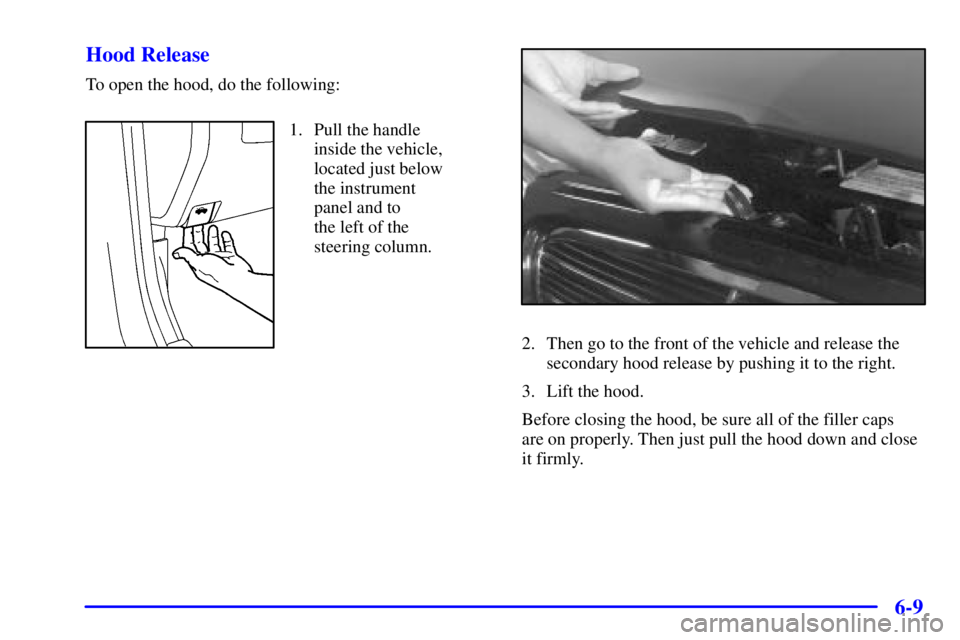
6-9 Hood Release
To open the hood, do the following:
1. Pull the handle
inside the vehicle,
located just below
the instrument
panel and to
the left of the
steering column.
2. Then go to the front of the vehicle and release the
secondary hood release by pushing it to the right.
3. Lift the hood.
Before closing the hood, be sure all of the filler caps
are on properly. Then just pull the hood down and close
it firmly.
Page 283 of 357
6-33 Headlamps
1. Open the hood.
2. Pull up on the headlamp retainers (A) to release the
assembly locator tabs.
3. Disconnect the electrical connector (B) from the
headlamp assembly.4. Slide the headlamp assembly out of the slots.
5. Remove the rubber access cover from behind the
bulb you are replacing.
Page 333 of 357

7-16 At Least Twice a Year
Restraint System Check
Make sure the safety belt reminder light and all your
belts, buckles, latch plates, retractors and anchorages are
working properly. Look for any other loose or damaged
safety belt system parts. If you see anything that might
keep a safety belt system from doing its job, have it
repaired. Have any torn or frayed safety belts replaced.
Also look for any opened or broken air bag coverings,
and have them repaired or replaced. (The air bag system
does not need regular maintenance.)
Wiper Blade Check
Inspect wiper blades for wear or cracking. Replace blade
inserts that appear worn or damaged or that streak or
miss areas of the windshield. Also see ªWiper Blades,
Cleaningº in the Index.
Weatherstrip Lubrication
Silicone grease on weatherstrips will make them last
longer, seal better, and not stick or squeak. Apply
silicone grease with a clean cloth. During very cold,
damp weather more frequent application may be
required. See ªRecommended Fluids and Lubricantsº
in the Index.Automatic Transaxle Check
Check the transaxle fluid level; add if needed.
See ªAutomatic Transaxle Fluidº in the Index.
A fluid loss may indicate a problem. Check the
system and repair if needed.
At Least Once a Year
Key Lock Cylinders Service
Lubricate the key lock cylinders with the lubricant
specified in Part D.
Body Lubrication Service
Lubricate all hinges and latches, including those for
the body doors, hood, secondary latch, pivots, spring
anchor, release pawl, rear compartment, glove box door
and the console door. Part D tells you what to use.
More frequent lubrication may be required when
exposed to a corrosive environment.
Page 339 of 357
7-22
USAGEFLUID/LUBRICANT
Power
Steering SystemGM Power Steering Fluid
(GM Part No. 1052884
- 1 pint,
1050017
- 1 quart, or equivalent).
Automatic
TransaxleDEXRON�-III Automatic
Transmission Fluid.
Key
Lock CylindersMulti-Purpose Lubricant,
Superlube� (GM Part
No. 12346241 or equivalent).
USAGEFLUID/LUBRICANT
Hood Latch
Assembly,
Secondary Latch,
Pivots, Spring
Anchor and
Release PawlLubriplate� Lubricant Aerosol
(GM Part No. 12346293 or
equivalent) or lubricant meeting
requirements of NLGI # 2,
Category LB or GC
-LB.
Hood and
Door HingesMulti-Purpose Lubricant,
Superlube� (GM Part
No. 12346241 or equivalent).
Weatherstrip
ConditioningDielectric Silicone Grease
(GM Part No. 12345579
or equivalent).