Page 82 of 357
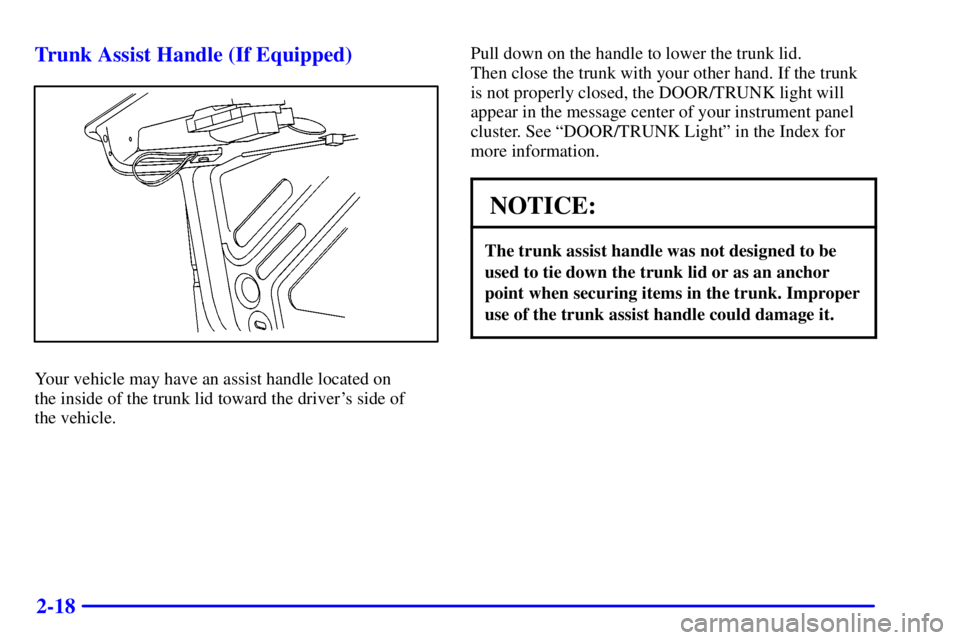
2-18 Trunk Assist Handle (If Equipped)
Your vehicle may have an assist handle located on
the inside of the trunk lid toward the driver's side of
the vehicle.Pull down on the handle to lower the trunk lid.
Then close the trunk with your other hand. If the trunk
is not properly closed, the DOOR/TRUNK light will
appear in the message center of your instrument panel
cluster. See ªDOOR/TRUNK Lightº in the Index for
more information.
NOTICE:
The trunk assist handle was not designed to be
used to tie down the trunk lid or as an anchor
point when securing items in the trunk. Improper
use of the trunk assist handle could damage it.
Page 83 of 357
2-19 Trunk Release Handle (If Equipped)
NOTICE:
The trunk release handle was not designed to be
used to tie down the trunk lid or as an anchor
point when securing items in the trunk. Improper
use of the trunk release handle could damage it.
There is a glow-in-the-dark trunk release handle
located inside the trunk on the latch. This handle will
glow following exposure to light. Pull the release handle
up to open the trunk from the inside.
Page 85 of 357

2-21
Disabling the Trunk Release Sensor
A. Sensor Lens
B. Disable Switch
Because the sensor detects motion, there are times when
you may want to turn off the trunk sensor so that the
motion of your vehicle or items in the trunk won't cause
the trunk to open, such as the following:
�When your vehicle is transported on a car ferry,
�when your vehicle is towed, or
�when you will be loading items through the opening
in the split folding rear seat (if equipped).Next to the sensor lens, there is a disable switch you can
use to turn off the trunk release sensor. To turn off the
sensor, turn the ignition to ON and press the switch next
to the lens for two seconds. The horn will chirp once
when the sensor is turned off. When the sensor is off, the
light in the switch will flash. The DOOR/TRUNK light
will flash for one minute each time the ignition is turned
on as a reminder that the sensor is turned off. See
ªDoor/Trunk Lightº in the Index.
To turn the sensor on again, press the switch again
or open the trunk. When the trunk is opened, the
sensor is automatically turned back on. If the sensor
is turned back on with the disable switch, the horn
will chirp twice.
Servicing the Trunk Release Sensor
The sensor lens should be inspected periodically.
If the lens is dirty, wipe it gently with a clean, soft
cotton cloth.
If there is an electrical problem with the sensor, the
SERVICE VEHICLE SOON light will appear in the
instrument panel cluster. There are other possible
reasons for this light to appear. Be sure to see your
dealer as soon as possible. See ªService Vehicle Soon
Lightº in the Index for more information.
Page 86 of 357

2-22
Theft
Vehicle theft is big business, especially in some cities.
Although your vehicle has a number of theft
-deterrent
features, we know that nothing we put on it can make
it impossible to steal. However, there are ways you
can help.
Key in the Ignition
If you leave your vehicle with the keys inside, it's an
easy target for joy riders or professional thieves
-- so
don't do it.
When you park your vehicle and open the driver's door,
you'll hear a chime reminding you to remove your key
from the ignition and take it with you. Always do this.
Your steering wheel will be locked, and so will your
ignition and transaxle. And remember to lock the doors.
Parking at Night
Park in a lighted spot, close all windows and lock your
vehicle. Remember to keep your valuables out of sight.
Put them in a storage area, or take them with you.
Parking Lots
Even if you park in a lot where someone will be
watching your vehicle, it's still best to lock it up and
take your keys. But what if you have to leave your
ignition key?
�If possible, park in a busy, well
-lit area.
�Put your valuables in a storage area, like your trunk
or glove box.
�Be sure to close and lock the storage area.
�Close all windows.
�Lock the glove box.
�Lock all the doors except the driver's.
�Then take the door key and remote keyless entry
transmitter with you.
Page 87 of 357

2-23
PASS-Key� II
Your vehicle is equipped
with the PASS
-Key II
(Personalized Automotive
Security System)
theft
-deterrent system.
PASS
-Key II is a passive
theft
-deterrent system.
It works when you insert
or remove the key from
the ignition.
PASS
-Key II uses a resistor pellet in the ignition key
that matches a decoder in your vehicle.
When the PASS
-Key II system senses that someone is
using the wrong key, it shuts down the vehicle's starter and
fuel systems. For about three minutes, the starter won't
work and fuel won't go to the engine. If someone tries to
start your vehicle again or uses another key during this
time, the vehicle will not start. This discourages someone
from randomly trying different keys with different resistor
pellets in an attempt to make a match.
The ignition key must be clean and dry before it's inserted
in the ignition or the engine may not start. If the engine
does not start and the SECURITY light is flashing, the key
may be dirty or wet. Turn the ignition off.Clean and dry the key. Wait about three minutes and try
again. If the starter still won't work, and the key appears
to be clean and dry, wait about three minutes and try
another ignition key. At this time, you may also want to
check the fuse (see ªFuses and Circuit Breakersº in the
Index). If the starter won't work with the other key, your
vehicle needs service. If your vehicle does start, the first
ignition key may be faulty. See your dealer or a
locksmith who can service the PASS
-Key II.
If you accidentally use a key that has a damaged or
missing resistor pellet, the starter won't work. The
SECURITY light will then come on. But you don't have
to wait three minutes before trying another ignition key.
See your dealer or a locksmith who can service the
PASS
-Key II to have a new key made.
If you're ever driving and the SECURITY light comes
on, you will be able to restart your engine if you turn it
off. Your PASS
-Key II system, however, is not working
properly and must be serviced by your dealer. Your
vehicle is not protected by the PASS
-Key II system.
If you lose or damage a PASS
-Key II ignition key, see
your dealer or a locksmith who can service PASS
-Key II
to have a new key made. Also, see ªRoadside
Assistanceº in the Index for more information.
Page 89 of 357

2-25
B (LOCK): This is the only position in which you
can insert or remove the key. This position locks the
ignition, steering wheel and transaxle. It's a
theft
-deterrent feature.
NOTICE:
If your key seems stuck in LOCK and you can't
turn it, be sure you are using the correct key;
if so, is it all the way in? If it is, then turn the
steering wheel left and right while you turn the
key hard. Turn the key only with your hand.
Using a tool to force it could break the key or the
ignition switch. If none of this works, then your
vehicle needs service.
C (OFF): This position lets you turn off the engine but
still turn the steering wheel. It doesn't lock the steering
wheel. Use OFF if you must have your vehicle pushed
or towed.D (RUN): This position is where the key returns to
after you start your vehicle. With the engine off, you
can use RUN to display some of your warning and
indicator lights.
E (START): This position starts your engine.
A warning chime will sound if you open the driver's
door when the ignition is in OFF, LOCK or
ACCESSORY and the key is in the ignition.
Retained Accessory Power (RAP)
(If Equipped)
With Retained Accessory Power (RAP), your
power windows, audio system and sunroof (if equipped)
will continue to work for up to 10 minutes after the
ignition key is turned to OFF and before any of the
doors are opened.
Page 103 of 357

2-39
If the arrow flashes faster than normal as you signal a
turn or a lane change, a signal bulb may be burned out
and other drivers won't see your turn signal.
If a bulb is burned out, replace it to help avoid an
accident. If the arrows don't go on at all when you
signal a turn, check for burned
-out bulbs and then check
the fuse (see ªFuses and Circuit Breakersº in the Index).
A chime will sound if you leave your turn signal on for
more than 3/4 mile (1.2 km).
Headlamp High/Low-Beam Changer
To change your headlamps from low beams to high
beams, or high to low, pull the multifunction lever all
the way toward you. Then release it.
When the high beams are on
this light, located on the
instrument panel cluster,
will also be on.
Flash-to-Pass Feature
This feature lets you use your high-beam headlamps
to signal the driver in front of you that you want to pass.
It works even if your headlamps are off.
To use it, pull the turn signal lever toward you a little,
but not so far that you hear a click.
If your headlamps are off or on low beam, your
high
-beam headlamps will turn on. They'll stay on as
long as you hold the lever toward you and the
high
-beam indicator on the dash will come on. Release
the lever to return to normal operation.
Windshield Wipers
To operate the windshield wipers turn the band located
on the multifunction lever upward or downward.
WIPER: Turn this band to control the
windshield wipers.
OFF: Turn the band to OFF to turn off the
windshield wipers.
LO (Low Speed): Turn the band away from you to
LO and past the delay settings for steady wiping at
low speed.
Page 104 of 357

2-40
HI (High Speed): Turn the band away from you, to
HI, and past the delay settings for wiping steady at
high speed.
(Delayed Wiping): Turn the band away from you, just
past OFF, to one of the five sensitivity settings, to
choose the delayed wiping cycle. The further the band is
turned upward, toward LO, the shorter the delay will be.
Use this setting for light rain or snow.
MIST: Turn the band to MIST for a single wiping cycle.
Hold it until the windshield wipers start. Then let it go.
The windshield wipers will stop after one wipe. If you
want more wipes, hold the band on MIST longer.
Be sure to clear ice and snow from the windshield wiper
blades before using them. If they are frozen to the
windshield, carefully loosen or thaw them. If your
blades do become worn or damaged, get new blades or
blade inserts.
Heavy snow or ice can overload your wipers. A circuit
breaker will stop them until the motor cools. Clear away
snow or ice to prevent an overload.Windshield Washer
At the top of the multifunction lever, there's a paddle
with the word PUSH on it. To spray washer fluid on the
windshield, push on the paddle. The wipers will run for
several sweeps and then either stop or return to your
preset speed. See ªWindshield Washer Fluidº in
the Index.
CAUTION:
In freezing weather, don't use your washer until
the windshield is warmed. Otherwise the washer
fluid can form ice on the windshield, blocking
your vision.
The LOW WASH light on
your instrument panel
cluster will glow when the
fluid level is low.