2002 BMW Z8 ABS
[x] Cancel search: ABSPage 91 of 174

91n
IndexDataTechnologyRepairsCar careControlsOverview
Disc brakesDriving notesWhen driving in heavy rain and on wet
roads it is advisable to apply light pres-
sure to the brake pedal every few miles.
Monitor traffic conditions to ensure that
this maneuver does not pose a hazard
to you or to other road users. The heat
generated in this braking process helps
dry the pads and rotors
Maximum braking force is obtained
while the wheels are not locked, but
rather when they are still barely turning
immediately prior to locking. ABS main-
tains this state automatically. If the ABS
fails, you should revert to the staggered
braking technique (refer to page 93).
When descending steep hills and
extended grades, downshift to a gear
that will allow you to continue safely
with only a minimal amount of braking.
By minimizing the loads placed on the
brake system, this strategy helps
ensure that optimal brake system
response will remain available at all
times.
You can enhance the engine's braking
effect by downshifting, into first gear, if
necessary. Even if engine braking fails to slow the
vehicle sufficiently, you should still
make every effort to avoid prolonged
braking with continuous application of
low to moderate pressure at the pedal.
It is better to decelerate the vehicle by
applying a higher level of force at the
pedal (watch following traffic!) and then
subsequently pausing to allow the
brakes to cool briefly before starting on
your next braking cycle. By protecting
brake system components against
overheating, the cooling phases
afforded by this staggered, or intermit-
tent braking technique help maintain
consistent availability of optimal braking
response when it is needed.
Do not coast with the clutch pedal
depressed, the gear-shift lever in
neutral, or, above all, with the engine
off; otherwise, the engine will provide
no braking effect if the transmission is
in neutral, and there is no braking or
steering power assist if the engine is
not running. Never allow floor mats,
carpets or any other objects to obstruct
the accelerator, clutch or brake pedals
and pose a safety hazard by reducing
their available travel range.<
Page 93 of 174

93n
IndexDataTechnologyRepairsCar careControlsOverview
Winter operationRubber seals and componentsTo prevent the weather-stripping from
freezing, apply a spray-on rubber treat-
ment or silicone spray to the door, hood
and luggage compartment lid seals.
A full range of car-care products is
available from your BMW center.
on rear tires, complying with the manu-
facturer's safety precautions. Do not
exceed a maximum speed of 30 mph
(50 km/h) while the snow chains are
mounted and refrain from activating the
Flat Tire Monitor, as the snow chains
could trigger false alarms and/or
prevent the system from detecting
actual pressure loss.
Starting off When starting off in deep snow or when
"rocking" the vehicle to free it, it may be
advisable to temporarily deactivate the
DSC. Refer to page 65.
To maintain vehicle stability,
always drive with the system
switched on whenever possible.<
Driving on low-traction road
surfaces Do not activate the Sport mode (refer to
page 66). Use smooth, gentle pressure
to control the accelerator pedal. Avoid
excessive engine speeds and upshift
early. Downshift well in advance when
approaching uphill or downhill grades.
Maintain an adequate distance
between yourself and the vehicle
ahead. BrakesWinter road conditions substantially
reduce the amount of traction available
between the tires and the road surface.
The resulting increases in braking
distance are considerable and should
be kept in mind at all times.
ABS is intended to prevent the wheels
from locking during brake applications,
thus helping to maintain vehicle stability
and steering response. If the ABS does not respond in a critical
braking situation and the wheels lock,
reduce the pressure on the brake pedal
until the wheels just start to roll again
while still maintaining enough force to
continue braking.
Then increase the pressure, reduce the
pressure when the wheels lock, reapply
pressure etc.
This staggered braking procedure will
reduce braking distances while helping
you maintain steering control.
You can always then attempt to steer
around hazards after you have reduced
pressure on the brake pedal.
Never downshift to exploit engine
braking when driving on slippery
road surfaces, as this could lead to a
loss of traction at the rear wheels,
impairing your ability to control the
vehicle.<
Depress the clutch during hard
braking on road surfaces that
provide only poor or uneven traction.<
Page 101 of 174

101n
IndexDataTechnologyRepairsCar careControlsOverview
Tire replacement Tire rotationTemperatureThe temperature grades are A (the
highest), B and C, representing the
tire's resistance to the generation of
heat and its ability to dissipate heat
when tested under controlled condi-
tions on a specified indoor laboratory
test wheel.
Sustained high temperature can cause
the tire material to degenerate and
reduce tire life, and excessive tempera-
ture can lead to sudden flat tire. The
grade C corresponds to a level of
performance which all passenger
vehicle tires must meet under the
Federal Motor Vehicle Safety Standard
No. 109. Grades B and A represent
higher levels of performance on the
laboratory test wheel than the minimum
required by law.
The temperature grade for this tire
is established for a tire that is
properly inflated and not overloaded.
Excessive speed, underinflation, or
excessive loading, either separately or
in combination, can cause heat buildup
and possibly a flat tire.<
Uniform Tire Quality GradingQuality grades can be found where
applicable on the tire sidewall between
tread shoulder and maximum section
width. For example:
Tread wear 200 Traction AA
Temperature A
Use only safety tires as there is no
spare tire available if you get a flat
tire.
For further information, refer to
page 137.
sidewall:
DOT ... 3201 indicates that the tire was
manufactured in week 32 of 2001.
Although tires may have a theoretical
service life of up to 10 years, BMW
strongly recommends that you replace
all tires after an absolute maximum of
6 years.
Between the axles
If different tire sizes are mounted
on the front and rear axles (refer to
page 10 4), then the tires may not be
rotated from one axle to the other.<
The tread wear patterns at the front end
differ from those at the rear Ð the actual
patterns will vary according to indi-
vidual driving conditions. In the inter-
ests of safety and maintaining optimal
handling characteristics, tire rotation is
not recommended.
Page 102 of 174

102n
Wheel and tire combinations The right choice
Use only wheels and tires
approved by BMW for the corre-
sponding vehicle model, as otherwise
the tires may make contact with the
body as the result of tolerances despite
the same nominal size being used,
resulting in serious accidents. If non-
approved wheels and tires are used,
BMW cannot evaluate their suitability,
and therefore cannot be held liable for
driving safety.<
For wheel and tire specifications
approved by BMW, refer to page 104.
The correct wheel and tire combi-
nation affects different systems
that otherwise will not function prop-
erly, e. g. ABS, DSC and Flat Tire
Monitor.
For this reason, use only tires of the
same brand and tread pattern on the
vehicle and, for example, restore the
approved wheel and tire combination
following a flat tire as soon as
possible.<
Codes on tires and wheels The code on tires has the following
meaning.
Codes on radial tires:
The speed rating indicates the
approved maximum speed for the tire.
Summer tires:
S = up to 112 mph (180 km/h)
T = up to 118 mph (190 km/h)
H = up to 130 mph (210 km/h)
V = up to 150 mph (240 km/h)
W = up to 167 mph (270 km/h)
Y = up to 186 mph (300 km/h)
ZR = over 150 mph (240 km/h)
Winter tires:
Q M+S = up to 100 mph (160 km/h)
T M+S = up to 118 mph (190 km/h)
H M+S = up to 130 mph (210 km/h) For example:
Nominal width
in mm
Aspect ratio in X
Radial tire code
Rim diameter in inches
Load rating
(not on ZR tires)
Speed rating
(before R on ZR tires)
245/45 R
1896W
Codes on light-alloy wheels:
Protect tire valves from dirt by using
screw-on valve stem caps. Dirt in the
valves frequently leads to slow leaks.
Safety tires carry additional designation
codes; these vary according to manu-
facturer:
Bridgestone RFT
Dunlop DSST
Goodyear EMT
Michelin ZPStorageAlways store tires in a cool, dry place,
protecting them against light whenever
possible. Protect the tires against
contact with oil, grease and fuel. For example:
Rim width
in inches
Code letter for
flange type
Symbol for full-drop
center rim
Rim diameter in inches
Hump on the 2 rim shoulders
8 x 18 EH2
J
Page 114 of 174
114n
Coolant Brake fluidAdding coolant To guard against the possibility of
scalding injuries, always wait until the
engine cools (temperature gauge
needle in blue sector) before
unscrewing the cap on the expansion
tank.
1. Turn the cap slightly counterclock-
wise in order to allow accumulated
pressure to escape. Then open
2. Slowly add coolant until the correct
level is reached Ð do not overfill.
The coolant is a mixture of water and
extended-duty antifreeze with corrosion
inhibitor. Always maintain the
prescribed all-season 50:50 mixture
ratio for year-round protection against
internal corrosion. No other additives
are required.
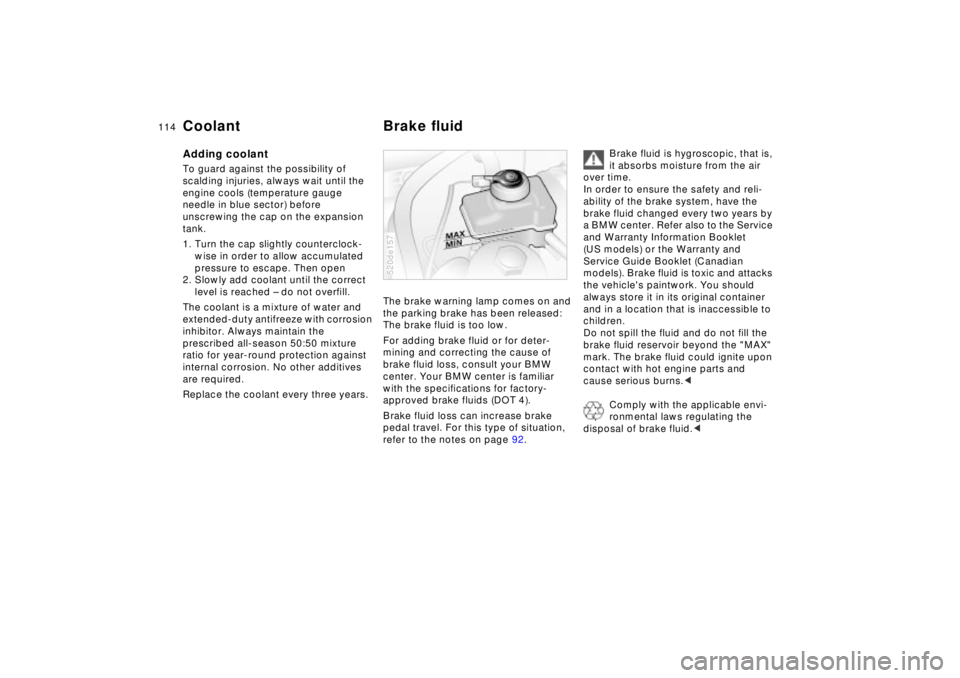
Replace the coolant every three years.The brake warning lamp comes on and
the parking brake has been released:
The brake fluid is too low.
For adding brake fluid or for deter-
mining and correcting the cause of
brake fluid loss, consult your BMW
center. Your BMW center is familiar
with the specifications for factory-
approved brake fluids (DOT 4).
Brake fluid loss can increase brake
pedal travel. For this type of situation,
refer to the notes on page 92.
520de157
Brake fluid is hygroscopic, that is,
it absorbs moisture from the air
over time.
In order to ensure the safety and reli-
ability of the brake system, have the
brake fluid changed every two years by
a BMW center. Refer also to the Service
and Warranty Information Booklet
(US models) or the Warranty and
Service Guide Booklet (Canadian
models). Brake fluid is toxic and attacks
the vehicle's paintwork. You should
always store it in its original container
and in a location that is inaccessible to
children.
Do not spill the fluid and do not fill the
brake fluid reservoir beyond the "MAX"
mark. The brake fluid could ignite upon
contact with hot engine parts and
cause serious burns.<
Comply with the applicable envi-
ronmental laws regulating the
disposal of brake fluid.<
Page 138 of 174
138n
Battery
Battery posts, terminals, and
related accessories contain lead
and lead compounds. Wash hands after
handling.<
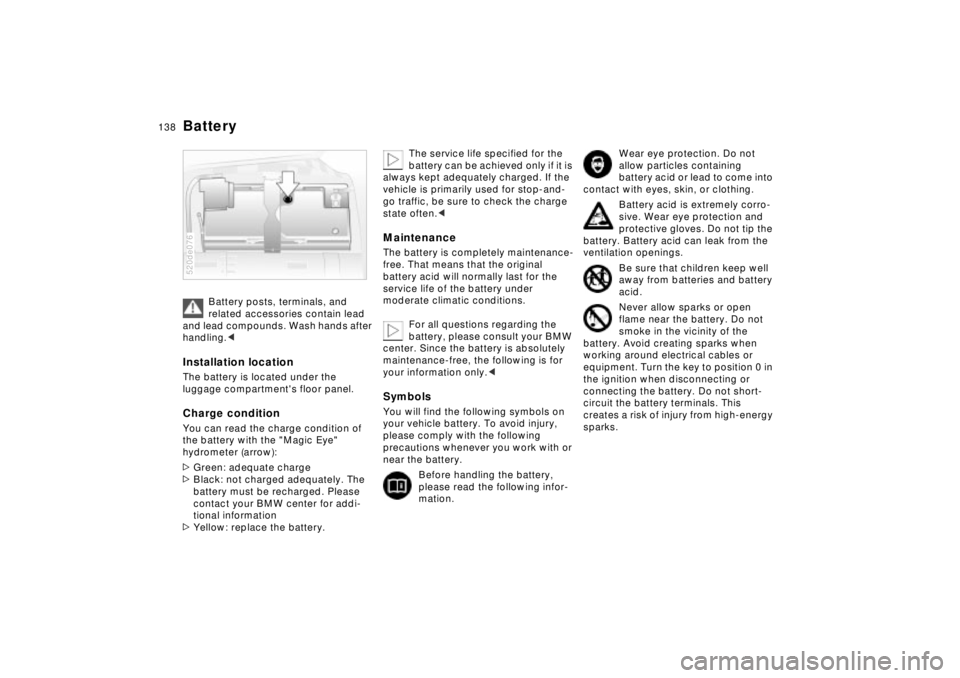
Installation location The battery is located under the
luggage compartment's floor panel. Charge conditionYou can read the charge condition of
the battery with the "Magic Eye"
hydrometer (arrow):
>Green: adequate charge
>Black: not charged adequately. The
battery must be recharged. Please
contact your BMW center for addi-
tional information
>Yellow: replace the battery.520de076
The service life specified for the
battery can be achieved only if it is
always kept adequately charged. If the
vehicle is primarily used for stop-and-
go traffic, be sure to check the charge
state often.<
MaintenanceThe battery is completely maintenance-
free. That means that the original
battery acid will normally last for the
service life of the battery under
moderate climatic conditions.
For all questions regarding the
battery, please consult your BMW
center. Since the battery is absolutely
maintenance-free, the following is for
your information only.
please comply with the following
precautions whenever you work with or
near the battery.
Before handling the battery,
please read the following infor-
mation.
Wear eye protection. Do not
allow particles containing
battery acid or lead to come into
contact with eyes, skin, or clothing.
Battery acid is extremely corro-
sive. Wear eye protection and
protective gloves. Do not tip the
battery. Battery acid can leak from the
ventilation openings.
Be sure that children keep well
away from batteries and battery
acid.
Never allow sparks or open
flame near the battery. Do not
smoke in the vicinity of the
battery. Avoid creating sparks when
working around electrical cables or
equipment. Turn the key to position 0 in
the ignition when disconnecting or
connecting the battery. Do not short-
circuit the battery terminals. This
creates a risk of injury from high-energy
sparks.
Page 145 of 174
145n
IndexDataTechnologyRepairsCar careControlsOverview
Do not use spray starter fluids to start
the engine.
If the battery is discharged, the engine
can be started with the use of two
jumper cables and the battery of
another vehicle. You can also use the
same method to help start another
vehicle. Use only jumper cables with
fully insulated grips on the terminal
clamps.
Do not touch high-voltage wiring
and cables on a running engine.
There is a risk of fatal injury if you do
this. Carefully comply with the following
instructions to avoid personal injury or
damage to one or both vehicles.<
1. Ensure that the battery in the support
vehicle is also rated at 12 volts. This
information is provided on the top of
the battery casing
2 Do not disconnect your battery from
your vehicle's electrical system.
Switch off all electrical accessories in
both vehicles
3 Make absolutely certain that there is
no contact between the bodywork of
the two vehicles Ð short circuit hazard
4 Start the engine on the support
vehicle and allow it to run
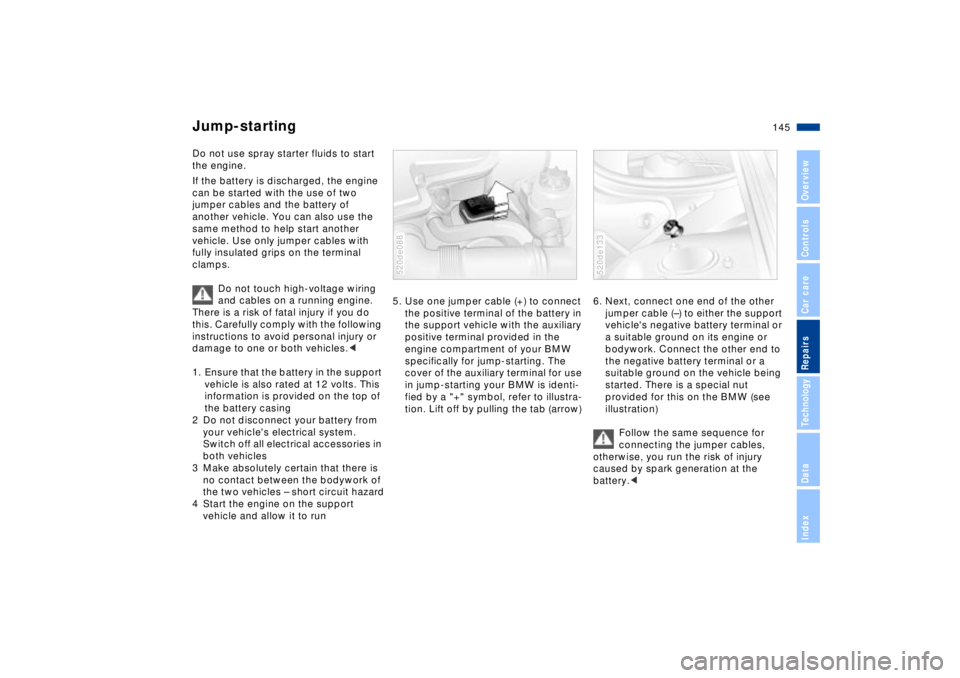
5. Use one jumper cable (+) to connect
the positive terminal of the battery in
the support vehicle with the auxiliary
positive terminal provided in the
engine compartment of your BMW
specifically for jump-starting. The
cover of the auxiliary terminal for use
in jump-starting your BMW is identi-
fied by a "+" symbol, refer to illustra-
tion. Lift off by pulling the tab (arrow) 520de088
6. Next, connect one end of the other
jumper cable (Ð) to either the support
vehicle's negative battery terminal or
a suitable ground on its engine or
bodywork. Connect the other end to
the negative battery terminal or a
suitable ground on the vehicle being
started. There is a special nut
provided for this on the BMW (see
illustration)
Follow the same sequence for
connecting the jumper cables,
otherwise, you run the risk of injury
caused by spark generation at the
battery.<520de133
Jump-starting
Page 147 of 174

147n
IndexDataTechnologyRepairsCar careControlsOverview
Towing the vehicle
Avoid "off-center" towing. Be sure
that the tow rope is pulled tightly
when the towing vehicle begins to
move.<
The towed vehicle should always
be the lighter of the two vehicles.
If this is not the case, it is no longer
possible to control vehicle response.<
Tow-startingFor instructions on jump-starting, refer
to page 145.
Never attempt to use your vehicle to
push another vehicle, since damage to
the energy-absorbing bumpers could
result.
Towing a vehicle1. Put the shift lever in neutral
2. Towing speed:
Max. 45 mph (70 km/h)
3. Towing distance:
Max. 95 miles (150 km)
4. Leave the ignition key in position 1 to
ensure that the brake lamps, turn
signals, horn and windshield wipers
remain operative, and to prevent the
steering lock detent from engaging
5. Switch on the hazard warning system
(comply with country-specific regula-
tions).
Find some means of identifying the
vehicle in tow, e. g. place a sign or
warning triangle in the rear window.
Make sure that the ignition key
remains in position 1 even when
the electrical system has failed to
prevent the steering lock from
engaging. The steering and brakes are
without power assist when the engine is
not running. This means that increased
effort is required for steering and
braking.<
Towing with a commercial tow
truck>Do not tow with sling-type equipment
>Use a wheel lift or flatbed equipment
>Please comply with applicable towing
laws.
Never allow passengers to ride in
a towed vehicle for any reason.<520us014