2002 BMW Z3 warning
[x] Cancel search: warningPage 126 of 187
126n
Coolant Brake fluid To add coolantWait until the engine cools before
removing the cap from the expansion
tank. The needle of the coolant gauge
in the instrument cluster must be
located in the blue field; otherwise,
there is a danger of scalding.
1. Turn the cap slightly counterclock-
wise in order to allow accumulated
pressure to escape, then open
2. If the coolant is low, slowly add
coolant until the correct level is
reached Ð do not overfill.
The coolant is a mixture of water and
extended-duty antifreeze with corrosion
inhibitor. Always maintain the
prescribed all-season 50 : 50 mixture
ratio for year-round protection against
internal corrosion. No other additives
are required.
Replace the coolant regularly. Refer to
the Service and Warranty Information
Booklet (US models) or the Warranty
and Service Guide Booklet (Canadian
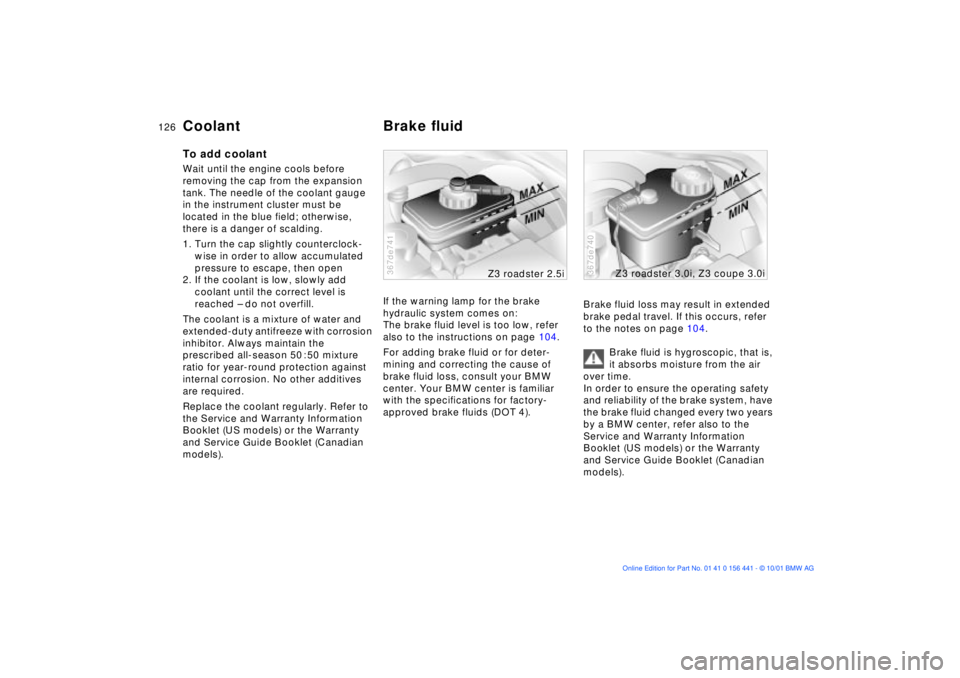
models).If the warning lamp for the brake
hydraulic system comes on:
The brake fluid level is too low, refer
also to the instructions on page 104.
For adding brake fluid or for deter-
mining and correcting the cause of
brake fluid loss, consult your BMW
center. Your BMW center is familiar
with the specifications for factory-
approved brake fluids (DOT 4).
367de741
Z3 roadster 2.5i
Brake fluid loss may result in extended
brake pedal travel. If this occurs, refer
to the notes on page 104.
Brake fluid is hygroscopic, that is,
it absorbs moisture from the air
over time.
In order to ensure the operating safety
and reliability of the brake system, have
the brake fluid changed every two years
by a BMW center, refer also to the
Service and Warranty Information
Booklet (US models) or the Warranty
and Service Guide Booklet (Canadian
models).367de740
Z3 roadster 3.0i, Z3 coupe 3.0i
Page 132 of 187

132n
Any BMW center will be happy to
advise you concerning the advisability,
legal implications and factory recom-
mendations for technical modifications
to the vehicle. For this purpose, the
BMW center will require the Vehicle
Identification Number. The engine
number is also required in some
instances.
Light-emitting diodes (LEDs)Light-emitting diodes installed behind
translucent lenses serve as the light
source for many of the controls and
displays in your vehicle. These LEDs
are similar to conventional laser tech-
nology.
Do not remove the protective lens
and avoid staring directly at the
unfiltered beam for extended periods
(several hours), since inflammation of
the iris could result.<
California laws require us to state the
following warning:
Engine exhaust, some of its
constituents, and certain vehicle
components contain or emit chemicals
known to the State of California to
cause cancer and birth defects or other
reproductive harm.<
Technical modifications California Proposition 65 Warning
Page 133 of 187

133n
IndexDataTechnologyRepairsMaintenanceControlsOverview
OBD interface socketAccess to the interface socket for the
Onboard Diagnostic system (OBD):
Lift off the side cover in the center
console on the passenger's side
(arrow).
The purpose of the OBD system is to
ensure proper operation of the emis-
sion control system throughout the
vehicle's lifetime by monitoring emis-
sion-related components and systems
for deterioration and malfunction.367us235
An illuminated indicator informs
you of the need for service,
but not of the need to stop the
vehicle. However, the systems should
be checked by your BMW center at the
earliest possible opportunity.
Under certain conditions, the indicator
will blink or flash. This indicates a rather
severe level of engine misfire. When
this occurs, you should reduce speed
and consult the nearest BMW center as
soon as possible. Severe engine misfire
over only a short period of time can
seriously damage emission control
components, especially the catalytic
converter.
"Service Engine Soon" warning
lamp for Canadian models.
When the filler cap is not properly
tightened, the OBD system can
detect the vapor leak and the indicator
will light up. If the filler cap is subse-
quently tightened, the indicator should
go out within a few days.<
Page 146 of 187
146n
Wheel change
Safety measures in the event of a
flat tire or a wheel change:
Stop the vehicle on a firm, level surface
as far as possible from the flow of
traffic. Turn on the hazard warning
flashers.
Turn the steering wheel to the straight-
ahead position and engage the steering
lock, engage the parking brake and
shift into 1st or reverse gear (selector
lever in "Park" with automatic transmis-
sion).
All passengers should be outside the
vehicle and well away from your imme-
diate working area (for instance, behind
the guardrail).
If a warning triangle or portable hazard
warning lamp is available, set it up on
the roadside at an appropriate distance
from the rear of the vehicle. Comply
with all safety guidelines and regula-
tions.
Change the wheel only on a level, firm
surface which is not slippery. Avoid
jacking the vehicle on a soft or slippery
support surface (snow, ice, tiles, loose
gravel, etc.), since it could slide side-
ways.
Place the jack on a firm support
surface.
Do not place wooden blocks or similar
objects under the jack. If this is done,
the jack might not be able to reach its
full support capacity because of the
limited height.
Do not lie under the vehicle or start the
engine when the vehicle is supported
by the jack. This creates the risk of fatal
injury.<
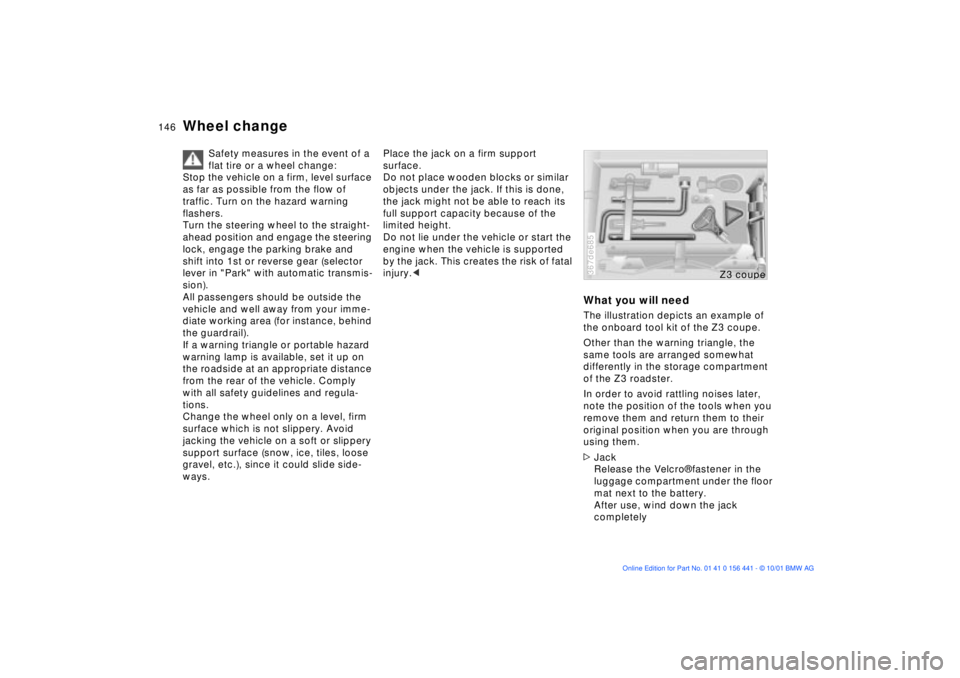
What you will needThe illustration depicts an example of
the onboard tool kit of the Z3 coupe.
Other than the warning triangle, the
same tools are arranged somewhat
differently in the storage compartment
of the Z3 roadster.
In order to avoid rattling noises later,
note the position of the tools when you
remove them and return them to their
original position when you are through
using them.
>Jack
Release the Velcro¨ fastener in the
luggage compartment under the floor
mat next to the battery.
After use, wind down the jack
completely367de685
Z3 coupe
Page 147 of 187
147n
IndexDataTechnologyRepairsMaintenanceControlsOverview
Wheel change>Wedge (wheel chock)
Next to the jack
>Lug wrench, centering pin, spark-
plug wrench and lifting handle
In the luggage compartment under
the floor mat
>Spare wheel
Stored under the luggage compart-
ment on the vehicle floor and
protected with a storage tray.
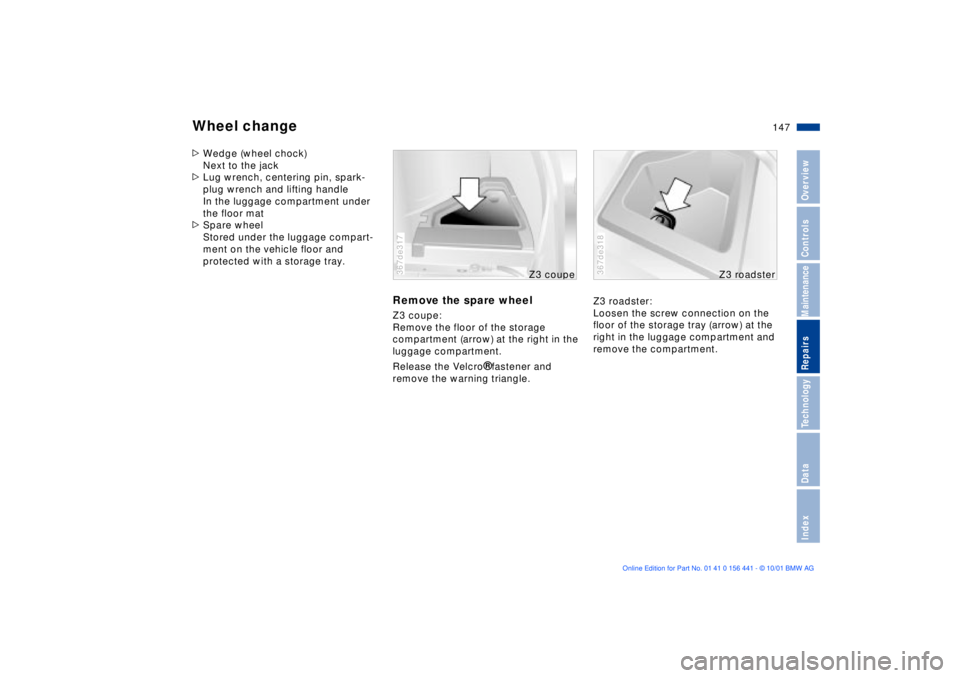
Remove the spare wheelZ3 coupe:
Remove the floor of the storage
compartment (arrow) at the right in the
luggage compartment.
Release the Velcro
¨ fastener and
remove the warning triangle.
367de317
Z3 cou
pe
Z3 roadster:
Loosen the screw connection on the
floor of the storage tray (arrow) at the
right in the luggage compartment and
remove the compartment.367de318
Z3 roadster
Page 160 of 187
160n
Towing the vehicle
The towed vehicle should always
be the lighter of the two vehicles.
If this is not the case, it will not be
possible to control vehicle handling.<
Tow-startingIt is not possible to start the engine of a
vehicle with an automatic transmission
by towing or pushing the vehicle.
For instructions on jump-starting, refer
to page 158.
Never attempt to use your vehicle to
push another vehicle. This could result
in damage to the energy-absorbing
bumpers.
Towing a vehicle with automatic
transmission1. Place the selector lever in
position "N"
2. Towing speed:
max. 45 mph (70 km/h)
3. Towing distance:
max. 95 miles (150 km)
4. Leave the ignition key in position 1 to
ensure that brake lamps, turn signal
indicators, horn and windshield
wipers remain operative, and to
prevent the steering lock from
engaging
5. Switch on the hazard-warning
flashers (observe applicable legal
regulations).
Find some means of identifying the
vehicle in tow. Place a sign or warning
triangle in the rear window, for
instance.
Even when the electrical system
has failed, make sure that the igni-
tion key remains in position 1 to prevent
the steering lock from engaging.
The steering and brakes are without
power assist when the engine is off.
This means that increased effort is
required for steering and braking.<
Towing with a commercial tow
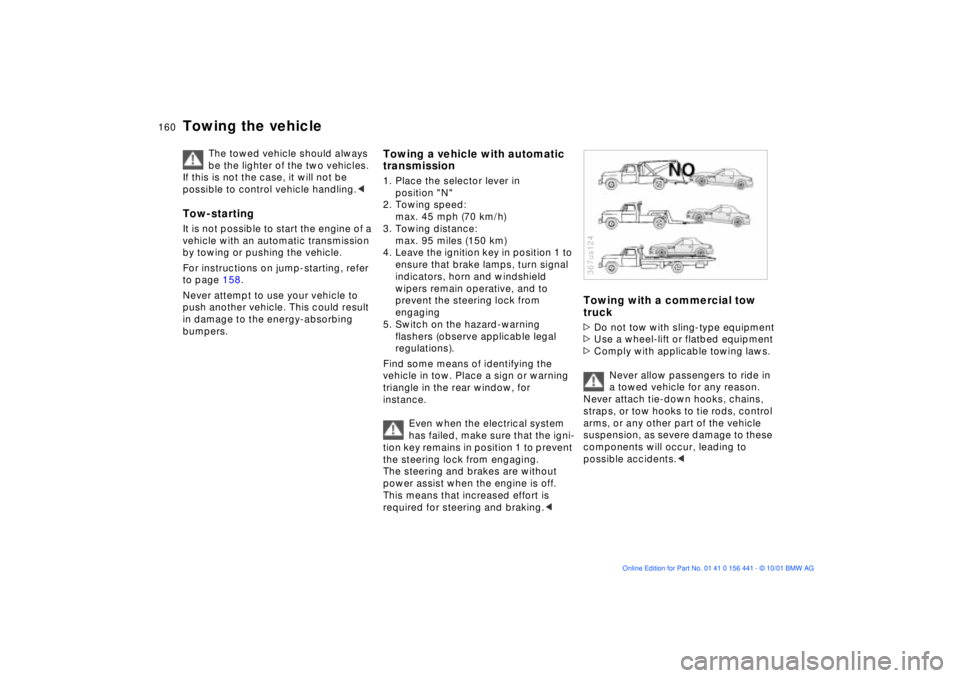
truck>Do not tow with sling-type equipment
>Use a wheel-lift or flatbed equipment
>Comply with applicable towing laws.
Never allow passengers to ride in
a towed vehicle for any reason.
Never attach tie-down hooks, chains,
straps, or tow hooks to tie rods, control
arms, or any other part of the vehicle
suspension, as severe damage to these
components will occur, leading to
possible accidents.< 367us124
Page 178 of 187

Everything from A to ZAABS (Antilock Brake
System)101
Accessories6
Adaptive Transmission
Control (ATC)62, 164
ADB (Automatic Differential
Braking)74
Adding
brake fluid126t
engine coolant126t
engine oil123t
washer fluid122t
Additional storage areas90
Adjusting
backrest50
mirrors50, 51
seat49
washer nozzles122t
Air conditioner84
Air distribution82, 86
Air outlets80, 84
ventilation85
Air supply82, 86
Air vents80, 84
Airbags21, 54, 164
important safety
notices130
sitting correctly55Antenna107
Antifreeze126
Antifreeze protection,
radiator105, 125
Antilock Brake System
(ABS)101
Anti-theft system32
Approved gross vehicle
weight172
Approved wheel and tire
specifications116
Aquaplaning99, 111
ASC+T (Automatic Stability
Control plus
Traction)73, 165
Ashtray91
ATC (Adaptive Transmission
Control)62, 164
Automatic cruise control67
Automatic Differential
Braking (ADB)74
Automatic rear window
washer65
Automatic Stability Control
plus Traction
(ASC+T)73, 165
Automatic transmission with
Steptronic62
gear indicator68Automatic windshield
washer122
Average fuel
consumption72
Average speed72
BBackrest, adjusting50
Backup lamps61
bulb replace-
ment139t, 140t
Battery153, 174
capacity174
charge condition154
charging154
discharged158
disposal154t
removal and
installation155
Battery change, keys143
Battery charge indicator
lamp20
Battery safety terminal155
Beverage holder91
BMW High Performance
Synthetic Oil124
Brake fluid126
disposal127tBrake hydraulic system20
Brake lamps, bulb replace-
ment139t, 140t
Brake pads22, 104
Brake system103, 104
brake fluid126
fluid level104
winter road
conditions105
Brakes, malfunctions104
Break-in procedure98
Bulb replacement137t
CCalifornia Proposition
65 Warning132
Capacities173
Car jack146t
Car keys30
Car radio
reception107, 166
refer also to the separate
Owner's Manual
Car wash systems, refer to
the "Caring for your
vehicle" manual
From A to Z
Page 180 of 187

Everything from A to ZDSC (Dynamic Stability
Control)74, 165
Dynamic Brake Control
(DBC)103
Dynamic Stability Control
(DSC)74, 165EElectric convertible top
operation44
Electric power windows38
Electrical malfunction
convertible top157t
doors32t
fuel filler door157t
luggage compartment
lid37t
power convertible
top157t
Electrical system174
Electronic immobilizer31
Emergency release of
luggage compartment lid
from luggage
compartment's interior38
Engine
compartment120, 121Engine coolant126
adding126t
Engine oil123
adding123t
dipstick123
disposal125t
grades124
level21, 123t
pressure20
viscosity124
Engine output170
Engine specifications170
Exterior mirrors50
FFailure of an electrical
accessory156t
Fan82, 86
Filler cap cover25
Filling the washer
reservoir122t
First-aid kit24
Fittings, tow-starting and
towing159t
Flasher, headlamp64Flat tire111
Z3 roadster,
Z3 coupe146t
Folding top40
Footbrake103
Front airbags54, 130
Front fog lamps76
bulb replacement139t
Frost protection,
radiator105
Fuel26
Fuel consumption,
average72
Fuel filler door
electrical
malfunction157t
manual operation157t
Fuel gauge68
Fuel specifications26
Fuel tank capacity173
Fuses156
GGasoline26
Gear indicator68
Glass sunroof39
Glove compartment90
Grilles80, 84
Gross vehicle weight172HHardtop108
Hazard warning
flashers24t
Hazard warning system24
Hazard warning
triangle24t
Head restraints50
Headlamp cleaning
system122
Headlamp cover,
care137t
Headlamp flasher64
Headlamp washers66
Headlamps, high
beam23, 64
bulb replacement137t
Headlamps, low beam76
bulb replacement137t