2002 BMW Z3 oil
[x] Cancel search: oilPage 97 of 187

Overview
Controls and features
Operation, maintenance
Owner service procedures
Technical data
Index Advanced technology
97n
IndexDataTechnologyRepairsMaintenanceControlsOverview
Special operating instructions:
Break-in procedure98
Driving notes99
Catalytic converter100
Antilock Brake System
(ABS)101
Disc brakes103
Brake system104
Winter operation105
Power steering106
Cellular phone107
Car radio reception107
Hardtop Ð roadster108
Wheels and tires:
Notes on inflation pressures110
Tire condition110
Tire replacement111
Tire rotation113
Wheel and tire
combinations114
Special features of winter
tires115
Snow chains115
Approved wheel and tire
specifications116In the engine compartment:
Hood118
Engine compartment120
Fluids for the washer
systems122
Washer nozzles122
Engine oil123
Coolant125
Brake fluid126
Vehicle Identification127
Care and maintenance:
The BMW Maintenance
System128
Airbags130
Storing your vehicle130
Laws and regulations:
Technical modifications132
California Proposition
65 Warning132
OBD interface socket133
Maintenance
Page 114 of 187

114n
Wheel and tire combinationsThe right choice
Use only wheels and tires
approved by BMW for the corre-
sponding vehicle model, as otherwise
the tires may make contact with the
body as the result of tolerances despite
the same nominal size being used,
resulting in serious accidents. If non-
approved wheels and tires are used,
BMW cannot evaluate their suitability,
and therefore cannot be held liable for
driving safety.<
For wheel and tire specifications
approved by BMW, refer to the informa-
tion beginning on page 116.
The correct wheel and tire combi-
nation affects different systems
such as ABS and ASC+T/DSC
*. The
function of these systems is impaired if
improper wheel and tire combinations
are used.
For this reason, use only tires of the
same manufacture and tread configura-
tion. In the event of a flat tire, for
example, remount the approved wheel
and tire combination as soon as
possible.<
Codes on tires and wheelsThe code on the tires has the following
meaning.
Codes on radial tires:
The speed rating indicates the
approved maximum speed for the tire.
Summer tires:
S = up to 112 mph (180 km/h)
T = up to 118 mph (190 km/h)
H = up to 130 mph (210 km/h)
V = up to 149 mph (240 km/h)
W = up to 167 mph (270 km/h)
Y = up to 186 mph (300 km/h)
ZR = over 149 mph (240 km/h) Example:
Nominal width
in mm
Aspect ratio in %
Belt rating ID code
for radial tires
Wheel diameter in inches
Load rating
(not on ZR tires)
Speed rating
(before R on ZR tires)
205/60 R 15 91 H
All season and winter tires:
Q M+S = up to 100 mph (160 km/h)
T M+S = up to 118 mph (190 km/h)
H M+S = up to 130 mph (210 km/h)
Codes on light-alloy wheels:
Protect valve inserts against dirt by
using screw-on valve caps. Dirt in the
valve inserts frequently causes a slow
loss in tire pressure.Storage Store tires in a cool, dry place,
protecting them against light whenever
possible. Protect the tires against
contact with oil, grease and fuel. Example:
Rim width
in inches
Code letter for
flange type
Symbol for full-drop
center rim
Rim diameter in inches
Hump on the 2 rim shoulders
7x15H2
J
Page 121 of 187

121n
IndexDataTechnologyRepairsMaintenanceControlsOverview
Engine compartment Ð Z3 roadster 2.5i, 3.0i, Z3 coupe 3.0i1 Engine oil dipstick123
2 Brake fluid reservoir,
the illustration shows the reservoir for
Z3 roadster 3.0i, Z3 coupe 3.0i126
3 Fuse box156
4 Coolant expansion tank125
5 Engine oil filler neck123
6 Reservoir for windshield and
headlamp
* washer fluid122
7 Auxiliary terminal for jump-starting Ð
negative terminal158
8 Auxiliary terminal for jump-starting Ð
positive terminal158
Page 123 of 187
123n
IndexDataTechnologyRepairsMaintenanceControlsOverview
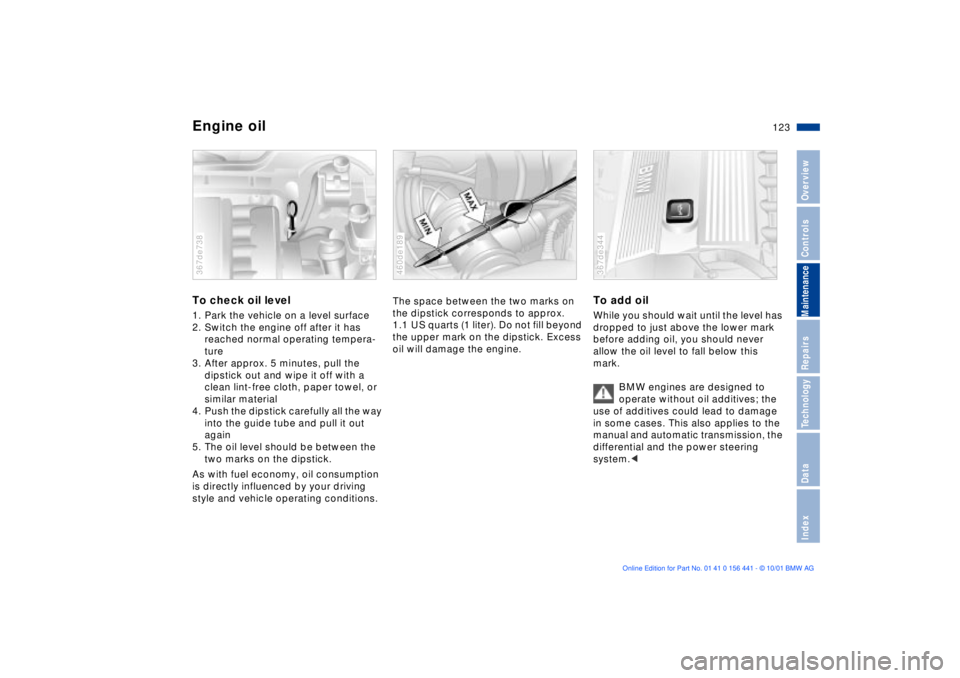
Engine oil To check oil level1. Park the vehicle on a level surface
2. Switch the engine off after it has
reached normal operating tempera-
ture
3. After approx. 5 minutes, pull the
dipstick out and wipe it off with a
clean lint-free cloth, paper towel, or
similar material
4. Push the dipstick carefully all the way
into the guide tube and pull it out
again
5. The oil level should be between the
two marks on the dipstick.
As with fuel economy, oil consumption
is directly influenced by your driving
style and vehicle operating conditions.367de738
The space between the two marks on
the dipstick corresponds to approx.
1.1 US quarts (1 liter). Do not fill beyond
the upper mark on the dipstick. Excess
oil will damage the engine.460de189
To add oilWhile you should wait until the level has
dropped to just above the lower mark
before adding oil, you should never
allow the oil level to fall below this
mark.
BMW engines are designed to
operate without oil additives; the
use of additives could lead to damage
in some cases. This also applies to the
manual and automatic transmission, the
differential and the power steering
system.< 367de344
Page 124 of 187
124n
Engine oilSpecified engine oilsThe quality of the engine oil which is
selected has critical significance for the
operation and service life of an engine.
Based on extensive testing, BMW has
approved only certain engine oils.
Use only approved "BMW High Perfor-
mance Synthetic Oil".
If you are unable to obtain "BMW High
Performance Synthetic Oil", you can
add small amounts of synthetic oil in
between oil changes. Only use oils with
the API SH specification or higher.
Ask your BMW center for details
concerning the specific "BMW
High Performance Synthetic Oil" or
"synthetic oils" which have been
approved.<
You can also call BMW of North
America at 1-800-831-1117 or visit this
website: www.bmwusa.com to obtain
this information.
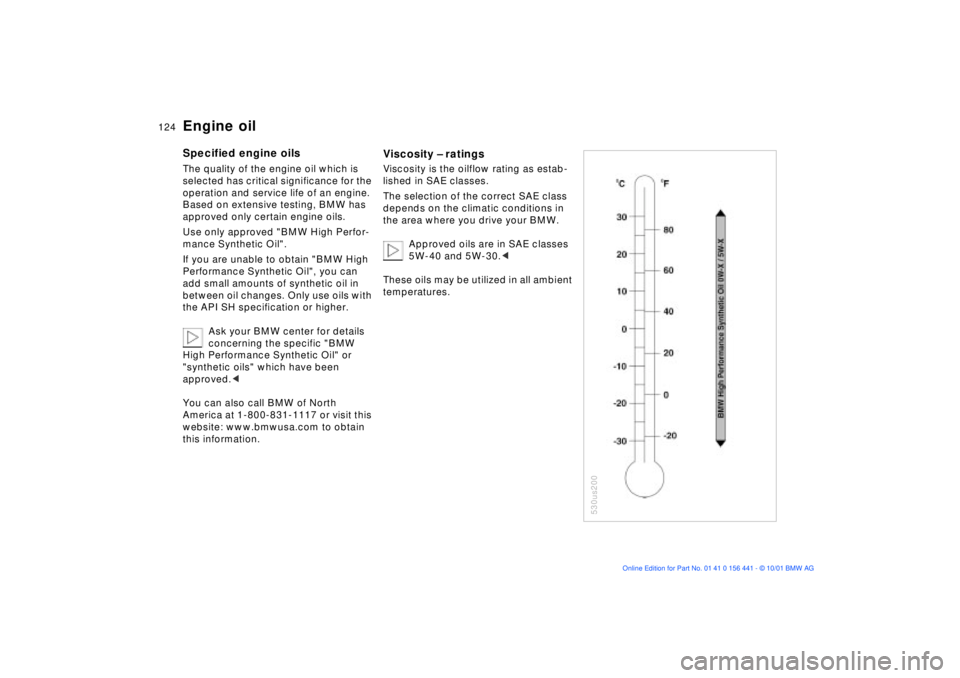
Viscosity Ð ratingsViscosity is the oilflow rating as estab-
lished in SAE classes.
The selection of the correct SAE class
depends on the climatic conditions in
the area where you drive your BMW.
Approved oils are in SAE classes
5W-40 and 5W-30.<
These oils may be utilized in all ambient
temperatures.
530us200
Page 125 of 187
125n
IndexDataTechnologyRepairsMaintenanceControlsOverview
Engine oil Coolant
Comply with the applicable envi-
ronmental laws regulating the
disposal of used oil.<
Recommendation: have the oil changed
by your BMW center only.
Continuous exposure to used oil
has caused cancer in laboratory
testing. Any skin areas that come in
contact with oil should thus be thor-
oughly washed with soap and water.
Store oil, grease, etc., out of reach of
children. Comply with warning labels
and information on containers.
If you use SAE 15W-40 engine oil in low
temperatures (below +14 7/Ð10 6),
the engine may become difficult to
start.
Special engine oils individually
approved by BMW are preferred for use
in your engine. Please contact your
BMW center for details.<
Do not add coolant to the cooling
system when the engine is hot. If
you do, escaping coolant can cause
burns.
To avoid the possibility of damage later
on, do not use anything other than
factory-approved, nitrite and amino-
free extended-duty antifreeze with
corrosion inhibitor which can be used
with aluminum radiator cores. Your
BMW center is familiar with the
approved specifications.
Antifreeze and anti-corrosion agents
are hazardous to health. Store them in
their original containers. Keep the
containers tightly closed and out of
reach of children.
Extended-duty antifreeze with corro-
sion inhibitor contains the flammable
substance ethylene glycol. For this
reason, do not spill extended-duty anti-
freeze with corrosion inhibitor on hot
engine components. If you do, it could
be ignited and cause burns.<
Comply with the applicable envi-
ronmental laws regulating the
disposal of extended-duty antifreeze
with corrosion inhibitor.<
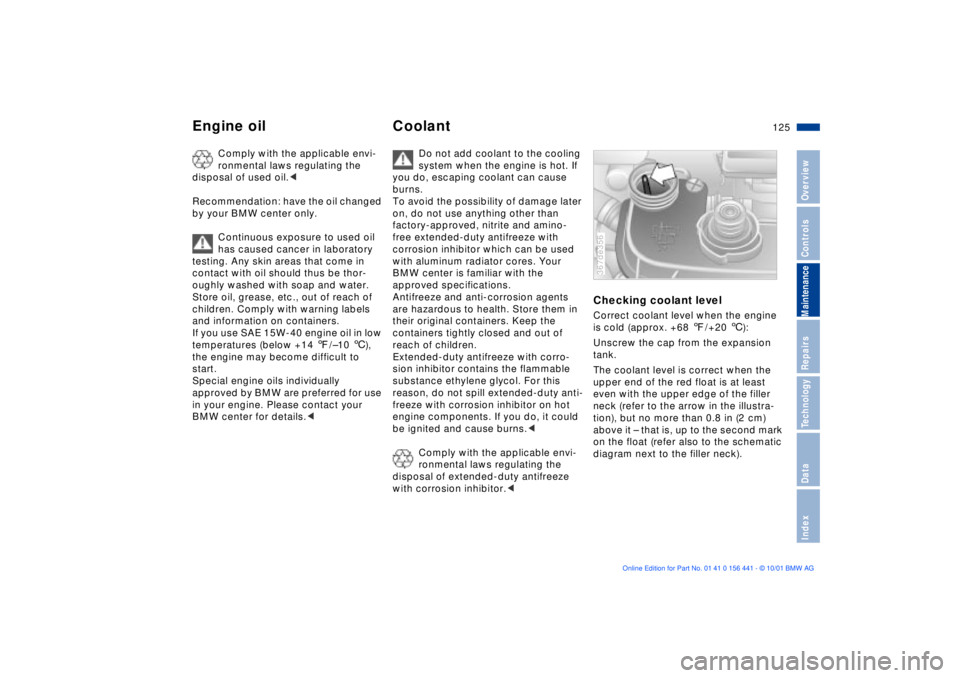
Checking coolant levelCorrect coolant level when the engine
is cold (approx. +68 7/+20 6):
Unscrew the cap from the expansion
tank.
The coolant level is correct when the
upper end of the red float is at least
even with the upper edge of the filler
neck (refer to the arrow in the illustra-
tion), but no more than 0.8 in (2 cm)
above it Ð that is, up to the second mark
on the float (refer also to the schematic
diagram next to the filler neck).367de356
Page 128 of 187
128n
The BMW Maintenance System has
been designed as a reliable means of
providing maximum driving and oper-
ating safety Ð and as cost-effectively as
possible for you.
Please keep in mind that regular main-
tenance is not only necessary for the
safety of your vehicle, but also plays a
significant role in maintaining the resale
value of your vehicle.
367us709
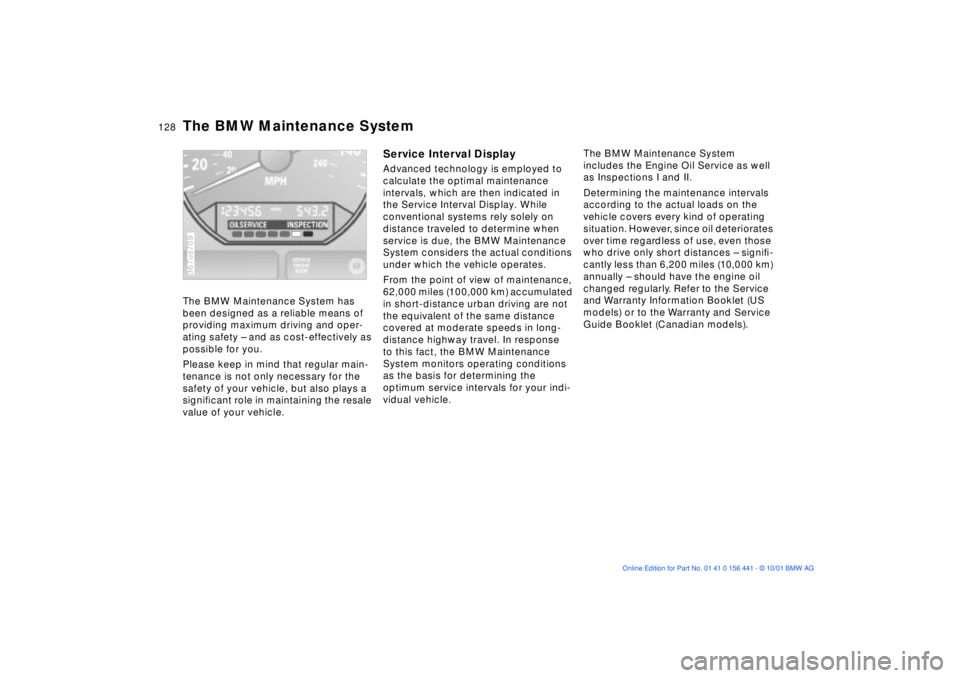
Service Interval DisplayAdvanced technology is employed to
calculate the optimal maintenance
intervals, which are then indicated in
the Service Interval Display. While
conventional systems rely solely on
distance traveled to determine when
service is due, the BMW Maintenance
System considers the actual conditions
under which the vehicle operates.
From the point of view of maintenance,
62,000 miles (100,000 km) accumulated
in short-distance urban driving are not
the equivalent of the same distance
covered at moderate speeds in long-
distance highway travel. In response
to this fact, the BMW Maintenance
System monitors operating conditions
as the basis for determining the
optimum service intervals for your indi-
vidual vehicle. The BMW Maintenance System
includes the Engine Oil Service as well
as Inspections I and II.
Determining the maintenance intervals
according to the actual loads on the
vehicle covers every kind of operating
situation. However, since oil deteriorates
over time regardless of use, even those
who drive only short distances Ð signiÞ-
cantly less than 6,200 miles (10,000 km)
annually Ð should have the engine oil
changed regularly. Refer to the Service
and Warranty Information Booklet (US
models) or to the Warranty and Service
Guide Booklet (Canadian models).
The BMW Maintenance System
Page 130 of 187
130n
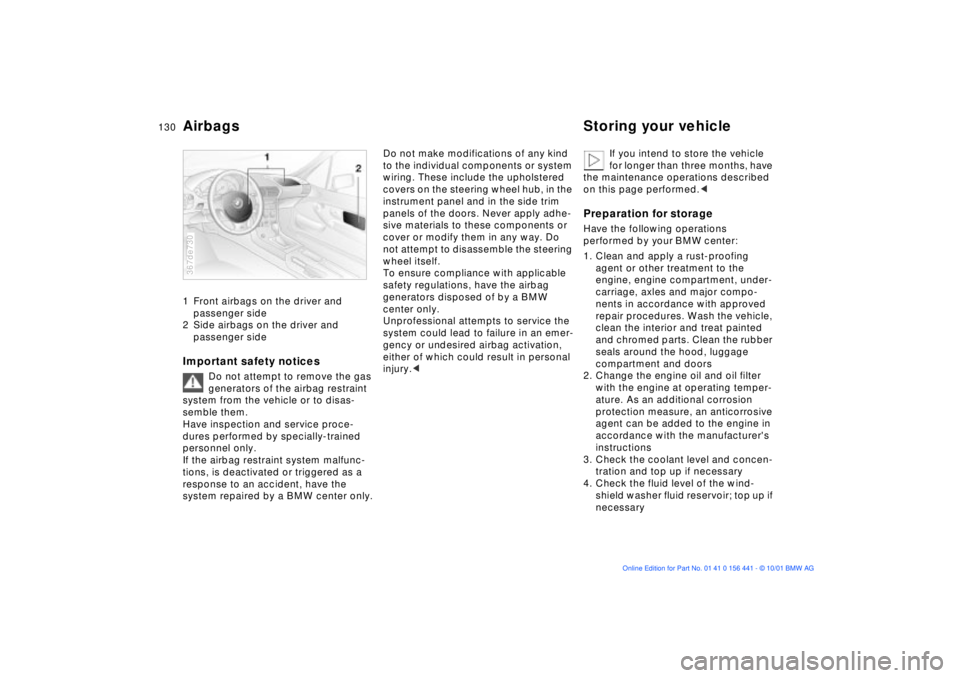
Airbags Storing your vehicle1 Front airbags on the driver and
passenger side
2 Side airbags on the driver and
passenger sideImportant safety notices
Do not attempt to remove the gas
generators of the airbag restraint
system from the vehicle or to disas-
semble them.
Have inspection and service proce-
dures performed by specially-trained
personnel only.
If the airbag restraint system malfunc-
tions, is deactivated or triggered as a
response to an accident, have the
system repaired by a BMW center only.
367de730
Do not make modifications of any kind
to the individual components or system
wiring. These include the upholstered
covers on the steering wheel hub, in the
instrument panel and in the side trim
panels of the doors. Never apply adhe-
sive materials to these components or
cover or modify them in any way. Do
not attempt to disassemble the steering
wheel itself.
To ensure compliance with applicable
safety regulations, have the airbag
generators disposed of by a BMW
center only.
Unprofessional attempts to service the
system could lead to failure in an emer-
gency or undesired airbag activation,
either of which could result in personal
injury.< If you intend to store the vehicle
for longer than three months, have
the maintenance operations described
on this page performed.<
Preparation for storageHave the following operations
performed by your BMW center:
1. Clean and apply a rust-proofing
agent or other treatment to the
engine, engine compartment, under-
carriage, axles and major compo-
nents in accordance with approved
repair procedures. Wash the vehicle,
clean the interior and treat painted
and chromed parts. Clean the rubber
seals around the hood, luggage
compartment and doors
2. Change the engine oil and oil filter
with the engine at operating temper-
ature. As an additional corrosion
protection measure, an anticorrosive
agent can be added to the engine in
accordance with the manufacturer's
instructions
3. Check the coolant level and concen-
tration and top up if necessary
4. Check the fluid level of the wind-
shield washer fluid reservoir; top up if
necessary