2002 BMW M5 SEDAN brake fluid
[x] Cancel search: brake fluidPage 6 of 154

Contents Operation, maintenance
Owner service procedures
Technical data
In the engine compartment:
Hood113
Engine compartment
essentials114
Washer fluids115
Engine oil115
Coolant117
Brake fluid118 Maintenance: The BMW Maintenance
System119 Laws and regulations: Technical modifications120
California Proposition
65 Warning120
OBD interface socket121
Replacement procedures:
Onboard tool kit124
Windshield wiper blades124
Lamps and bulbs124
Repairing a flat tire128
Battery131
Fuses132
Assistance, giving and
receiving:
Jump-starting133
Towing the vehicle135Engine data140
Dimensions141
Weights142
Capacities143
Page 16 of 154

16n
Indicator and warning lamps
Technology that monitors itself
The system runs a check on the
warning and indicator lamps marked by
"
l
" each time you switch on the igni-
tion. They each light up once for
different periods of time.
If a fault should occur in one of these
systems, the corresponding lamp does
not go out after the engine is started or
it lights up while the vehicle is moving.
The following section describes how
you should respond.
Red: stop immediately
Alternator charge current
l
The battery is no longer being
charged. Indicates a defective
alternator drive belt or a problem with
the alternator's charge circuit. Please
contact the nearest BMW center.
You should never attempt to
continue driving with a defective
drive belt, as the engine could overheat
and sustain serious damage. A defec-
tive drive belt will also make the vehicle
harder to steer.
<
Engine oil pressure
l
May be accompanied by the
warning "STOP!ENGINE
OILPRESS" in the Check Control
display panel: stop vehicle and switch
off engine immediately. Check level of
oil in engine, top up as required. If oil
level is correct: please contact the
nearest BMW center.
Stop at once. Attempts to
continue driving can lead to
serious engine damage stemming from
a lack of adequate lubrication.
<
Brake system hydraulic
circuits
l
Have the brake fluid level
checked. Before driving further, be sure
to read the notes on pages 108
and 118
The indicator lamp comes on together
with the "CHECK BRAKE LININGS"
message in the Check Control.
Brake system hydraulic circuits
warning lamp for Canadian
models.
Page 66 of 154

66n
Text messages are used to alert the
driver to system malfunctions with the
ignition key in position 2 and higher.
The alert is accompanied by a gong.
1 Status symbol for messages
2 Display
3 CHECK button
Messages warning of system malfunc-
tions are assigned one of two priority
levels.
39mus027
Priority 1
These defects are immediately indi-
cated by a gong and a flashing warning
symbol 1. Simultaneous defects will be
displayed consecutively. These status
messages remain in the display until the
defects are corrected. They cannot be
deleted by pressing the CHECK
button 3:
>"RELEASE PARKINGBRAKE"
>"COOLANT TEMPERATURE"
The coolant is overheated. Stop the
vehicle and switch off the engine
immediately. Refer to page 117
>"STOP!ENGINE OILPRESS"
The oil pressure is too low. Stop the
vehicle and switch off the engine
immediately. Refer to pages 16, 115>"CHECK BRAKE FLUID"
The level has dropped nearly to the
minimum. Top up the brake fluid at
the earliest opportunity. Refer to
page 118. Have the source of the
brake fluid loss diagnosed and
corrected at your BMW center
>"TIRE DEFECT"
Reduce vehicle speed immediately
and stop the vehicle. Avoid hard
brake applications. Do not oversteer.
Refer to page 83
>"SPEED LIMIT"
*
This is displayed if the programmed
speed limit has been exceeded.
Refer to page 73
Check Control
Page 67 of 154

67n
OverviewControlsMaintenanceRepairsDataIndex
Check Control Priority 2
These displays appear for 20 seconds
with the ignition key in position 2. The
warning symbols remain after the
message disappears. The messages
can be recalled again with Check
button 3.
>"TRUNKLID OPEN"
This message appears only when you
initially begin a trip
>"DOOR OPEN"
This message appears after a defined
road speed has been exceeded
>"FASTEN SEAT BELTS"
*
In addition to this message, an indi-
cator lamp with the safety belt icon
appears and an acoustic signal is
sounded
>"WASHER FLUID LOW"
Too low; top up fluid at the next
opportunity. Refer to page 115
>"CHECK ENGINE OIL LEV"
The oil level is at the absolute
minimum, so add engine oil as soon
as possible. Refer to page 115. Until
then, do not drive more than approx.
30 miles (50 km)>"SET TIRE PRESSURE"
The Flat Tire Monitor has adopted the
tires' current inflation pressures as its
reference levels. Refer to page 82
>"TIRECONTROL INACTIVE"
Transient malfunctions and system
errors in the Flat Tire Monitor. Refer
to page 83
>"CHECK BRAKE LIGHTS"
A lamp has failed or the electrical
circuit has a fault. Refer to page 126
and 132 or consult a BMW center
>"CHECK LOWBEAM LIGHTS"
"CHECK SIDE LIGHTS"
"CHECK REAR LIGHTS"
"CHECK FRONT FOGLAMPS"
"CHECK LICPLATE LIGHT"
"CHECK HIGHBEAM LIGHT"
"CHECK BACK UP LIGHTS"
Defective bulb or circuit. Refer to
page 124 ff. and 132 or consult a
BMW center>"CHECK BRAKE LININGS"
Have the brake pads checked at your
BMW center. Refer to page 108
>"CHECK COOLANT LEVEL"
The coolant level is too low; top off at
the next opportunity. Refer to
page 118
>"CHECK FILLER CAP"
Check to see whether the fuel filler
cap has been properly closed. Refer
to page 20. An improperly closed fuel
filler cap will activate the Service
Engine Soon lamp
>"ENGINE FAILSAFE PROG"
Indicates a malfunction in the elec-
tronic engine-management system,
which then reverts to an emergency
default program allowing continued
operation at reduced power and
lower engine speeds.
Please have the system inspected by
your BMW center
>
"Outside temperature 24 7 (Ð 5.0 6)"This temperature display is only an
example. The current temperature is
displayed at outside temperatures of
37.5 7 (+3 6) and below. Refer also
to page 63.
Page 108 of 154

108n
Brake systemBrake fluid level If the brake fluid level is too low and
brake pedal travel has become notice-
ably longer, there may be a defect in
one of the brake system's hydraulic
circuits.
Proceed to the nearest BMW
center. Higher brake application
pressure may be necessary under these
conditions, and the vehicle may exhibit
a slight tendency to pull to one side
when the brakes are applied. Braking
distances may also be longer. Please
remember to adapt your driving style
accordingly.<
Disc brakesLimited vehicle use, extended periods
with the vehicle parked or in storage,
and operating conditions in which
braking is restricted to gentle, low-
pressure applications will all increase
the tendency for corrosion to form on
the rotors; this is often accompanied by
a simultaneous accumulation of
contamination on the brake pads. The
pads must exert a certain minimal level
of pressure against the rotors for the
disc brakes' inherent self-cleaning
effect to remain effective; the pressure
available under the above conditions
may not provide adequate cleansing.
If the brake rotors are corroded, they
will tend to respond to braking with a
pulsating effect that even extended
brake applications will fail to cure.
When driving in heavy rain and on wet
roads it is a good idea to apply light
pressure to the brake pedal every few
miles. Monitor traffic conditions to
ensure that this maneuver does not
pose a hazard to you or to other road
users. The heat generated in this
process helps dry the pads and rotors
to ensure that your brake system will
respond with undiminished efficiency
when you need it.When descending steep hills and
extended grades, downshift to a gear
that will allow you to continue safely
with only a minimal amount of braking.
By minimizing the loads placed on the
brake system, this strategy helps
ensure that optimal brake system
response will remain available at all
times.
Do not coast with the clutch
depressed or with the transmis-
sion or selector lever in Neutral. Do not
coast with the engine shut off. The
engine provides no braking effect when
the clutch is depressed and there is no
power-assist for braking or steering
when the engine is not running.
Never allow floor mats, carpets or any
other objects to protrude into the area
around the accelerator, clutch and
brake pedals and obstruct their move-
ment.<
Brake pads
For your own safety: use only
brake pads that BMW has
approved for your particular vehicle
model. BMW cannot evaluate non-
approved brake pads to determine if
they are suited for use, and therefore
cannot ensure the operating safety of
the vehicle if they are installed.<
Page 114 of 154

114n
Engine compartment essentials 1 Reservoir for brake fluid (under the
housing of the microfilter)118
2 Auxiliary terminal for jump
starting1333 Engine oil dipstick115
4 Engine oil filler neck116
5 Coolant expansion tank1186 Reservoir for the intensive-cleaning
system115
7 Reservoir for the windshield and
headlamp washer system115
39mde150
Page 118 of 154

118n
Coolant Brake fluidChecking coolant level and
adding coolantCorrect coolant level when the engine
is cold (approx. 68 7/20 6):
In the translucent container's visible
range, as far as the graduation marked
KALT/COLD.
1. Turn the cap counterclockwise
slightly in order to allow accumulated
pressure to escape
2. If the coolant is low, slowly add
coolant until the correct level is
reached Ð do not overfill.
Comply with the applicable envi-
ronmental laws regulating the
disposal of extended-duty antifreeze
with corrosion inhibitor.<39mde111
Brake fluid level
The warning lamp for the brake
system hydraulic circuits comes
on and/or the message "CHECK
BRAKE FLUID" appears in the
Check Control panel:
Brake fluid level too low.
To add brake fluidThe brake fluid reservoir is located
under the microfilter housing on the
driver's side of the vehicle. For adding
brake fluid or for determining and
correcting the cause of brake fluid loss,
consult your BMW center. Your BMW
center is familiar with the specifications
for factory-approved brake fluids
(DOT 4).
Brake fluid loss may result in extended
brake pedal travel. If this occurs, refer
to the information on page 108.
Brake fluid is hygroscopic, that is,
it absorbs moisture from the air
over time.
In order to ensure the safety and reli-
ability of the brake system, have the
brake fluid changed every two years at
a BMW center. Refer also to the Service
and Warranty Information Booklet (US
models) or the Warranty and Service
Guide Booklet (Canadian models).
Brake fluid is toxic and damages the
vehicle's paint. You should always store
it in its original container and in a loca-
tion which is out of reach of children.
Do not spill the fluid and do not fill the
brake fluid reservoir beyond the MAX
mark. The brake fluid could ignite upon
contact with hot engine parts and
cause serious burns.<
Comply with the applicable envi-
ronmental laws regulating
the disposal of brake fluid.<
Page 146 of 154
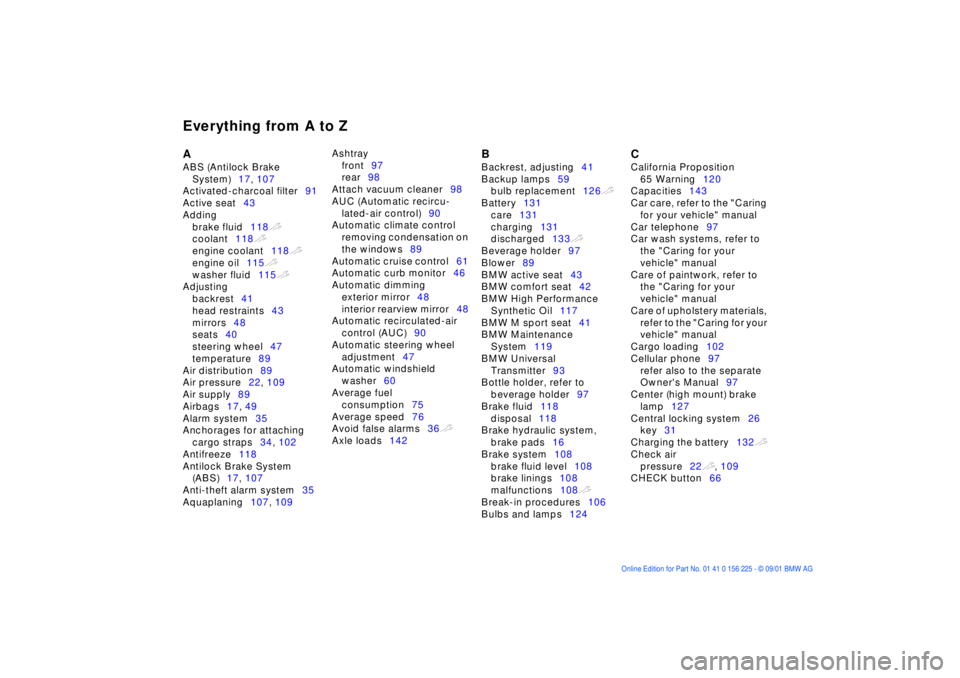
Everything from A to Z
A
ABS (Antilock Brake System) 17, 107
Activated-charcoal filter 91
Active seat 43
Adding brake fluid 118t
coolant 118t
engine coolant 118t
engine oil 115t
washer fluid 115t
Adjusting backrest 41
head restraints 43
mirrors 48
seats 40
steering wheel 47
temperature 89
Air distribution 89
Air pressure 22, 109
Air supply 89
Airbags 17, 49
Alarm system 35
Anchorages for attaching cargo straps 34, 102
Antifreeze 118
Antilock Brake System (ABS) 17, 107
Anti-theft alarm system 35
Aquaplaning 107, 109 Ashtray
front 97
rear 98
Attach vacuum cleaner 98
AUC (Automatic recircu- lated-air control) 90
Automatic climate control removing condensation on
the windows 89
Automatic cruise control 61
Automatic curb monitor 46
Automatic dimming exterior mirror 48
interior rearview mirror 48
Automatic recirculated-air control (AUC) 90
Automatic steering wheel adjustment 47
Automatic windshield washer 60
Average fuel consumption 75
Average speed 76
Avoid false alarms 36t
Axle loads 142 B
Backrest, adjusting 41
Backup lamps 59
bulb replacement 126t
Battery 131
care 131
charging 131
discharged 133t
Beverage holder 97
Blower 89
BMW active seat 43
BMW comfort seat 42
BMW High Performance Synthetic Oil 117
BMW M sport seat 41
BMW Maintenance System 119
BMW Universal Transmitter 93
Bottle holder, refer to beverage holder 97
Brake fluid 118
disposal 118
Brake hydraulic system, brake pads 16
Brake system 108
brake fluid level 108
brake linings 108
malfunctions 108t
Break-in procedures 106
Bulbs and lamps 124 C
California Proposition 65 Warning 120
Capacities 143
Car care, refer to the "Caring for your vehicle" manual
Car telephone 97
Car wash systems, refer to the "Caring for your
vehicle" manual
Care of paintwork, refer to the "Caring for your
vehicle" manual
Care of upholstery materials, refer to the "Caring for your
vehicle" manual
Cargo loading 102
Cellular phone 97
refer also to the separate
Owner's Manual 97
Center (high mount) brake lamp 127
Central locking system 26
key 31
Charging the battery 132t
Check air pressure 22t , 109
CHECK button 66