Page 116 of 159
116n
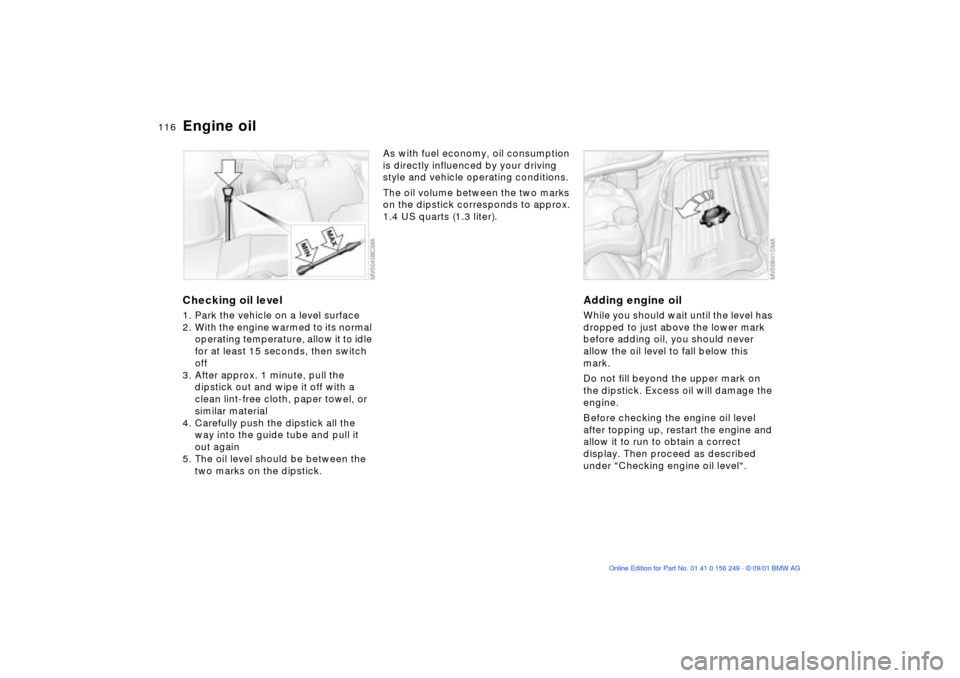
Engine oilChecking oil level 1. Park the vehicle on a level surface
2. With the engine warmed to its normal
operating temperature, allow it to idle
for at least 15 seconds, then switch
off
3. After approx. 1 minute, pull the
dipstick out and wipe it off with a
clean lint-free cloth, paper towel, or
similar material
4. Carefully push the dipstick all the
way into the guide tube and pull it
out again
5. The oil level should be between the
two marks on the dipstick.
As with fuel economy, oil consumption
is directly influenced by your driving
style and vehicle operating conditions.
The oil volume between the two marks
on the dipstick corresponds to approx.
1.4 US quarts (1.3 liter).
Adding engine oil While you should wait until the level has
dropped to just above the lower mark
before adding oil, you should never
allow the oil level to fall below this
mark.
Do not fill beyond the upper mark on
the dipstick. Excess oil will damage the
engine.
Before checking the engine oil level
after topping up, restart the engine and
allow it to run to obtain a correct
display. Then proceed as described
under "Checking engine oil level".
Page 126 of 159

126n
The onboard tool kit is located in the
luggage compartment lid.
Loosen the wingnut to open.
Location the tow fitting, refer to page,
138.
1. Rotate the wiper arm completely out
from the windshield
2. Position the wiper blade at an angle
and pull the release spring (arrow)
3. Fold the wiper blade down and
unhook it toward the windshield
4. Pull the wiper blade past the wiper
arm toward the top
5. Insert a new wiper blade and apply
pressure until you hear it engage.
Use only wiper blades which have
been approved by BMW.<
The lamps and bulbs make essential
contributions to the safety of your
vehicle. Therefore, comply fully with the
following instructions during bulb
replacement. If you are not familiar with
any of the procedures, consult your
BMW center.
Do not touch the glass portion of
a new bulb with your bare hands
since even small amounts of impurities
burn into the surface and reduce the
service life of the bulb. Use a clean
cloth, paper napkin, or a similar mate-
rial, or hold the bulb by its metallic
base.<
A replacement bulb set is available from
your BMW center.
Whenever working on the elec-
trical system, switch off the elec-
trical accessory you are working on or
disconnect the cable from the negative
terminal of the battery. Failure to do this
could result in short circuits.
To prevent injuries and damage when
changing a bulb, be sure to comply with
any instructions provided by the bulb
manufacturer.<
Onboard tool kit Wiper blades Lamps and bulbs
Page 128 of 159
128n
Lamps and bulbsTurn signal indicator, front 21 watt bulb
1. Using a screwdriver, release the
inner hook through the upper
opening
2. Remove lamp by pulling it out toward
the front
3. Applying light pressure, turn the bulb
to the left. Remove and exchange the
bulb
4. Insert the 2 pins on the lamp into the
guides on the vehicle
5. Push the lamp in. Carefully apply
pressure until you hear it snap into
place.
Side turn signal indicators5 watt bulb
1. Use finger pressure against the rear
end of the lamp (arrow) to press it
forward for removal
2. Apply gentle pressure to the bulb
while turning it to the left to remove.
Page 129 of 159
129n
OverviewControlsMaintenanceRepairsDataIndex
Lamps and bulbsFront fog lamps HB4 bulb, 51 watt
The bulb is pressurized. There-
fore, wear safety glasses and
protective gloves. Failure to comply
with this precaution could lead to injury
if the bulb is damaged during replace-
ment.<
1. Pull out the cover around the head-
lamp toward the front
2. Loosen the screw (arrow) and swing
the lamp assembly out
3. Release the spring on the back of the
lamp and turn the cover to the left
4. Release the clamp, remove the
contact base and replace the bulb.
Tail lamp assembly Tail lamp 4: bulbs 21/4 watt
Remaining bulbs: 21 watt
1 Turn signal indicator yellow
2 Backup lamp yellow
3 Tail lamp red
4 Tail lamp/brake lamp red
The illustration shows the right-hand
luggage compartment opening.Bulbs in the fenderAll of the bulbs are integrated in a
central bulb holder.
1. Release the bulb holder (arrow)
Page 131 of 159
131n
OverviewControlsMaintenanceRepairsDataIndex
Lamps and bulbsCenter (high-mount) brake lamp
LED strip in luggage compartment lid.
Please contact a BMW center in case of
a malfunction.
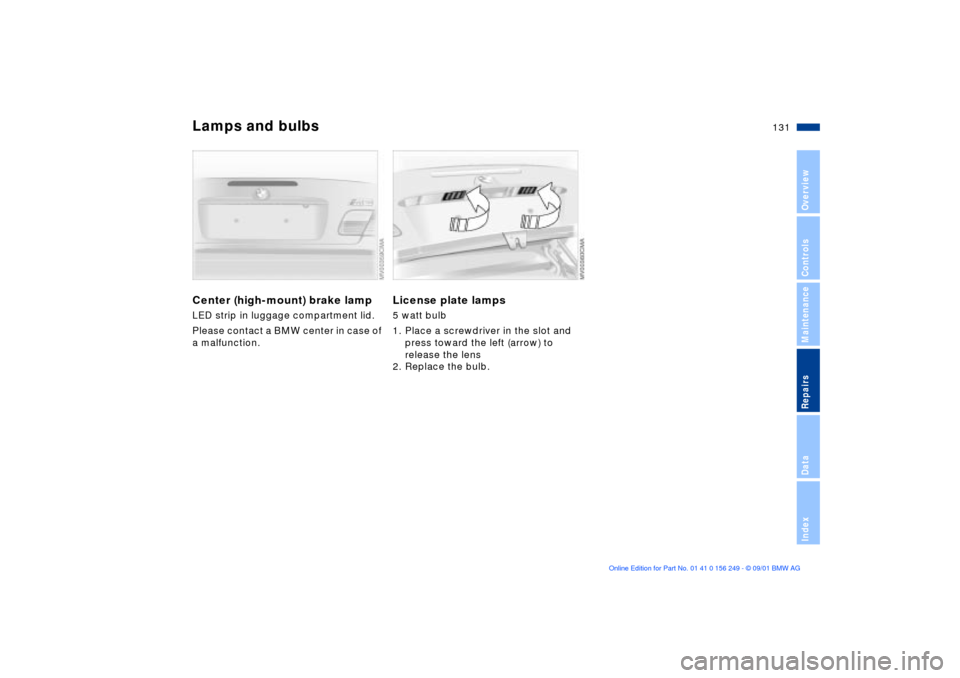
License plate lamps 5 watt bulb
1. Place a screwdriver in the slot and
press toward the left (arrow) to
release the lens
2. Replace the bulb.
Page 134 of 159
134n
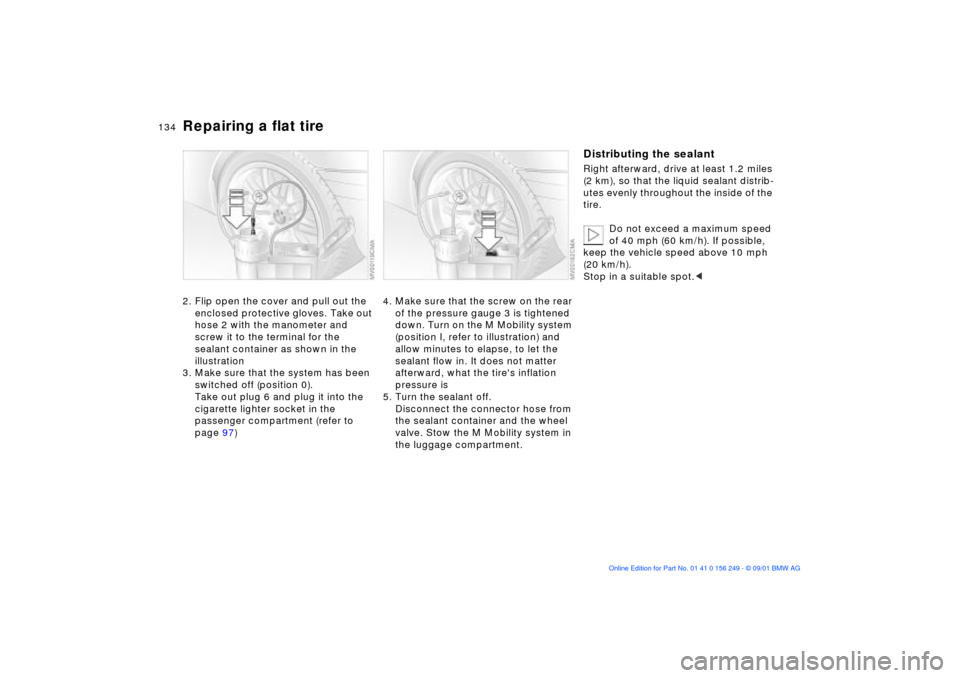
Repairing a flat tire2. Flip open the cover and pull out the
enclosed protective gloves. Take out
hose 2 with the manometer and
screw it to the terminal for the
sealant container as shown in the
illustration
3. Make sure that the system has been
switched off (position 0).
Take out plug 6 and plug it into the
cigarette lighter socket in the
passenger compartment (refer to
page 97)
4. Make sure that the screw on the rear
of the pressure gauge 3 is tightened
down. Turn on the M Mobility system
(position I, refer to illustration) and
allow minutes to elapse, to let the
sealant flow in. It does not matter
afterward, what the tire's inflation
pressure is
5. Turn the sealant off.
Disconnect the connector hose from
the sealant container and the wheel
valve. Stow the M Mobility system in
the luggage compartment.
Distributing the sealantRight afterward, drive at least 1.2 miles
(2 km), so that the liquid sealant distrib-
utes evenly throughout the inside of the
tire.
Do not exceed a maximum speed
of 40 mph (60 km/h). If possible,
keep the vehicle speed above 10 mph
(20 km/h).
Stop in a suitable spot.<
Page 135 of 159

135n
OverviewControlsMaintenanceRepairsDataIndex
Repairing a flat tire Inflating tire to correct pressure1. Take out the hose with the pressure
gauge and screw it onto the valve.
Take the plug out and plug it into the
cigarette lighter socket in the
passenger compartment
2. Reset the air pressure to 29 psi
(200 kilopascal), and:
>Increase tire pressure: turn on the
M Mobility system (position I). Turn
the unit off while you check the
current setting for the tire inflation
pressure
>Decrease tire pressure: turn the
screw on the back of the mano-
meter, a valve located there will
open
Even if the tire fails to hold the
pressure, you should still carry out
Step 3 before proceeding to drive the
vehicle again, refer to "Distributing
sealant" for more information. Then
repeat Steps 1 through 3.
The use of the M Mobility system may
be ineffective if the damaged area in
the tire is larger than approx. 0.16 in
(4 mm). Please consult the nearest
BMW center if the tire cannot be
temporarily repaired with the M Mobility
system.<
3. Unscrew the hose from the valve and
stow the M Mobility system in the
luggage compartment. Screw the
dust cap onto the valve again.
Do not exceed the maximum
speed limit described below,
otherwise it could lead to accidents.<
When you start driving again, do not
exceed the permissible maximum
speed of 50 mph (80 km/h).
You will find corresponding
instructions for using the
M Mobility system on the device.
Replace the defective tire as soon as
possible and have the new wheel
balanced. Reinitialize the Flat Tire
Monitor, and refer to page 83 for further
information. Have the M Mobility
system refilled. Contact your BMW
center for this.<
Protect valve stems against dirt using
screw-on dust caps. Dirty valve stems
frequently lead to slow pressure loss.
Page 139 of 159
139n
OverviewControlsMaintenanceRepairsDataIndex
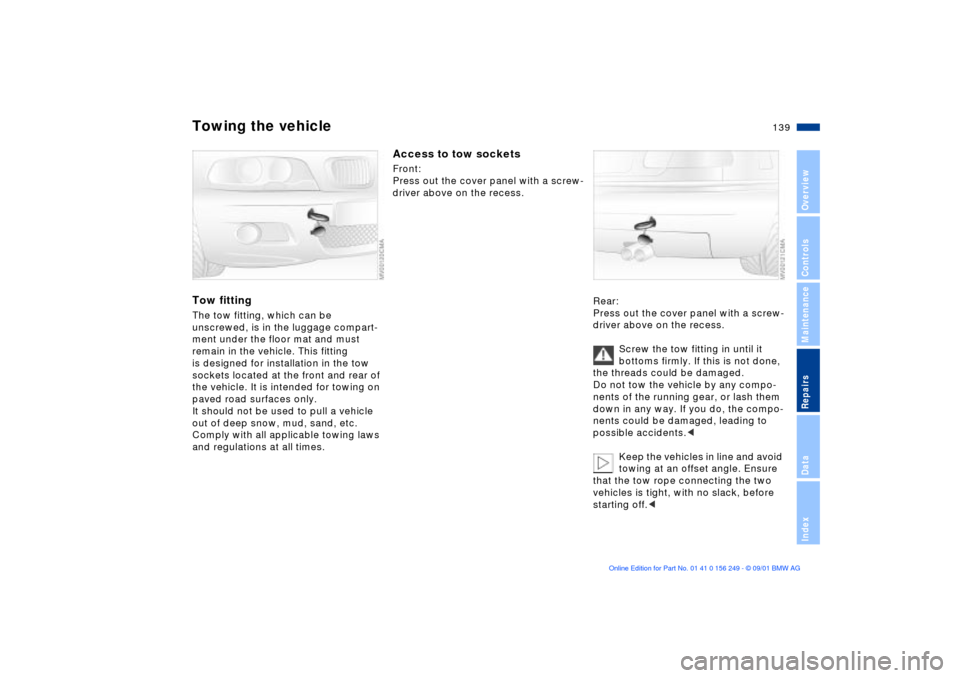
Towing the vehicleTow fittingThe tow fitting, which can be
unscrewed, is in the luggage compart-
ment under the floor mat and must
remain in the vehicle. This fitting
is designed for installation in the tow
sockets located at the front and rear of
the vehicle. It is intended for towing on
paved road surfaces only.
It should not be used to pull a vehicle
out of deep snow, mud, sand, etc.
Comply with all applicable towing laws
and regulations at all times.
Access to tow socketsFront:
Press out the cover panel with a screw-
driver above on the recess.
Rear:
Press out the cover panel with a screw-
driver above on the recess.
Screw the tow fitting in until it
bottoms firmly. If this is not done,
the threads could be damaged.
Do not tow the vehicle by any compo-
nents of the running gear, or lash them
down in any way. If you do, the compo-
nents could be damaged, leading to
possible accidents.<
Keep the vehicles in line and avoid
towing at an offset angle. Ensure
that the tow rope connecting the two
vehicles is tight, with no slack, before
starting off.<