2002 BMW M3 CONVERTIBLE tow
[x] Cancel search: towPage 89 of 159

89n
OverviewControlsMaintenanceRepairsDataIndex
Air conditionerAir supply (blower)
You can select blower speeds
from 1 to 4. The heating and
ventilation become more and
more effective as the air
supply settings are increased. In posi-
tion 0, the blower and the heater are
switched off. By using position 0, you
can totally block the air supply by
pressing the button for the recirculated-
air mode.
Temperature
In order to increase the
temperature of the passenger
compartment, turn it to the
right (red). Temperature regu-
lation will keep the interior temperature
you have selected constant.
Air distribution
You can direct air to flow onto
the windows , toward the
upper body and into the
footwell . All intermediate
settings are possible. In the setting,
there is a low flow of air onto the
windows to keep them free of conden-
sation.
Rear window defroster
With the convertible top closed
or with the hardtop
* mounted,
press the button. The indicator lamp
remains on. The rear window defroster
switches off automatically.
The rear defroster automatically
assumes operation within 5
minutes after the engine is started at
outside temperatures below 40 7
(4 6).<
Air conditioner
The air is cooled and dehumidi-
fied and Ð depending on the
temperature setting Ð rewarmed when
the air conditioner system is switched
on.
Depending on the weather, the wind-
shield may fog over briefly when the
engine is started.
Condensation forms in the air
conditioner system during opera-
tion, which then exits under the vehicle.
Traces of condensed water of this kind
are thus normal.<
Recirculated-air mode
You can respond to unpleasant
external odors by temporarily
excluding the supply of outside air. The
system then recirculates the air
currently within the vehicle.
If the windows fog over in the
recirculated-air mode, switch the
recirculated-air mode off and increase
the air supply as required.
<< < <
Page 90 of 159

90n
Air conditionerDraft-free ventilation You can adjust the blower controls for
the upper body area to select the
optimum airflow rates and directions for
your personal requirements:
1 Rotary dials for opening and closing
the vent outlets through an infinitely
variable range
2 Lever for adjusting airflow direction
3 With the rotary dial you can adjust the
temperature of the outgoing air.
>Turn toward blue Ð colder
>Turn toward red Ð warmer.
MicrofilterAn microfilter, which traps incoming
dust and pollen, has been installed in
your vehicle. Your BMW center will
replace it during routine maintenance.
A substantial reduction in airflow indi-
cates that the filter needs to be
replaced early.
To defrost windows and remove
condensation1. Set the blower speed control for the
airflow rate to position 4
2. Turn the rotary temperature control
completely to the right (red)
3. Rotary control for air distribution in
position
4. Switch on the rear window defroster
to defrost the rear window.
Page 91 of 159

91n
OverviewControlsMaintenanceRepairsDataIndex
Automatic climate control
*
1 Air onto the windshield and onto the
side windows
2 Airflow toward the upper body92
3 Front footwell ventilation
4 Recirculated-air mode/Automatic
recirculated-air control (AUC)935 Air supply (blower)92
6 Temperature92
7 Automatic air distribution92
8 Individual air distribution92
9 Interior temperature sensor Ð please
keep clear and unobstructed10 Display for temperature and air
supply92
11 Defrost the windshield and side
windows92
12 Air conditioner93
13 Rear window defroster93
Page 94 of 159

94n
Automatic climate control
*
Draft-free ventilation You can adjust the blower controls for
the upper body area to select the
optimum airflow rates and directions for
your personal requirements:
1 Rotary dials for opening and closing
the vents at any setting desired
2 Selector lever for airflow direction
3 With the rotary dial you can adjust the
temperature of the outgoing air.
>Turn toward blue Ð colder
>Turn toward red Ð warmer.
Microfilter, activated-charcoal
filterThe built-in microfilter removes dust
and pollen from the incoming air. The
activated-charcoal filter provides addi-
tional protection by filtering gaseous
pollutants from the outside air. Your
BMW center will replace the combined
filter as a standard part of your sched-
uled maintenance. A substantial reduc-
tion in airflow indicates that the filter
needs to be replaced early.
Page 100 of 159
100n
Cargo loading
Always position and secure the
load correctly. If you do not, it can
endanger the passengers during
braking or evasive maneuvers.
Do not exceed the permissible gross
weight and the permissible axle loads
(refer to page 146), otherwise the
vehicle's operating safety is no longer
assured and you are in violation of the
law.
Do not stow heavy or hard objects in
the passenger compartment without
first securing them. Otherwise they
would be thrown around during braking
and evasive maneuvers and endanger
the occupants.<
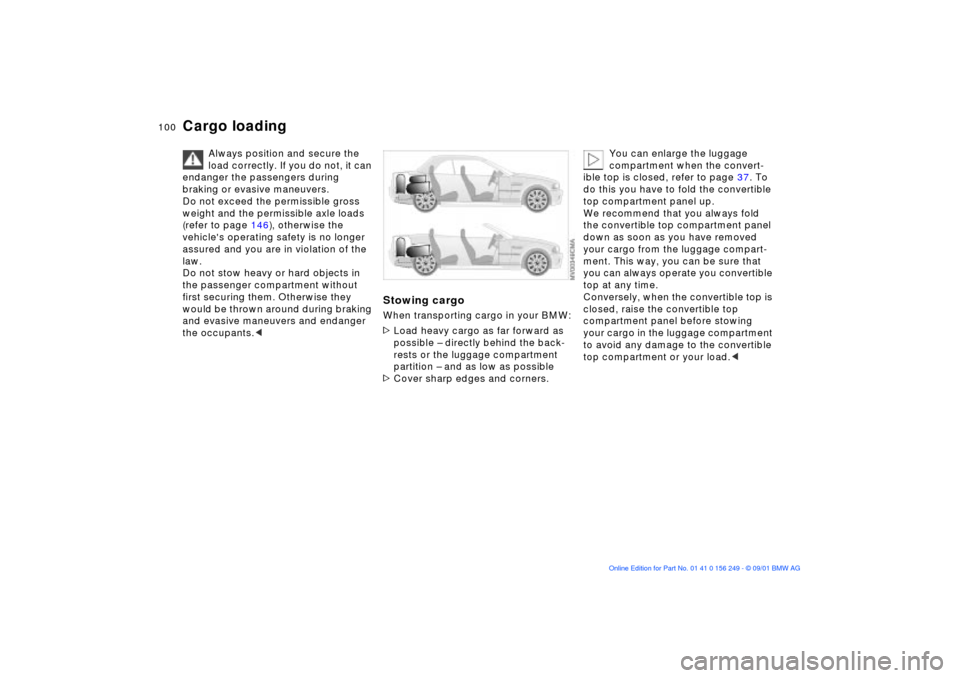
Stowing cargo When transporting cargo in your BMW:
>Load heavy cargo as far forward as
possible Ð directly behind the back-
rests or the luggage compartment
partition Ð and as low as possible
>Cover sharp edges and corners.
You can enlarge the luggage
compartment when the convert-
ible top is closed, refer to page 37. To
do this you have to fold the convertible
top compartment panel up.
We recommend that you always fold
the convertible top compartment panel
down as soon as you have removed
your cargo from the luggage compart-
ment. This way, you can be sure that
you can always operate you convertible
top at any time.
Conversely, when the convertible top is
closed, raise the convertible top
compartment panel before stowing
your cargo in the luggage compartment
to avoid any damage to the convertible
top compartment or your load.<
Page 104 of 159

104n
To ensure that your vehicle provides
maximum economy throughout a long
service life, we request that you
observe the following suggestions.
Because of its engineering design,
the BMW M3 convertible is an
especially high-quality vehicle. It is in
your best interest to follow the break-in
tips very closely. Doing this, you will
create the basis for a long, optimum
service life.<
Engine and differential>Up to 1,200 miles (2,000 km): drive at
varying engine and road speeds, but
do not exceed the following engine or
road speeds:
5,500 rpm or 105 mph (170 km/h)
Obey your local and state maximum
speed limits.
Do not depress the accelerator pedal to
the full-throttle position.
Vehicles with SMG II
* (refer to
page 64): refrain from using driving
program 6 in the sequential mode
during the break-in period.
>Following the break-in inspection at
1,200 miles (2,000 km), you can
gradually increase engine or road
speeds.
Follow the same break-in procedure if
either the engine or the differential is
replaced in the future.TiresDue to technical factors associated
with their manufacture, tires do not
achieve their full traction potential until
an initial break-in period has elapsed.
Thus drive with extra care during the
initial 200 miles (300 km).
Obey your local and state maximum
speed limits.
When the vehicle is operated on
wet or slushy roads, a wedge of
water may form between the tire and
the road surface. This phenomenon is
referred to as aquaplaning, or hydro-
planing, and can lead to partial or
complete loss of traction, vehicle
control and braking effectiveness.
Reduce your speed on wet roads.<
Brake systemApprox. 300 miles (500 km) must elapse
before the brake pads and rotors
achieve the optimal pad-surface and
wear patterns required for trouble-free
operation and long service life later on.
To break-in the separate parking brake
drums, apply the parking brake lightly
when coasting to a standstill (at a traffic
signal, for instance), provided that
traffic conditions permit to do so.
To avoid corrosion, repeat this proce-
dure from time to time.
The brake lamps do not come on
when the parking brake is
engaged.
Vacuum for the brake system servo unit
on your BMW is available only when the
engine is running. When you move the
vehicle with the engine off Ð when
towing, for example Ð substantially
higher levels of pedal force will be
required to brake the vehicle.
(500 km). Drive cautiously during this
break-in period and do not press the
clutch or shift at high engine speeds.
Break-in procedures
Page 107 of 159
107n
OverviewControlsMaintenanceRepairsDataIndex
Hardtop
*
Two people are required for installation
or removal. Work with extreme caution
in order to avoid paint damage and
damage to the body or hardtop.
To facilitate hardtop installation or
removal, you can obtain a specially
designed hardtop lift
* or hardtop rack
*
at your BMW center.
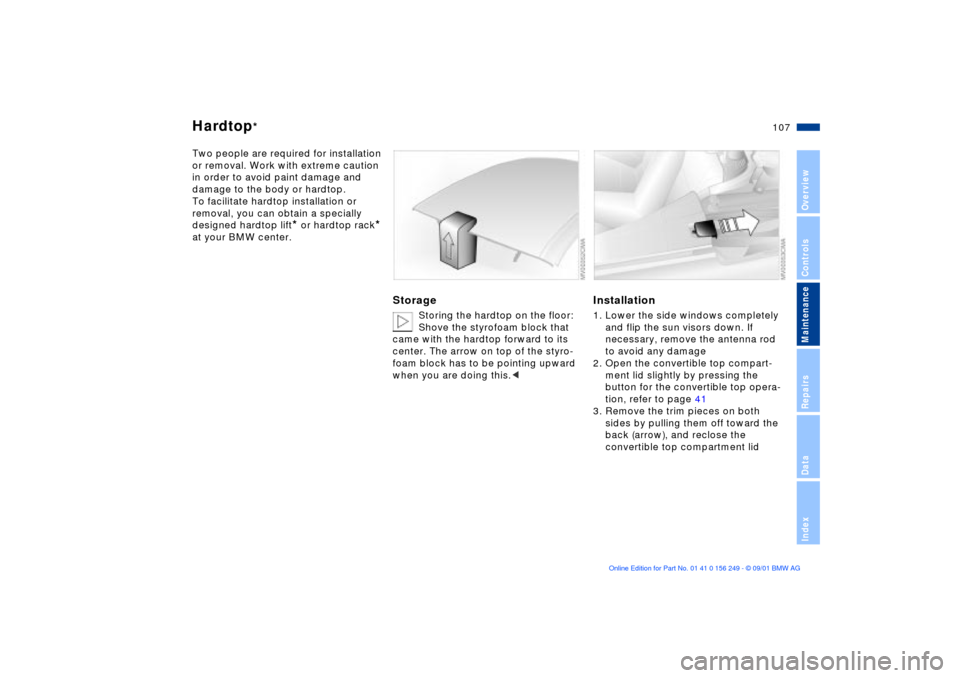
Storage
Storing the hardtop on the floor:
Shove the styrofoam block that
came with the hardtop forward to its
center. The arrow on top of the styro-
foam block has to be pointing upward
when you are doing this.<
Installation1. Lower the side windows completely
and flip the sun visors down. If
necessary, remove the antenna rod
to avoid any damage
2. Open the convertible top compart-
ment lid slightly by pressing the
button for the convertible top opera-
tion, refer to page 41
3. Remove the trim pieces on both
sides by pulling them off toward the
back (arrow), and reclose the
convertible top compartment lid
Page 109 of 159

109n
OverviewControlsMaintenanceRepairsDataIndex
Information for your safetyThe factory-approved radial tires are
matched to the vehicle and have been
selected to provide optimum safety and
driving comfort on your vehicle.
It is not merely the tire's service life, but
also driving comfort and Ð above all else
Ð driving safety that depend on the
condition of the tires and the mainte-
nance of the specified tire pressure.
Incorrect inflation pressure is a frequent
cause of tire damage. It also signifi-
cantly influences the roadholding ability
of your BMW.
Check tire inflation pressures on a
regular basis (refer to page 24), at
least every two weeks and before every
long trip. If this is not done, incorrect
tire pressures can cause driving insta-
bility and tire damage, ultimately
resulting in accidents.<
Tire tread Ð tire damageInspect your tires frequently for tread
wear, signs of damage and for foreign
objects lodged in the tread. Check the
tread depth.
Tread depth should not be allowed to go
below 0.12 in (3 mm), even though the
legally specified minimum tread depth is
only 0.063 in (1.6 mm). Tread wear indi-
cators (arrow) are embedded in the base
of the tire's tread. Their locations are
indicated by the legend "TWI" Ð Tread
Wear Indicator Ð at various points on the
tire's shoulder. When the tread reaches a
depth of 0.063 in (1.6 mm), these indica-
tors appear to signal that the tires have
worn to the minimum legal level. Below
0.12 in (3 mm) tread depth, there is an
increased risk of aquaplaning, even at
relatively moderate speeds and with only
small amounts of water on the road.
Do not drive on a deflated (flat) tire.
A flat tire greatly impairs steering
and braking response, and can lead to
complete loss of control over the
vehicle.
Avoid overloading the vehicle so that the
permitted load on the tires is not
exceeded. Overloading can lead to
overheating and increases the rate at
which damage develops inside the tires.
You could have a blowout as a result.
Unusual vibrations encountered during
normal vehicle operation can indicate
tire failure or some other vehicle defect.
The type of problem can be caused by
contact with curbs, etc. This is also true
for irregularities in the vehicle's handling
characteristics, such as a pronounced
tendency to pull to the left or right.
Should this occur, respond by immedi-
ately reducing your speed. Proceed
carefully to the nearest BMW center or
professional tire center, or have the
vehicle towed in to have it and its wheels
and tires inspected.
Tire damage (up to and including blow-
outs) can endanger the lives of both the
vehicle occupants and other road
users.<
Tire inflation pressure Tire condition