2002 BMW 320i SEDAN Time
[x] Cancel search: TimePage 125 of 155
125n
OverviewControlsMaintenanceRepairsDataIndex
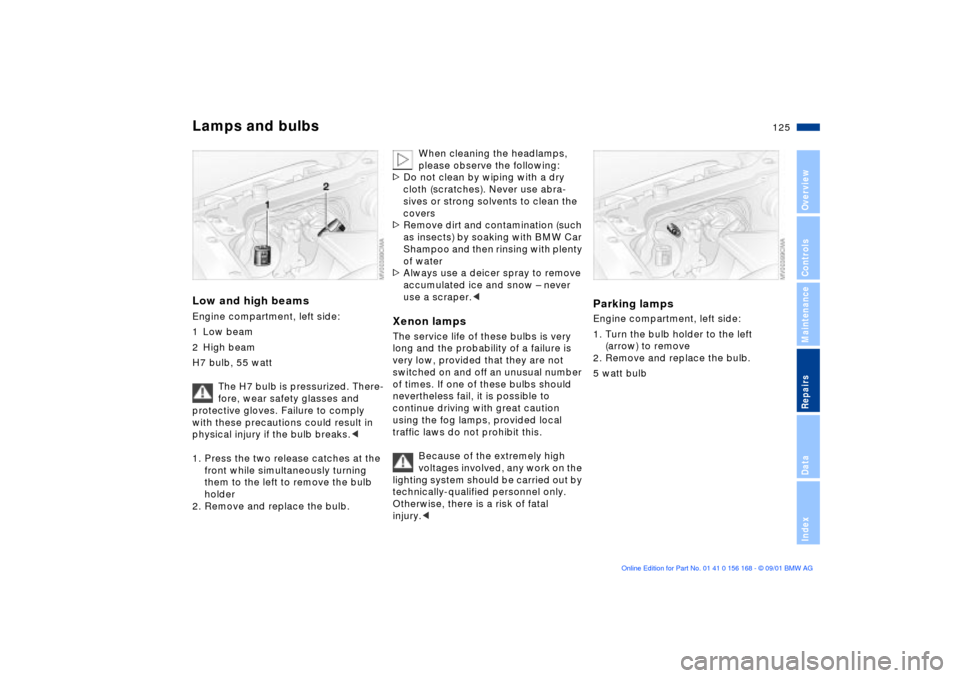
Lamps and bulbsLow and high beamsEngine compartment, left side:
1 Low beam
2 High beam
H7 bulb, 55 watt
The H7 bulb is pressurized. There-
fore, wear safety glasses and
protective gloves. Failure to comply
with these precautions could result in
physical injury if the bulb breaks.<
1. Press the two release catches at the
front while simultaneously turning
them to the left to remove the bulb
holder
2. Remove and replace the bulb.
When cleaning the headlamps,
please observe the following:
>Do not clean by wiping with a dry
cloth (scratches). Never use abra-
sives or strong solvents to clean the
covers
>Remove dirt and contamination (such
as insects) by soaking with BMW Car
Shampoo and then rinsing with plenty
of water
>Always use a deicer spray to remove
accumulated ice and snow Ð never
use a scraper.<
Xenon lamps
The service life of these bulbs is very
long and the probability of a failure is
very low, provided that they are not
switched on and off an unusual number
of times. If one of these bulbs should
nevertheless fail, it is possible to
continue driving with great caution
using the fog lamps, provided local
traffic laws do not prohibit this.
Because of the extremely high
voltages involved, any work on the
lighting system should be carried out by
technically-qualified personnel only.
Otherwise, there is a risk of fatal
injury.<
Parking lampsEngine compartment, left side:
1. Turn the bulb holder to the left
(arrow) to remove
2. Remove and replace the bulb.
5 watt bulb
Page 132 of 155

132n
Changing a wheelDriving with the space-saver
spare tireDrive cautiously. Do not exceed a
speed of 50 mph (80 km/h).
You can anticipate changes in vehicle
handling such as delayed braking
response, longer braking distances and
sacrifices in roadholding.
The changes in handling characteristics
will be even more pronounced if winter
tires are mounted.
Only one space-saver spare tire
may be mounted at one time.
Reinstall wheels and tires of the same
size and specification as soon as
possible. Maintain correct tire pres-
sures, refer to page 25.<
Safety tires
*
Safety tires consist of self-supporting
tires and special rims. The tire rein-
forcement ensures that the tire retains
some residual safety in the event of
pressure drop and driving remains
possible to a restricted degree. The
vehicle is equipped with Tire Pressure
Monitor (RDC) or Flat Tire Monitor,
which indicate a flat tire.Flat tireIf there is a tire failure, the red warning
lamp symbol lights up. A supplemen-
tary gong is also heard.
For additional information on Tire Pres-
sure Monitor (RDC) or Flat Tire Monitor
refer to pages 78 or 80.
Reduce vehicle speed carefully to
under 50 mph (80 km/h), avoiding hard
brake applications and steering maneu-
vers.
With the safety tires, you can drive
another approx. 155 miles (250 km) to
reach a safe parking location, a service
station or the nearest BMW center.
With a low vehicle load, this can also be
considerably more than 155 miles
(250 km).Safety tires are only possible in
conjunction with Tire Pressure
Monitor (RDC) or Flat Tire Monitor.<
If the defective wheel can not be seen
as such immediately from the outside,
check the tire inflation pressure at all
four wheels.
Have the tires changed by your
BMW center. For safety reasons,
do not have a safety tire repaired. Your
BMW center has the information
needed for working with safety tires
and is equipped with the necessary
special tools.<
If appropriate, please consult your
BMW center to reequip your
vehicle from summer to winter tires Ð or
vice versa.<
Page 133 of 155
133n
OverviewControlsMaintenanceRepairsDataIndex
Battery FusesBattery careThe battery is maintenance-free, that is,
the original electrolyte will normally last
for the service life of the battery under
moderate climatic conditions.
Please consult your BMW center
whenever you have any questions
concerning the battery. The battery is
completely maintenance-free; the
following section is provided for your
information only.<
Never disconnect the battery
when the engine is running; the
ensuing voltage surge would seriously
damage the vehicle's onboard elec-
tronic systems.<
Charging the batteryWhen charging the battery in the
vehicle, leave the engine off at all times.
Connect the charge cables to the termi-
nals in the engine compartment, for
information on terminal locations, refer
to Jump-starting on page 134.
Return used batteries to a recy-
cling point or your BMW center.
Maintain the battery in an upright posi-
tion for transport and storage. Secure
the battery against tilting during trans-
port.<
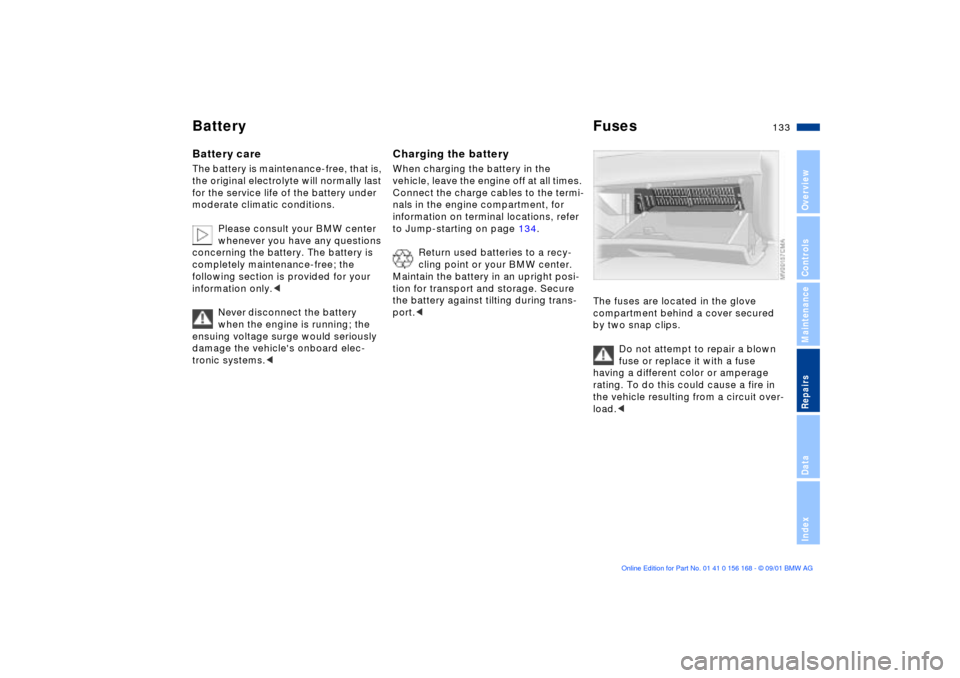
The fuses are located in the glove
compartment behind a cover secured
by two snap clips.
Do not attempt to repair a blown
fuse or replace it with a fuse
having a different color or amperage
rating. To do this could cause a fire in
the vehicle resulting from a circuit over-
load.<
Page 135 of 155

135n
OverviewControlsMaintenanceRepairsDataIndex
Towing the vehicleTow fittingThe screw-in tow fitting is stored in the
onboard tool kit; be sure that it remains
in the vehicle at all times. This fitting is
designed for installation in the tow
sockets located at the front and rear of
the vehicle, and is intended for towing
on paved road surfaces only. This fitting
should not be used to pull a vehicle out
of deep snow, mud, sand, etc.
Always comply with all applicable
towing laws and regulations.Access to tow socketsFront:
Press out the cover panel with a screw-
driver inserted in the recess at the top.
Rear:
Press out the cover panel with a screw-
driver inserted in the recess at the top.
Screw the tow fitting in until it is all
the way in. Failure to screw the
fitting all the way in can cause thread
damage.
Never attach tie-down hooks, chains,
straps, or tow hooks to tie rods, control
arms, or any other part of the vehicle
suspension, as severe damage to these
components will occur, leading to
possible accidents.<
Towing with a commercial tow
truck>Do not tow with sling-type equipment
>Use wheel-lift or flatbed equipment
>Please comply with applicable state
towing laws.
Never allow passengers to ride in
a towed vehicle for any reason.
Never attach tie-down hooks, chains,
straps, or tow hooks to tie rods, control
arms, or any other part of the vehicle
suspension, as severe damage to these
components will occur, leading to
possible accidents.c
Page 143 of 155

143n
OverviewControlsMaintenanceRepairsDataIndex
Capacities
Notes
Fuel tank
Reserve gal. (liters)
gal. (liters)approx. 16.6 (approx. 63)
approx. 2.1 (approx. 8)Fuel specification, refer to
page 23
Windshield/
Headlamp washer reservoir quarts (liters) approx. 5.6 (approx. 5.3)Specifications, refer to
page 114
Cooling system including
heater circuitquarts (liters) approx. 8.9 (approx. 8.4) Specifications, refer to
page 117
Engine oil and filter change quarts (liters) 320i, 325i, 330i:
approx. 6.9 (approx. 6.5)
325xi, 330xi:
approx. 7.9 (approx. 7.5)BMW High Performance
Synthetic Oil
Specifications, refer to
page 115
Manual and automatic transmission,
transfer box and differential.Ð Lifetime lubricant, no oil change
required
Page 147 of 155

Everything from A to Z
147n
OverviewControlsMaintenanceRepairsDataIndex
C
California Proposition
65 Warning120
Capacities143
Car care, refer to the "Caring
for your vehicle" manual
Car key28
Car phone94
refer also to the separate
"Owner's Manual"
Car wash systems, refer to
the "Caring for your
vehicle" manual
Care of upholstery materials,
refer to the "Caring for your
vehicle" manual
Cargo loading99
Cassette operation, refer to
the "Radio Owner's
Manual"
CBC (Cornering Brake
Control)18, 73
CD operation, refer to the
"Radio Owner's Manual"
Cellular phone94
refer also to the separate
"Owner's Manual"94 Center (high-mount) brake
lamp128
Center armrest92
Central locking system28
button32
Changing a wheel/tire129
Check Control68
Checking coolant level117
Checking engine oil
level115
Child-restraint systems52
Clean the headlamps63
Cleaning windshield63
Clock68
refer to the "Radio Owner's
Manual"
Cockpit14
Coin box93
Compartments92
Compression ratio140
Computer69
refer also to the "Onboard
Computer Owner's
Manual"69
Configuring individual
settings via Vehicle and
Key Memory55 Consumption70
display67
Convenience operation via
the door lock
sliding/tilt sunroof31
windows31
Coolant117
add117
capacity143
checking level117
Coolant temperature
gauge67
Cooling system including
heater circuit,
capacity143
Copyright4
Cornering Brake Control
(CBC)18, 73
Correct sitting posture41
Cover, sun blinds91
Cruise control64
Cruising range70
Cup holder, refer to
beverage holder93
Curb monitor47
Curb weight142
Current check indicator17
D
Data
dimensions141
engine140
weights142
Daytime driving lamps82
DBC (Dynamic Brake
Control)73, 74
Deep water105
Defrost windows and
remove
condensation87, 89
Defroster, rear
window86, 90
Digital clock68
Dimensions141
Dipstick, engine oil115
Displacement140
Display lighting83
Displays15
Distance warning71
Divided rear-seat
backrest96
Door key28
Page 153 of 155

To ensure that you always have conve-
nient access to all essential information
when you stop for fuel, we recommend
that you take the time to fill out the
adjoining chart by entering the data that
apply to your vehicle.
Consult the index for individual specifi-
cations.
Fuel Please enter your preferred fuel here. Engine oil The oil volume between the
two marks on the dipstick
corresponds to 1.1 US quarts (1 liter). Designation
QualityTire inflation pressures
Summer tires Winter tires
Front Rear Front Rear
Up to 4 persons
5 persons or 4 plus luggage
Refueling