2001 YAMAHA XVZ1300TF recommended oil
[x] Cancel search: recommended oilPage 62 of 132

5-1
5
EAU01114
5-PRE-OPERATION CHECKSThe condition of a vehicle is the owner’s responsibility. Vital components can start to deteriorate quickly and unexpectedly,
even if the vehicle remains unused (for example, as a result of exposure to the elements). Any damage, fluid leakage or loss
of tire air pressure could have serious consequences. Therefore, it is very important, in addition to a thorough visual inspec-
tion, to check the following points before each ride.
EAU03439
Pre-operation check list
ITEM CHECKS PAGE
Fuel• Check fuel level in fuel tank.
• Refuel if necessary.
• Check fuel line for leakage.3-12
Engine oil• Check oil level in engine.
• If necessary, add recommended oil to specified level.
• Check vehicle for oil leakage.7-12
Final gear oil• Check vehicle for oil leakage. 7-15
Coolant• Check coolant level in reservoir.
• If necessary, add recommended coolant to specified level.
• Check cooling system for leakage.7-15–7-16
Front brake• Check operation.
• If soft or spongy, have Yamaha dealer bleed hydraulic system.
• Check lever free play.
• Adjust if necessary.
• Check fluid level in reservoir.
• If necessary, add recommended brake fluid to specified level.
• Check hydraulic system for leakage.7-25, 7-27–7-29
Rear brake• Check operation.
• If soft or spongy, have Yamaha dealer bleed hydraulic system.
• Check fluid level in reservoir.
• If necessary, add recommended brake fluid to specified level.
• Check hydraulic system for leakage.7-26–7-29
E_5jc.book Page 1 Monday, January 22, 2001 12:12 PM
Page 85 of 132

PERIODIC MAINTENANCE AND MINOR REPAIR
7-12
7
EAU01703
Engine oil and oil filter
cartridge The engine oil level should be checked
before each ride. In addition, the oil
must be changed and the oil filter car-
tridge replaced at the intervals speci-
fied in the periodic maintenance and
lubrication chart.
To check the engine oil level
1. Place the motorcycle on a level
surface and hold it in an upright
position.NOTE:Make sure that the motorcycle is posi-
tioned straight up when checking the oil
level. A slight tilt to the side can result in
a false reading. @2. Start the engine, warm it up for
several minutes, and then turn it
off.3. Wait a few minutes until the oil set-
tles, and then check the oil level
through the check window located
at the bottom-right side of the
crankcase.
NOTE:@ The engine oil should be between the
minimum and maximum level marks. @4. If the engine oil is below the mini-
mum level mark, add sufficient oil
of the recommended type to raise
it to the correct level.To change the engine oil (with or
without oil filter cartridge replace-
ment)
1. Start the engine, warm it up for
several minutes, and then turn it
off.
2. Place an oil pan under the engine
to collect the used oil.1. Engine oil level check window
2. Maximum level mark
3. Minimum level mark
1. Engine oil filler cap
E_5jc.book Page 12 Monday, January 22, 2001 12:12 PM
Page 87 of 132
PERIODIC MAINTENANCE AND MINOR REPAIR
7-14
7 8. Add the specified amount of the
recommended engine oil, and
then install and tighten the oil filler
cap.
EC000072
CAUTION:@ l
In order to prevent clutch slip-
page (since the engine oil also
lubricates the clutch), do not
mix any chemical additives with
the oil or use oils of a higher
grade than “CD”. In addition, do
not use oils labeled “ENERGY
CONSERVING II” or higher.
l
Make sure that no foreign mate-
rial enters the crankcase.
@9. Start the engine, and then let it idle
for several minutes while checking
it for oil leakage. If oil is leaking,
immediately turn the engine off
and check for the cause.NOTE:@ After the engine is started, the engine
oil level warning light should go off if the
oil level is sufficient. @
EC000067
CAUTION:@ If the oil level warning light flickers
or remains on, immediately turn the
engine off and have a Yamaha deal-
er check the vehicle. @10. Turn the engine off, and then
check the oil level and correct it if
necessary. Recommended engine oil:
See page 9-1.
Oil quantity:
Without oil filter cartridge
replacement:
3.5 L
With oil filter cartridge
replacement:
3.7 L
Total amount (dry engine):
4.3 L
E_5jc.book Page 14 Monday, January 22, 2001 12:12 PM
Page 101 of 132

PERIODIC MAINTENANCE AND MINOR REPAIR
7-28
7
EAU03914
Checking the brake and clutch
fluid levels Insufficient brake or clutch fluid may al-
low air to enter the brake or clutch sys-
tems, possibly causing them to
become ineffective.
Before riding, check that the brake and
clutch fluids are above the minimum
level marks and replenish if necessary.
A low brake or clutch fluid level may in-
dicate brake or clutch system leakage
and/or worn brake pads. If the brake or
clutch levels are low, be sure to check
the brake or clutch systems for leakage
and the brake pads for wear.Observe these precautions:
l
When checking the brake and
clutch fluid levels, make sure that
the top of each reservoir is level.
l
Use only the recommended quali-
ty brake fluid, otherwise the rubber
seals may deteriorate, causing
leakage and poor braking or clutch
performance.
l
Refill with the same type of brake
fluid. Mixing fluids may result in a
harmful chemical reaction and
lead to poor braking or clutch per-
formance.
l
Be careful that water does not en-
ter the brake or clutch fluid reser-
voir when refilling. Water will
significantly lower the boiling point
of the fluid and may result in vapor
lock.
l
Brake fluid may deteriorate paint-
ed surfaces or plastic parts. Al-
ways clean up spilled fluid
immediately.
l
As the brake pads wear, it is nor-
mal for the brake fluid level to
gradually go down. However, if the
brake fluid level goes down sud-
denly, have a Yamaha dealer
check the cause.
1. Minimum level markFront brake
1. Minimum level markRecommended brake and clutch
fluid: DOT 4 brake fluidRear brake
1. Minimum level markClutch
E_5jc.book Page 28 Monday, January 22, 2001 12:12 PM
Page 102 of 132
PERIODIC MAINTENANCE AND MINOR REPAIR
7-29
7
EAU03984
Changing the brake and
clutch fluids Have a Yamaha dealer change the
brake and clutch fluids at the intervals
specified in the NOTE after the periodic
maintenance and lubrication chart. In
addition, have the oil seals of the brake
and clutch master cylinders and cali-
pers as well as the brake and clutch
hoses replaced at the intervals listed
below or whenever they are damaged
or leaking.l
Oil seals: Replace every two
years.
l
Brake and clutch hoses: Replace
every four years.
EAU03370
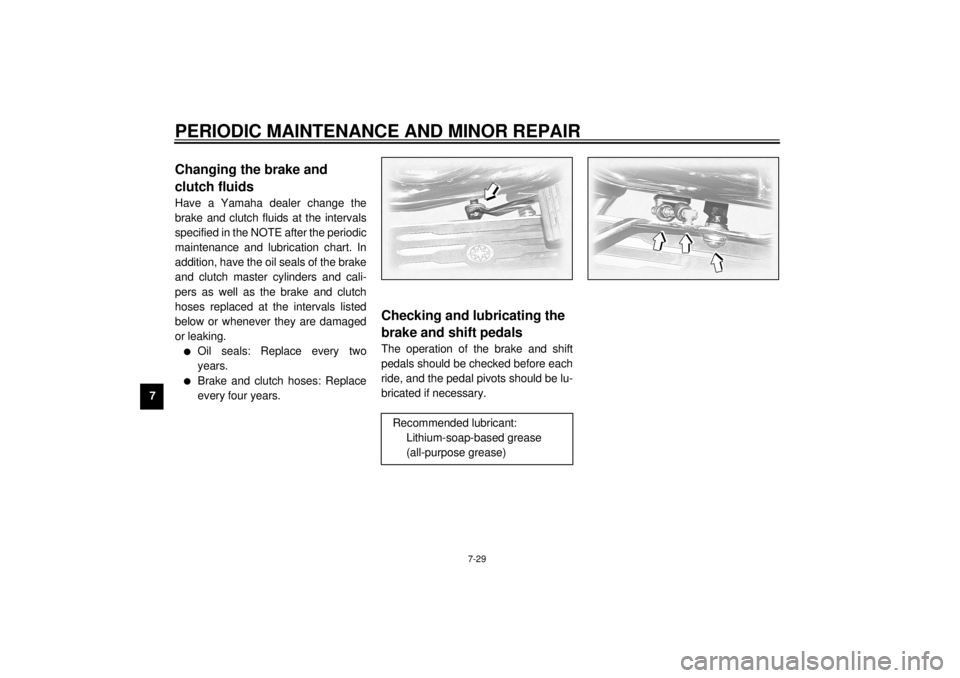
Checking and lubricating the
brake and shift pedals The operation of the brake and shift
pedals should be checked before each
ride, and the pedal pivots should be lu-
bricated if necessary.
Recommended lubricant:
Lithium-soap-based grease
(all-purpose grease)
E_5jc.book Page 29 Monday, January 22, 2001 12:12 PM
Page 120 of 132

9-1
9
EAU01038
9-SPECIFICATIONSSpecifications CS-01E
Model XVZ1300TF
Dimensions
Overall length 2,705 mm
Overall width 900 mm
Overall height 1,565 mm (except for D)
1,380 mm (for D)
Seat height 750 mm
Wheelbase 1,705 mm
Minimum ground clearance 155 mm
Minimum turning radius 3,500 mm
Basic weight (with oil and full
fuel tank)
394 kg
Engine
Engine type Liquid-cooled 4-stroke, DOHC
Cylinder arrangement V-type, 4-cylinder
Displacement 1,294 cm
3
Bore ´ stroke 79 ´ 66 mm
Compression ratio 10:1
Starting system Electric starter
Lubrication system Wet sumpEngine oil
Ty p e
Recommended engine oil
classification API Service SE, SF, SG or
higher
Quantity
Without oil filter cartridge
replacement 3.5 L
With oil filter car tridge
replacement 3.7 L
Total amount (dry engine) 4.3 L
-20 -10 0
10 20 30
40
50 ˚C
SAE 10W-30
SAE 15W-40SAE 20W-40SAE 20W-50
SAE 10W-40
CAUTION:Be sure to use motor oils that do not contain anti-friction
modifiers. Passenger car motor oils (often labeled
“ENERGY CONSERVING II”) contain anti-friction additives
which will cause clutch and/or starter clutch slippage, result-
ing in reduced component life and poor engine performance.
E_5jc.book Page 1 Monday, January 22, 2001 12:12 PM