2001 YAMAHA XVS250 warning
[x] Cancel search: warningPage 66 of 88
PERIODIC MAINTENANCE AND MINOR REPAIR
6-34
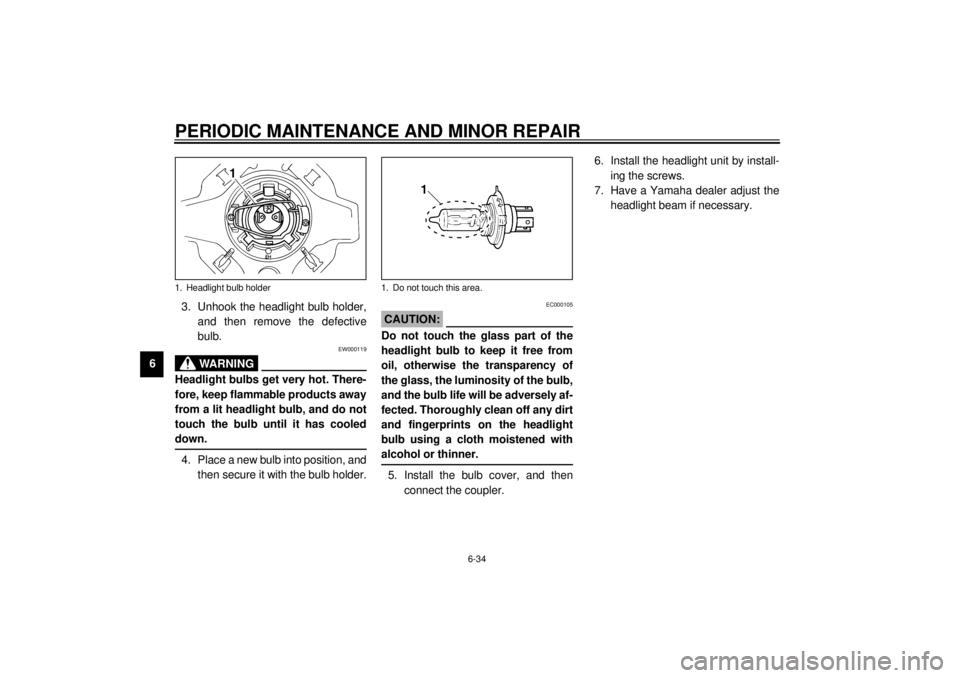
63. Unhook the headlight bulb holder,
and then remove the defective
bulb.
EW000119
WARNING
_ Headlight bulbs get very hot. There-
fore, keep flammable products away
from a lit headlight bulb, and do not
touch the bulb until it has cooled
down. _4. Place a new bulb into position, and
then secure it with the bulb holder.
EC000105
CAUTION:_ Do not touch the glass part of the
headlight bulb to keep it free from
oil, otherwise the transparency of
the glass, the luminosity of the bulb,
and the bulb life will be adversely af-
fected. Thoroughly clean off any dirt
and fingerprints on the headlight
bulb using a cloth moistened with
alcohol or thinner. _5. Install the bulb cover, and then
connect the coupler.6. Install the headlight unit by install-
ing the screws.
7. Have a Yamaha dealer adjust the
headlight beam if necessary.
1. Headlight bulb holder
1. Do not touch this area.
E_5kr.book Page 34 Tuesday, September 12, 2000 4:46 PM
Page 69 of 88
PERIODIC MAINTENANCE AND MINOR REPAIR
6-37
6 To service the rear wheel
Raise the rear wheel off the ground by
using a motorcycle stand or, if a motor-
cycle stand is not available, by placing
a jack either under each side of the
frame in front of the rear wheel or under
each side of the swingarm.
EAU03737
Front wheel To remove the front wheel
EW000122
WARNING
_ l
It is advisable to have a Yamaha
dealer service the wheel.
l
Securely support the motor-
cycle so that there is no danger
of it falling over.
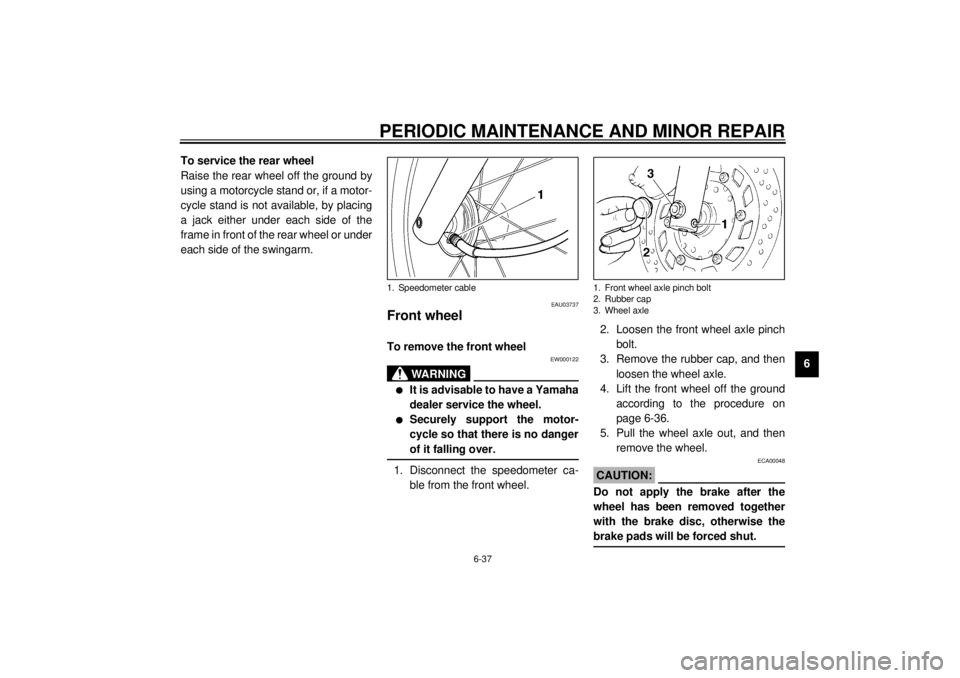
_1. Disconnect the speedometer ca-
ble from the front wheel.2. Loosen the front wheel axle pinch
bolt.
3. Remove the rubber cap, and then
loosen the wheel axle.
4. Lift the front wheel off the ground
according to the procedure on
page 6-36.
5. Pull the wheel axle out, and then
remove the wheel.
ECA00048
CAUTION:_ Do not apply the brake after the
wheel has been removed together
with the brake disc, otherwise the
brake pads will be forced shut. _
1. Speedometer cable
1. Front wheel axle pinch bolt
2. Rubber cap
3. Wheel axle
E_5kr.book Page 37 Tuesday, September 12, 2000 4:46 PM
Page 71 of 88
PERIODIC MAINTENANCE AND MINOR REPAIR
6-39
6
EAU03189
Rear wheel To remove the rear wheel
EW000122
WARNING
_ l
It is advisable to have a Yamaha
dealer service the wheel.
l
Securely support the motor-
cycle so that there is no danger
of it falling over.
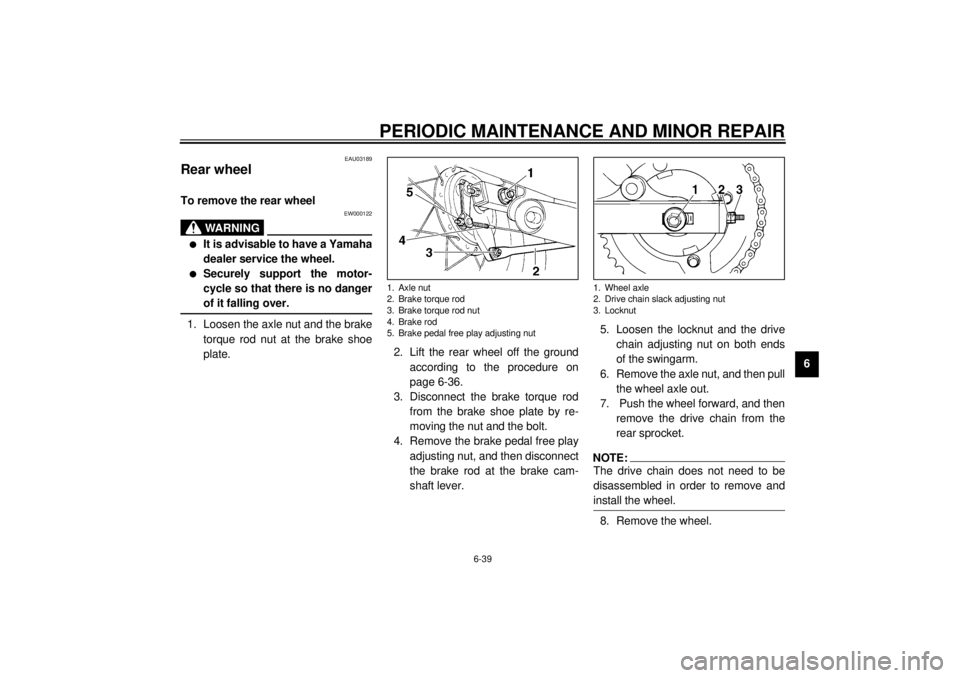
_1. Loosen the axle nut and the brake
torque rod nut at the brake shoe
plate.2. Lift the rear wheel off the ground
according to the procedure on
page 6-36.
3. Disconnect the brake torque rod
from the brake shoe plate by re-
moving the nut and the bolt.
4. Remove the brake pedal free play
adjusting nut, and then disconnect
the brake rod at the brake cam-
shaft lever.5. Loosen the locknut and the drive
chain adjusting nut on both ends
of the swingarm.
6. Remove the axle nut, and then pull
the wheel axle out.
7. Push the wheel forward, and then
remove the drive chain from the
rear sprocket.
NOTE:_ The drive chain does not need to be
disassembled in order to remove and
install the wheel. _8. Remove the wheel.
1. Axle nut
2. Brake torque rod
3. Brake torque rod nut
4. Brake rod
5. Brake pedal free play adjusting nut
1. Wheel axle
2. Drive chain slack adjusting nut
3. Locknut
E_5kr.book Page 39 Tuesday, September 12, 2000 4:46 PM
Page 72 of 88

PERIODIC MAINTENANCE AND MINOR REPAIR
6-40
6
EAU03190
To install the rear wheel
1. Insert the wheel axle from the left-
hand side, and then install the
drive chain onto the rear sprocket.
2. Install the axle nut, and then lower
the rear wheel so that it is on the
ground.
3. Install the brake rod onto the brake
camshaft lever, and then install
the brake pedal free play adjusting
nut onto the brake rod.
4. Connect the brake torque rod to
the brake shoe plate by installing
the bolt and the nut, and then tight-
en the bolt to the specified torque.
5. Adjust the drive chain slack. (See
page 6-25 for drive chain slack ad-
justment procedures.)6. Tighten the axle nut to the speci-
fied torque.
7. Adjust the brake pedal position
and free play. (See page 6-20 for
brake pedal position and free play
adjustment procedures.)
EW000103
WARNING
_ After adjusting the brake pedal free
play, check the operation of the
brake light. _
EAU01008
Troubleshooting Although Yamaha motorcycles receive
a thorough inspection before shipment
from the factory, trouble may occur dur-
ing operation. Any problem in the fuel,
compression, or ignition systems, for
example, can cause poor starting and
loss of power.
The following troubleshooting chart
represents a quick and easy procedure
for checking these vital systems your-
self. However, should your motorcycle
require any repair, take it to a Yamaha
dealer, whose skilled technicians have
the necessary tools, experience, and
know-how to service the motorcycle
properly.
Use only genuine Yamaha replace-
ment parts. Imitation parts may look
like Yamaha parts, but they are often
inferior, have a shorter service life and
can lead to expensive repair bills. Tightening torque:
Brake torque rod bolt:
23 Nm (2.3 m·kg)
Tightening torque:
Axle nut:
104 Nm (10.4 m·kg)
E_5kr.book Page 40 Tuesday, September 12, 2000 4:46 PM
Page 73 of 88

PERIODIC MAINTENANCE AND MINOR REPAIR
6-41
6
EAU01297
Troubleshooting chart
EW000125
WARNING
_ Keep away open flames and do not smoke while checking or working on the fuel system. _
Check the fuel level in
the fuel tank.1. Fuel
There is enough fuel.
There is no fuel.
Check the compression.
Supply fuel.
The engine does not start.
Check the compression.
Operate the electric starter.2. Compression
There is compression.
There is no compression.
Check the ignition.
Have a Yamaha dealer
check the vehicle.
Remove the spark plugs
and check the electrodes.3. Ignition
Wipe off with a dry cloth and correct the
spark plug gaps, or replace the spark plugs.
Have a Yamaha dealer check the vehicle.
The engine does not start.
Have a Yamaha dealer
check the vehicle.
The engine does not start.
Check the battery.
Operate the electric starter.4. Battery
The engine turns over
quickly.
The engine turns over
slowly.
The battery is good.Check the battery lead connections,
and charge the battery if necessary.
DryWet
Open the throttle halfway and operate
the electric starter.
E_5kr.book Page 41 Tuesday, September 12, 2000 4:46 PM
Page 76 of 88
MOTORCYCLE CARE AND STORAGE
7-3
7After cleaning
1. Dry the motorcycle with a chamois
or an absorbing cloth.
2. Immediately dry the drive chain
and lubricate it to prevent it from
rusting.
3. Use a chrome polish to shine
chrome, aluminum and stainless-
steel parts, including the exhaust
system. (Even the thermally in-
duced discoloring of stainless-
steel exhaust systems can be re-
moved through polishing.)
4. To prevent corrosion, it is recom-
mended to apply a corrosion pro-
tection spray on all metal,
including chrome- and nickel-plat-
ed, surfaces.
5. Use spray oil as a universal clean-
er to remove any remaining dirt.
6. Touch up minor paint damage
caused by stones, etc.
7. Wax all painted surfaces.
8. Let the motorcycle dry completely
before storing or covering it.
EWA00001
WARNING
_ l
Make sure that there is no oil or
wax on the brakes or tires. If
necessary, clean the brake
discs and brake linings with a
regular brake disc cleaner or ac-
etone, and wash the tires with
warm water and a mild deter-
gent.
l
Before operating the motor-
cycle test its braking perfor-
mance and cornering behavior.
_
ECA00013
CAUTION:_ l
Apply spray oil and wax spar-
ingly and make sure to wipe off
any excess.
l
Never apply oil or wax to any
rubber and plastic parts, but
treat them with a suitable care
product.
l
Avoid using abrasive polishing
compounds as they will wear
away the paint.
_NOTE:_ Consult a Yamaha dealer for advice on
what products to use. _
E_5kr.book Page 3 Tuesday, September 12, 2000 4:46 PM
Page 77 of 88

MOTORCYCLE CARE AND STORAGE
7-4
7
Storage Short-term
Always store your motorcycle in a cool,
dry place and, if necessary, protect it
against dust with a porous cover.
ECA00014
CAUTION:_ l
Storing the motorcycle in a
poorly ventilated room or cover-
ing it with a tarp, while it is still
wet, will allow water and humid-
ity to seep in and cause rust.
l
To prevent corrosion, avoid
damp cellars, stables (because
of the presence of ammonia)
and areas where strong chemi-
cals are stored.
_
Long-term
Before storing your motorcycle for
several months:
1. Follow all the instructions in the
“Care” section of this chapter.
2. Turn the fuel cock lever to “ON”.
3. Drain the carburetor float cham-
bers by loosening the drain bolts;
this will prevent fuel deposits from
building up. Pour the drained fuel
into the fuel tank.
4. Fill up the fuel tank and add fuel
stabilizer (if available) to prevent
the fuel tank from rusting and the
fuel from deteriorating.
5. Perform the following steps to pro-
tect the cylinders, piston rings, etc.
from corrosion.a. Remove the spark plug caps and
spark plugs.
b. Pour a teaspoonful of engine oil
into each spark plug bore.
c. Install the spark plug caps onto the
spark plugs, and then place the
spark plugs on the cylinder head
so that the electrodes are ground-
ed. (This will limit sparking during
the next step.)
d. Turn the engine over several times
with the starter. (This will coat the
cylinder walls with oil.)
e. Remove the spark plug caps from
the spark plugs, and then install
the spark plugs and the spark plug
caps.
EWA00003
WARNING
_ To prevent damage or injury from
sparking, make sure to ground the
spark plug electrodes while turning
the engine over. _
E_5kr.book Page 4 Tuesday, September 12, 2000 4:46 PM
Page 82 of 88

SPECIFICATIONS
8-4
8
Bulb voltage, wattage ´ quantity
Headlight 12 V, 60/55 W ´ 1
Tail/brake light 12 V, 5/21 W ´ 1
Turn signal light 12 V, 21 W ´ 4
Auxiliary light 12 V, 4 W ´ 1
Meter lighting 12 V, 1.7 W ´ 1
Neutral indicator light 12 V, 1.7 W ´ 1
High beam indicator light 12 V, 1.7 W ´ 1
Turn signal indicator light 12 V, 1.7 W ´ 1
Engine trouble warning light 12 V, 1.7 W ´ 1
Fuses
Main fuse 30 A
Headlight fuse 15 A
Signaling system fuse 10 A
Ignition fuse 10 A
Carburetor heater fuse 10 A
E_5kr.book Page 4 Tuesday, September 12, 2000 4:46 PM