Page 22 of 88
INSTRUMENT AND CONTROL FUNCTIONS
3-10
3
EAU00300
Adjusting the shock absorber
assemblies Each shock absorber assembly is
equipped with a spring preload adjust-
ing ring.
EC000015
CAUTION:_ Never attempt to turn an adjusting
mechanism beyond the maximum
or minimum settings. _
EW000040
WARNING
_ Always adjust both shock absorber
assemblies equally, otherwise poor
handling and loss of stability may
result. _
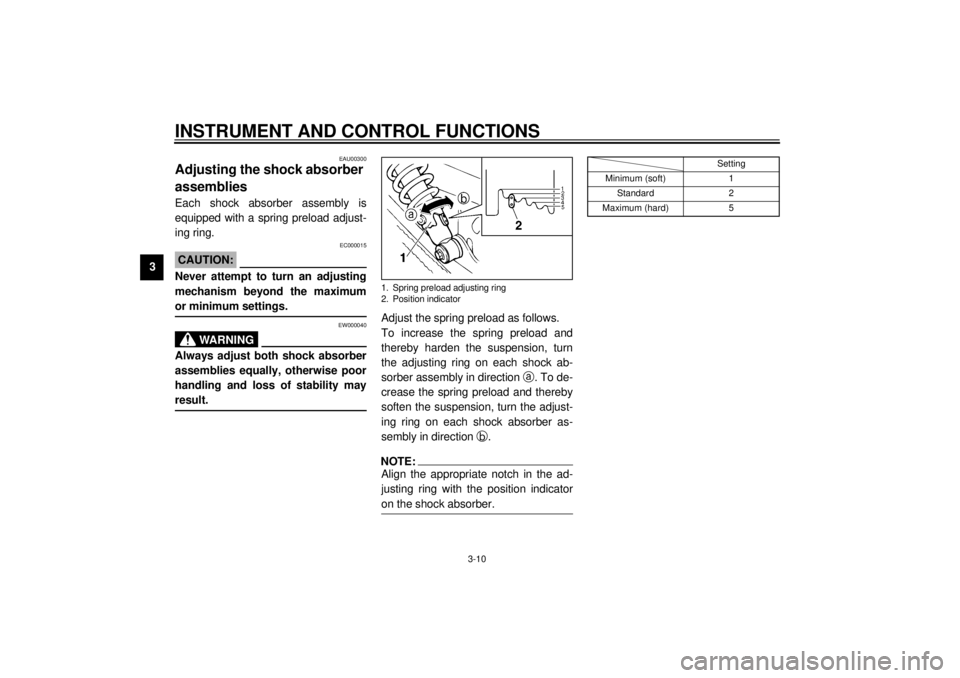
Adjust the spring preload as follows.
To increase the spring preload and
thereby harden the suspension, turn
the adjusting ring on each shock ab-
sorber assembly in direction
a. To de-
crease the spring preload and thereby
soften the suspension, turn the adjust-
ing ring on each shock absorber as-
sembly in direction
b.NOTE:_ Align the appropriate notch in the ad-
justing ring with the position indicator
on the shock absorber. _
CI-10E
1. Spring preload adjusting ring
2. Position indicator
Setting
Minimum (soft) 1
Standard 2
Maximum (hard) 5
E_5kr.book Page 10 Tuesday, September 12, 2000 4:46 PM
Page 23 of 88

INSTRUMENT AND CONTROL FUNCTIONS
3-11
3
EAU00330
Sidestand The sidestand is located on the left side
of the frame. Raise the sidestand or
lower it with your foot while holding the
motorcycle upright.NOTE:_ The built-in sidestand switch is part of
the ignition circuit cut-off system, which
cuts the ignition in certain situations.
(See further down for an explanation of
the ignition circuit cut-off system.) _
EW000044
WARNING
_ The motorcycle must not be ridden
with the sidestand down, or if the
sidestand cannot be properly
moved up (or does not stay up), oth-
erwise the sidestand could contact
the ground and distract the opera-
tor, resulting in a possible loss of
control. Yamaha’s ignition circuit
cut-off system has been designed to
assist the operator in fulfilling the
responsibility of raising the side-
stand before starting off. Therefore,
check this system regularly as de-
scribed below and have a Yamaha
dealer repair it if it does not function
properly. _
EAU03720
Ignition circuit cut-off system The ignition circuit cut-off system (com-
prising the sidestand switch, clutch
switch and neutral switch) has the fol-
lowing functions.l
It prevents starting when the trans-
mission is in gear and the side-
stand is up, but the clutch lever is
not pulled.
l
It prevents starting when the trans-
mission is in gear and the clutch
lever is pulled, but the sidestand is
still down.
l
It cuts the running engine when
the transmission is in gear and the
sidestand is moved down.
Periodically check the operation of the
ignition circuit cut-off system according
to the following procedure.
EW000045
WARNING
_ If a malfunction is noted, have a
Yamaha dealer check the system
before riding. _
E_5kr.book Page 11 Tuesday, September 12, 2000 4:46 PM
Page 27 of 88
PRE-OPERATION CHECKS
4-3
4
NOTE:_ Pre-operation checks should be made each time the motorcycle is used. Such an inspection can be accomplished in a very
short time; and the added safety it assures is more than worth the time involved. _
EWA00033
WARNING
_ If any item in the Pre-operation check list is not working properly, have it inspected and repaired before operating
the motorcycle. _E_5kr.book Page 3 Tuesday, September 12, 2000 4:46 PM
Page 28 of 88

5-1
5
EAU00372
5-OPERATION AND IMPORTANT RIDING POINTS
EAU00373
WARNING
_ l
Become thoroughly familiar
with all operating controls and
their functions before riding.
Consult a Yamaha dealer re-
garding any control or function
that you do not thoroughly
understand.
l
Never start the engine or operate
it in a closed area for any length
of time. Exhaust fumes are poi-
sonous, and inhaling them can
cause loss of consciousness
and death within a short time. Al-
ways make sure that there is ad-
equate ventilation.
l
Before starting out, make sure
that the sidestand is up. If the
sidestand is not raised com-
pletely, it could contact the
ground and distract the opera-
tor, resulting in a possible loss
of control.
_
EAU03515*
Starting the engine In order for the ignition circuit cut-off
system to enable starting, one of the
following conditions must be met:l
The transmission is in the neutral
position.
l
The transmission is in gear with
the clutch lever pulled and the
sidestand up.
EW000054
WARNING
_ l
Before starting the engine,
check the function of the igni-
tion circuit cut-off system ac-
cording to the procedure
described on page 3-12.
l
Never ride with the sidestand
down.
_
1. Turn the fuel cock lever to “ON”.
2. Turn the key to “ON” and make
sure that the engine stop switch is
set to “ ”.
3. Shift the transmission into the neu-
tral position.NOTE:_ When the transmission is in the neutral
position, the neutral indicator light
should be on, otherwise have a
Yamaha dealer check the electrical
circuit. _1. Arrow mark positioned over “ON”
E_5kr.book Page 1 Tuesday, September 12, 2000 4:46 PM
Page 32 of 88
OPERATION AND IMPORTANT RIDING POINTS
5-5
5
EAU00457
Parking When parking, stop the engine, re-
move the key from the main switch,
and then turn the fuel cock lever to
“OFF”.
EW000058
WARNING
_ l
Since the engine and exhaust
system can become very hot,
park in a place where pedestri-
ans or children are not likely to
touch them.
l
Do not park on a slope or on
soft ground, otherwise the
motorcycle may overturn.
_E_5kr.book Page 5 Tuesday, September 12, 2000 4:46 PM
Page 33 of 88

6-1
6
EAU00462
6-PERIODIC MAINTENANCE AND MINOR REPAIR
EAU00464
Safety is an obligation of the owner.
Periodic inspection, adjustment and lu-
brication will keep your vehicle in the
safest and most efficient condition pos-
sible. The most important points of in-
spection, adjustment, and lubrication
are explained on the following pages.
The intervals given in the periodic main-
tenance and lubrication chart should be
simply considered as a general guide
under normal riding conditions. Howev-
er, DEPENDING ON THE WEATHER,
TERRAIN, GEOGRAPHICAL LOCA-
TION, AND INDIVIDUAL USE, THE
MAINTENANCE INTERVALS MAY
NEED TO BE SHORTENED.
EW000060
WARNING
_ If you are not familiar with motor-
cycle maintenance work, have a
Yamaha dealer do it for you. _
EAU01175
Owner’s tool kit The owner’s tool kit is located behind
panel A. (See page 6-5 for panel re-
moval and installation procedures.)
The service information included in this
manual and the tools provided in the
owner’s tool kit are intended to assist
you in the performance of preventive
maintenance and minor repairs. How-
ever, additional tools such as a torque
wrench may be necessary to perform
certain maintenance work correctly.
NOTE:_ If you do not have the tools or experi-
ence required for a particular job, have
a Yamaha dealer perform it for you. _
EW000063
WARNING
_ Modifications not approved by
Yamaha may cause loss of perfor-
mance and render the vehicle un-
safe for use. Consult a Yamaha
dealer before attempting any
changes. _
1. Owner’s tool kit
E_5kr.book Page 1 Tuesday, September 12, 2000 4:46 PM
Page 48 of 88

PERIODIC MAINTENANCE AND MINOR REPAIR
6-16
6
EAU00637
Adjusting the valve clearance The valve clearance changes with use,
resulting in improper air-fuel mixture
and/or engine noise. To prevent this
from occurring, the valve clearance
must be adjusted by a Yamaha dealer
at the intervals specified in the periodic
maintenance and lubrication chart.
EAU03362
Tires To maximize the performance, durabil-
ity, and safe operation of your motor-
cycle, note the following points
regarding the specified tires.
Tire air pressure
The tire air pressure should be
checked and, if necessary, adjusted
before each ride.
EW000082
WARNING
_ l
The tire air pressure must be
checked and adjusted on cold
tires (i.e., when the temperature
of the tires equals the ambient
temperature).
l
The tire air pressure must be
adjusted in accordance with the
riding speed and with the total
weight of rider, passenger, car-
go, and accessories approved
for this model.
_
CE-01E
CE-07E
Tire air pressure
(measured on cold tires)
Load* Front Rear
Up to 90 kg175 kPa
(1.75 kg/cm
2,
1.75 bar)200 kPa
(2.00 kg/cm
2,
2.00 bar)
90 kg–maximum225 kPa
(2.25 kg/cm
2,
2.25 bar)225 kPa
(2.25 kg/cm
2,
2.25 bar)
Maximum load* 180 kg
* Total weight of rider, passenger, cargo and
accessories
E_5kr.book Page 16 Tuesday, September 12, 2000 4:46 PM
Page 49 of 88
PERIODIC MAINTENANCE AND MINOR REPAIR
6-17
6
EWA00012
WARNING
_ Because loading has an enormous
impact on the handling, braking,
performance and safety characteris-
tics of your motorcycle, you should
keep the following precautions in
mind. l
NEVER OVERLOAD THE
MOTORCYCLE! Operation of an
overloaded motorcycle may re-
sult in tire damage, loss of con-
trol, or severe injury. Make sure
that the total weight of rider,
passenger, cargo, and accesso-
ries does not exceed the speci-
fied maximum load for the
vehicle.
l
Do not carry along loosely
packed items, which can shift
during a ride.
l
Securely pack the heaviest
items close to the center of the
motorcycle and distribute the
weight evenly on both sides.
l
Adjust the suspension and tire
air pressure with regard to the
load.
l
Check the tire condition and air
pressure before each ride.
_
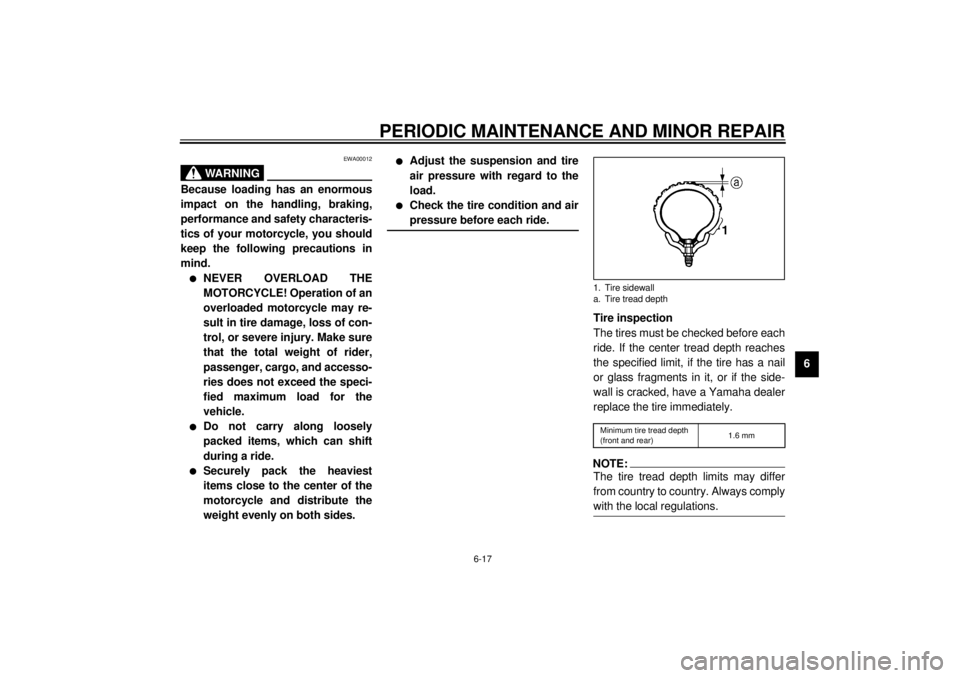
Tire inspection
The tires must be checked before each
ride. If the center tread depth reaches
the specified limit, if the tire has a nail
or glass fragments in it, or if the side-
wall is cracked, have a Yamaha dealer
replace the tire immediately.CE-08ENOTE:_ The tire tread depth limits may differ
from country to country. Always comply
with the local regulations. _1. Tire sidewall
a. Tire tread depthMinimum tire tread depth
(front and rear)1.6 mm
E_5kr.book Page 17 Tuesday, September 12, 2000 4:46 PM