2001 YAMAHA WR 250F lock
[x] Cancel search: lockPage 596 of 686

5 - 65
CHASREAR SHOCK ABSORBER
2. Tighten:
lAdjuster 1
3. Adjust:
lSpring length (installed) a
* For EUROPE
** For AUS, NZ and ZA
NOTE:
The length of the spring (installed) changes
1.5 mm (0.06 in) per turn of the adjuster.
CAUTION:
Never attempt to turn the adjuster beyond
the maximum or minimum setting.
4. Tighten:
lLocknut 1
Rear shock absorber
1. Install:
lDust seal 1
lO-ring 2
lCollar 3
NOTE:
lApply the molybdenum disulfide grease on
the bearing.
lApply the lithium soap base grease on the
dust seals, O-rings and collars.
Spring length (installed) a:
Standard
lengthExtent of
adjustment
240.5 mm (9.47 in)
* 247 mm (9.72 in)
**243.5 mm (9.59 in)240.5 ~ 258.5 mm
(9.47 ~ 10.18 in)
Page 613 of 686
–+ELEC
SYSTEME D’ALLUMAGE
ZÜNDANLAGE
IMPIANTO DI ACCENSIONE
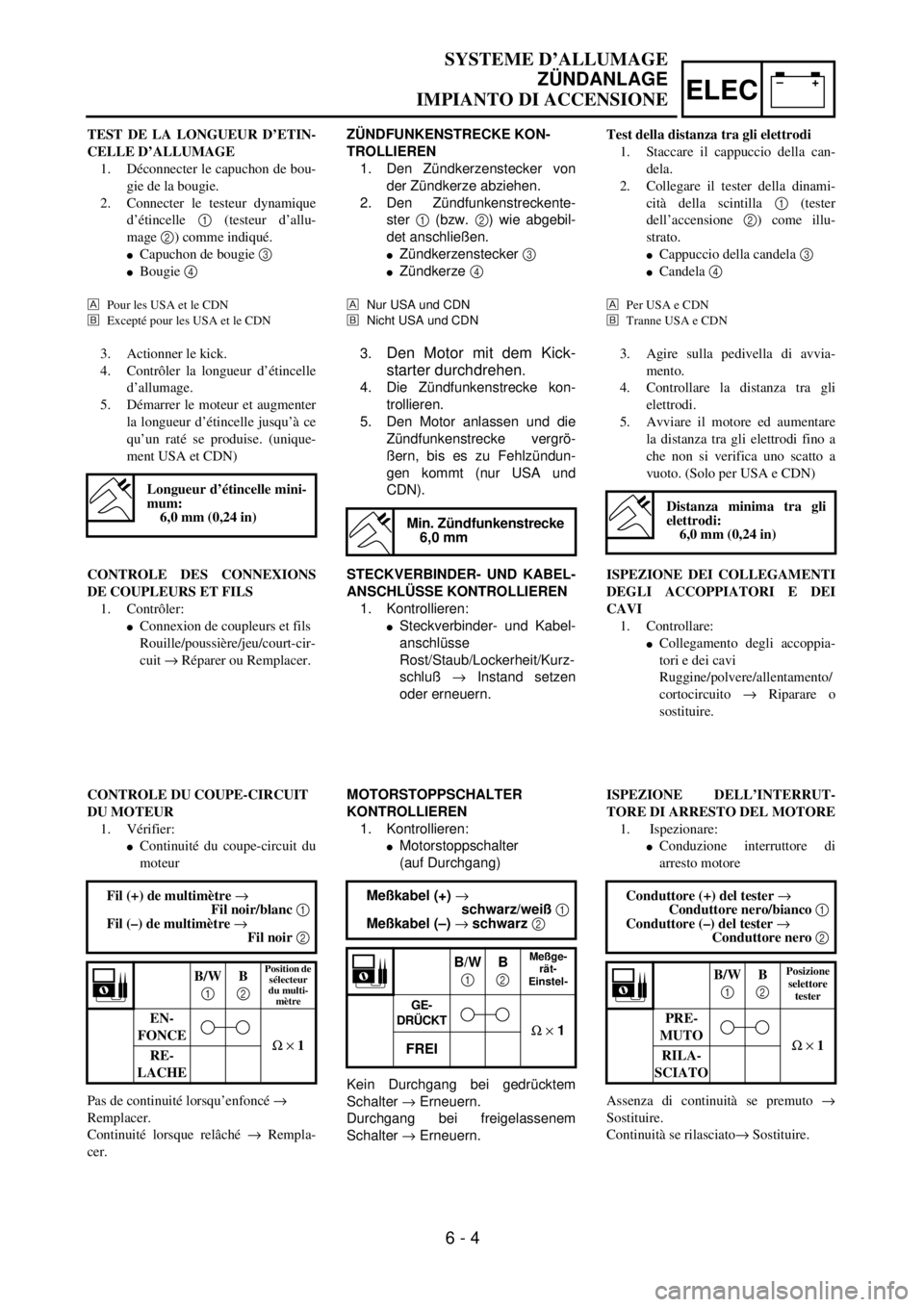
ZÜNDFUNKENSTRECKE KON-
TROLLIEREN
1. Den Zündkerzenstecker von
der Zündkerze abziehen.
2. Den Zündfunkenstreckente-
ster 1 (bzw. 2) wie abgebil-
det anschließen.
lZündkerzenstecker 3
lZündkerze 4
Nur USA und CDN
õNicht USA und CDN
3.Den Motor mit dem Kick-
starter durchdrehen
.
4. Die Zündfunkenstrecke kon-
trollieren.
5. Den Motor anlassen und die
Zündfunkenstrecke vergrö-
ßern, bis es zu Fehlzündun-
gen kommt (nur USA und
CDN).
Min. Zündfunkenstrecke
6,0 mm
STECKVERBINDER- UND KABEL-
ANSCHLÜSSE KONTROLLIEREN
1. Kontrollieren:
lSteckverbinder- und Kabel-
anschlüsse
Rost/Staub/Lockerheit/Kurz-
schluß ® Instand setzen
oder erneuern.
MOTORSTOPPSCHALTER
KONTROLLIEREN
1. Kontrollieren:
lMotorstoppschalter
(auf Durchgang)
Kein Durchgang bei gedrücktem
Schalter ® Erneuern.
Durchgang bei freigelassenem
Schalter ® Erneuern. Meßkabel (+) ®
schwarz/weiß 1
Meßkabel (–) ® schwarz 2
B/W
1 B
2 Meßge-
rät-
Einstel-
GE-
DRÜCKT
W ´ 1
FREI
TEST DE LA LONGUEUR D’ETIN-
CELLE D’ALLUMAGE
1. Déconnecter le capuchon de bou-
gie de la bougie.
2. Connecter le testeur dynamique
d’étincelle 1 (testeur d’allu-
mage 2) comme indiqué.
lCapuchon de bougie 3
lBougie 4
Pour les USA et le CDN
õExcepté pour les USA et le CDN
3. Actionner le kick.
4. Contrôler la longueur d’étincelle
d’allumage.
5. Démarrer le moteur et augmenter
la longueur d’étincelle jusqu’à ce
qu’un raté se produise. (unique-
ment USA et CDN)
Longueur d’étincelle mini-
mum:
6,0 mm (0,24 in)
CONTROLE DES CONNEXIONS
DE COUPLEURS ET FILS
1. Contrôler:
lConnexion de coupleurs et fils
Rouille/poussière/jeu/court-cir-
cuit ® Réparer ou Remplacer.
CONTROLE DU COUPE-CIRCUIT
DU MOTEUR
1. Vérifier:
lContinuité du coupe-circuit du
moteur
Pas de continuité lorsqu’enfoncé ®
Remplacer.
Continuité lorsque relâché ® Rempla-
cer.Fil (+) de multimètre ®
Fil noir/blanc 1
Fil (–) de multimètre ®
Fil noir 2
B/W
1B
2Position de
sélecteur
du multi-
mètre
EN-
FONCE
W ´ 1
RE-
LACHE
6 - 4
Test della distanza tra gli elettrodi
1. Staccare il cappuccio della can-
dela.
2. Collegare il tester della dinami-
cità della scintilla 1 (tester
dell’accensione 2) come illu-
strato.
lCappuccio della candela 3
lCandela 4
Per USA e CDN
õTranne USA e CDN
3. Agire sulla pedivella di avvia-
mento.
4. Controllare la distanza tra gli
elettrodi.
5. Avviare il motore ed aumentare
la distanza tra gli elettrodi fino a
che non si verifica uno scatto a
vuoto. (Solo per USA e CDN)
Distanza minima tra gli
elettrodi:
6,0 mm (0,24 in)
ISPEZIONE DEI COLLEGAMENTI
DEGLI ACCOPPIATORI E DEI
CAVI
1. Controllare:
lCollegamento degli accoppia-
tori e dei cavi
Ruggine/polvere/allentamento/
cortocircuito ® Riparare o
sostituire.
ISPEZIONE DELL’INTERRUT-
TORE DI ARRESTO DEL MOTORE
1. Ispezionare:
lConduzione interruttore di
arresto motore
Assenza di continuità se premuto ®
Sostituire.
Continuità se rilasciato® Sostituire. Conduttore (+) del tester ®
Conduttore nero/bianco 1
Conduttore (–) del tester ®
Conduttore nero 2
B/W
1B
2Posizione
selettore
tester
PRE-
MUTO
W ´ 1
RILA-
SCIATO
Page 623 of 686

–+ELEC
INSPEKTION DER STECKVERBIN-
DUNGEN UND KABELANSCHLÜS-
SE
1. Prüfen:
lSteckverbindungen und Ka-
belanschlüsse
Rost/Staub/Lockerung/Kurz-
schluß ® Reparieren oder
austauschen.
INSPEKTION DER TPS-SPULE
1. Prüfen:
lWiderstand der Drosselklap-
pen-Positionssensor-Spule
Außerhalb des Sollwerts ®
Austauschen.
2. Lockerung:
lDrosselklappen-Anschlag-
schraube 1
HINWEIS:
Die Drosselklappen-Anschlag-
schraube herausdrehen, bis die
Drosselklappenwelle vollständig ge-
schlossen ist.Prüfgerätkabel (+) ®
Blaues Kabel 1
Prüfgerätkabel (–) ®
Schwarzes Kabel 2
Widerstand der
Drosselklappen-Positionssen-
sor-Spule
Prüfgeräte-
instellung
4–6 kW
bei 20 ˚CkW ´ 1
3. Prüfen:
lRegelwiderstand der Dros-
selklappen-Positionssensor-
Spule
Prüfen, ob sich der Wider-
stand erhöht, während der
geschlossene Gasdrehgriff
ganz aufgedreht wird.
Außerhalb des Sollwerts ®
Austauschen.
Prüfgerätkabel (+) ®
Gelbes Kabel 1
Prüfgerätkabel (–) ®
Schwarzes Kabel 2
Drosselklappen-
Positionssensor-
SpulenwiderstandPrüfgerät-
einstel-
lung
Ganz
geschlo
ssenGanz
offen
kW ´ 1
0–3 kW
bei
20 ˚C4–6 kW
bei
20 ˚C
CONTROLE DES CONNEXIONS
DES COUPLEURS ET DES FILS
1. Vérifier:
lConnexion coupleurs et fils
Rouille/poussière/desserre-
ment/court-circuit ® Réparer
ou remplacer.
CONTROLE DE LA BOBINE DE
CAPTEUR DE PAPILLON DES
GAZ
1. Contrôler:
lRésistance de la bobine du cap-
teur de papillon des gaz
Hors spécifications ® Rempla-
cer.
2. Serrer:
lVis d’arrêt d’accélérateur 1
N.B.:
Tourner la vis d’arrêt d’accélérateur
jusqu’à ce que l’axe de l’accélérateur
soit en position de fermeture complète.Fil (+) de multinètre ® Fil bleu 1
Fil (–) de multinètre ® Fil noir 2
Fiche rapide de fil de
capteur de position
de papillon des gaz Position du
sélecteur de
l’appareil de
contrôle
4 à 6 kW à
20 ˚C (68 ˚F)kW ´ 1
3. Contrôler:
lRésistance variable de la
bobine du capteur de papillon
des gaz
S’assurer que la résistance aug-
mente lorsque la poignée des
gaz est tournée de la position
de fermeture complète à la
position d’ouverture complète.
Hors spécifications ® Rempla-
cer.
Fil (+) de multinètre ®
Fil jaune 1
Fil (–) de multinètre ®
Fil noir 2
Résistance variable de
la bobine du capteur
de papillon des gazPosition du
sélecteur de
multinètre
Ferme-
ture
complèteOuver-
ture
complète
kW ´ 1
0 à 3 kW
à 20 ˚C
(68 ˚F)4 à 6 kW
à 20 ˚C
(68 ˚F)
ISPEZIONE DEI COLLEGAMENTI
DEGLI ACCOPPIATORI E DEI
CAVI
1. Controllare:
lCollegamento degli accoppia-
tori e dei cavi
Ruggine/polvere/allentamento/
cortocircuito ® Riparare o
sostituire.
ISPEZIONE BOBINA SENSORE
DELLA POSIZIONE DELLA VAL-
VOLA A FARFALLA
1. Ispezionare:
lResistenza bobina sensore di
posizione della valvola a far-
falla
Fuori specifica ® Regolare.
2. Allentare:
lVite di arresto della valvola a
farfalla 1
NOTA:
Svitare la vite di arresto della valvola a
farfalla finché l’albero della valvola a
farfalla non si trova in posizione di com-
pleta chiusura.
3. Ispezionare:
lResistenza variabile bobina
sensore di posizione della val-
vola a farfalla
Controllare che la resistenza
aumenti quando la manopola
dell’acceleratore si sposta dalla
posizione di chiusura completa
alla posizione di apertura com-
pleta.
Fuori specifica ® Regolare. Conduttore (+) del tester ®
Conduttore blu 1
Conduttore (–) del tester ®
Conduttore nero 2
Resistenza bobina
sensore di posizione
della valvola a far-
fallaPosizione
selettore
tester
4 ~ 6 kW a
20 ˚C (68 ˚F)kW ´ 1
Conduttore (+) del tester ®
Conduttore giallo 1
Conduttore (–) del tester ®
Conduttore nero 2
Resistenza variabile
bobina sensore di
posizione della val-
vola a farfallaPosizione
selettore
tester
Comple-
tamente
chiusoComple-
tamente
aperto
kW ´ 1
Zero ~
3 kW a
20 ˚C
(68 ˚F)4 ~ 6 kW a
20 ˚C
(68 ˚F)
CIRCUIT DU CAPTEUR DE PAPILLON DES GAZ
DROSSELKLAPPEN-POSITIONSSENSOR
SISTEMA SENSORE DELLA POSIZIONE DELLA VALVOLA A FARFALLA
6 - 8
Page 660 of 686

7 - 13
TUNSETTING
EC722011
Front fork setting
The front fork setting should be made depend-
ing on the rider’s feeling of an actual run and
the circuit conditions.
The front fork setting includes the following
three factors:
1. Setting of air spring characteristics
lChange the fork oil level.
2. Setting of spring preload
lChange the spring.
lInstall the adjustment washer.
3. Setting of damping force
lChange the compression damping.
lChange the rebound damping.
The spring acts on the load and the
damping force acts on the cushion
travel speed.
EC723001
Change in level and characteristics of fork
oil
Damping characteristic near the final stroke can
be changed by changing the fork oil amount.
CAUTION:
Adjust the oil level in 5 mm (0.2 in) incre-
ments or decrements. Too low oil level
causes the front fork to produce a noise at
full rebound or the rider to feel some pres-
sure on his hands or body. Alternatively,
too high oil level will develop unexpectedly
early oil lock with the consequent shorter
front fork travel and deteriorated perfor-
mance an characteristics. Therefore, adjust
the front fork within the specified range.
* For EUROPE
Air spring characteristics in relation to oil level
change
õLoad
‚Stroke
1Max. oil level
2Standard oil level
3Min. oil level
Standard oil level:
140 mm (5.51 in)
* 130 mm (5.12 in)
Extent of adjustment:
80 ~ 150 mm (3.15 ~ 5.91 in)
From top of outer tube with
inner tube and damper rod fully
compressed without spring.
Page 668 of 686

7 - 17
TUN
EC72B000
Rear suspension setting
The rear suspension setting should be made
depending on the rider’s feeling of an actual
run and the circuit conditions.
The rear suspension setting includes the fol-
lowing two factors:
1. Setting of spring preload
lChange the set length of the spring.
lChange the spring.
2. Setting of damping force
lChange the rebound damping.
lChange the compression damping.
EC72C001
Choosing set length
1. Place a stand or block under the engine
to put the rear wheel above the floor, and
measure the length a between the rear
wheel axle center and the rear fender
holding bolt.
2. Remove the stand or block from the
engine and with a rider astride the seat,
measure the sunken length b between
the rear wheel axle center and the rear
fender holding bolt.
3. Loosen the locknut 1 and make adjust-
ment by turning the spring adjuster 2 to
achieve the standard figure from the sub-
traction of the length b from the length
a.
Standard figure:
90 ~ 100 mm (3.5 ~ 3.9 in)
SETTING
Page 676 of 686

7 - 21
TUNSETTING
EC72H002
Suspension setting
lFront fork
NOTE:
lIf any of the following symptoms is experienced with the standard position as the base, make
resetting by reference to the adjustment procedure given in the same chart.
lBefore any change, set the rear shock absorber sunken length to the standard figure 90 ~
100 mm (3.5 ~ 3.9 in).
SymptomSection
Check Adjust
JumpLarge
gapMedium
gapSmall
gap
Stiff over entire range
CCC
Compression damping
Oil level (oil amount)
SpringTurn adjuster counterclockwise (about 2 clicks) to
decrease damping.
Decrease oil level by about 5 ~ 10 mm (0.2 ~ 0.4 in).
Replace with soft spring.
Unsmooth movement
over entire range
CCCC
Outer tube
Inner tube
Under bracket tightening
torqueCheck for any bends, dents, and other noticeable
scars, etc. If any, replace affected parts.
Retighten to specified torque.
Poor initial
movement
C
Rebound damping
Oil sealTurn adjuster counterclockwise (about 2 clicks) to
decrease damping.
Apply grease in oil seal wall.
Soft over entire range,
bottoming out
CC
Compression damping
Oil level (oil amount)
SpringTurn adjuster clockwise (about 2 clicks) to increase
damping.
Increase oil level by about 5 ~ 10 mm (0.2 ~ 0.4 in).
Replace with stiff spring.
Stiff toward stroke end
COil level (oil amount) Decrease oil level by about 5 mm (0.2 in).
Soft toward stroke end,
bottoming out
COil level (oil amount) Increase oil level by about 5 mm (0.2 in).
Stiff initial movement
CCCCCompression dampingTurn adjuster counterclockwise (about 2 clicks) to
decrease damping.
Low front, tending to
lower front posture
CC
Compression damping
Rebound damping
Balance with rear end
Oil level (oil amount)Turn adjuster clockwise (about 2 clicks) to increase
damping.
Turn adjuster counterclockwise (about 2 clicks) to
decrease damping.
Set sunken length for 95 ~ 100 mm (3.7 ~ 3.9 in) when
one passenger is astride seat (lower rear posture).
Increase oil level by about 5 mm (0.2 in).
“Obtrusive” front, tend-
ing to upper front pos-
ture
CC
Compression damping
Balance with rear end
Spring
Oil lever (oil amount)Turn adjuster counterclockwise (about 2 clicks) to
decrease damping.
Set sunken length for 90 ~ 95 mm (3.5 ~ 3.7 in) when
one passenger is astride seat (upper rear posture).
Replace with soft spring.
Decrease oil level by about 5 ~ 10 mm (0.2 ~ 0.4 in).
Page 677 of 686

7 - 22
TUNSETTING
lRear shock absorber
NOTE:
lIf any of the following symptoms is experienced with the standard position as the base, make
resetting by reference to the adjustment procedure given in the same chart.
lAdjust the rebound damping in 2-click increments or decrements.
lAdjust the low compression damping in 1-click increments or decrements.
lAdjust the high compression damping in 1/6 turn increments or decrements.
SymptomSection
Check Adjust
JumpLarge
gapMedium
gapSmall
gap
Stiff, tending to sink
CC
Rebound damping
Spring set lengthTurn adjuster counterclockwise (about 2 clicks) to
decrease damping.
Set sunken length for 90 ~ 100 mm (3.5 ~ 3.9 in) when
one passenger is astride seat.
Spongy and unstable
CC
Rebound damping
Low compression damping
SpringTurn adjuster clockwise (about 2 clicks) to increase
damping.
Turn adjuster clockwise (about 1 click) to increase
damping.
Replace with stiff spring.
Heavy and dragging
CC
Rebound damping
SpringTurn adjuster counterclockwise (about 2 clicks) to
decrease damping.
Replace with soft spring.
Poor road gripping
C
Rebound damping
Low compression damping
High compression damp-
ing
Spring set length
SpringTurn adjuster counterclockwise (about 2 clicks) to
decrease damping.
Turn adjuster clockwise (about 1 clicks) to increase
damping.
Turn adjuster clockwise (about 1/6 clicks) to increase
damping.
Set sunken length for 90 ~ 100 mm (3.5 ~ 3.9 in) when
one passenger is astride seat.
Replace with soft spring.
Bottoming out
CC
High compression damp-
ing
Spring set length
SpringTurn adjuster clockwise (about 1/6 turn) to increase
damping.
Set sunken length for 90 ~ 100 mm (3.5 ~ 3.9 in) when
one passenger in astride seat.
Replace with stiff spring.
Bouncing
CC
Rebound damping
SpringTurn adjuster clockwise (about 2 clicks) to increase
damping.
Replace with soft spring.
Stiff travel
CC
High compression damp-
ing
Spring set length
SpringTurn adjuster counterclockwise (about 1/6 turn) to
decrease damping.
Set sunken length for 90 ~ 100 mm (3.5 ~ 3.9 in) when
one passenger is astride seat.
Replace with soft spring.