2001 YAMAHA VMAX battery
[x] Cancel search: batteryPage 78 of 110

PERIODIC MAINTENANCE AND MINOR REPAIR
6-35
6
EW000116
WARNING
@ l
Electrolyte is poisonous and
dangerous since it contains sul-
furic acid, which causes severe
burns. Avoid any contact with
skin, eyes or clothing and al-
ways shield your eyes when
working near batteries. In case
of contact, administer the fol-
lowing FIRST AID.
• EXTERNAL: Flush with plenty
of water.
• INTERNAL: Drink large quan-
tities of water or milk and im-
mediately call a physician.
• EYES: Flush with water for
15 minutes and seek prompt
medical attention.
l
Batteries produce explosive hy-
drogen gas. Therefore, keep
sparks, flames, cigarettes, etc.,
away from the battery and pro-
vide sufficient ventilation when
charging it in an enclosed
space.
l
KEEP THIS AND ALL BATTER-
IES OUT OF THE REACH OF
CHILDREN.
@
EC000100
CAUTION:@ Use only distilled water, as tap water
contains minerals that are harmful
to the battery. @
9. Check and, if necessary, correct
the breather hose routing.
10. Install the ignition coil assemblies
by installing the bolts.1. Battery
2. Battery breather hose
3. Pass through the cable guide.
E_3lr.book Page 35 Wednesday, November 22, 2000 4:10 PM
Page 79 of 110

PERIODIC MAINTENANCE AND MINOR REPAIR
6-36
6 11. Connect and tighten the positive
battery lead and the starter motor
lead to the starter motor relay.
EW000118
WARNING
@ Pass the positive battery lead and
starter lead through the hole in the
ignition coil bracket as shown. Im-
proper routing of these leads could
bring about a short circuit, causing
the engine and lights to fail and pos-
sibly resulting in an accident. @12. Connect and tighten the negative
battery lead to the battery.
13. Install the rider seat.To store the battery
1. If the motorcycle will not be used
for more than one month, remove
the battery, fully charge it, and
then place it in a cool, dry place.
2. If the battery will be stored for
more than two months, check the
specific gravity of the electrolyte at
least once a month and fully
charge the battery whenever nec-
essary.
3. Fully charge the battery before in-
stallation.
4. After installation, make sure that
the battery leads are properly con-
nected to the battery terminals and
that the breather hose is properly
routed, in good condition, and not
obstructed.
EC000099
CAUTION:@ If the breather hose is positioned in
such a way that the frame is ex-
posed to electrolyte or gas expelled
from the battery, the frame could
suffer structural and external dam-
ages. @
1. Battery positive lead (red)
2. Starter motor lead (black)
E_3lr.book Page 36 Wednesday, November 22, 2000 4:10 PM
Page 88 of 110
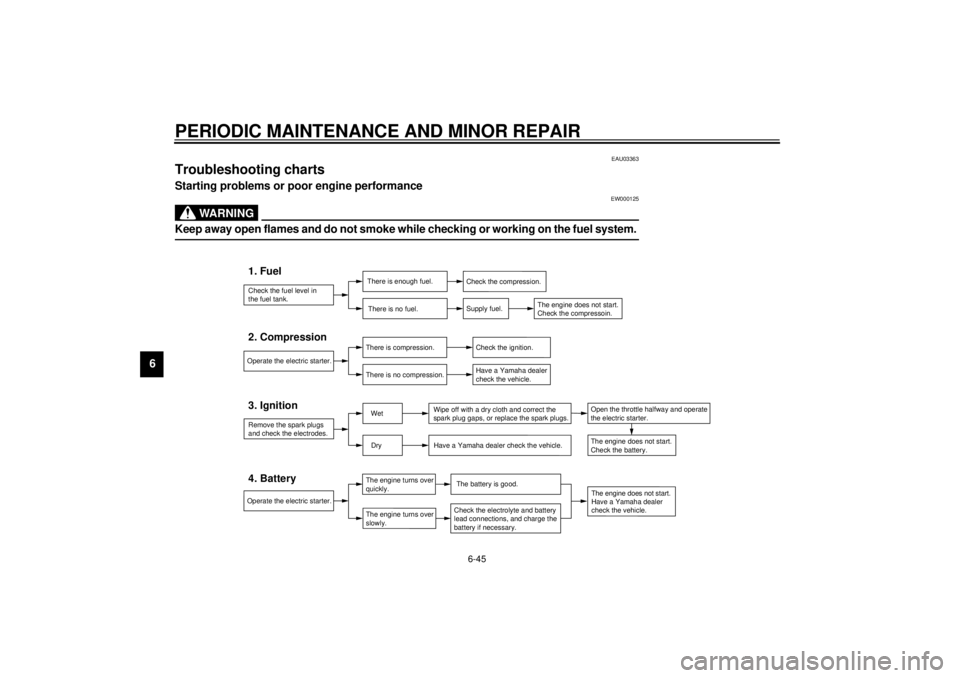
PERIODIC MAINTENANCE AND MINOR REPAIR
6-45
6
EAU03363
Troubleshooting charts Starting problems or poor engine performance
EW000125
WARNING
@ Keep away open flames and do not smoke while checking or working on the fuel system. @
Check the fuel level in
the fuel tank.1. Fuel
There is enough fuel.
There is no fuel.
Check the compression.
Supply fuel.
Operate the electric starter.2. Compression
There is compression.
There is no compression.
Check the ignition.
Have a Yamaha dealer
check the vehicle.
Remove the spark plugs
and check the electrodes.3. Ignition
Wet
Dry
Wipe off with a dry cloth and correct the
spark plug gaps, or replace the spark plugs.
Have a Yamaha dealer check the vehicle.The engine does not start.
Check the battery.
Open the throttle halfway and operate
the electric starter.
Operate the electric starter.4. Battery
The engine turns over
quickly.
The engine turns over
slowly.The battery is good.
Check the electrolyte and battery
lead connections, and charge the
battery if necessary.The engine does not start.
Have a Yamaha dealer
check the vehicle.
The engine does not start.
Check the compressoin.
E_3lr.book Page 45 Wednesday, November 22, 2000 4:10 PM
Page 96 of 110

MOTORCYCLE CARE AND STORAGE
7-5
76. Lubricate all control cables and
the pivoting points of all levers and
pedals as well as of the sidestand/
centerstand.
7. Check and, if necessary, correct
the tire air pressure, and then lift
the motorcycle so that both of its
wheels are off the ground. Alterna-
tively, turn the wheels a little every
month in order to prevent the tires
from becoming degraded in one
spot.
8. Cover the muffler outlets with plas-
tic bags to prevent moisture from
entering them.
9. Remove the battery and fully
charge it. Store it in a cool, dry
place and charge it once a month.
Do not store the battery in an ex-
cessively cold or warm place (less
than 0 °C or more than 30 °C). For
more information on storing the
battery, see page 6-36.
NOTE:@ Make any necessary repairs before
storing the motorcycle. @
E_3lr.book Page 5 Wednesday, November 22, 2000 4:10 PM
Page 100 of 110

SPECIFICATIONS
8-3
8
Maximum load* 209 kg
Tire air pressure (measured
on cold tires)
Up to 90 kg*
Front 225 kPa (2.25 kg/cm
2, 2.25 bar)
Rear 225 kPa (2.25 kg/cm2, 2.25 bar)
90 kg–maximum*
Front 225 kPa (2.25 kg/cm2, 2.25 bar)
Rear 250 kPa (2.50 kg/cm2, 2.50 bar)
High-speed riding
Front 225 kPa (2.25 kg/cm2, 2.25 bar)
Rear 250 kPa (2.50 kg/cm2, 2.50 bar)
* Total weight of rider, passenger, cargo and accessories
Wheels
Front
Type Cast wheel
Size 18 ´ MT 2.15
Rear
Type Cast wheel
Size 15M/C ´ MT 3.50
Brakes
Front
Type Dual disc brake
Operation Right hand
Fluid DOT 4Rear
Type Single disc brake
Operation Right foot
Fluid DOT 4
Suspension
Front Telescopic fork
Rear Swingarm
Spring/shock absorber
Front Coil-air spring / oil damper
Rear Coil spring / oil damper
Wheel travel
Front 140 mm
Rear 100 mm
Electrical system
Ignition system T.C.I. (digital)
Charging system
Type A.C. magneto
Standard output 14 V, 22.5 A @ 5,000 r/min
Battery
Model YB16AL-A2
Voltage, capacity 12 V, 16 Ah
Headlight typeQuartz bulb (halogen)
E_3lr.book Page 3 Wednesday, November 22, 2000 4:10 PM
Page 106 of 110

10-INDEXAAir filter element, cleaning ...................... 6-19
Anti-theft alarm ........................................3-3BBattery ................................................... 6-33
Brake and clutch levers, checking and
lubricating ............................................ 6-30
Brake and shift pedals, checking and
lubricating ............................................ 6-29
Brake fluid, changing ............................. 6-28
Brake fluid level, checking...................... 6-27
Brake lever...............................................3-6
Brake lever free play, adjusting .............. 6-25
Brake light switch (rear), adjusting ......... 6-26
Brake pads, checking............................. 6-26
Brake pedal..............................................3-6
Brake pedal position, adjusting .............. 6-25CCables, checking and lubricating............ 6-28
Carburetors, adjusting............................ 6-20
Care.........................................................7-1
Centerstand and sidestand, checking
and lubricating ..................................... 6-30
Clutch lever ..............................................3-5
Clutch lever free play ............................. 6-24
Conversion table ......................................8-5
Coolant .................................................. 6-14
Changing .......................................... 6-15
Checking .......................................... 6-14
Coolant temperature gauge .....................3-3
Cowlings and panels, removing and
installing................................................ 6-6DDimmer switch ......................................... 3-4EEngine break-in ....................................... 5-4
Engine oil and oil filter cartridge ............... 6-9
Engine stop switch................................... 3-4FFinal gear oil .......................................... 6-13
Front fork, adjusting ............................... 3-11
Front fork, checking ............................... 6-31
Fuel ......................................................... 3-8
Fuel consumption, tips for reducing ......... 5-4
Fuel level warning light ............................ 3-2
Fuel reserve switch.................................. 3-5
Fuel tank cap ........................................... 3-7
Fuses, replacing .................................... 6-37HHandlebar switches ................................. 3-4
Headlight bulb, replacing ....................... 6-38
Helmet holder ........................................ 3-10
High beam indicator light ......................... 3-2
Horn switch ............................................. 3-4IIdentification numbers ............................. 9-1
Idling speed, adjusting ........................... 6-20
Ignition circuit cut-off system.................. 3-16
Indicator and warning lights ..................... 3-1
KKey identification number .........................9-1LLight switch ..............................................3-4MMain switch ..............................................3-1
Maintenance and lubrication, periodic ......6-3
Model label ..............................................9-2NNeutral indicator light ...............................3-1OOil level warning light ...............................3-2
Operation .................................................5-1PParking.....................................................5-5
Part locations ...........................................2-1
Pass switch ..............................................3-4
Pre-operation check list ............................4-1RRider seat ................................................3-9SSafety information ....................................1-1
Shifting .....................................................5-3
Shift pedal ................................................3-6
Shift points (for Switzerland only) .............5-4
Shock absorber assemblies, adjusting ...3-12
Sidestand ...............................................3-16
Spark plugs, checking ..............................6-7
Specifications ...........................................8-1
E_3lr.book Page 1 Wednesday, November 22, 2000 4:10 PM