2001 YAMAHA TDR 125 clutch
[x] Cancel search: clutchPage 32 of 94

5-1
EAU00373
w8Become thoroughly familiar
with all operating controls and
their functions before riding.
Consult a Yamaha dealer
regarding any control or func-
tion that you do not thorough-
ly understand.
8Never start the engine or oper-
ate it in a closed area for any
length of time. Exhaust fumes
are poisonous, and inhaling
them can cause loss of con-
sciousness and death within a
short time. Always make sure
that there is adequate ventila-
tion.
8Before starting out, make sure
that the sidestand is up. If the
sidestand is not raised com-
pletely, it could contact the
ground and distract the opera-
tor, resulting in a possible loss
of control.
EAU00381
Starting a cold engineIn order for the ignition circuit cut-off
system to enable starting, one of the
following conditions must be met:
8The transmission is in the neutral
position.
8The transmission is in gear with
the clutch lever pulled and the
sidestand up.
EW000054
w8Before starting the engine,
check the function of the igni-
tion circuit cut-off system
according to the procedure
described on page 3-17.
8Never ride with the sidestand
down.1.Turn the fuel cock lever to ÒONÓ.
2.Turn the key to ÒONÓ and make
sure that the engine stop switch
is set to Ò#Ó.3.Shift the transmission into the
neutral position.
NOTE:
When the transmission is in the neu-
tral position, the neutral indicator light
should be on, otherwise have a
Yamaha dealer check the electrical
circuit.4.Turn the starter (choke) on and
completely close the throttle.
(See page 3-12 for starter
(choke) operation.)
5.Start the engine by pushing the
start switch.NOTE:
If the engine fails to start, release the
start switch, wait a few seconds, and
then try again. Each starting attempt
should be as short as possible to pre-
serve the battery. Do not crank the
engine more than 10 seconds on any
one attempt.
EAU00372
OPERATION AND IMPORTANT RIDING POINTS
1
2
3
45
6
7
8
9
5AE-9-E4 (ENG) 8/30/00 5:04 PM Page 31
Page 34 of 94
5-3
EAU00423
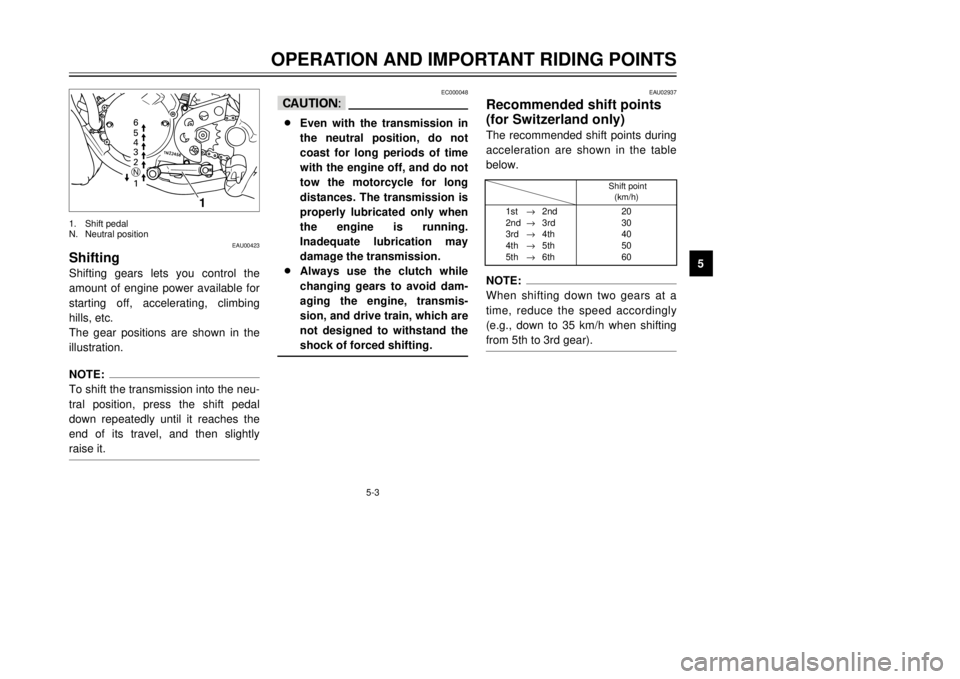
ShiftingShifting gears lets you control the
amount of engine power available for
starting off, accelerating, climbing
hills, etc.
The gear positions are shown in the
illustration.NOTE:
To shift the transmission into the neu-
tral position, press the shift pedal
down repeatedly until it reaches the
end of its travel, and then slightly
raise it.
EC000048
cC8Even with the transmission in
the neutral position, do not
coast for long periods of time
with the engine off, and do not
tow the motorcycle for long
distances. The transmission is
properly lubricated only when
the engine is running.
Inadequate lubrication may
damage the transmission.
8Always use the clutch while
changing gears to avoid dam-
aging the engine, transmis-
sion, and drive train, which are
not designed to withstand the
shock of forced shifting.
OPERATION AND IMPORTANT RIDING POINTS
1
2
3
45
6
7
8
9
6
5
4
3
2
1 N
1
1.Shift pedal
N.Neutral position
EAU02937
Recommended shift points
(for Switzerland only)The recommended shift points during
acceleration are shown in the table
below.NOTE:
When shifting down two gears at a
time, reduce the speed accordingly
(e.g., down to 35 km/h when shifting
from 5th to 3rd gear).
Shift point
(km/h)
1st®2nd
2nd®3rd
3rd®4th
4th®5th
5th®6th20
30
40
50
60
5AE-9-E4 (ENG) 8/30/00 5:04 PM Page 33
Page 38 of 94

6-2
PERIODIC MAINTENANCE AND MINOR REPAIR
1
2
3
4
56
7
8
9
EAU03686
Periodic maintenance and lubrication chart
NOTE:
8The annual checks must be performed every year, except if a kilometer-based maintenance is performed instead.
8From 30,000 km, repeat the maintenance intervals starting from 6,000 km.
8Items marked with an asterisk should be performed by a Yamaha dealer as they require special tools, data and
technical skills.NO.ITEMCHECK OR MAINTENANCE JOBODOMETER READING (´1,000 km)
ANNUAL
CHECK
16121824
1
*Fuel line¥Check fuel hoses for cracks or damage.ÖÖÖÖÖ
2Spark plug¥Replace.ÖÖÖÖÖ
3Air filter element¥Clean.ÖÖ
¥Replace.ÖÖ
4Clutch¥Check operation.
¥Adjust.ÖÖÖÖÖ
5*Front brake¥Check operation, fluid level and vehicle for fluid leakage.
(See NOTE on page 6-4.)ÖÖÖÖÖÖ
¥Replace brake pads.Whenever worn to the limit
6*Rear brake¥Check operation, fluid level and vehicle for fluid leakage.
(See NOTE on page 6-4.)ÖÖÖÖÖÖ
¥Replace brake pads.Whenever worn to the limit
7*Brake hoses¥Check for cracks or damage.ÖÖÖÖÖ
¥Replace. (See NOTE on page 6-4.)Every 4 years
8*Wheels¥Check runout and for damage.ÖÖÖÖ
5AE-9-E4 (ENG) 8/30/00 5:04 PM Page 37
Page 46 of 94

6-10
EC000077
cC8In order to prevent clutch slip-
page (since the transmission
oil also lubricates the clutch),
do not mix any chemical addi-
tives with the oil.
8Make sure that no foreign
material enters the transmis-
sion.6.Start the engine, and then let it
idle for several minutes while
checking the transmission for oil
leakage. If oil is leaking, immedi-
ately turn off the engine and
check for the cause.
PERIODIC MAINTENANCE AND MINOR REPAIR
1
2
3
4
56
7
8
9 Recommended transmission oil:
See page 8-1
Oil quantity:
Periodic oil change:
0.75 L
Total amount (dry transmission):
0.8 L
1
2
1.Maximum level mark
2.Minimum level mark2.Check the coolant level in the
coolant reservoir.NOTE:
The coolant should be between the
minimum and maximum level marks.3.If the coolant is at or below the
minimum level mark, open the
reservoir cap, add coolant to the
maximum level mark, and then
close the reservoir cap.
EAU03761
CoolantTo check the coolant level
1.Place the motorcycle on a level
surface and hold it in an upright
position.NOTE:
8The coolant level must be
checked on a cold engine since
the level varies with engine tem-
perature.
8Make sure that the motorcycle is
positioned straight up when
checking the coolant level. A
slight tilt to the side can result in
a false reading.
5AE-9-E4 (ENG) 8/30/00 5:04 PM Page 45
Page 56 of 94
6-20
PERIODIC MAINTENANCE AND MINOR REPAIR
1
2
3
4
56
7
8
9
EAU03773
Cast wheelsTo maximize the performance, dura-
bility, and safe operation of your
motorcycle, note the following points
regarding the specified wheels.
8The wheel rims should be
checked for cracks, bends or
warpage before each ride. If any
damage is found, have a
Yamaha dealer replace the
wheel. Do not attempt even the
smallest repair to the wheel. A
deformed or cracked wheel must
be replaced.
8The wheel should be balanced
whenever either the tire or wheel
has been changed or replaced.
An unbalanced wheel can result
in poor performance, adverse
handling characteristics, and a
shortened tire life.
8Ride at moderate speeds after
changing a tire since the tire sur-
face must first be Òbroken inÓ for
it to develop its optimal charac-
teristics.
ab
12 c
EAU00694
Adjusting the clutch lever
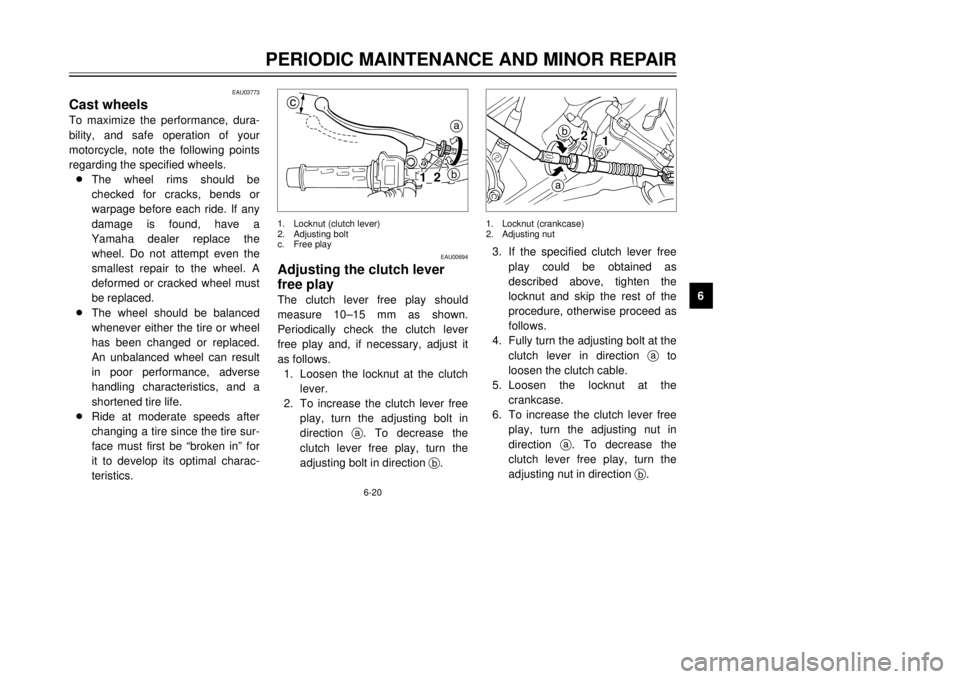
free playThe clutch lever free play should
measure 10Ð15 mm as shown.
Periodically check the clutch lever
free play and, if necessary, adjust it
as follows.
1.Loosen the locknut at the clutch
lever.
2.To increase the clutch lever free
play, turn the adjusting bolt in
direction a. To decrease the
clutch lever free play, turn the
adjusting bolt in direction b.1.Locknut (clutch lever)
2.Adjusting bolt
c.Free play
ba
1
2
3.If the specified clutch lever free
play could be obtained as
described above, tighten the
locknut and skip the rest of the
procedure, otherwise proceed as
follows.
4.Fully turn the adjusting bolt at the
clutch lever in direction ato
loosen the clutch cable.
5.Loosen the locknut at the
crankcase.
6.To increase the clutch lever free
play, turn the adjusting nut in
direction a. To decrease the
clutch lever free play, turn the
adjusting nut in direction b.1.Locknut (crankcase)
2.Adjusting nut
5AE-9-E4 (ENG) 8/30/00 5:04 PM Page 55
Page 57 of 94
6-21
PERIODIC MAINTENANCE AND MINOR REPAIR
1
2
3
4
56
7
8
9
1
2b
c
a
EAU00696
Adjusting the brake lever
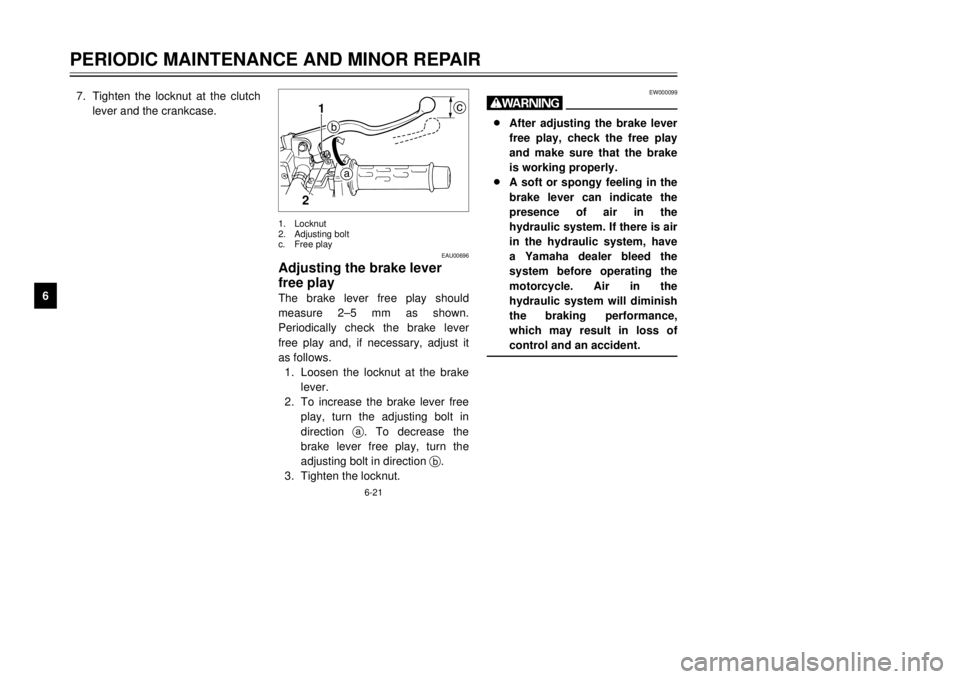
free playThe brake lever free play should
measure 2Ð5 mm as shown.
Periodically check the brake lever
free play and, if necessary, adjust it
as follows.
1.Loosen the locknut at the brake
lever.
2.To increase the brake lever free
play, turn the adjusting bolt in
direction a. To decrease the
brake lever free play, turn the
adjusting bolt in direction b.
3.Tighten the locknut.1.Locknut
2.Adjusting bolt
c.Free play
EW000099
w8After adjusting the brake lever
free play, check the free play
and make sure that the brake
is working properly.
8A soft or spongy feeling in the
brake lever can indicate the
presence of air in the
hydraulic system. If there is air
in the hydraulic system, have
a Yamaha dealer bleed the
system before operating the
motorcycle. Air in the
hydraulic system will diminish
the braking performance,
which may result in loss of
control and an accident.
7.Tighten the locknut at the clutch
lever and the crankcase.
5AE-9-E4 (ENG) 8/30/00 5:04 PM Page 56
Page 65 of 94
6-29
PERIODIC MAINTENANCE AND MINOR REPAIR
1
2
3
4
56
7
8
9
EAU03165
Checking and lubricating the
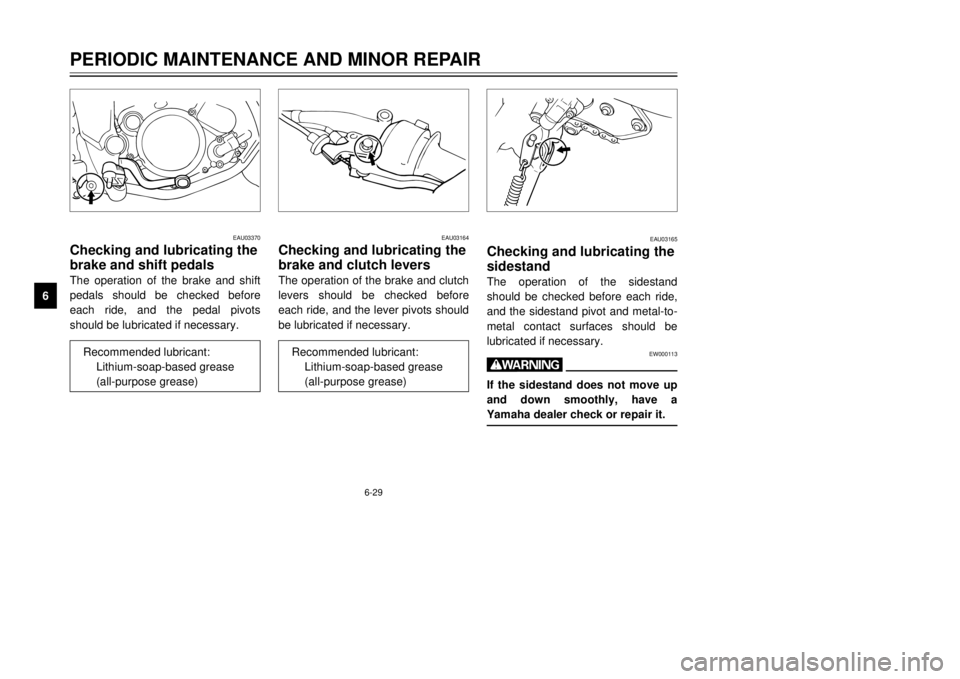
sidestandThe operation of the sidestand
should be checked before each ride,
and the sidestand pivot and metal-to-
metal contact surfaces should be
lubricated if necessary.
EW000113
wIf the sidestand does not move up
and down smoothly, have a
Yamaha dealer check or repair it.
EAU03370
Checking and lubricating the
brake and shift pedalsThe operation of the brake and shift
pedals should be checked before
each ride, and the pedal pivots
should be lubricated if necessary.
Recommended lubricant:
Lithium-soap-based grease
(all-purpose grease)
EAU03164
Checking and lubricating the
brake and clutch leversThe operation of the brake and clutch
levers should be checked before
each ride, and the lever pivots should
be lubricated if necessary.
Recommended lubricant:
Lithium-soap-based grease
(all-purpose grease)
5AE-9-E4 (ENG) 8/30/00 5:04 PM Page 64
Page 86 of 94

SPECIFICATIONS
1
2
3
4
5
6
78
9
8-2 Spark plug
Manufacturer/modelNGK / BR9ES
Spark plug gap0.7Ð0.8 mm
Clutch typeWet, multiple-disc
Transmission
Primary reduction systemHelical gear
Primary reduction ratio71/22 (3.227)
Secondary reduction systemChain drive
Secondary reduction ratio3.563
Number of drive chain
sprocket teeth (Rear/front)57/16
Transmission typeConstant mesh 6-speed
OperationLeft foot
Gear ratio1st2.833
2nd1.875
3rd1.412
4th1.143
5th0.957
6th0.818
Chassis
Frame typeSemi double cradle
Caster angle26¡
Trail116 mmTires
Front
TypeTubeless
Size100/90-18 56P
Manufacturer/BRIDGESTONE / TW53
modelDUNLOP / D602F
Rear
TypeTubeless
Size130/80-17 65P
Manufacturer/BRIDGESTONE / TW54
modelDUNLOP / D602
Maximum load*180 kg
179 kg (CH, A)
Air pressure (cold tire)
up to 90 kg load*
Front175 kPa (1.75 kg/cm
2, 1.75 bar)
Rear200 kPa (2.00 kg/cm2, 2.00 bar)
90 kg loadÐMaximum
load*
Front175 kPa (1.75 kg/cm2, 1.75 bar)
Rear225 kPa (2.25 kg/cm2, 2.25 bar)
* Total weight of rider, passenger, cargo and accessories
5AE-9-E4 (ENG) 8/30/00 5:04 PM Page 85