Page 10 of 110

1
1-1
EAU00021
1-GIVE SAFETY THE RIGHT OF WAY
Motorcycles are fascinating vehicles, which can give you an unsurpassed feeling of power and
freedom. However, they also impose certain limits, which you must accept; even the best motorcycle
does not ignore the laws of physics.
Regular care and maintenance are essential for preserving value and operating condition of your
motorcycle. Moreover, what is true for the motorcycle is also true for the rider: good performance
depends on being in good shape. Riding under the influence of medication, drugs and alcohol is, of
course, out of the question. Motorcycle riders—more than car drivers—must always be at their mental
and physical best. Under the influence of even small amounts of alcohol, there is a tendency to take
dangerous risks.
Protective clothing is as essential for the motorcycle rider as seat belts are for car drivers and
passengers. Always wear a complete motorcycle suit (whether made of leather or tear-resistant
synthetic materials with protectors), sturdy boots, motorcycle gloves and a properly fitting helmet.
Optimum protective wear, however, should not encourage carelessness. Although full-coverage
helmets and suits, in particular, create an illusion of total safety and protection, motorcyclists will
always be vulnerable. Riders who lack critical self-control run the risk of going too fast and are apt to
take chances. This is even more dangerous in wet weather. The good motorcyclist rides safely,
predictably and defensively—avoiding all dangers, including those caused by others.
Enjoy your ride!
E_4tx.book Page 1 Wednesday, October 4, 2000 4:28 PM
Page 16 of 110

3-1
3
EAU00027
3-INSTRUMENT AND CONTROL FUNCTIONS
EAU00029
Main switch/steering lock The main switch/steering lock controls
the ignition and lighting systems, and is
used to lock the steering. The various
positions are described below.
EAU00036
ON
All electrical systems are supplied with
power, and the engine can be started.
The key cannot be removed.
EAU00038
OFF
All electrical systems are off. The key
can be removed.
EAU00040
LOCK
The steering is locked, and all electrical
systems are off. The key can be re-
moved.
To lock the steering1. Turn the handlebars all the way to
the left.
2. Push the key in from the “OFF” po-
sition, and then turn it to “LOCK”
while still pushing it.
3. Remove the key.
To unlock the steeringPush the key in, and then turn it to
“OFF” while still pushing it.
EW000016
WARNING
@ Never turn the key to “OFF” or
“LOCK” while the motorcycle is
moving, otherwise the electrical
systems will be switched off, which
may result in loss of control or an
accident. Make sure that the motor-
cycle is stopped before turning the
key to “OFF” or “LOCK”. @1. Push.
2. Turn.
E_4tx.book Page 1 Wednesday, October 4, 2000 4:28 PM
Page 19 of 110

INSTRUMENT AND CONTROL FUNCTIONS
3-4
3 To set the clock
1. Push both the “SELECT” and
“RESET” buttons for at least two
seconds.
2. When the hour digits start flashing,
push the “RESET” button to set
the hours.
3. Push the “SELECT” button to
change the minutes.
4. When the minute digits start flash-
ing, push the “RESET” button to
set the minutes.
5. Push the “SELECT” button to start
the clock.NOTE:@ After setting the clock, be sure to push
the “SELECT” button before turning the
key to “OFF”, otherwise the clock will
not be set. @
EAU00101
Tachometer The electric tachometer allows the rider
to monitor the engine speed and keep it
within the ideal power range.
EC000003
CAUTION:@ Do not operate the engine in the ta-
chometer red zone.
Red zone: 8,000 r/min and above @
EAU00103
Self-diagnosis device This model is equipped with a self-di-
agnosis device for the throttle position
sensor circuit.
If the throttle position sensor circuit is
defective, the tachometer will repeat-
edly display the following error code:CB-10EIf the tachometer displays such an er-
ror code, have a Yamaha dealer check
the motorcycle.
EC000004
CAUTION:@ When the tachometer displays an
error code, the motorcycle should
be checked as soon as possible in
order to avoid engine damage. @
1. Tachometer
2. Tachometer red zone
0 r/min for
3 seconds
3,000 r/min
for 2.5 sec-
onds
Current engine
speed for
3 seconds
E_4tx.book Page 4 Wednesday, October 4, 2000 4:28 PM
Page 42 of 110
OPERATION AND IMPORTANT RIDING POINTS
5-3
5
EAU00423
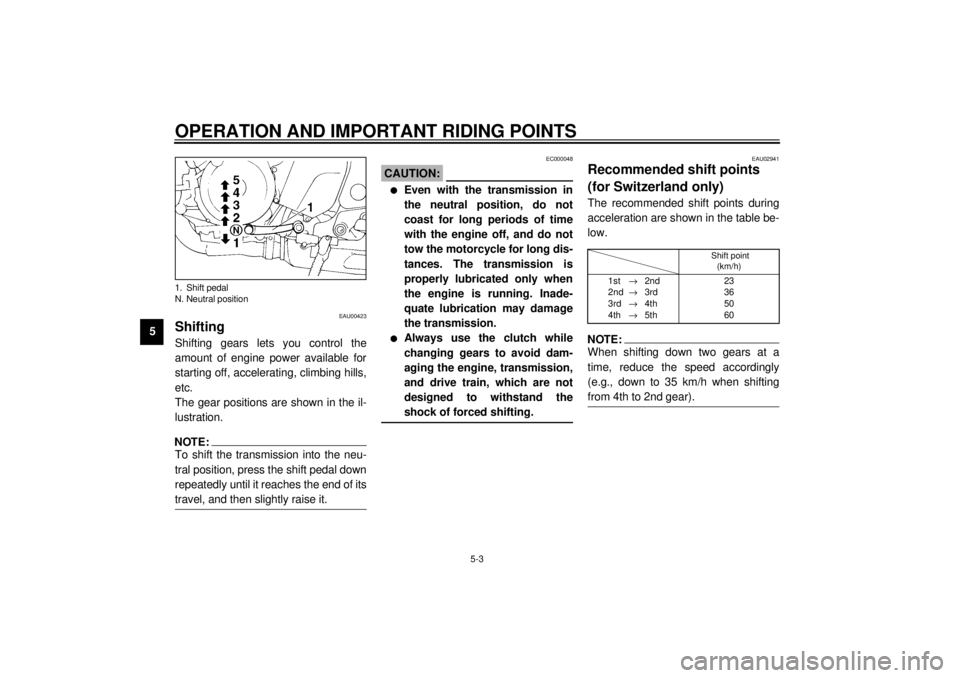
Shifting Shifting gears lets you control the
amount of engine power available for
starting off, accelerating, climbing hills,
etc.
The gear positions are shown in the il-
lustration.NOTE:@ To shift the transmission into the neu-
tral position, press the shift pedal down
repeatedly until it reaches the end of its
travel, and then slightly raise it. @
EC000048
CAUTION:@ l
Even with the transmission in
the neutral position, do not
coast for long periods of time
with the engine off, and do not
tow the motorcycle for long dis-
tances. The transmission is
properly lubricated only when
the engine is running. Inade-
quate lubrication may damage
the transmission.
l
Always use the clutch while
changing gears to avoid dam-
aging the engine, transmission,
and drive train, which are not
designed to withstand the
shock of forced shifting.
@
EAU02941
Recommended shift points
(for Switzerland only) The recommended shift points during
acceleration are shown in the table be-
low.CF-01ENOTE:_ When shifting down two gears at a
time, reduce the speed accordingly
(e.g., down to 35 km/h when shifting
from 4th to 2nd gear). _
1. Shift pedal
N. Neutral position
Shift point
(km/h)
1st®2nd
2nd®3rd
3rd®4th
4th®5th23
36
50
60
E_4tx.book Page 3 Wednesday, October 4, 2000 4:28 PM
Page 88 of 110
PERIODIC MAINTENANCE AND MINOR REPAIR
6-43
6
EAU03087
Troubleshooting Although Yamaha motorcycles receive
a thorough inspection before shipment
from the factory, trouble may occur dur-
ing operation. Any problem in the fuel,
compression, or ignition systems, for
example, can cause poor starting and
loss of power.
The following troubleshooting charts
represent quick and easy procedures
for checking these vital systems your-
self. However, should your motorcycle
require any repair, take it to a Yamaha
dealer, whose skilled technicians have
the necessary tools, experience, and
know-how to service the motorcycle
properly.
Use only genuine Yamaha replace-
ment parts. Imitation parts may look
like Yamaha parts, but they are often
inferior, have a shorter service life and
can lead to expensive repair bills. E_4tx.book Page 43 Wednesday, October 4, 2000 4:28 PM
