Page 17 of 107
1-10
E
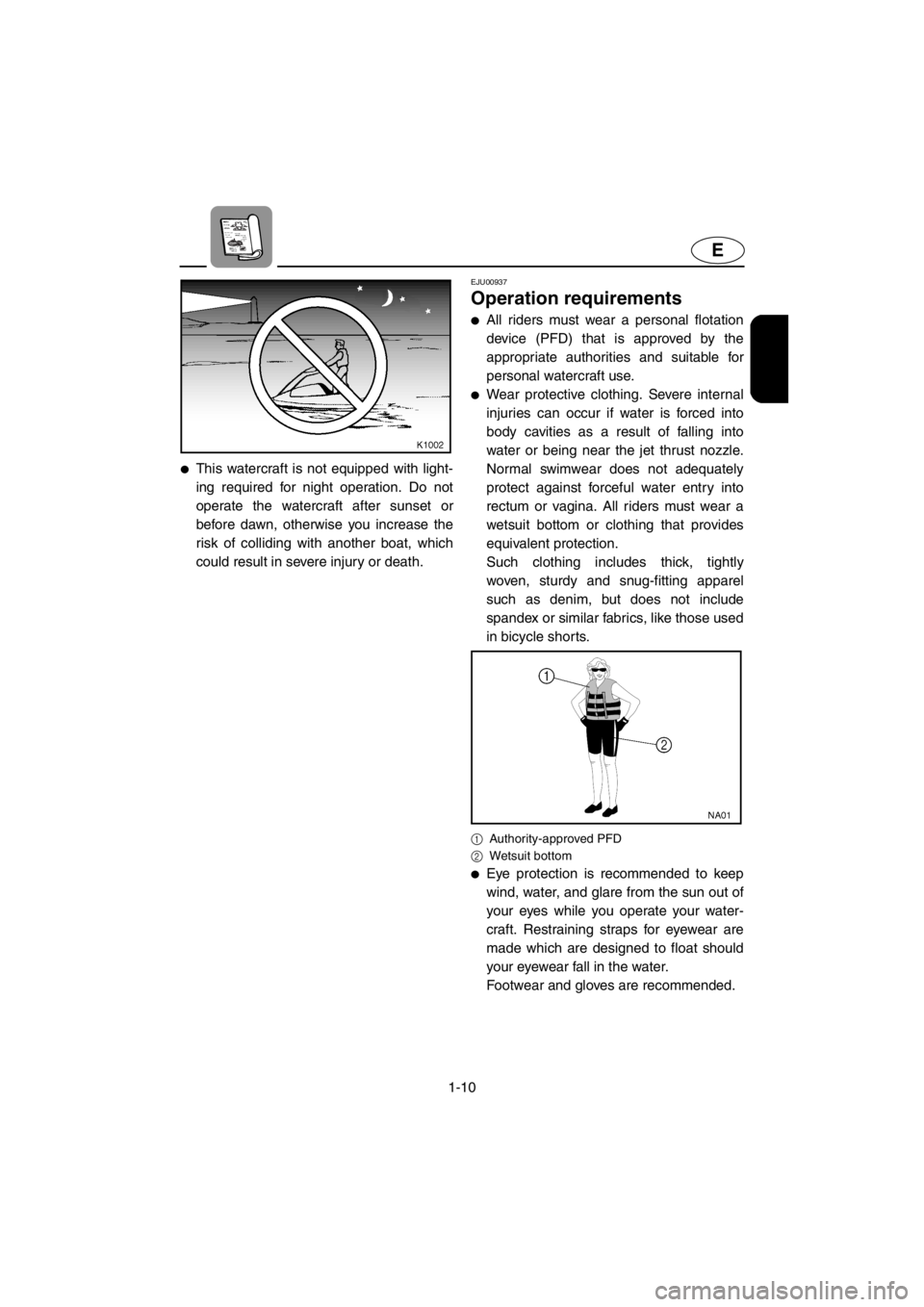
●This watercraft is not equipped with light-
ing required for night operation. Do not
operate the watercraft after sunset or
before dawn, otherwise you increase the
risk of colliding with another boat, which
could result in severe injury or death.
EJU00937
Operation requirements
●All riders must wear a personal flotation
device (PFD) that is approved by the
appropriate authorities and suitable for
personal watercraft use.
●Wear protective clothing. Severe internal
injuries can occur if water is forced into
body cavities as a result of falling into
water or being near the jet thrust nozzle.
Normal swimwear does not adequately
protect against forceful water entry into
rectum or vagina. All riders must wear a
wetsuit bottom or clothing that provides
equivalent protection.
Such clothing includes thick, tightly
woven, sturdy and snug-fitting apparel
such as denim, but does not include
spandex or similar fabrics, like those used
in bicycle shorts.
1
Authority-approved PFD
2
Wetsuit bottom
●Eye protection is recommended to keep
wind, water, and glare from the sun out of
your eyes while you operate your water-
craft. Restraining straps for eyewear are
made which are designed to float should
your eyewear fall in the water.
Footwear and gloves are recommended.
E_GM6-1.fm Page 10 Tuesday, July 11, 2000 10:49 AM
Page 33 of 107
2-10
E
EJU00406a
Storage pouch
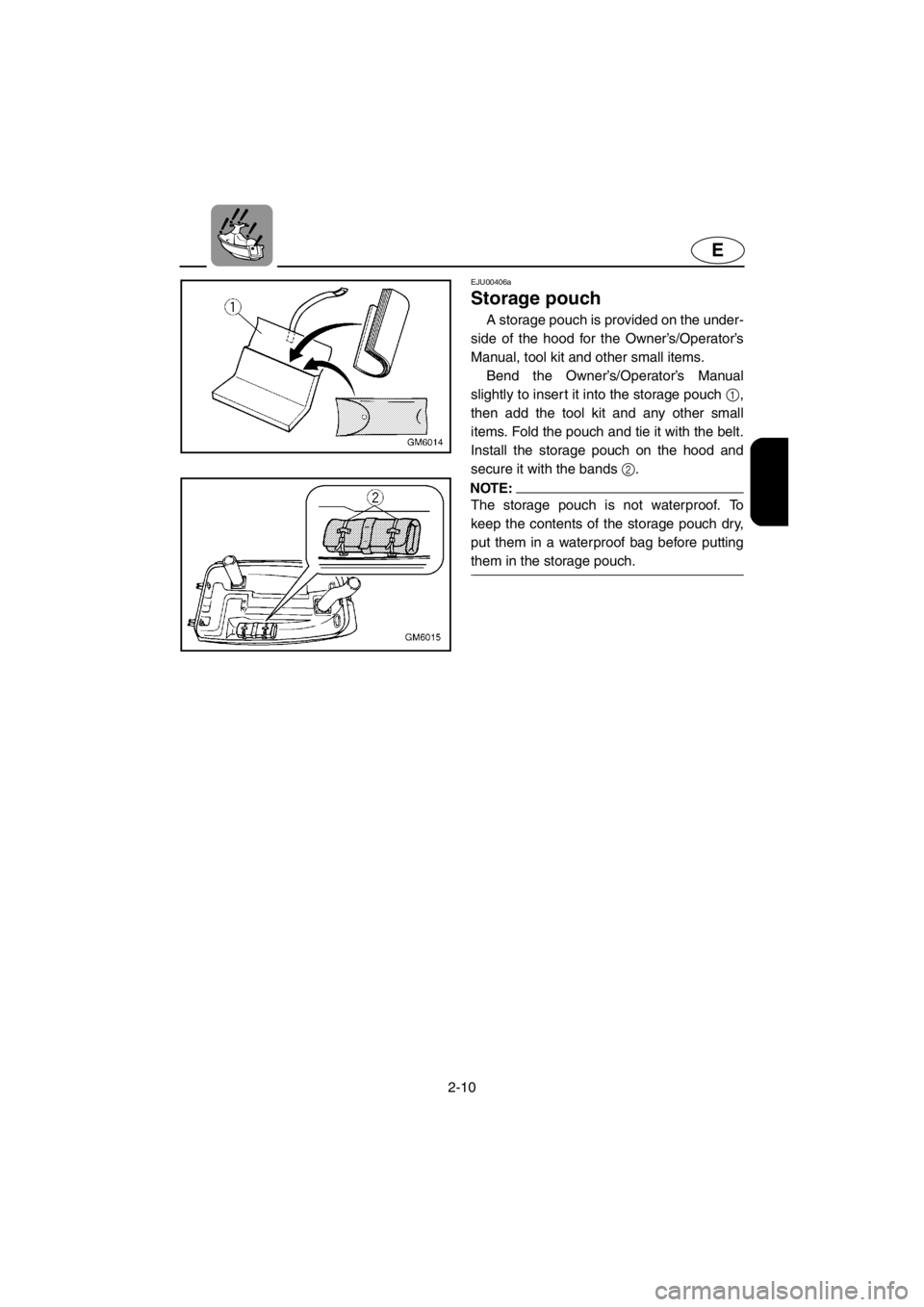
A storage pouch is provided on the under-
side of the hood for the Owner’s/Operator’s
Manual, tool kit and other small items.
Bend the Owner’s/Operator’s Manual
slightly to insert it into the storage pouch 1,
then add the tool kit and any other small
items. Fold the pouch and tie it with the belt.
Install the storage pouch on the hood and
secure it with the bands 2.
NOTE:@The storage pouch is not waterproof. To
keep the contents of the storage pouch dry,
put them in a waterproof bag before putting
them in the storage pouch.
@
E_GM6-2.fm Page 10 Tuesday, July 11, 2000 10:51 AM
Page 51 of 107
3-16
E
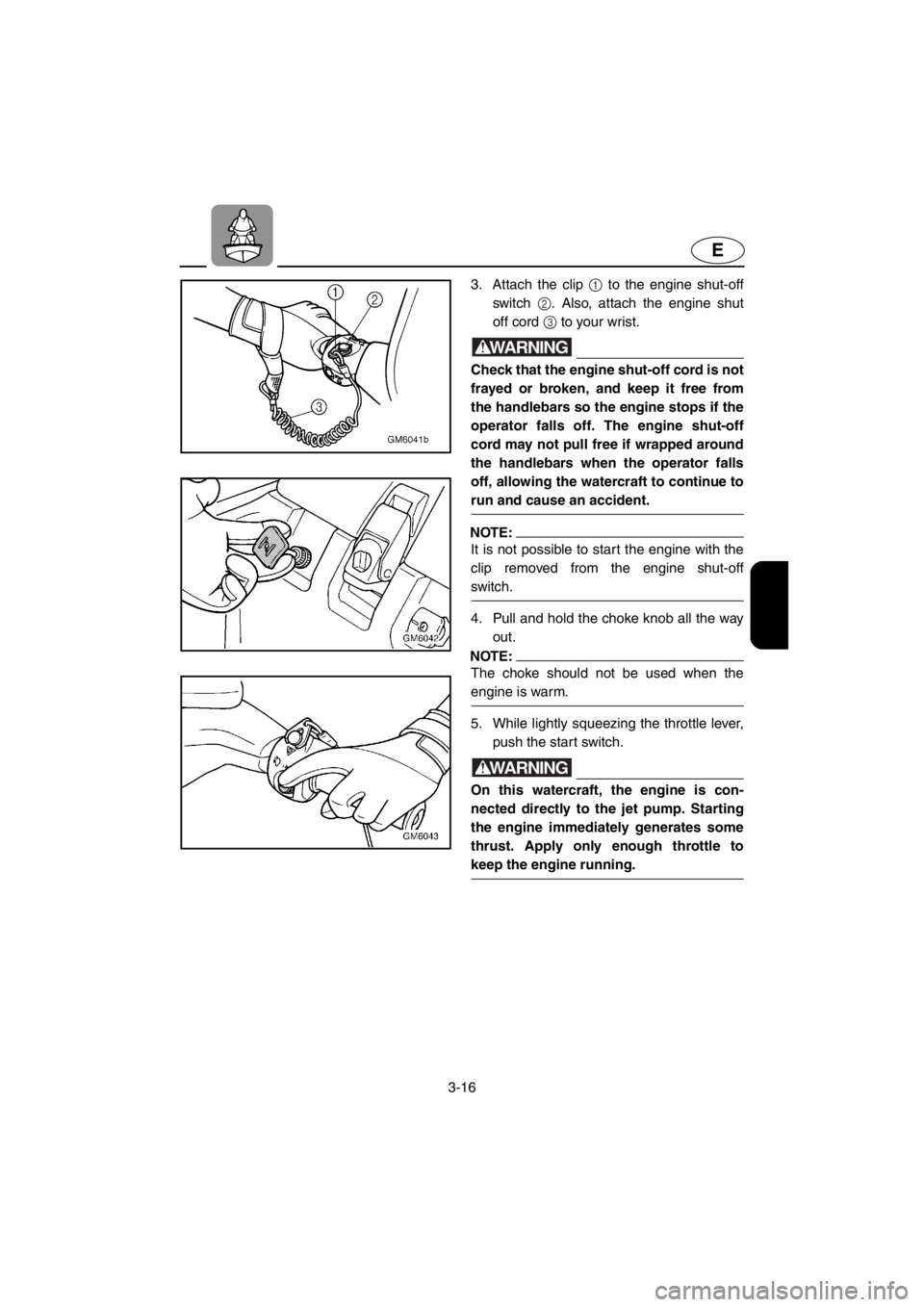
3. Attach the clip 1 to the engine shut-off
switch 2. Also, attach the engine shut
off cord 3 to your wrist.
WARNING@Check that the engine shut-off cord is not
frayed or broken, and keep it free from
the handlebars so the engine stops if the
operator falls off. The engine shut-off
cord may not pull free if wrapped around
the handlebars when the operator falls
off, allowing the watercraft to continue to
run and cause an accident.
@
NOTE:@It is not possible to start the engine with the
clip removed from the engine shut-off
switch.
@
4. Pull and hold the choke knob all the way
out.
NOTE:@The choke should not be used when the
engine is warm.
@
5. While lightly squeezing the throttle lever,
push the start switch.
WARNING@On this watercraft, the engine is con-
nected directly to the jet pump. Starting
the engine immediately generates some
thrust. Apply only enough throttle to
keep the engine running.
@
E_GM6-3.fm Page 16 Tuesday, July 11, 2000 10:52 AM
Page 54 of 107
3-19
E
EJU00464
Operating your watercraft
Getting to know your
watercraft
Operating your watercraft requires skills
acquired through practice over a period of
time. Take the time to learn the basic tech-
niques well before attempting more difficult
maneuvers.
Operating your new watercraft can be a
very enjoyable activity, providing you with
hours of pleasure. However, it is essential to
familiarize yourself with the operation of the
watercraft to achieve the skill necessary to
enjoy riding safely. Before operating this
watercraft, read this Owner’s/Operator’s
Manual, the Riding Practice Guide, and all
warning and caution labels on the water-
craft. Pay particular attention to the safety
information on pages 1-8 to 1-14. These
materials should give you an understanding
of the watercraft and its operation.
Remember: This watercraft is designed to
carry the operator only. Never have more
than one person on the watercraft at any
time.
EJU00470
Learning to operate your
watercraft
Before operating, always perform the pre-
operation checks listed on page 3-5. The
short time spent checking the watercraft will
reward you with added safety and reliability.
Check all local laws before operating your
watercraft.
Operate defensively at safe speeds and
keep a safe distance away from people,
objects and other watercraft. Select a wide
area to learn in, where you have good visi-
bility and light boat traffic.
Use the buddy system—operate with
someone nearby. Scan constantly for peo-
ple, objects and other watercraft. Be alert for
conditions that limit your visibility or block
your vision of others.
Attach the engine shut-off cord (lanyard)
to your wrist and keep it free from the han-
dlebars so that the engine stops if the opera-
tor falls off.
Wear a personal flotation device (PFD).
All riders must wear a PFD that is approved
by the appropriate authorities and suitable
for personal watercraft use.
E_GM6-3.fm Page 19 Tuesday, July 11, 2000 10:52 AM
Page 58 of 107
3-23
E
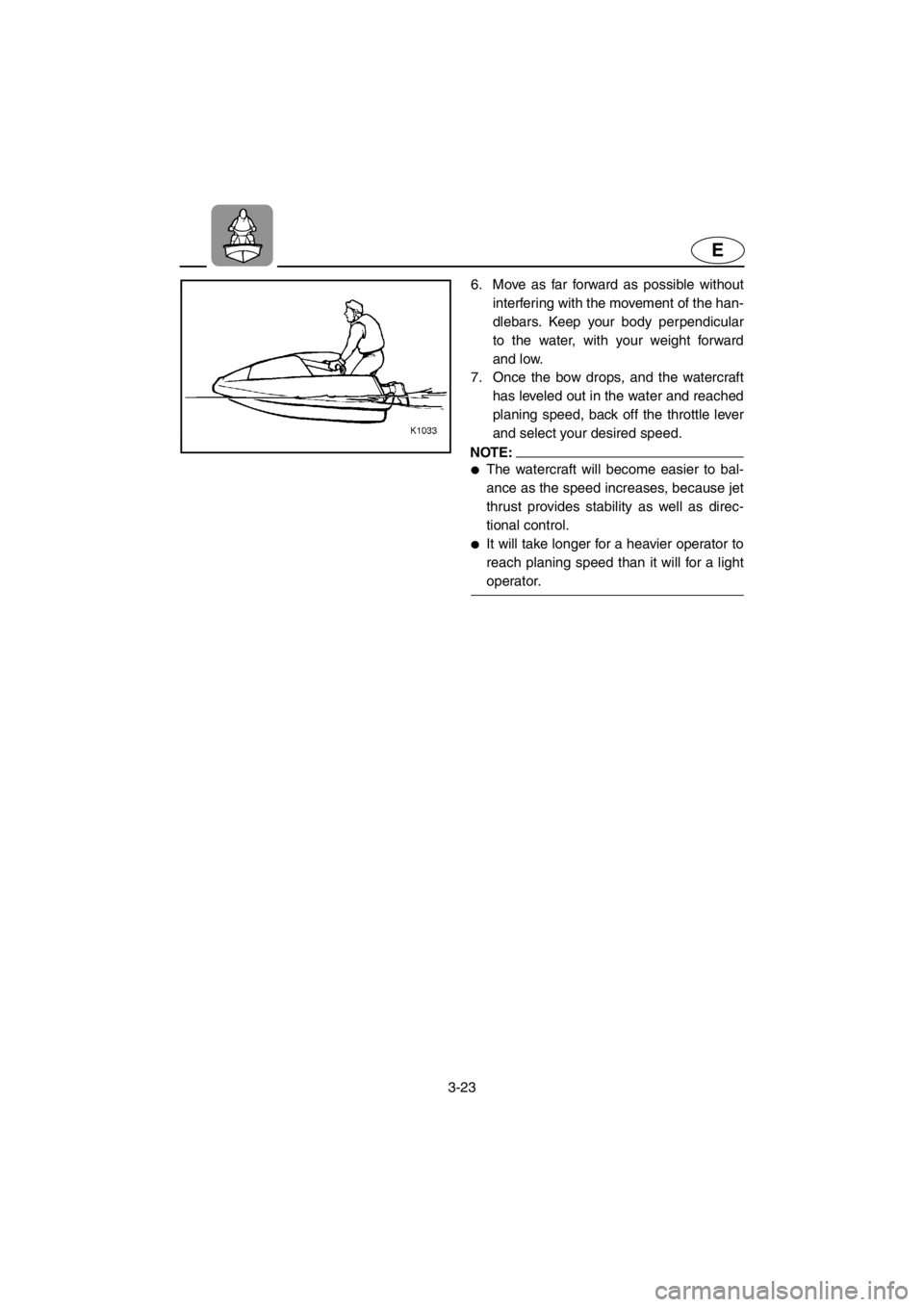
6. Move as far forward as possible without
interfering with the movement of the han-
dlebars. Keep your body perpendicular
to the water, with your weight forward
and low.
7. Once the bow drops, and the watercraft
has leveled out in the water and reached
planing speed, back off the throttle lever
and select your desired speed.
NOTE:@●The watercraft will become easier to bal-
ance as the speed increases, because jet
thrust provides stability as well as direc-
tional control.
●It will take longer for a heavier operator to
reach planing speed than it will for a light
operator.
@
E_GM6-3.fm Page 23 Tuesday, July 11, 2000 10:52 AM
Page 85 of 107
4-16
E
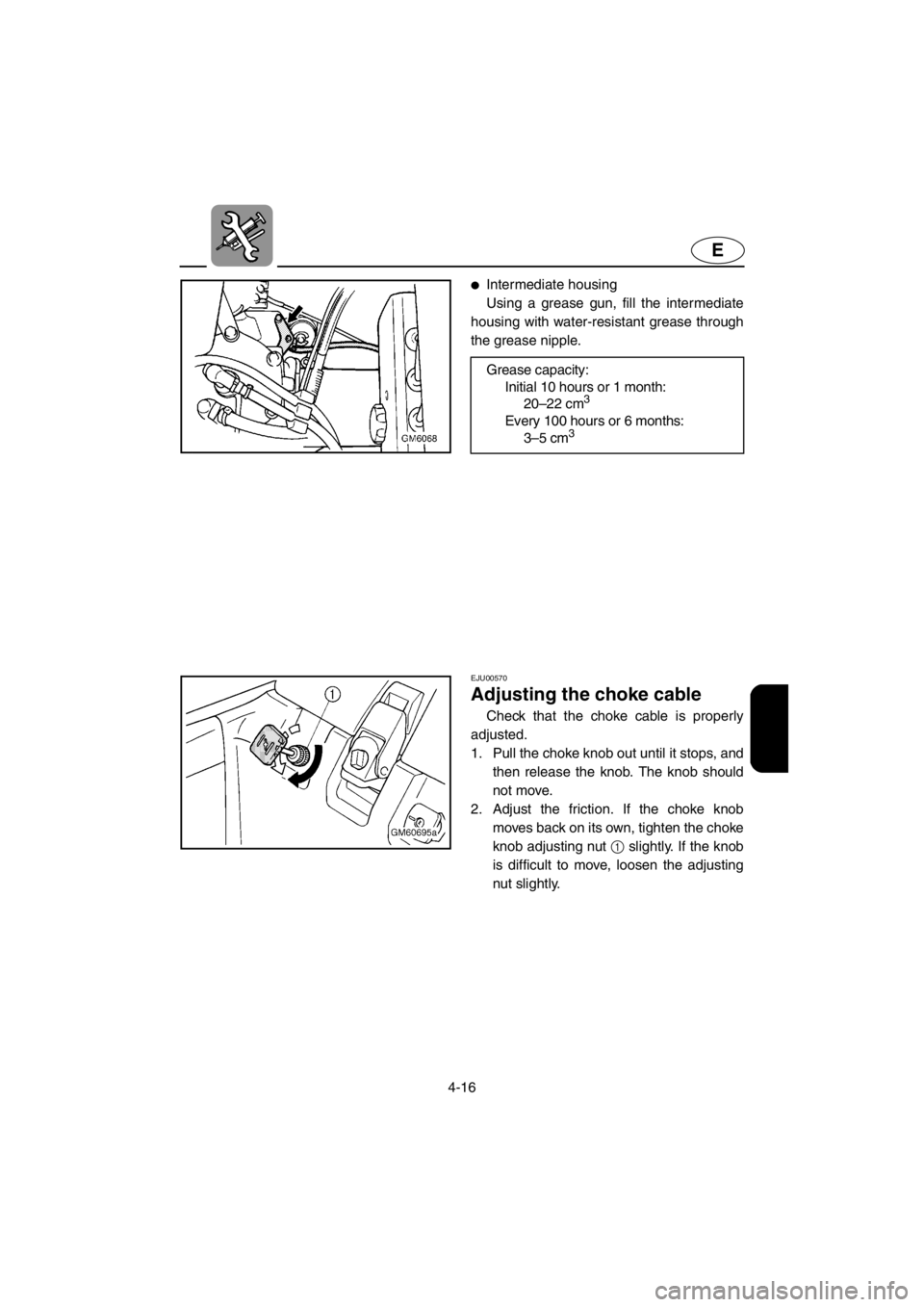
●Intermediate housing
Using a grease gun, fill the intermediate
housing with water-resistant grease through
the grease nipple.
Grease capacity:
Initial 10 hours or 1 month:
20–22 cm
3
Every 100 hours or 6 months:
3–5 cm3
EJU00570
Adjusting the choke cable
Check that the choke cable is properly
adjusted.
1. Pull the choke knob out until it stops, and
then release the knob. The knob should
not move.
2. Adjust the friction. If the choke knob
moves back on its own, tighten the choke
knob adjusting nut 1 slightly. If the knob
is difficult to move, loosen the adjusting
nut slightly.
E_GM6-4.fm Page 16 Tuesday, July 11, 2000 11:28 AM