Page 70 of 107
4-1
E
EJU00516
Storage
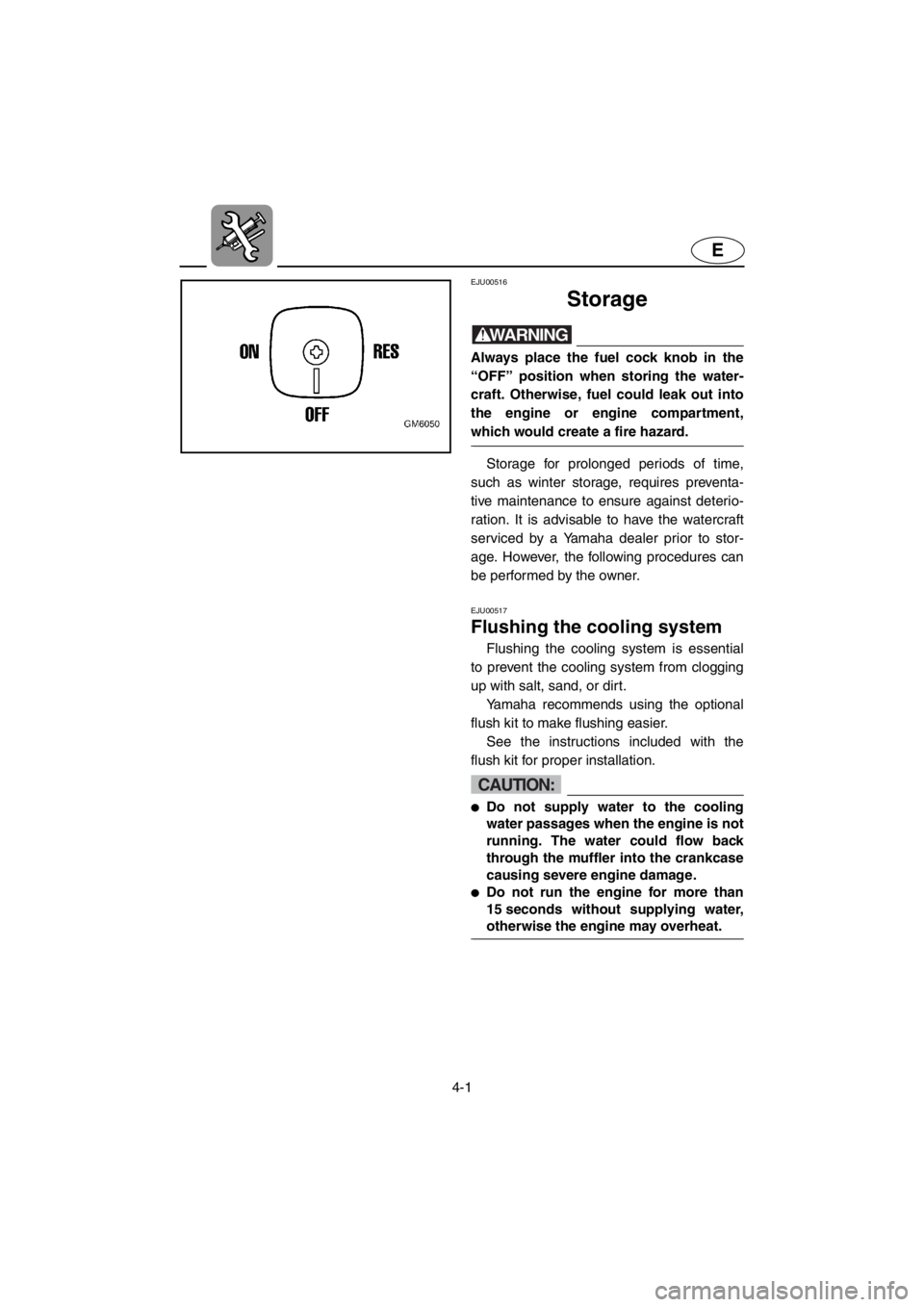
WARNING@Always place the fuel cock knob in the
“OFF” position when storing the water-
craft. Otherwise, fuel could leak out into
the engine or engine compartment,
which would create a fire hazard.
@
Storage for prolonged periods of time,
such as winter storage, requires preventa-
tive maintenance to ensure against deterio-
ration. It is advisable to have the watercraft
serviced by a Yamaha dealer prior to stor-
age. However, the following procedures can
be performed by the owner.
EJU00517
Flushing the cooling system
Flushing the cooling system is essential
to prevent the cooling system from clogging
up with salt, sand, or dirt.
Yamaha recommends using the optional
flush kit to make flushing easier.
See the instructions included with the
flush kit for proper installation.
CAUTION:@●Do not supply water to the cooling
water passages when the engine is not
running. The water could flow back
through the muffler into the crankcase
causing severe engine damage.
●Do not run the engine for more than
15 seconds without supplying water,
otherwise the engine may overheat.
@
E_GM6-4.fm Page 1 Tuesday, July 11, 2000 11:28 AM
Page 72 of 107
4-3
E
EJU00945
Lubrication
WARNING@To reduce the risk of fire or explosion:
Never pour or spray gasoline, or any sub-
stance other than a rust inhibitor through
the hole in the carburetor silencer cover.
@
CAUTION:@●Make sure to replace the cap securely
after fogging the engine, otherwise
water could enter the engine and
cause damage.
●Do not attempt to run the engine at full
throttle or for more than 15 seconds
while the watercraft is out of the water,
otherwise the engine may overheat
and/or seize.
@
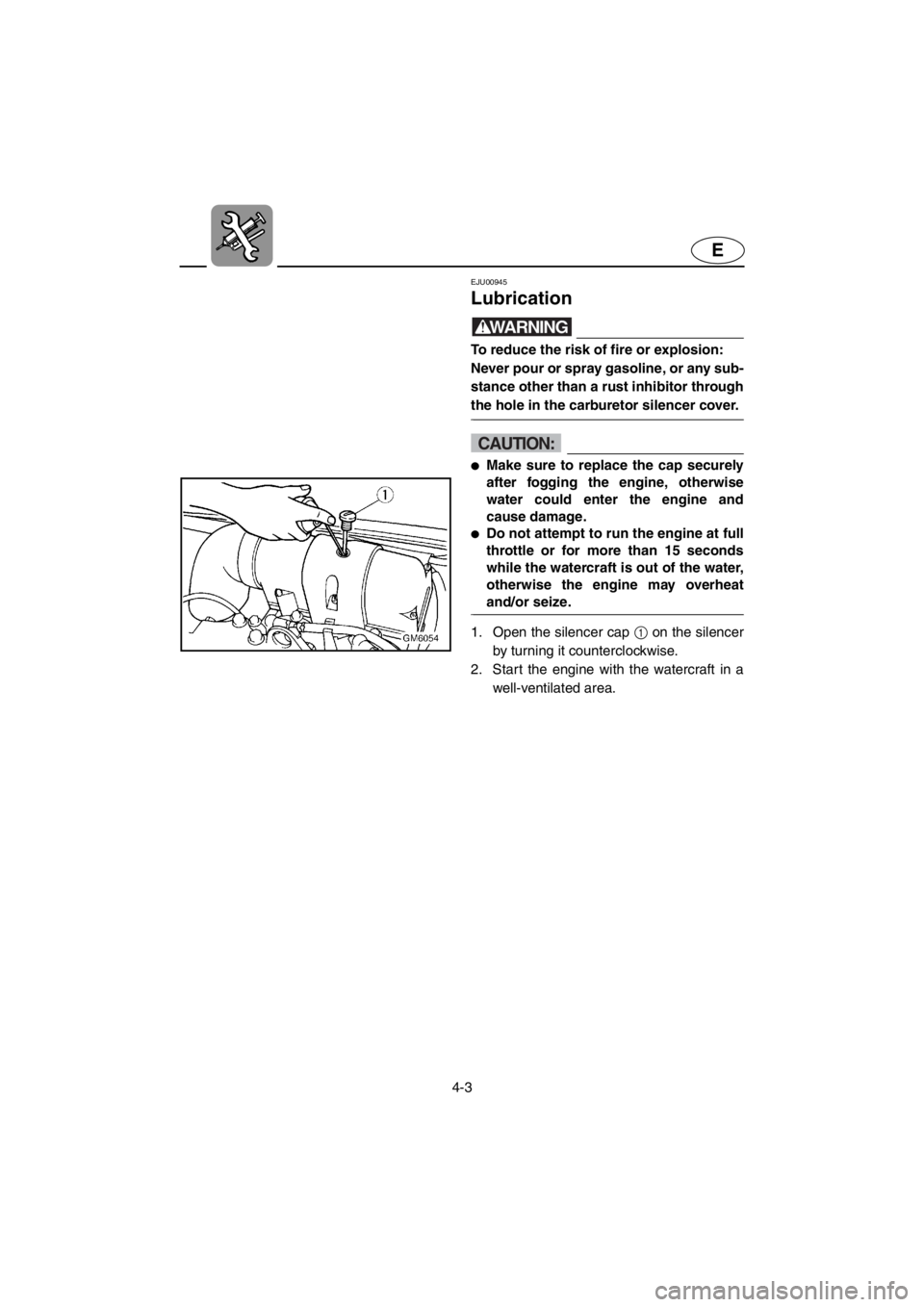
1. Open the silencer cap 1 on the silencer
by turning it counterclockwise.
2. Start the engine with the watercraft in a
well-ventilated area.
E_GM6-4.fm Page 3 Tuesday, July 11, 2000 11:28 AM
Page 74 of 107
4-5
E
EJU00946
Fuel system
Draining the fuel system prevents buildup
of varnishes and other harmful deposits that
result when gasoline sits for a prolonged
period of time.
WARNING@Gasoline is highly flammable and explo-
sive. A fire or explosion can cause
severe injury or death. Shut the engine
off. Refuel in well-ventilated areas away
from flames or sparks. Do not smoke.
Avoid spilling gasoline. Wipe up spilled
gasoline immediately.
@
To drain the fuel system:
1. Place the fuel cock knob in the “OFF”
position.
2. Drain the fuel tank using a siphon.
EJU00530
Battery
When the watercraft is not to be used for
a month or more, remove the battery and
store it in a cool, dark place. Clean the bat-
tery’s casing and terminals using a mixture
of baking soda and water (one tablespoon of
baking soda to one cup of water). Apply
dielectric grease or petroleum jelly to the
battery terminals and to all exposed battery
leads.
If the battery is to be stored for a longer
period, check the specific gravity of the elec-
trolyte at least once a month and charge the
battery if necessary.
Specific gravity: 1.28 at 20 °C (68 °F)
E_GM6-4.fm Page 5 Tuesday, July 11, 2000 11:28 AM
Page 76 of 107
4-7
E
EJU00535a
Maintenance and
adjustments
Periodic inspection, adjustment and lubri-
cation will keep your watercraft in the safest
and most efficient condition possible. Safety
is an obligation of the watercraft owner. The
most important points of watercraft inspec-
tion, adjustment and lubrication are
explained on the following pages.
See your Yamaha dealer for genuine
Yamaha replacement parts and optional
accessories designed for your watercraft.
Remember that failures that are the result of
the installation of parts or accessories which
are not qualitatively equivalent to genuine
Yamaha parts are not covered by the limited
warranty.
WARNING
●Be sure to turn off the engine when
you perform maintenance unless oth-
erwise specified, otherwise an acci-
dent or injury could result from
unexpected operation, moving parts,
or electric shock. If the owner is not
familiar with watercraft servicing, this
work should be done by a Yamaha
dealer. Improperly serviced compo-
nents could fail or stop operating cor-
rectly, which could result in an
accident.
●Modifications to this watercraft not
approved by Yamaha may cause loss
of performance or excessive noise, or
render it unsafe for use. Consult a
Yamaha dealer before attempting any
changes.
@
E_GM6-4.fm Page 7 Tuesday, July 11, 2000 11:28 AM
Page 79 of 107
4-10
E
EJU00537
Inspecting the fuel system
WARNING@Gasoline and its vapors are highly flam-
mable and explosive.
@
Check the fuel system for leakage,
cracks, or malfunctions. If any problem is
found, do the necessary repair or replace-
ment as required. If repair is necessary, con-
sult a Yamaha dealer.
Check:
●Carburetors for leakage.
●Fuel pump for malfunction or leakage.
●Fuel tank for water or dirt.
●Fuel tank for damage, cracks or leakage.
●Fuel hose joint for leakage.
●Fuel hose for cracks or other damage.
●Fuel filter for leakage.
●Fuel cock for leakage.
●Air vent check valve for leakage.
WARNING@Failure to check for and repair any fuel
leakage may result in fire or explosion.
@
E_GM6-4.fm Page 10 Tuesday, July 11, 2000 11:28 AM
Page 80 of 107
4-11
E
EJU00538
Fuel filter
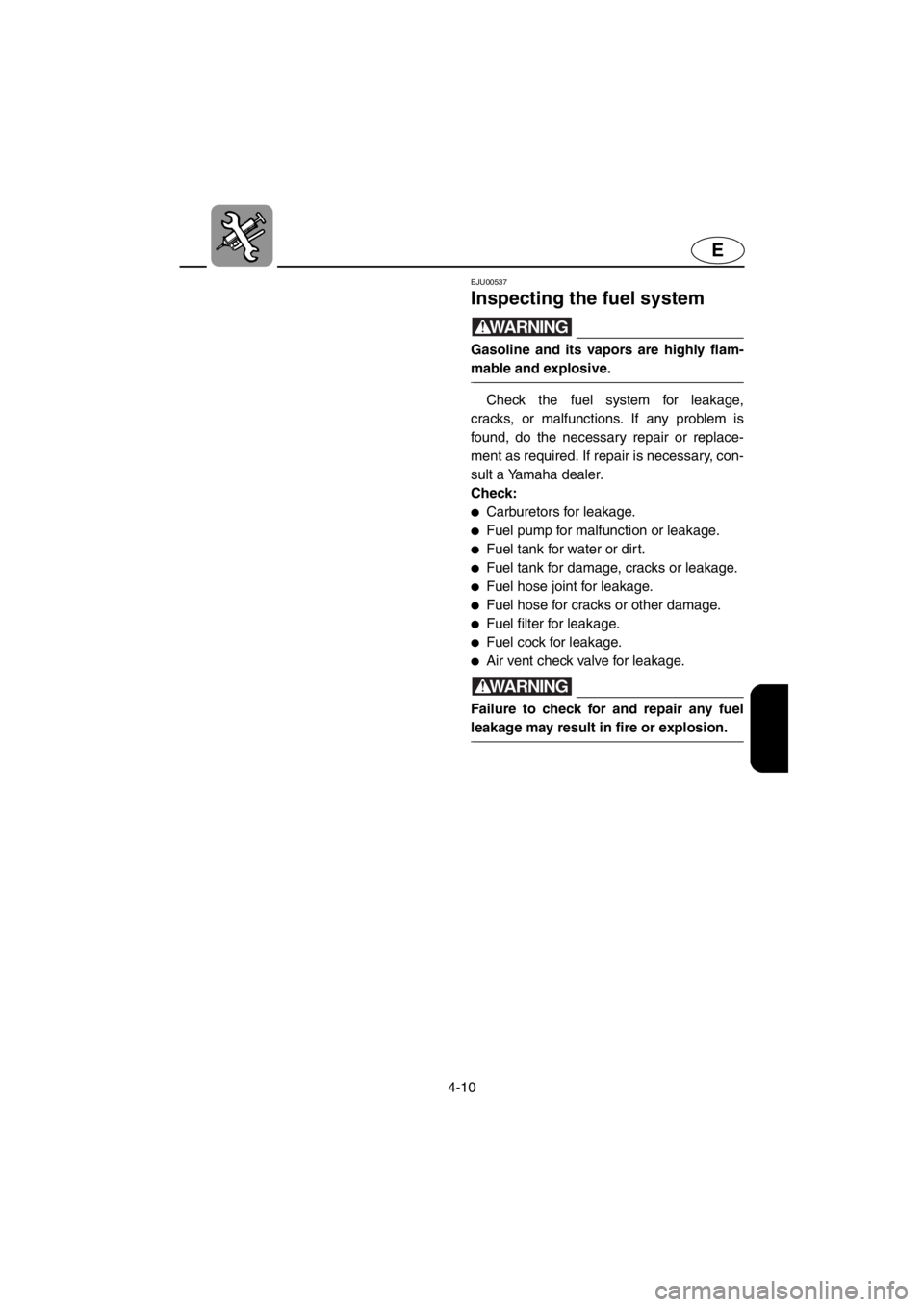
This watercraft is equipped with a one-
piece, disposable fuel filter 1. The fuel filter
should be replaced once a year or after
every 200 hours of operation, or if water is
found in the filter. Have a Yamaha dealer
replace the fuel filter if necessary.
WARNING@Do not try to replace the fuel filter your-
self. An incorrectly installed filter can
leak gasoline, which could lead to fire or
explosion. If necessary, have a Yamaha
dealer replace the fuel filter.
@
EJU00540
Fuel tank
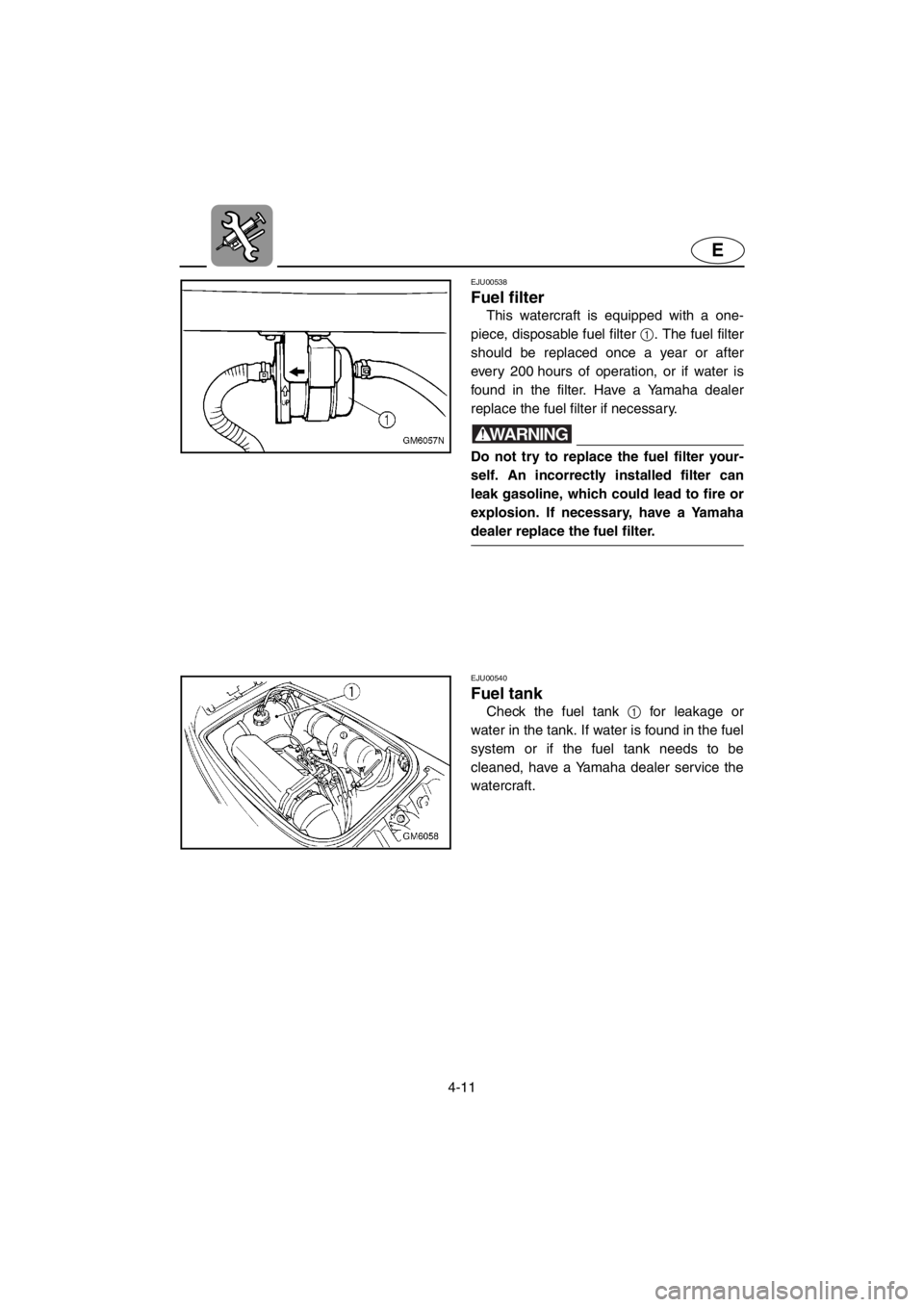
Check the fuel tank 1 for leakage or
water in the tank. If water is found in the fuel
system or if the fuel tank needs to be
cleaned, have a Yamaha dealer service the
watercraft.
E_GM6-4.fm Page 11 Tuesday, July 11, 2000 11:28 AM
Page 83 of 107
4-14
E
NOTE:@●Wipe off any water on the spark plug or
inside the cap before installing the spark
plug cap. Push the spark plug cap down
until it clicks.
●If a torque wrench is not available when
you are fitting a new spark plug, a good
estimate of the correct torque with a new
gasket is a quarter turn to a half turn past
finger tight. Have the spark plug adjusted
to the correct torque with a torque wrench
as soon as possible.
@
WARNING@Be careful not to damage the insulator
when removing or installing a spark plug.
A damaged insulator could allow sparks
to escape, which could lead to explosion
or fire.
@
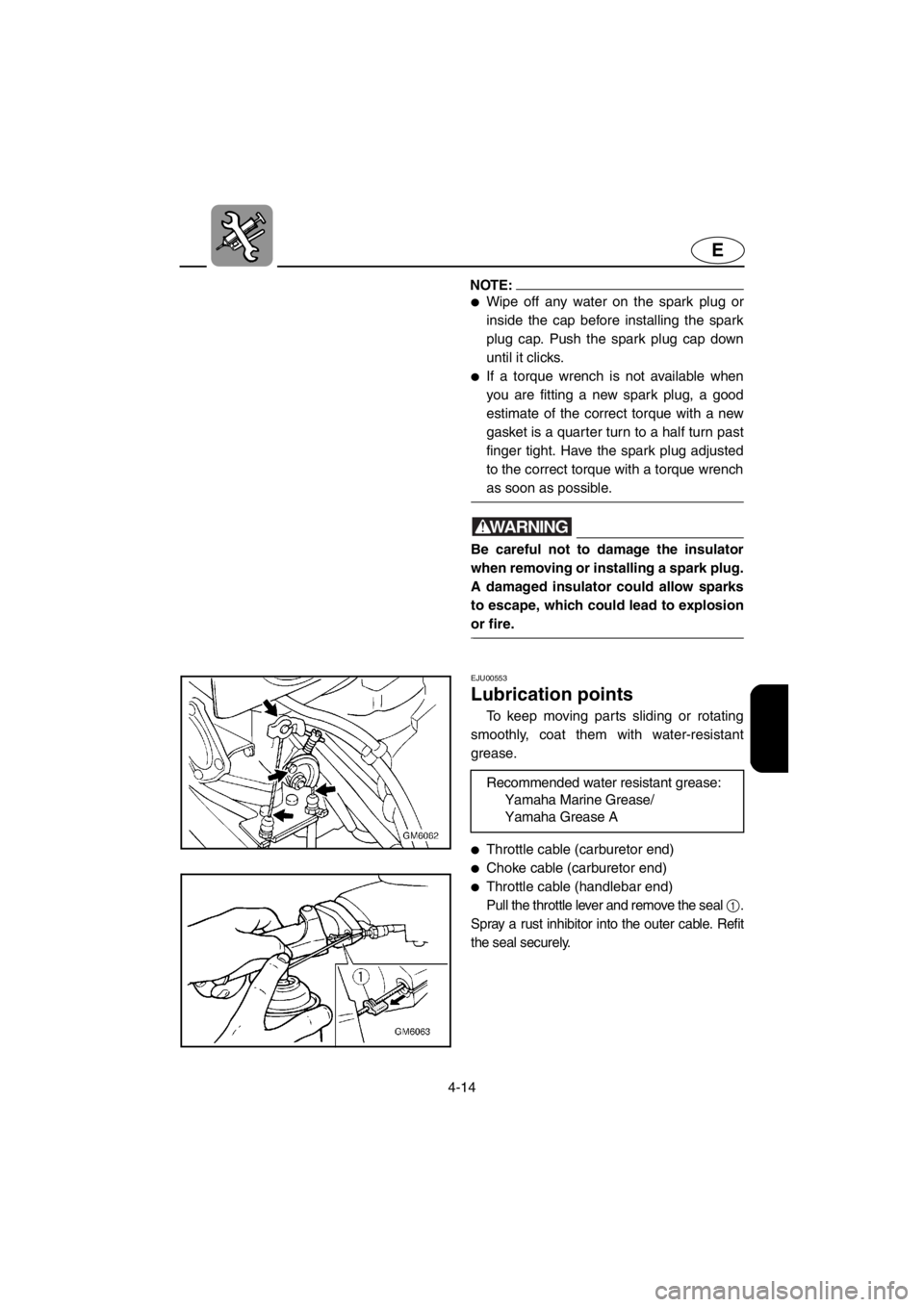
EJU00553
Lubrication points
To keep moving parts sliding or rotating
smoothly, coat them with water-resistant
grease.
●Throttle cable (carburetor end)
●Choke cable (carburetor end)
●Throttle cable (handlebar end)
Pull the throttle lever and remove the seal 1.
Spray a rust inhibitor into the outer cable. Refit
the seal securely.
Recommended water resistant grease:
Yamaha Marine Grease/
Yamaha Grease A
E_GM6-4.fm Page 14 Tuesday, July 11, 2000 11:28 AM
Page 86 of 107
4-17
E
EJU00572
Inspecting the battery
Check the level of the battery electrolyte
and make sure the leads are secure.
WARNING@Battery electrolyte is poisonous and dan-
gerous, causing severe burns, etc. Elec-
trolyte contains sulfuric acid. Avoid
contact with skin, eyes or clothing.
Antidotes
External: Flush with water.
Internal: Drink large quantities of water
or milk. Follow with milk of magnesia,
beaten egg or vegetable oil. Call physi-
cian immediately.
Eyes: Flush with water for 15 minutes
and get prompt medical attention.
Batteries produce explosive gases. Keep
sparks, flame, cigarettes, etc., well away.
If using or charging the battery in an
enclosed space, make sure that it is well
ventilated. Always shield your eyes when
working near batteries.
KEEP OUT OF THE REACH OF CHIL-
DREN.
@
CAUTION:
Be careful not to place the battery on its
side.
Make sure to remove the battery from the
battery compartment when adding the
battery electrolyte or charging the bat-
tery.
When checking the battery, make sure
the breather hose is connected to the
battery and not obstructed.
@
E_GM6-4.fm Page 17 Tuesday, July 11, 2000 11:28 AM