Page 61 of 107
3-26
E
EJU00931
Capsized watercraft
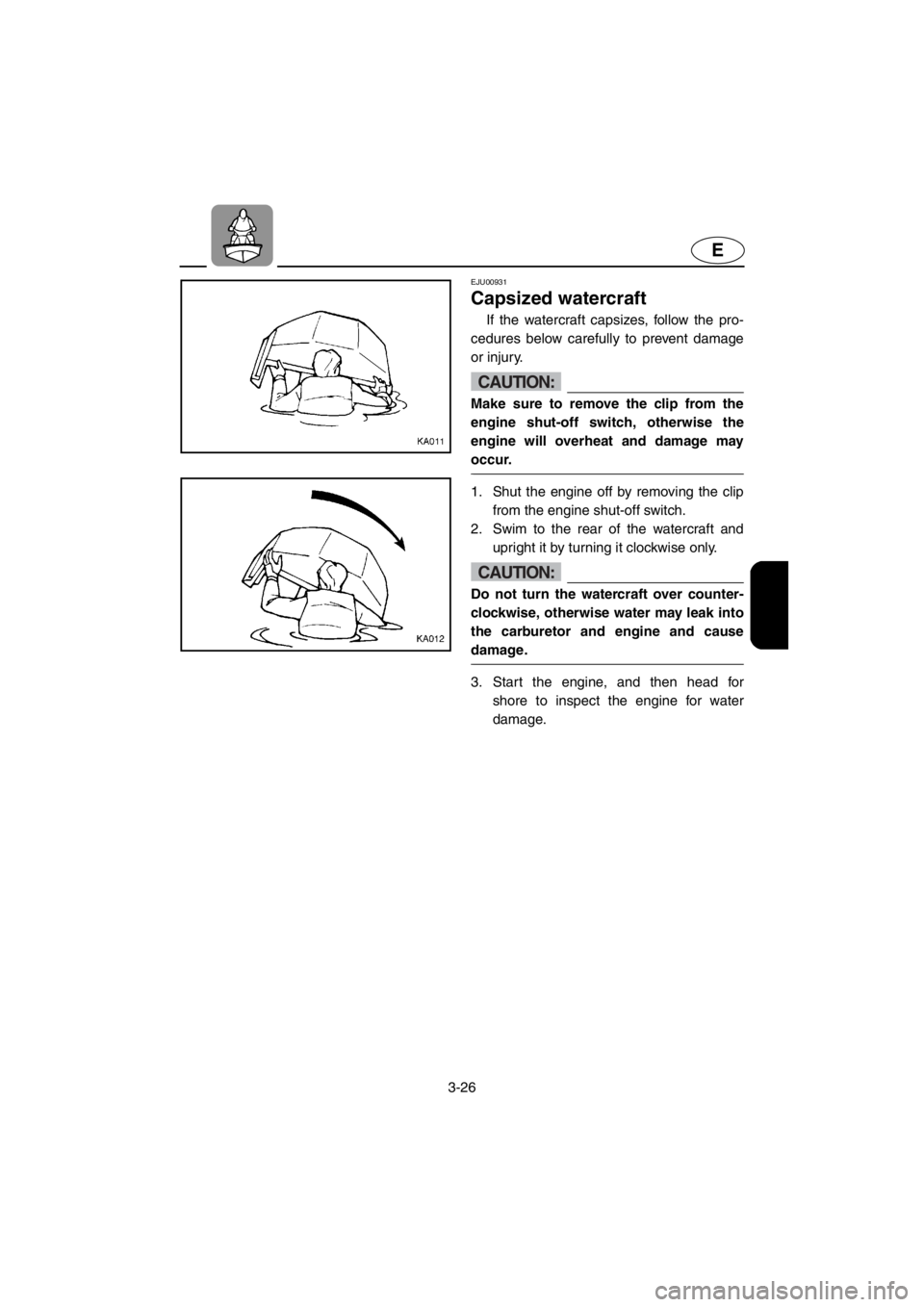
If the watercraft capsizes, follow the pro-
cedures below carefully to prevent damage
or injury.
CAUTION:@Make sure to remove the clip from the
engine shut-off switch, otherwise the
engine will overheat and damage may
occur.
@
1. Shut the engine off by removing the clip
from the engine shut-off switch.
2. Swim to the rear of the watercraft and
upright it by turning it clockwise only.
CAUTION:@Do not turn the watercraft over counter-
clockwise, otherwise water may leak into
the carburetor and engine and cause
damage.
@
3. Start the engine, and then head for
shore to inspect the engine for water
damage.
E_GM6-3.fm Page 26 Tuesday, July 11, 2000 10:52 AM
Page 68 of 107
3-33
E
EJU00952
Transporting
WARNING@Always place the fuel cock knob in the
“OFF” position when transporting the
watercraft, otherwise fuel could leak out
into the engine or engine compartment,
which would create a fire hazard.
@
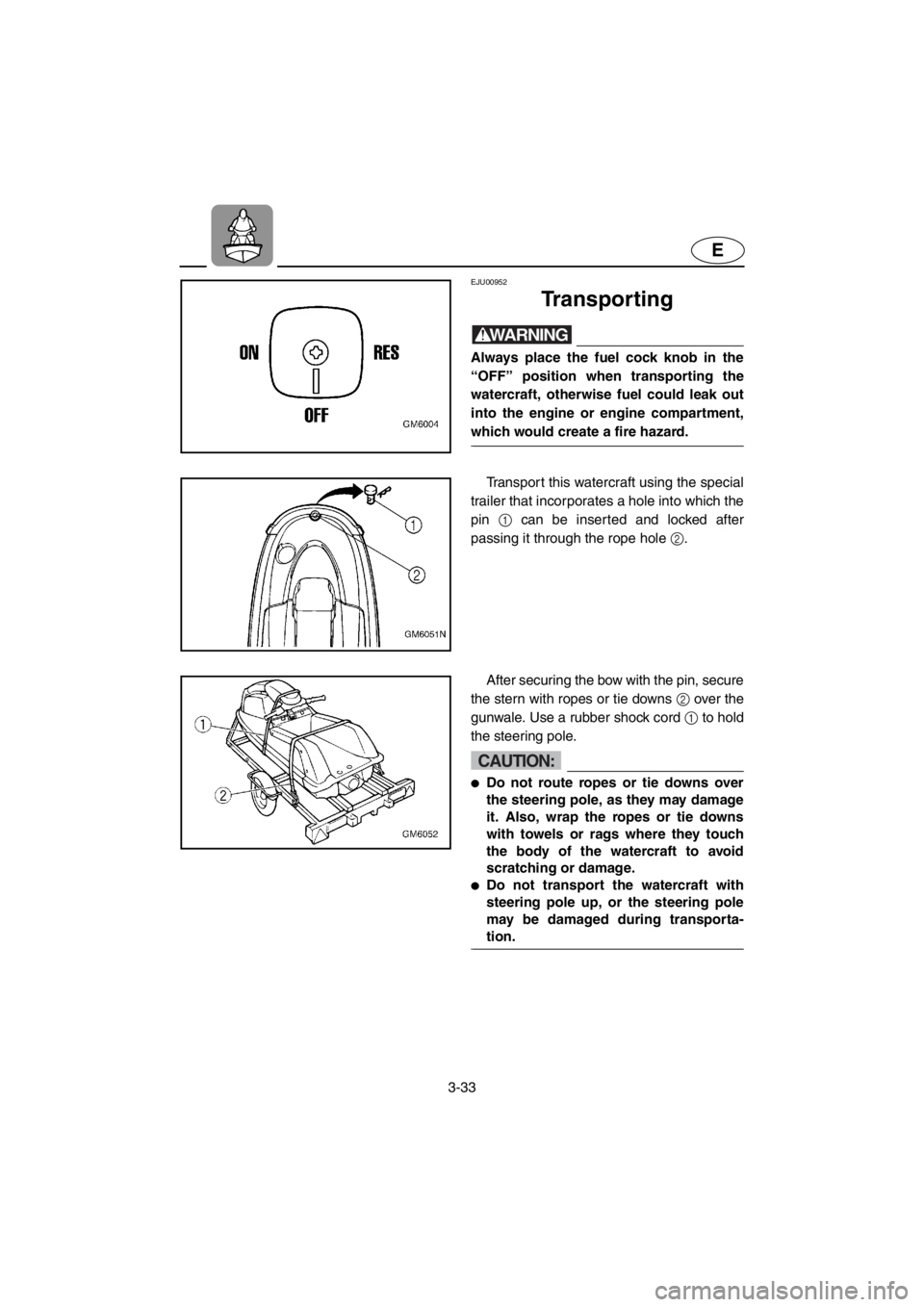
Transport this watercraft using the special
trailer that incorporates a hole into which the
pin 1 can be inserted and locked after
passing it through the rope hole 2.
After securing the bow with the pin, secure
the stern with ropes or tie downs 2 over the
gunwale. Use a rubber shock cord 1 to hold
the steering pole.
CAUTION:@●Do not route ropes or tie downs over
the steering pole, as they may damage
it. Also, wrap the ropes or tie downs
with towels or rags where they touch
the body of the watercraft to avoid
scratching or damage.
●Do not transport the watercraft with
steering pole up, or the steering pole
may be damaged during transporta-
tion.
@
E_GM6-3.fm Page 33 Tuesday, July 11, 2000 10:52 AM
Page 72 of 107
4-3
E
EJU00945
Lubrication
WARNING@To reduce the risk of fire or explosion:
Never pour or spray gasoline, or any sub-
stance other than a rust inhibitor through
the hole in the carburetor silencer cover.
@
CAUTION:@●Make sure to replace the cap securely
after fogging the engine, otherwise
water could enter the engine and
cause damage.
●Do not attempt to run the engine at full
throttle or for more than 15 seconds
while the watercraft is out of the water,
otherwise the engine may overheat
and/or seize.
@
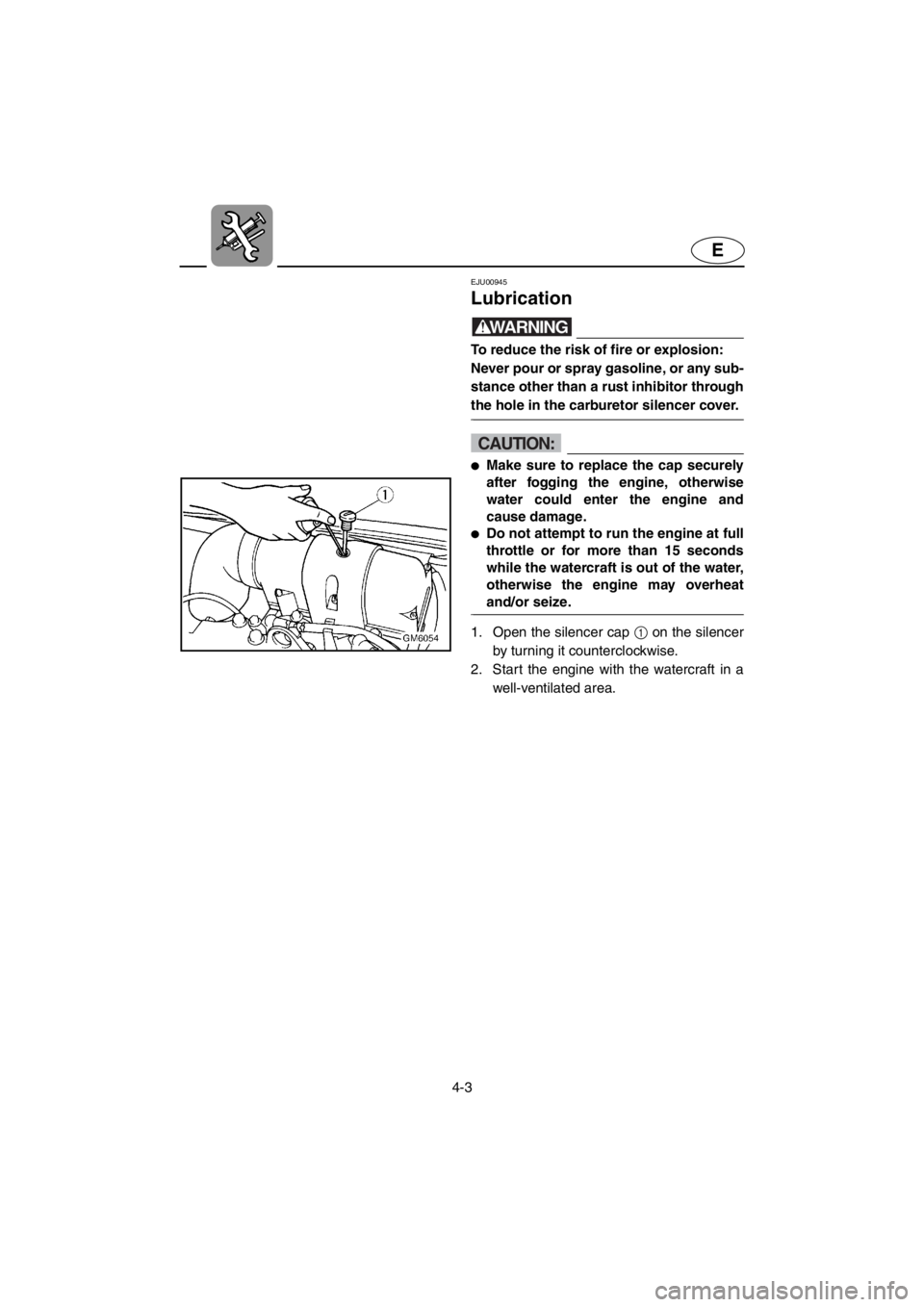
1. Open the silencer cap 1 on the silencer
by turning it counterclockwise.
2. Start the engine with the watercraft in a
well-ventilated area.
E_GM6-4.fm Page 3 Tuesday, July 11, 2000 11:28 AM
Page 81 of 107
4-12
E
EJU00546
Inspecting the steering cable
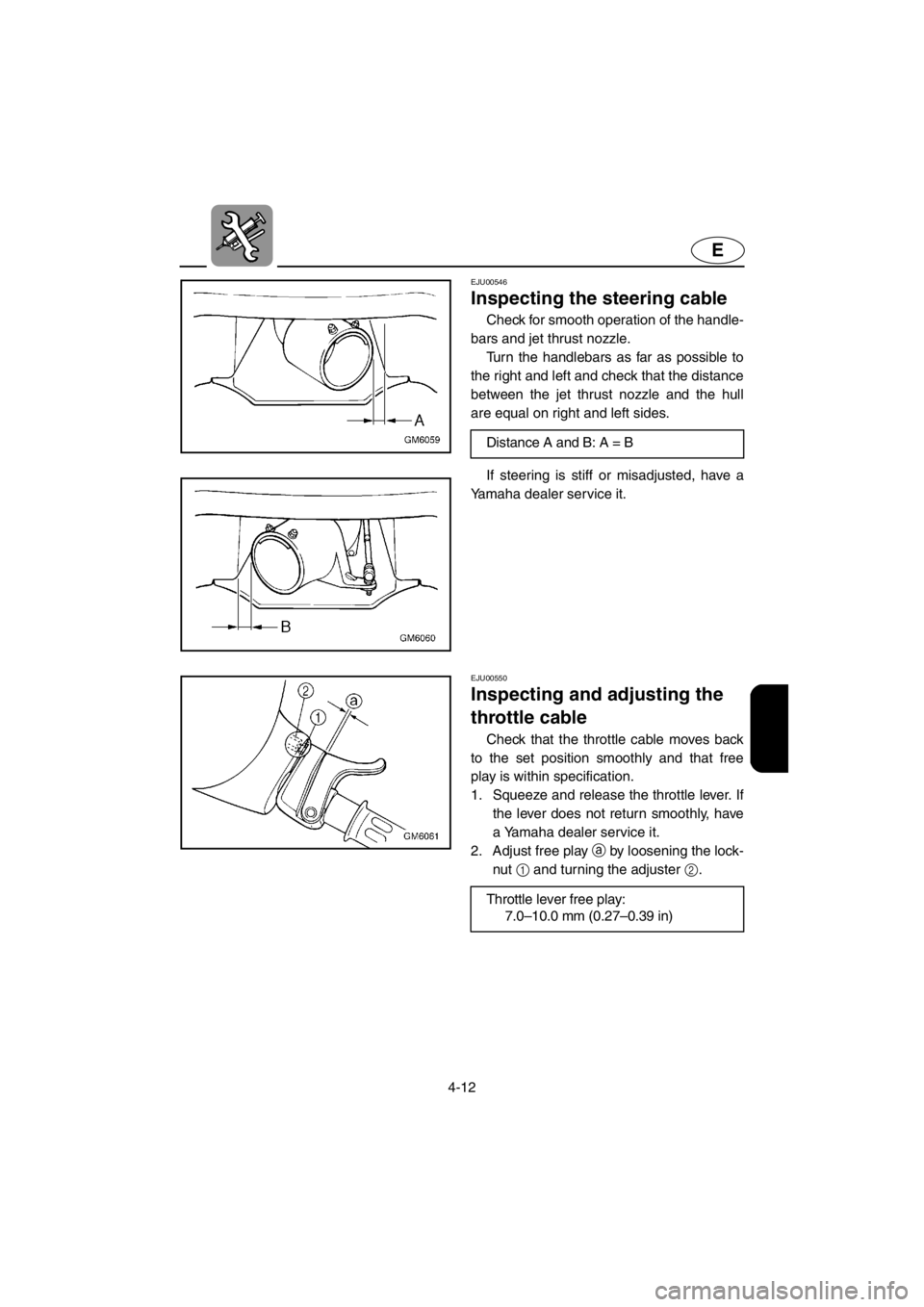
Check for smooth operation of the handle-
bars and jet thrust nozzle.
Turn the handlebars as far as possible to
the right and left and check that the distance
between the jet thrust nozzle and the hull
are equal on right and left sides.
If steering is stiff or misadjusted, have a
Yamaha dealer service it.Distance A and B: A = B
EJU00550
Inspecting and adjusting the
throttle cable
Check that the throttle cable moves back
to the set position smoothly and that free
play is within specification.
1. Squeeze and release the throttle lever. If
the lever does not return smoothly, have
a Yamaha dealer service it.
2. Adjust free play a by loosening the lock-
nut 1 and turning the adjuster 2.
Throttle lever free play:
7.0–10.0 mm (0.27–0.39 in)
E_GM6-4.fm Page 12 Tuesday, July 11, 2000 11:28 AM
Page 88 of 107
4-19
E
EJU00573
Adjusting the carburetor
The carburetor is a vital part of the engine
and requires very sophisticated adjustment.
Most adjusting should be left to a Yamaha
dealer who has the professional knowledge
and experience to perform it. However, the
operator may adjust the trolling speed as
part of the usual maintenance routine.
CAUTION:@The carburetor was set at the Yamaha
factory after many tests. If the settings
are disturbed by someone who does not
have the necessary technical knowledge,
poor engine performance and damage
may result.
@
EJU00574a
Adjusting the trolling speed
1. Put the watercraft in the water.
2. Start the engine and warm it up for 1 or
2 minutes. Using a diagnostic tachome-
ter, adjust the engine speed to specifica-
tion.
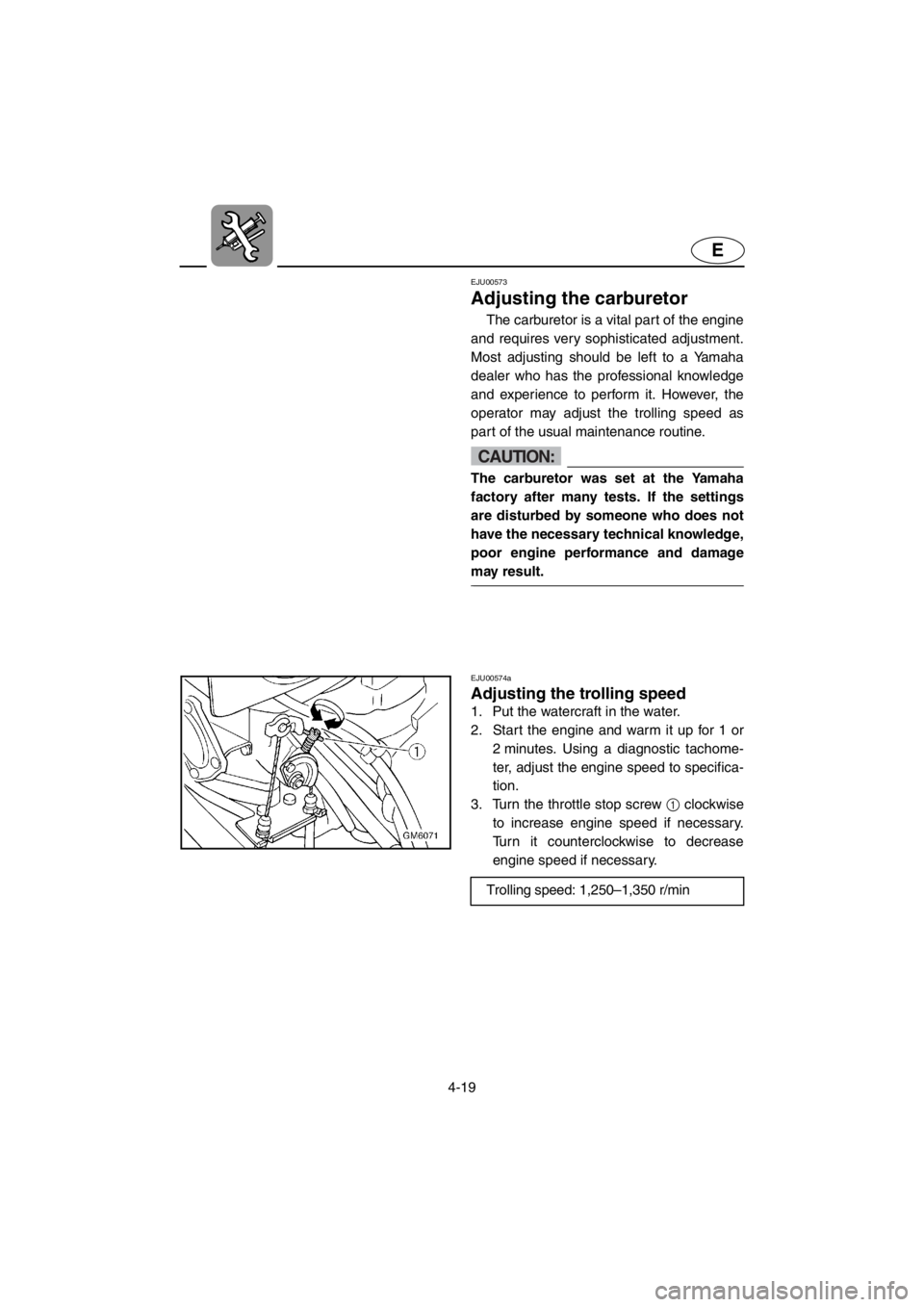
3. Turn the throttle stop screw 1 clockwise
to increase engine speed if necessary.
Turn it counterclockwise to decrease
engine speed if necessary.
Trolling speed: 1,250–1,350 r/min
E_GM6-4.fm Page 19 Tuesday, July 11, 2000 11:28 AM
Page 89 of 107

4-20
E
EJU00578
Replacing the fuse
The fuse is in the electrical box 1.
To replace the fuse:
1. Remove the cap 2, pull out the red lead,
and bring the fuse holder 3 out of the
electrical box.
2. Open the fuse holder and replace the
fuse4 with one of the correct amper-
age.
WARNING@Do not use fuses of higher amperage
than those recommended. Substitution
of a fuse of improper rating can cause
extensive electrical system damage and
possible fire.
@
Fuse amperage: 10 A
EJU00582
Adjusting the steering friction
The amount of friction in the steering can
be adjusted to suit operator preference.
To adjust the friction:
1. Loosen the four screws, and then
remove the handlebar cover.
2. Turn the handlebars as far as possible to
starboard (right).
3. Loosen the locknut 2.
4. Tighten or loosen the adjusting nut 1
until the desired amount of friction is
reached.
5. Hold the adjusting nut with one wrench
while tightening the locknut with another
wrench.
Tightening torque:
29 Nm (2.9 m·kg, 21 ft·lb)
E_GM6-4.fm Page 20 Tuesday, July 11, 2000 11:28 AM
Page 91 of 107
4-22
E
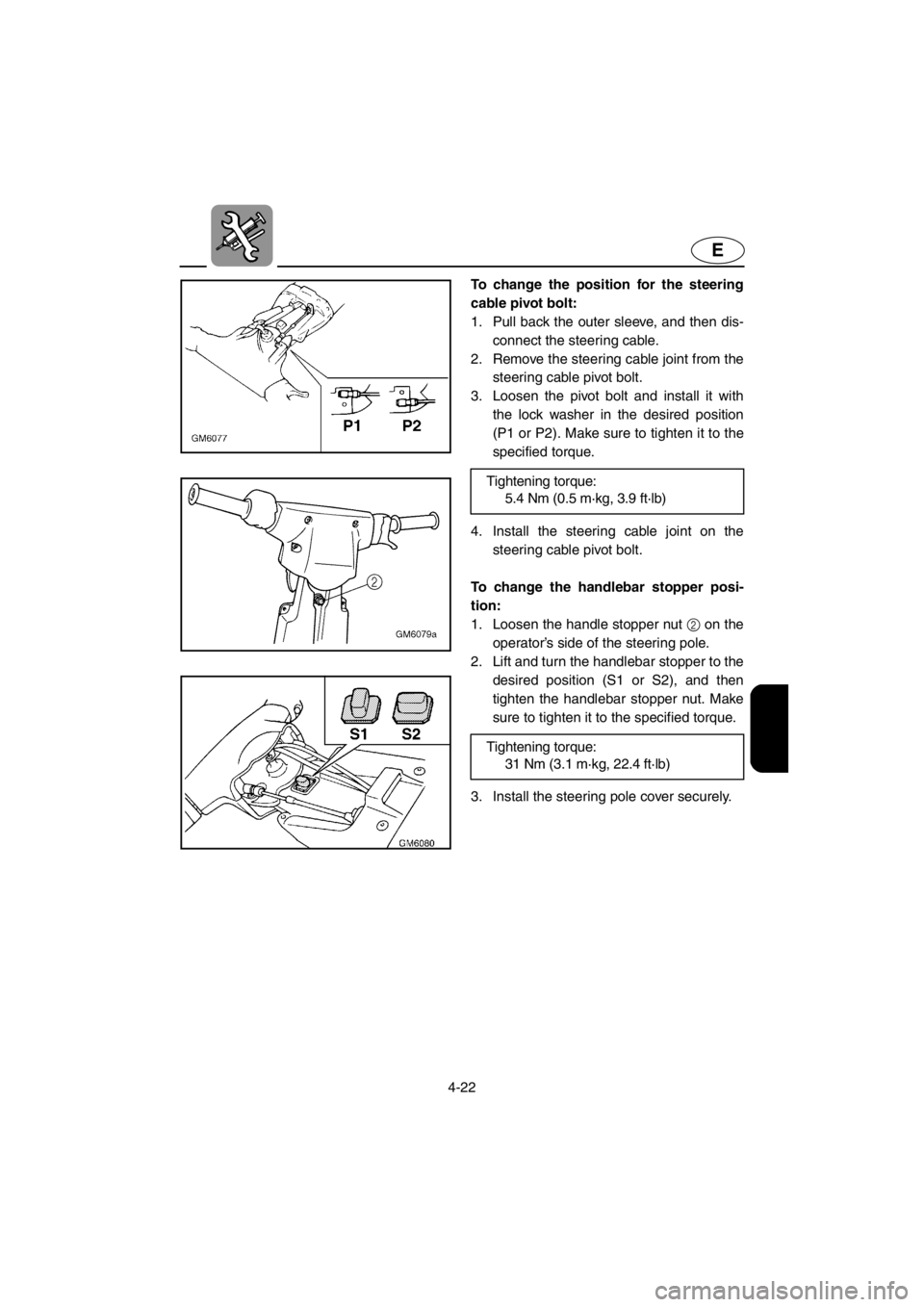
To change the position for the steering
cable pivot bolt:
1. Pull back the outer sleeve, and then dis-
connect the steering cable.
2. Remove the steering cable joint from the
steering cable pivot bolt.
3. Loosen the pivot bolt and install it with
the lock washer in the desired position
(P1 or P2). Make sure to tighten it to the
specified torque.
4. Install the steering cable joint on the
steering cable pivot bolt.
To change the handlebar stopper posi-
tion:
1. Loosen the handle stopper nut 2 on the
operator’s side of the steering pole.
2. Lift and turn the handlebar stopper to the
desired position (S1 or S2), and then
tighten the handlebar stopper nut. Make
sure to tighten it to the specified torque.
3. Install the steering pole cover securely. Tightening torque:
5.4 Nm (0.5 m·kg, 3.9 ft·lb)
Tightening torque:
31 Nm (3.1 m·kg, 22.4 ft·lb)
E_GM6-4.fm Page 22 Tuesday, July 11, 2000 11:28 AM
Page 92 of 107

4-23
E
EJU00590
Specifications
*1: Pump Octane Number
*1: Research Octane NumberMODEL
ITEMUnit SJ700
WATERCRAFT CAPACITY
Maximum people on board Number of people 1
DIMENSIONS
Length mm (in) 2,240 (88.2)
Width mm (in) 680 (26.8)
Height mm (in) 660 (26.0)
Dry weight kg (lb) 132 (291)
PERFORMANCE
Maximum power output kW (PS) @ r/min 53.6 (73) @ 6,300
Maximum fuel consumption L/h (US gal/h, Imp gal/h) 29 (7.7, 6.4)
Cruising range at full throttle hr. 0.6
Trolling speed r/min 1,250–1,350
ENGINE
Engine type 2-stroke
Number of cylinders 2
Engine displacement
cm
3 (cu in)701 (42.78)
Bore & stroke mm (in) 81 ×
68 (3.19 ×
2.68)
Compression ratio 7.2
Lubrication system Pre-mixed fuel
Cooling system Water cooled
Starting system Electric starter
Ignition system CDI
Spark plug BR-7HS (NGK)
Spark plug gap mm (in) 0.6–0.7 (0.024–0.028)
Battery capacity V-AH 12-19
Charging system Flywheel magneto
DRIVE UNIT
Propulsion system Jet pump
Jet pump type Mixed flow, single stage
Impeller rotation Counterclockwise (viewed from rear)
Transmission Direct drive from engine
Jet thrust nozzle angle Degree 37, 41, 45, 49
FUEL AND OIL
Recommended fuel Regular unleaded gasoline
Minimum octane rating PON (*1)
RON (*1)86
90
Recommended engine oil YAMALUBE 2-W, or an equivalent NMMA-
certified TC-W3 marine oil
Fuel mixing ratio (fuel to oil) 50:1
Fuel tank capacity
Total L (US gal, Imp gal) 18 (4.8, 4.0)
Reserve L (US gal, Imp gal) 5.5 (1.45, 1.21)
E_GM6-4.fm Page 23 Tuesday, July 11, 2000 11:28 AM