Page 27 of 107
2-4
E
2. Push down on the hood latch, and then
turn the knob to the lock position.
NOTE:@Make sure that the hood is properly secured
before operating the watercraft.
@
EJU00345
Fuel tank filler cap
To remove the fuel tank filler cap 1, turn it
counterclockwise.
NOTE:@Make sure that the cap is securely tightened
before operating the watercraft.
@
EJU00348
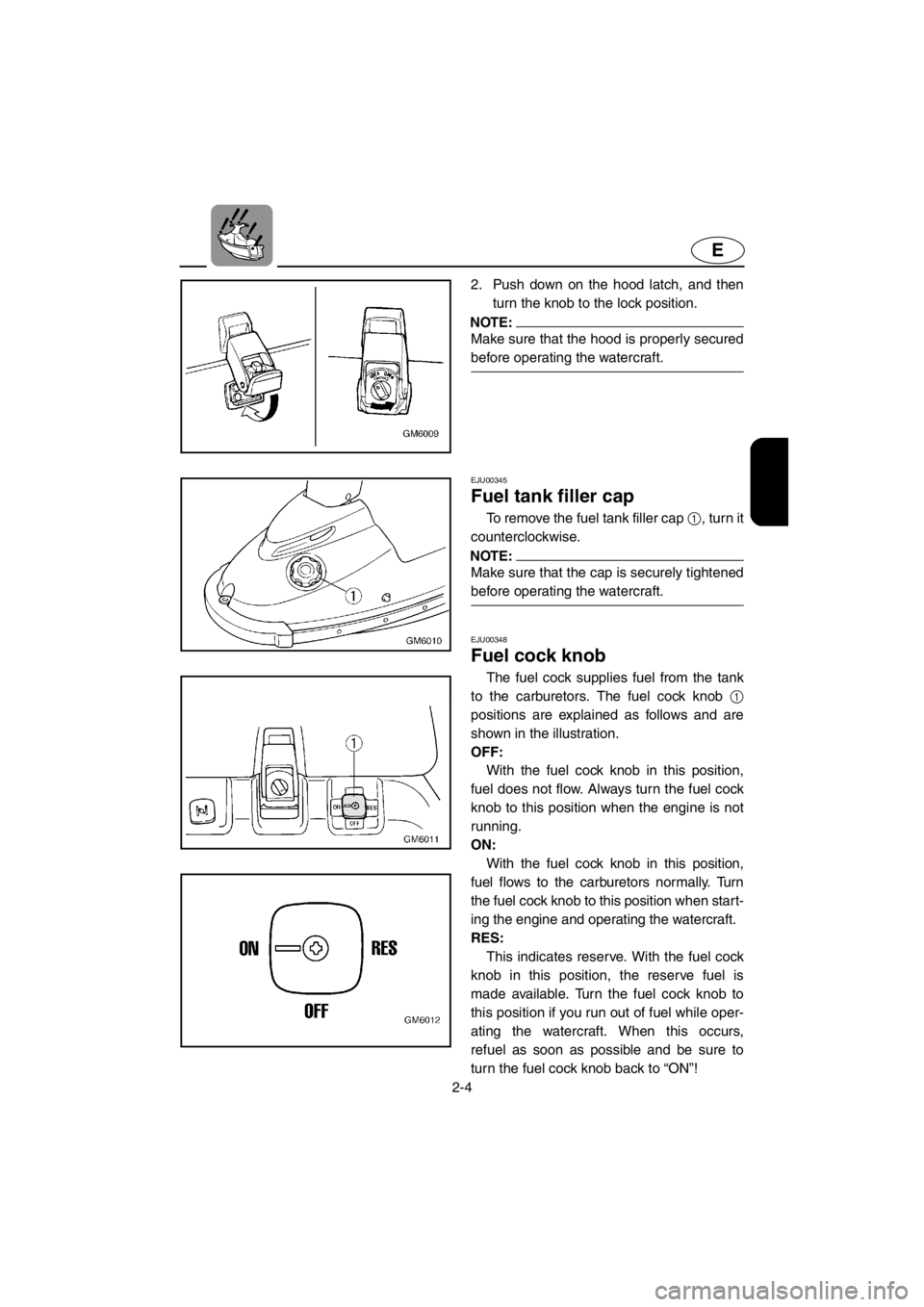
Fuel cock knob
The fuel cock supplies fuel from the tank
to the carburetors. The fuel cock knob 1
positions are explained as follows and are
shown in the illustration.
OFF:
With the fuel cock knob in this position,
fuel does not flow. Always turn the fuel cock
knob to this position when the engine is not
running.
ON:
With the fuel cock knob in this position,
fuel flows to the carburetors normally. Turn
the fuel cock knob to this position when start-
ing the engine and operating the watercraft.
RES:
This indicates reserve. With the fuel cock
knob in this position, the reserve fuel is
made available. Tur n the fuel cock knob to
this position if you run out of fuel while oper-
ating the watercraft. When this occurs,
refuel as soon as possible and be sure to
turn the fuel cock knob back to “ON”!
E_GM6-2.fm Page 4 Tuesday, July 11, 2000 10:51 AM
Page 28 of 107
2-5
E
EJU00705
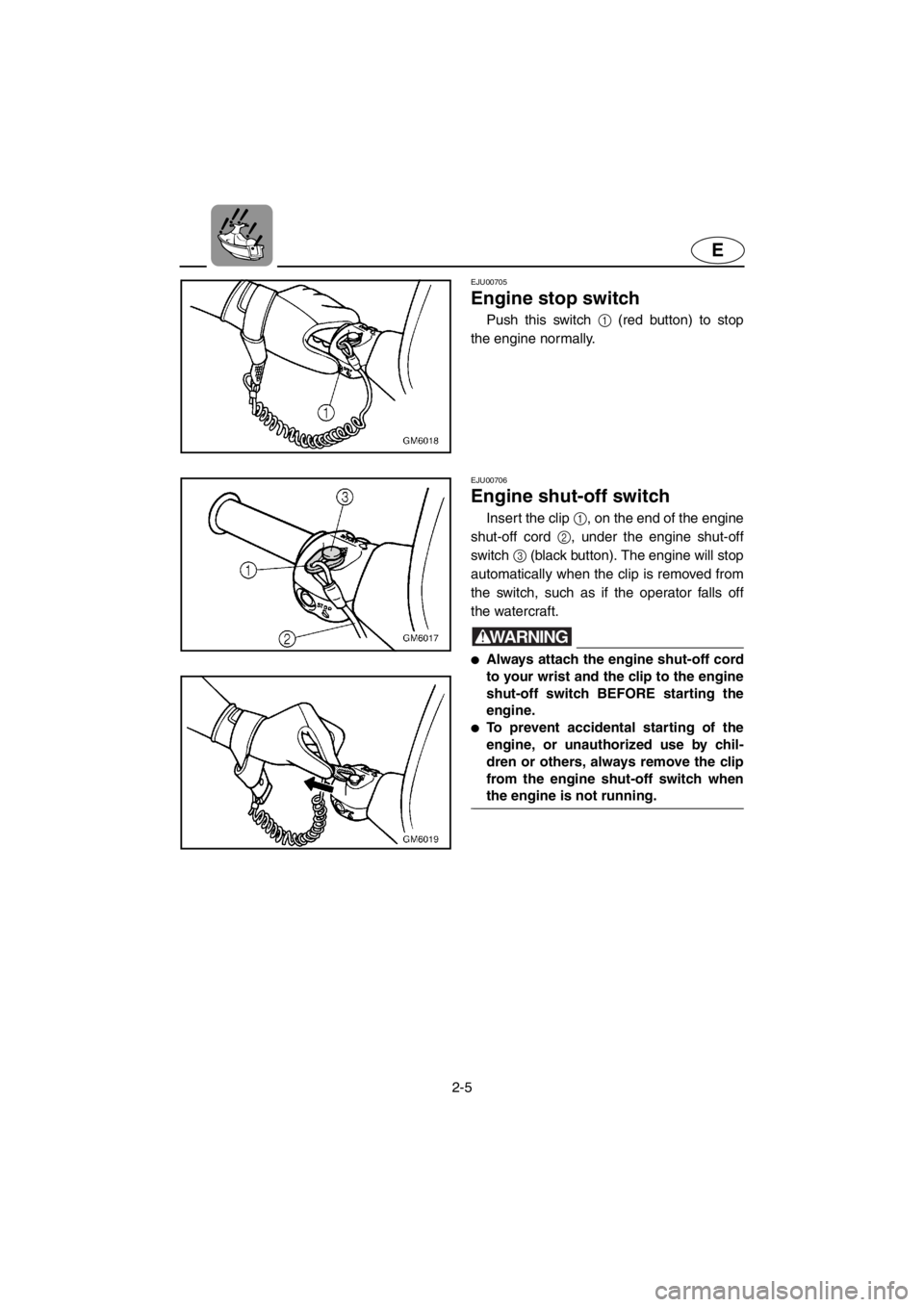
Engine stop switch
Push this switch 1 (red button) to stop
the engine normally.
EJU00706
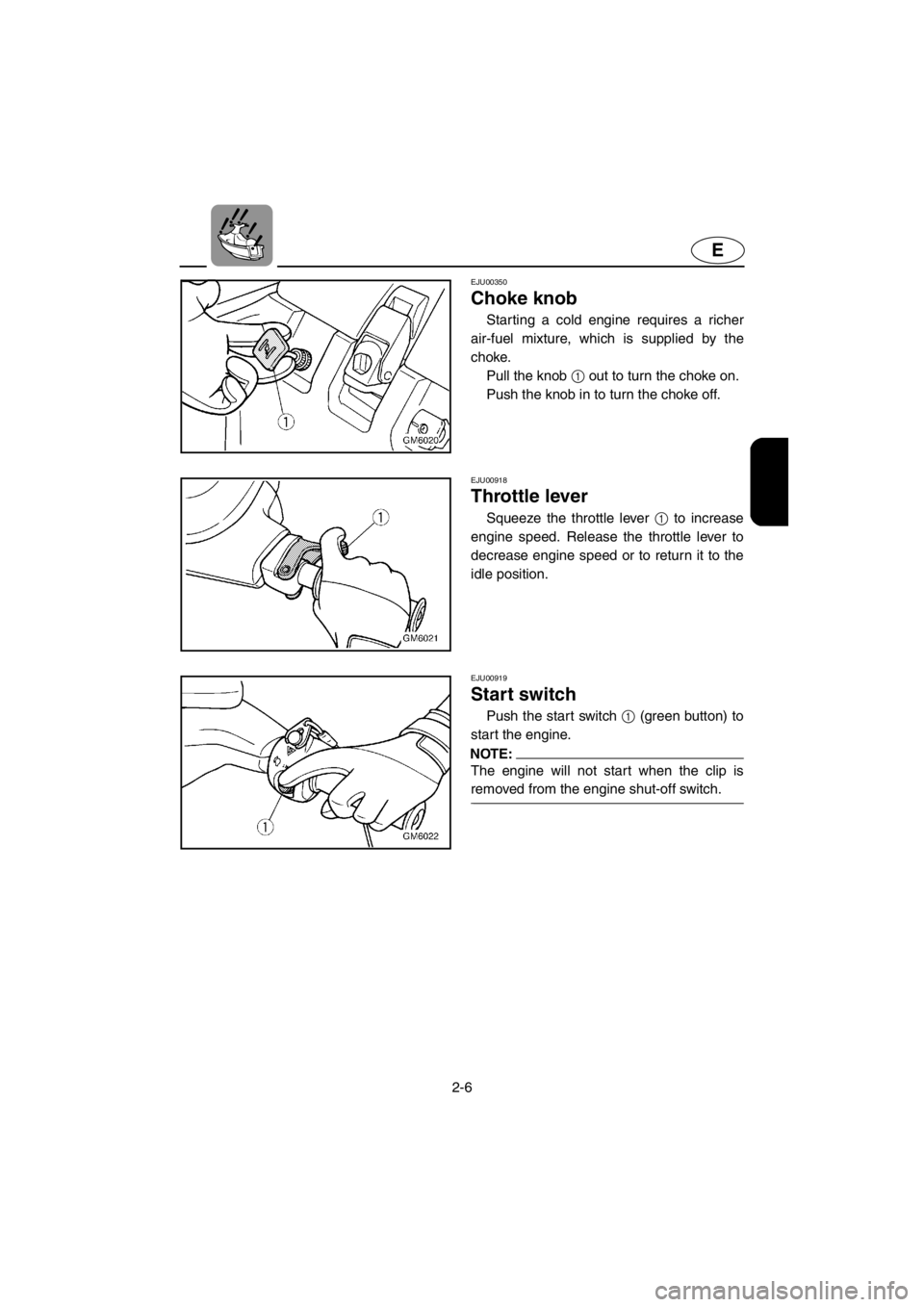
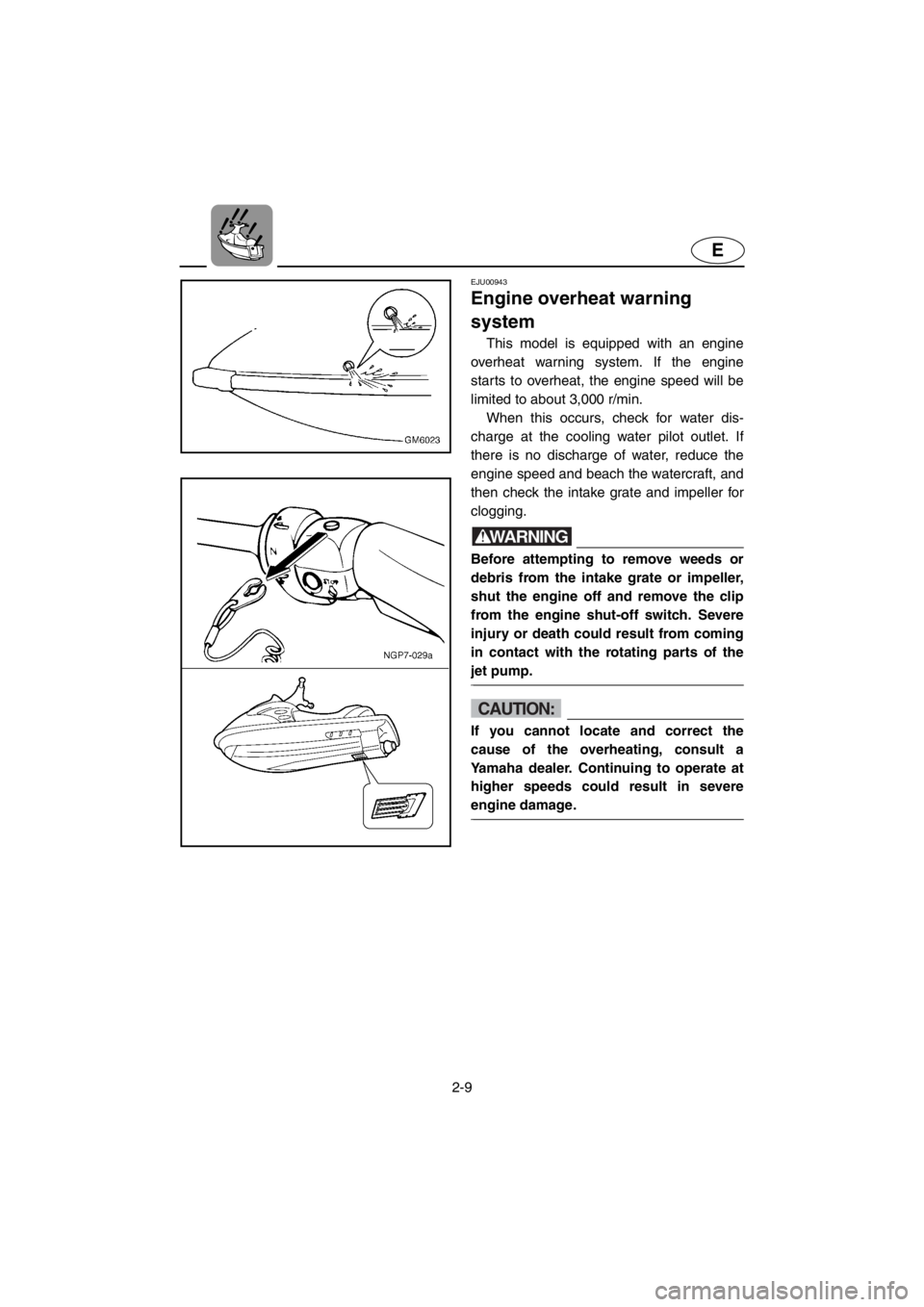
Engine shut-off switch
Insert the clip 1, on the end of the engine
shut-off cord 2, under the engine shut-off
switch 3 (black button). The engine will stop
automatically when the clip is removed from
the switch, such as if the operator falls off
the watercraft.
WARNING@●Always attach the engine shut-off cord
to your wrist and the clip to the engine
shut-off switch BEFORE starting the
engine.
●To prevent accidental starting of the
engine, or unauthorized use by chil-
dren or others, always remove the clip
from the engine shut-off switch when
the engine is not running.
@
E_GM6-2.fm Page 5 Tuesday, July 11, 2000 10:51 AM
Page 29 of 107
2-6
E
EJU00350
Choke knob
Starting a cold engine requires a richer
air-fuel mixture, which is supplied by the
choke.
Pull the knob 1 out to turn the choke on.
Push the knob in to turn the choke off.
EJU00918
Throttle lever
Squeeze the throttle lever 1 to increase
engine speed. Release the throttle lever to
decrease engine speed or to return it to the
idle position.
EJU00919
Start switch
Push the start switch 1 (green button) to
start the engine.
NOTE:@The engine will not start when the clip is
removed from the engine shut-off switch.
@
E_GM6-2.fm Page 6 Tuesday, July 11, 2000 10:51 AM
Page 30 of 107
2-7
E
EJU00923
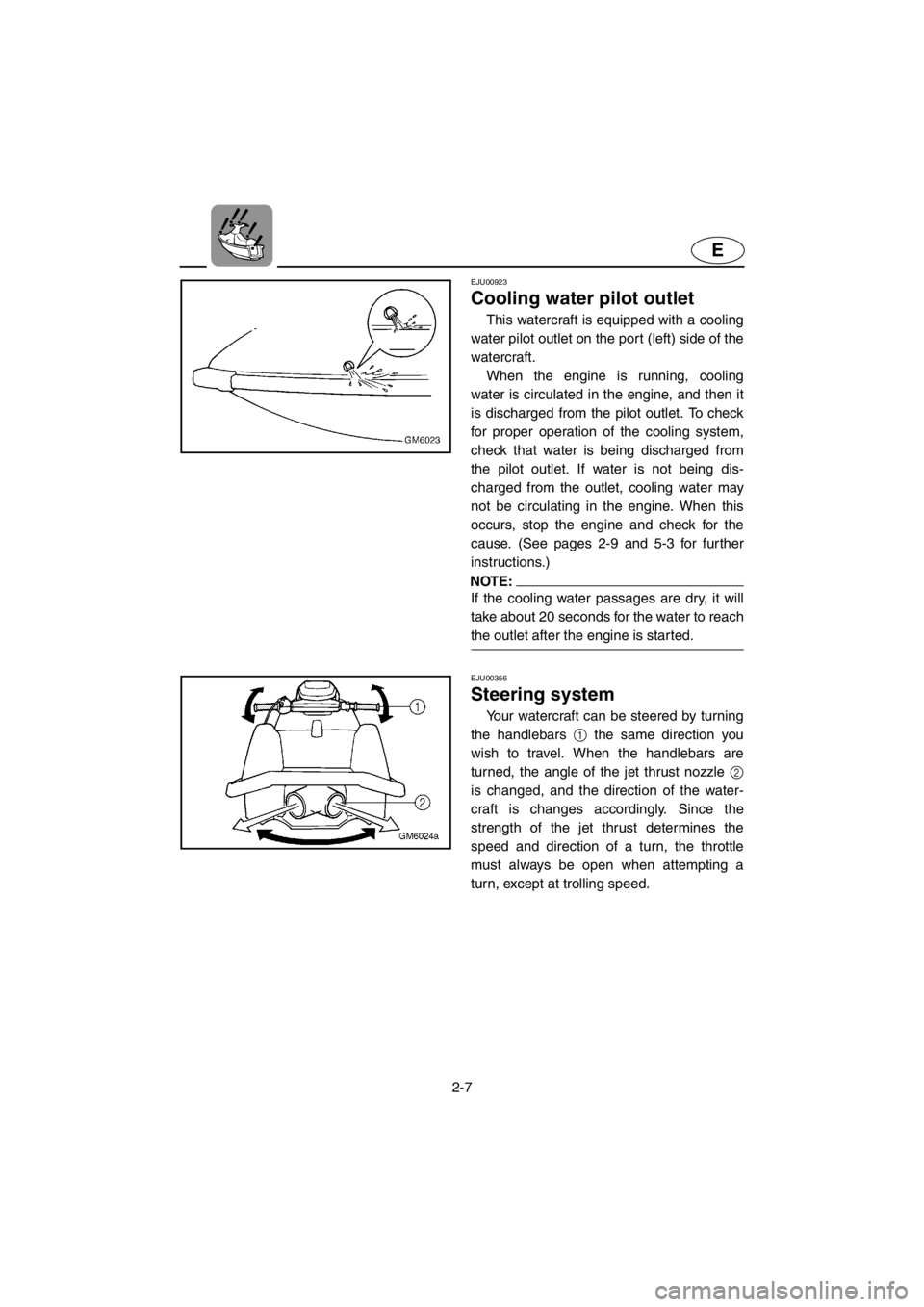
Cooling water pilot outlet
This watercraft is equipped with a cooling
water pilot outlet on the port (left) side of the
watercraft.
When the engine is running, cooling
water is circulated in the engine, and then it
is discharged from the pilot outlet. To check
for proper operation of the cooling system,
check that water is being discharged from
the pilot outlet. If water is not being dis-
charged from the outlet, cooling water may
not be circulating in the engine. When this
occurs, stop the engine and check for the
cause. (See pages 2-9 and 5-3 for further
instructions.)
NOTE:@If the cooling water passages are dry, it will
take about 20 seconds for the water to reach
the outlet after the engine is started.
@
EJU00356
Steering system
Your watercraft can be steered by turning
the handlebars 1 the same direction you
wish to travel. When the handlebars are
turned, the angle of the jet thrust nozzle 2
is changed, and the direction of the water-
craft is changes accordingly. Since the
strength of the jet thrust determines the
speed and direction of a turn, the throttle
must always be open when attempting a
turn, except at trolling speed.
E_GM6-2.fm Page 7 Tuesday, July 11, 2000 10:51 AM
Page 32 of 107
2-9
E
EJU00943
Engine overheat warning
system
This model is equipped with an engine
overheat warning system. If the engine
starts to overheat, the engine speed will be
limited to about 3,000 r/min.
When this occurs, check for water dis-
charge at the cooling water pilot outlet. If
there is no discharge of water, reduce the
engine speed and beach the watercraft, and
then check the intake grate and impeller for
clogging.
WARNING@Before attempting to remove weeds or
debris from the intake grate or impeller,
shut the engine off and remove the clip
from the engine shut-off switch. Severe
injury or death could result from coming
in contact with the rotating parts of the
jet pump.
@
CAUTION:@If you cannot locate and correct the
cause of the overheating, consult a
Yamaha dealer. Continuing to operate at
higher speeds could result in severe
engine damage.
@
E_GM6-2.fm Page 9 Tuesday, July 11, 2000 10:51 AM
Page 35 of 107
E
3
EJU00410
OPERATION
Fuel and oil................................................ 3-1
Gasoline .................................................. 3-1
2-stroke engine oil................................... 3-2
Mixing fuel and oil .................................. 3-3
Filling the fuel tank .................................. 3-4
Pre-operation checks............................... 3-5
Pre-operation check list .......................... 3-5
Pre-operation check points..................... 3-6
Operation................................................. 3-13
Engine break-in ..................................... 3-13
Starting the engine................................ 3-15
Stopping the engine.............................. 3-18
Leaving the watercraft .......................... 3-18
Operating your watercraft..................... 3-19
Getting to know your watercraft............ 3-19
Learning to operate your watercraft ..... 3-19
Starting the watercraft........................... 3-21
Operating positions ............................... 3-25
Capsized watercraft .............................. 3-26
Turning the watercraft........................... 3-27
Stopping the watercraft......................... 3-29
Beaching the watercraft ........................ 3-30
Rough water operation ......................... 3-30
Post-operation checks.......................... 3-31
Transporting........................................... 3-33
E_GM6-3TOC.fm Page 1 Tuesday, July 11, 2000 10:51 AM
Page 36 of 107
3-1
E
EJU00421
Fuel and oil
Gasoline
WARNING@GASOLINE AND ITS VAPORS ARE
HIGHLY FLAMMABLE AND EXPLOSIVE!
●Do not smoke when refueling, and
keep away from sparks, flames, or
other sources of ignition.
●Stop engine before refueling.
●Refuel in a well-ventilated area. Do not
stand or sit on the watercraft while
refueling in case of fire.
●Take care not to spill gasoline. If gaso-
line spills, wipe it up immediately with
dry rags. Always properly dispose of
gasoline-soaked rags.
●Avoid overfilling the fuel tank. Stop fill-
ing when the fuel level just reaches the
bottom of the filler tube. Do not fill up
the filler tube because fuel expands as
it warms up and could overflow.
●Tighten the filler cap securely after
refueling.
●If you should swallow some gasoline,
inhale a lot of gasoline vapor, or get
gasoline in your eyes, get immediate
medical attention.
●If any gasoline spills onto your skin,
immediately wash with soap and
water. Change clothing if gasoline
spills on it.
@
CAUTION:@Use only fresh gasoline that has been
stored in clean containers.
@
Recommended gasoline:
Regular unleaded gasoline:
Minimum octane rating:
86 (Pump octane number): (R+M)/2
90 (Research octane number)
E_GM6-3.fm Page 1 Tuesday, July 11, 2000 10:52 AM
Page 37 of 107
3-2
E
Gasohol
There are two types of gasohol: gasohol
containing ethanol and that containing meth-
anol.
Gasohol containing ethanol can be used
if ethanol content does not exceed 10% and
the fuel meets minimum octane ratings.
Gasohol containing methanol is not rec-
ommended by Yamaha because it can
cause fuel system damage or engine perfor-
mance problems.
EJU00939
2-stroke engine oil
If YAMALUBE 2-W is not available,
another 2-stroke engine oil with an NMMA-
certified TC-W3 rating may be used.Recommended engine oil:
YAMALUBE 2-W
E_GM6-3.fm Page 2 Tuesday, July 11, 2000 10:52 AM