2001 VOLVO S80 service
[x] Cancel search: servicePage 39 of 106

2 0 0 1
VOLVO S80
Chapter 5 - Keys, Locks, Alarm
pg. 55 Keys, Locks, Alarm
Keys, Exterior courtesy lights, Locking and unlocking the car56
Remote keyless entry system57
Unlocking the trunk with the master key, Central locking buttons, "Trunk lock" function59
Alarm60
Child safety locks - rear doors62
pg. 56 Keys, Exterior courtesy lights, Locking and unlocking the car
Keys
Two keys are provided with your car; a master key and a service key. The master key, the remote control, and the
central locking button may all be used to lock and unlock all of your car's locks.
The service key will operate only the driver's door and the ignition switch. It is intended to help deter unwanted entry
into the glove compartment and trunk.
Turn the key once to unlock the driver's door only.
Turn the key again (within 10 seconds) to unlock all doors and the trunk.
One turn with the key towards lock in the drivers door locks all doors, trunk.
ProCarManuals.com
Page 41 of 106
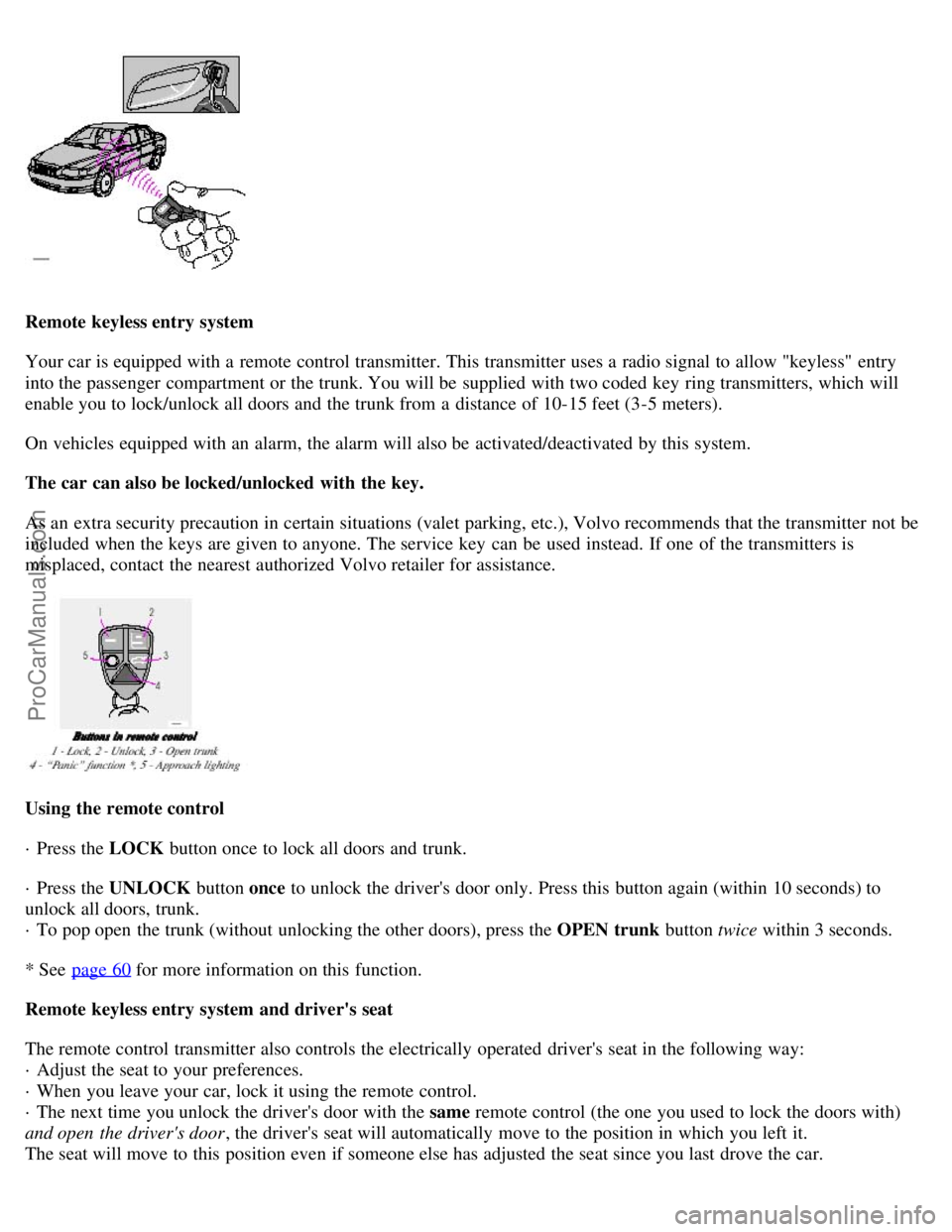
Remote keyless entry system
Your car is equipped with a remote control transmitter. This transmitter uses a radio signal to allow "keyless" entry
into the passenger compartment or the trunk. You will be supplied with two coded key ring transmitters, which will
enable you to lock/unlock all doors and the trunk from a distance of 10-15 feet (3-5 meters).
On vehicles equipped with an alarm, the alarm will also be activated/deactivated by this system.
The car can also be locked/unlocked with the key.
As an extra security precaution in certain situations (valet parking, etc.), Volvo recommends that the transmitter not be
included when the keys are given to anyone. The service key can be used instead. If one of the transmitters is
misplaced, contact the nearest authorized Volvo retailer for assistance.
Using the remote control
· Press the LOCK button once to lock all doors and trunk.
· Press the UNLOCK button once to unlock the driver's door only. Press this button again (within 10 seconds) to
unlock all doors, trunk.
· To pop open the trunk (without unlocking the other doors), press the OPEN trunk button twice within 3 seconds.
* See page 60
for more information on this function.
Remote keyless entry system and driver's seat
The remote control transmitter also controls the electrically operated driver's seat in the following way:
· Adjust the seat to your preferences.
· When you leave your car, lock it using the remote control.
· The next time you unlock the driver's door with the same remote control (the one you used to lock the doors with)
and open the driver's door , the driver's seat will automatically move to the position in which you left it.
The seat will move to this position even if someone else has adjusted the seat since you last drove the car.
ProCarManuals.com
Page 48 of 106

2 0 0 1
VOLVO S80
Chapter 6 - Starting and driving
pg. 63 Starting and driving
Fuel requirements64
Refueling65
Starting the engine66
Automatic transmission67
Driving economy71
Points to remember72
Emergency towing74
Vehicle towing information75
Towing a trailer76
Jump starting79
Winter driving80
Long distance trips81
Three-way catalytic converter82
pg. 64 Fuel requirements
NOTE ENGINE OIL:
Although some oil consumption occurs during normal engine operation, more oil is consumed when the engine is new
as the internal parts generate higher friction while wearingin to each other. From the time the engine is new until the
first service is performed, the oil consumption could be higher than normal. For this reason, it is especially
important to check the oil every time you refuel your car during this period. See page 115
.
Fuel requirements
Octane rating
ProCarManuals.com
Page 49 of 106

Volvo engines are designed for optimum performance on unleaded premium gasoline with an octane rating. AKI of 91,
or above. AKI (ANTI KNOCK INDEX) is an average of the Research Octane Number, RON, and the Motor Octane
Number, MON. (RON + MON/2).
The minimum octane requirement is AKI 87 (RON 91).
Deposit control gasoline (detergent additives)
Volvo recommends the use of gasoline containing deposit control additives. These additives have shown to be efficient
in keeping injectors and intake valves clean. Consistent use of deposit control gasolines will help ensure good
driveability and fuel economy. If you are not sure whether the gasoline contains deposit control additives, check with
the service station operator.
Unleaded fuel
Each Volvo has a three-way catalytic converter and must use only unleaded gasoline. U.S. and Canadian regulations
require that pumps delivering unleaded gasoline be labelled "UNLEADED". Only these pumps have nozzles which fit
your car's filler inlet. It is unlawful to dispense leaded fuel into a vehicle labelled "unleaded gasoline only". Leaded
gasoline damages the three-way catalytic converter and the heated oxygen sensor system. Repeated use of leaded
gasoline will lessen the effectiveness of the emission control system and could result in loss of emission warranty
coverage. State and local vehicle inspection programs will make detection of misfueling easier, possibly resulting in
emission test failure for misfueled vehicles.
NOTE: Some U.S. and Canadian gasolines contain an octane enhancing additive called methyl-cyclopentadienyl
manganese tricarbonyl (MMT). If such fuels are used, your Emission Control System performance may be affected,
and the Check Engine Light (malfunction indicator lamp) located on your instrument panel may light. If this occurs,
please return your vehicle to an authorized Volvo retailer for service.
Gasoline containing alcohol and ethers
"Oxygenated fuels"
Some fuel suppliers sell gasoline containing "oxygenates" which are usually alcohols or ethers. In some areas, state or
local laws require that the service pump be marked indicating use of alcohols or ethers. However, there are areas in
which the pumps are unmarked. If you are not sure whether there is alcohol or ethers in the gasoline you buy, check
with the service station operator. To meet seasonal air quality standards, some areas require the use of "oxygenated"
fuel.
Volvo allows the use of the following "oxygenated fuels; however, the octane ratings listed on this page must still be
met.
Alcohol — Ethanol: Fuels containing up to 10% ethanol by volume may be used. Ethanol may also be referred to as
Ethyl alcohol, or "Gasohol".
Ethers — MTBE: Fuels containing up to 15% MTBE may be used.
pg. 65 Refueling
ProCarManuals.com
Page 50 of 106

Refueling
The fuel tank is designed to hold approximately 21.1 US gal. (80 liters) with sufficient volume left over to
accommodate possible expansion of the fuel in hot weather. Be aware that the "usable" tank capacity will be somewhat
less than the specified maximum. When the fuel level is low, such factors as ambient temperature, the fuel's "Reid
vapor pressure" characteristics, and terrain can affect the fuel pumps' ability to supply the engine with an adequate
supply of fuel. Therefore, it is advisable to refuel as soon as possible when the needle nears the red zone, or when the
fuel warning light comes on.
Fuel filler door
If you lock your car with the key or remote control, the fuel filler door will lock after a 10- minute delay. If you intend
to leave your car while it is being refueled, this feature enables you to lock the doors/trunk while leaving the fuel filler
door unlocked.
You can also keep the car locked if you remain inside it during refueling. The central locking button does not lock the
fuel filler door. Be sure the fuel filler door is not obstructed and is completely closed after refueling.
Open the fuel filler cap slowly during hot weather conditions.
NOTE: During a transitional period, a small number of service stations may still have fuel nozzles that are not
compatible with the fuel filler neck on cars equipped with the evaporative control system. Please refer to page 109
for
additional information.
CAUTION:
· Do not refuel with the engine running *. Turn the ignition off or to position I. If the ignition is on, an incorrect
reading could occur in the fuel gauge.
· After refueling, close the fuel filler cap by turning it clockwise until it clicks into place *.
· Allow for fuel expansion by not overfilling the tank. Overfilling could also cause damage to the emission control
systems.
· Avoid spilling gasoline during refueling. In addition to causing damage to the environment, gasolines containing
alcohol can cause damage to painted surfaces, which may not be covered under the New Vehicle Limited Warranty.
· Do not use gasolines containing methanol (methyl alcohol, wood alcohol). This practice can result in vehicle
performance deterioration and can damage critical parts in the fuel system. Such damage may not be covered under the
New Vehicle Limited Warranty.
* If the fuel filler cap is not closed tightly or if the engine is running when the car is refueled, the Check Engine
Light (Malfunction Indicator Lamp) may indicate a fault. However, your vehicle's performance will not be affected.
Use only Volvo original or approved fuel filler caps.
pg. 66 Starting the engine
ProCarManuals.com
Page 57 of 106
· Note that roof racks, ski racks, etc., increase air resistance and also fuel consumption.
· Avoid using automatic transmission kickdown feature unless necessary.
· However, at higher driving speeds, fuel consumption will be lower with the air conditioning on and the windows
closed than with the air conditioning off and the windows open.
· Using the onboard trip computer's fuel consumption modes can help you learn how to drive more economically.
Other factors which decrease gas mileage are:
· Worn or dirty spark plugs
· Incorrect spark plug gap
· Dirty air cleaner
· Dirty engine oil and clogged oil filter
· Dragging brakes
· Incorrect front end alignment
Some of the above mentioned items and others are checked at the standard Maintenance Service intervals.
NOTE: Vehicles equipped with automatic transmissions should use (D)rive as often as possible and avoid using
"kickdown" to help improve fuel economy.
Cooling system
The risk for engine overheating is greatest, especially in hot weather, when:
· Towing a trailer up steep inclines for prolonged periods at wide open throttle and low engine rpm.
· Stopping the engine suddenly after high speed driving (so-called "after-boiling" can occur).
· To avoid overheating, the following rules should be followed: Do not drive for prolonged periods at engine speeds
above 4500 rpm if you are towing a trailer in hilly terrain.
· Reduce speed when towing a trailer up long, steep inclines. The risk of overheat -ing can be reduced by switching off
the air conditioning system for a short time.
· Do not let the engine idle unnecessarily for prolonged periods.
· Do not mount auxiliary lamps in front of the grill. When the risk of overheating is imminent, or in the event of
overheating (the temperature gauge goes repeatedly into, or stays continual-ly in, the red section), the following
precau-tions should be taken:
· Switch off the air conditioning system.
· Pull off the road, away from traffic, stop the car and put the gear selector into Park. Do not stop the engine!
· Switch the heater to full (maximum) position. Increase the engine speed to approx. 2000 rpm (twice idling speed)
until the temperature begins to drop.
· If the warning light in the center of the instrument panel is red, and the message "Coolant level lo stop engine" is
displayed, switch off the engine as soon as possible.
WARNING!
Do not remove coolant expansion tank cap. The coolant will be extremely hot.
If necessary, see See page 110
for information on checking and topping-up the coolant level.
Contents | Top of Page
ProCarManuals.com
Page 62 of 106
Uniform tire quality grading
All passenger car tires must conform to Federal Safety Requirements in addition to these grades
Quality grades can be found, where applicable, on the tire sidewall between the tread should and maximum section
width. For example:
Treadwear 200 Traction AA Temperature A
TREADWEAR
The treadwear grade is a comparative rating based on the wear rate of the tire when tested under controlled conditions
on a specified government test course. For example, a tire graded 150 would wear one and one half (1 1/2) times as
well on the government course as a tire graded 100. The relative performance of tires depends upon the actual
conditions of their use, however, and many depart significantly from the norm due to variation in driving habits,
service practices and differences in road characteristics and climate.
TRACTION
The traction grades, from highest to lowest, are AA, A, B, and C, as measured under controlled conditions on specified
government test surfaces of asphalt and concrete. A tire marked C may have poor traction performance.WARNING!
The traction grade assigned to this tire is based on braking (straight-ahead) traction tests and does not include
cornering (turning) traction.
TEMPERATURE
The temperature grades are AA (the highest), A, B, and C, representing the tire's resistance to the generation of heat
and its ability to dissipate heat when tested under controlled conditions on a specified indoor laboratory test wheel.
Sustained high temperature can cause the material of the tire to degenerate and reduce tire life, and excessive
temperature can lead to sudden tire failure. The grade C corresponds to a minimum level of performance that all
passenger car tires must meet under the Federal Motor Safety Standard No. 109. Grades B and A represent higher
levels of performance on the laboratory test wheel than the minimum required by law. WARNING!
The temperature grade for this tire is established for a tire that is properly inflated and not overloaded. Excessive
speed, under-inflation, or excessive loading, either separately or in combination, can cause heat buildup and possible
tire failure.
pg. 88 Changing wheels
ProCarManuals.com
Page 66 of 106

2 0 0 1
VOLVO S80
Chapter 8 - Maintenance/Servicing
pg.91 Maintenance/Servicing
Fuses92
Replacing bulbs96
Paint touch up103
Washing the car104
Cleaning the upholstery105
Maintenance service, Warranty106
Maintenance schedule107
Fuel/emissions systems109
Drive belt, Air pump system, Coolant110
Servicing111
Opening the hood, Engine compartment113
Engine oil114
Power steering/Brake fluid reservoirs116
Battery maintenance117
Replacing wiper blades119
pg.92 Fuses
ProCarManuals.com