2001 VOLVO S60 fuel
[x] Cancel search: fuelPage 84 of 128

D (Drive)
D is the normal driving position and should be used as often as possible to help improve fuel economy. The car
should not be moving when shifting from R to the D position.
Neutral control
When the engine is idling, the gear selector is in the Drive position and the brake pedal is depressed, the
transmission will automatically switch to neutral.
The transmission will automatically return to Drive when the brake pedal is released.
This function has been added to help reduce emissions and fuel consumption.
4 (Intermediate gear)
The transmission will shift automatically between gears 4, 3, 2 or 1 from this position. The transmission cannot shift
up to (D) rive from fourth gear.
3 (Intermediate gear)
The transmission will shift automatically between gears 3, 2 and 1 from this position. The transmission cannot shift up
to fourth gear or (D) rive from third gear.
L (Low gears)
The transmission is locked in gears 1 and 2 when the selector is in this position.
NOTE: Gears 4, 3, or L can be used if you are driving in a mountainous area, towing a trailer or to increase engine
braking effect.
The transmission has a built- in limiter designed to help prevent excessive engine speeds (high rpm) when gears 4, 3
or L are selected.
pg. 134 Automatic transmission (option)
W - Winter/ Wet driving mode - enhanced vehicle traction
Mode W will only function if the gear selector is in the (D) rive position.
Press the button at the base of the gear selector to engage/ disengage this driving mode (see illustration).
When the W driving mode is engaged, this is displayed in the instrument panel (see page 30).
This mode may be selected for starting/ moving off on slippery roads.
ProCarManuals.com
Page 86 of 128

Never leave the car unattended when the engine is running. If, by mistake, the gear selector is moved from P, the
car may start moving.
R (Reverse)
Never engage R while the car is moving forward.
N (Neutral)
Neutral - no gear engaged. Use the parking brake.
D (Drive)
D is the normal driving position and should be used as often as possible to help improve fuel economy. The car
should not be moving when shifting from R to the D position.
Automatic transmission - adaptive system
The automatic transmission is controlled by an adaptive control system that constantly monitors the way in which the
transmission functions. It senses and adapts each gear shift for optimal performance. The system also monitors your
particular driving style and adapts gear shifting accordingly.
Automatic transmission - shift gate positions
You can move the gear selector freely between the (MAN) ual and (D) rive positions while driving.
Depress the button on the front of the gear selector knob to move between the R, N, D, and P positions.
pg. 136 Geartronic (option )
Manual shifting - Geartronic
You can move the gear selector freely between the (MAN) ual and (D) rive positions while driving. Gears 3, and 4
have a "lock - up" function which reduces engine speed and helps save fuel.
The currently selected gear will be displayed in the instrument panel (see page 30
).
To access the (MAN) ual shifting position from (D) rive, move the gear selector to the left to MAN.
To return to the (D) rive position from MAN, move the gear selector to the right.
While driving
If you select the (MAN) ual position while driving, the gear that was being used in the (D) rive position will also
initially be selected in (MAN) ual position.
Move the gear selector forward (toward "+") to shift to a higher gear or rearward (toward "-") to shift to a lower
gear.
If you hold the gear selector toward "-", the transmission will downshift, one gear at a time, and will utilize the
braking power of the engine. If the current speed is too high for using a lower gear, the downshift will not occur until
the speed has decreased enough to allow the lower gear to be used.
ProCarManuals.com
Page 90 of 128

2 0 0 1
VOLVO S60
Wheels and tires
pg. 151 Wheels and tires
General information 152
Tire pressure154
Tread wear indicators155
Changing wheels156
Uniform Tire Quality Grading158
pg. 152 General information
General information about wheels and tires
Your vehicle is equipped with tires according to the tire information label on the inside of the fuel filler door.
All tires have a dimension designation.
Example of designation: 215/ 55R16.
215 section width (mm)
55 relationship between section
height and width
R radial tire
16 wheel rim diameter (")
The tires have good road holding characteristics and offer good handling on dry and wet surfaces. It should be noted
however that the tires have been developed to give these features on snow/ ice- free surfaces.
Certain models are equipped with "all- season" tires, which provide a somewhat higher degree of road holding
on slippery surfaces than tires without the "all- season" rating. However, for optimum road holding on icy or
snow-covered roads - we recommend suitable winter tires on all four wheels. When replacing tires, be sure that the
new tires are the same size designation, type (radial) and preferably from the same manufacturer, on all four wheels.
Otherwise there is a risk of altering the car's roadholding and handling characteristics.
NOTE: When storing wheel/ tire assemblies (e. g. winter tires and wheels), either stand the assemblies upright, or
suspend them off the ground. Laying wheel/ tire assemblies on their sides for prolonged periods can cause wheel and/
or tire damage.
New tires
Remember that tires are perishable goods. This tire was manufactured week 15 in 1998! (158). As of 2000,
manufacturing year and week will be indicated with 4 digits (e. g. 0015 means that the tire is manufactured year 2000,
ProCarManuals.com
Page 91 of 128
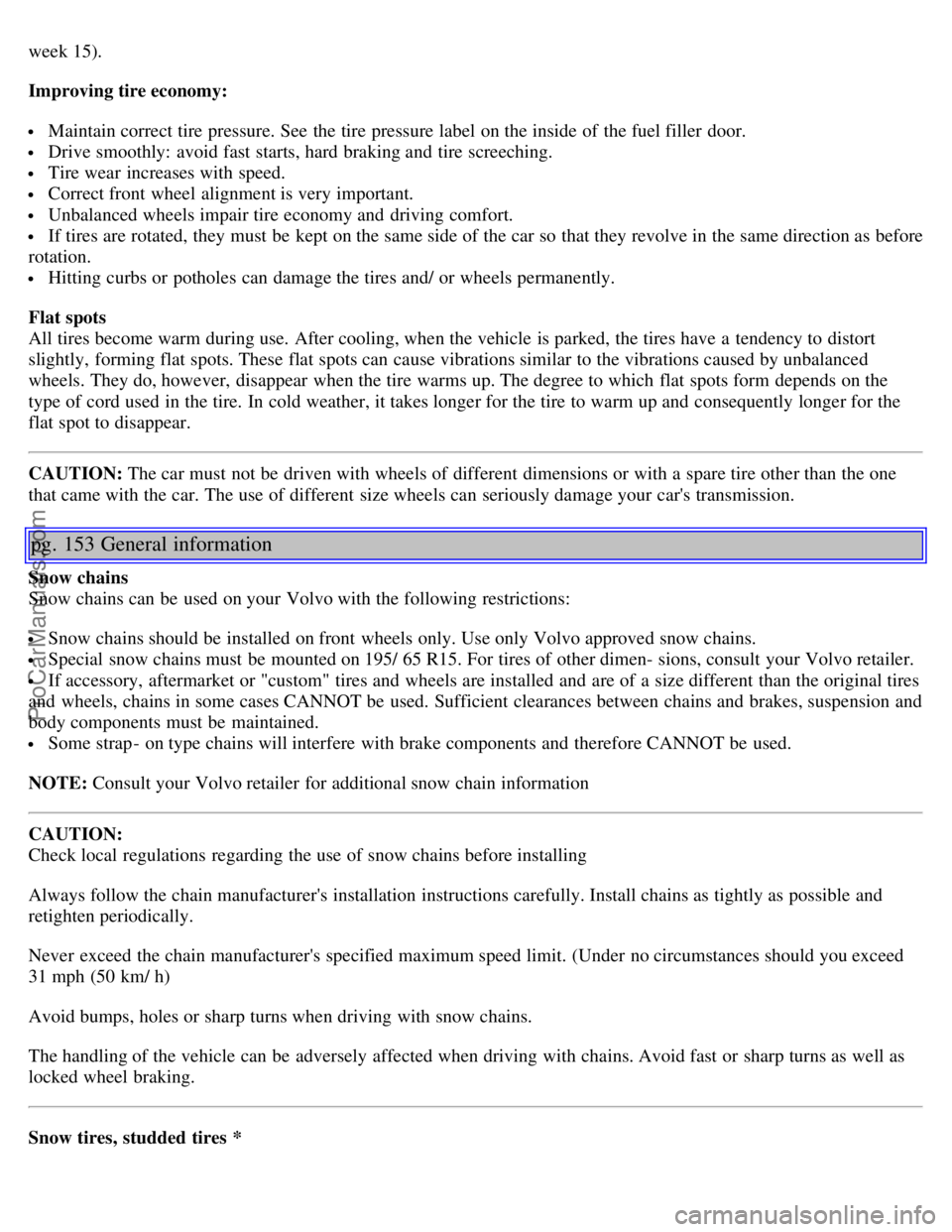
week 15).
Improving tire economy:
Maintain correct tire pressure. See the tire pressure label on the inside of the fuel filler door.
Drive smoothly: avoid fast starts, hard braking and tire screeching.
Tire wear increases with speed.
Correct front wheel alignment is very important.
Unbalanced wheels impair tire economy and driving comfort.
If tires are rotated, they must be kept on the same side of the car so that they revolve in the same direction as before
rotation.
Hitting curbs or potholes can damage the tires and/ or wheels permanently.
Flat spots
All tires become warm during use. After cooling, when the vehicle is parked, the tires have a tendency to distort
slightly, forming flat spots. These flat spots can cause vibrations similar to the vibrations caused by unbalanced
wheels. They do, however, disappear when the tire warms up. The degree to which flat spots form depends on the
type of cord used in the tire. In cold weather, it takes longer for the tire to warm up and consequently longer for the
flat spot to disappear.
CAUTION: The car must not be driven with wheels of different dimensions or with a spare tire other than the one
that came with the car. The use of different size wheels can seriously damage your car's transmission.
pg. 153 General information
Snow chains
Snow chains can be used on your Volvo with the following restrictions:
Snow chains should be installed on front wheels only. Use only Volvo approved snow chains.
Special snow chains must be mounted on 195/ 65 R15. For tires of other dimen- sions, consult your Volvo retailer.
If accessory, aftermarket or "custom" tires and wheels are installed and are of a size different than the original tires
and wheels, chains in some cases CANNOT be used. Sufficient clearances between chains and brakes, suspension and
body components must be maintained.
Some strap - on type chains will interfere with brake components and therefore CANNOT be used.
NOTE: Consult your Volvo retailer for additional snow chain information
CAUTION:
Check local regulations regarding the use of snow chains before installing
Always follow the chain manufacturer's installation instructions carefully. Install chains as tightly as possible and
retighten periodically.
Never exceed the chain manufacturer's specified maximum speed limit. (Under no circumstances should you exceed
31 mph (50 km/ h)
Avoid bumps, holes or sharp turns when driving with snow chains.
The handling of the vehicle can be adversely affected when driving with chains. Avoid fast or sharp turns as well as
locked wheel braking.
Snow tires, studded tires *
ProCarManuals.com
Page 92 of 128
Tires for winter use:
Owners who live in or regularly commute through areas with sustained periods of snow or icy driving conditions are
strongly advised to fit suitable winter tires to help retain the highest degree of traction.
It is important to install winter tires on all four wheels to help retain traction during cornering, braking, and
accelerating. Failure to do so could reduce traction to an unsafe level or adversely affect handling. Do not mix tires of
different design as this could also negatively affect overall tire road grip.
Volvo recommends195/ 65 R15 (205/ 55R16 on turbo models) winter tires on all four wheels.
Winter tires wear more quickly on dry roads in warm weather. They should be removed when the winter driving
season has ended.
Studded tires should be run- in 300- 600 miles (500- 1000 km) during which the car should be driven as smoothly as
possible to give the studs the opportunity to seat properly in the tires. The tires should have the same rotational
direction throughout their entire lifetime. In other words, if you wish to rotate the wheels, make sure that the same
wheels are always on the same side of the car.
NOTE: Please consult state or provincial regulations restricting the use of studded winter tires before installing such
tires.
* Where permitted
pg. 154 Tire pressure
Checking and correcting tire pressure
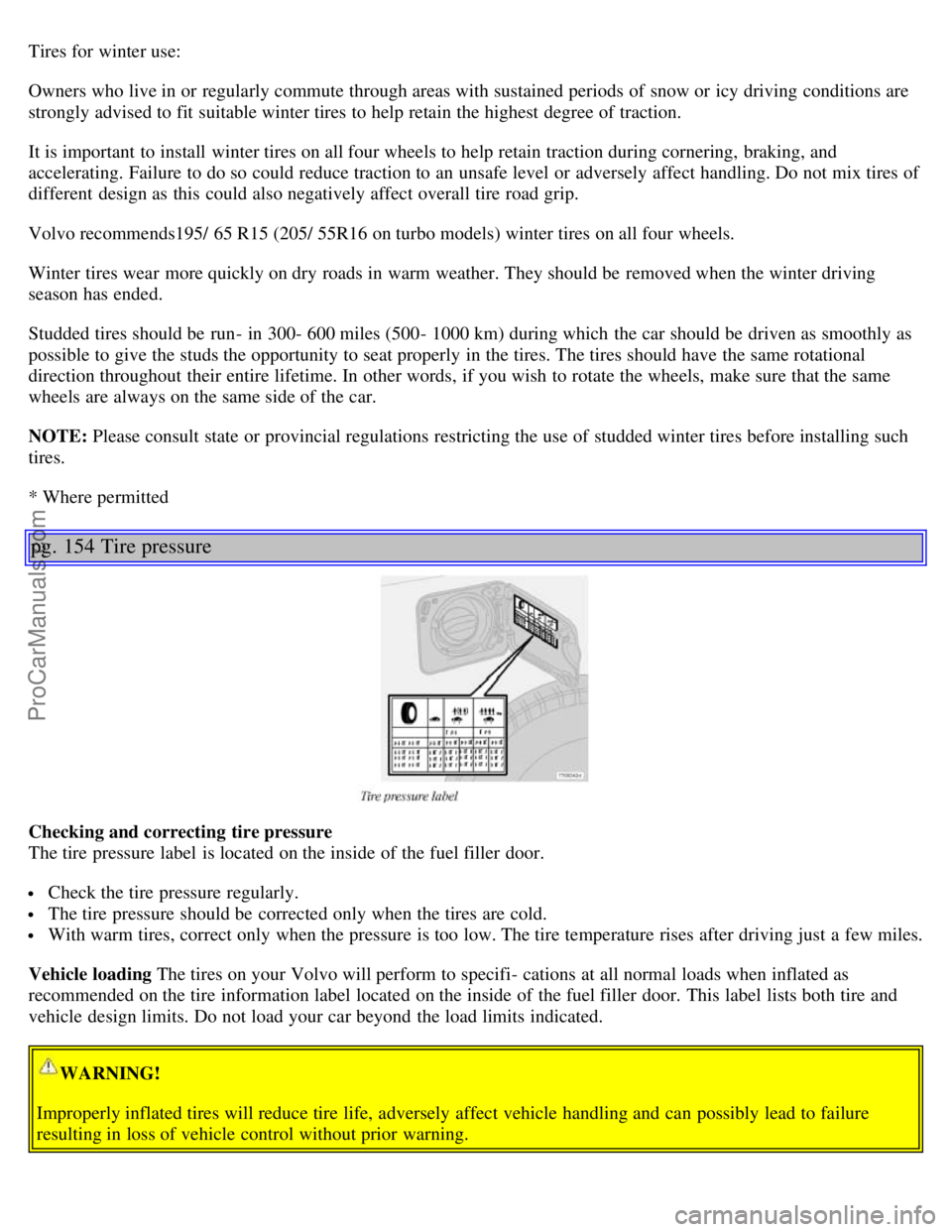
The tire pressure label is located on the inside of the fuel filler door.
Check the tire pressure regularly.
The tire pressure should be corrected only when the tires are cold.
With warm tires, correct only when the pressure is too low. The tire temperature rises after driving just a few miles.
Vehicle loading The tires on your Volvo will perform to specifi- cations at all normal loads when inflated as
recommended on the tire information label located on the inside of the fuel filler door. This label lists both tire and
vehicle design limits. Do not load your car beyond the load limits indicated.
WARNING!
Improperly inflated tires will reduce tire life, adversely affect vehicle handling and can possibly lead to failure
resulting in loss of vehicle control without prior warning.
ProCarManuals.com
Page 93 of 128
Temporary Spare (certain models)
The spare tire in your car is called a "Temporary Spare". It has the following designation: T125/ 80 R17.
Recommended tire pressure (see decal on Fuel filler door) should be maintained irrespective of which position on the
car the Temporary Spare tire is used on. In the event of damage to this tire, a new one can be purchased from your
Volvo retailer.
WARNING!
Current legislation prohibits the use of the "Temporary Spare" tire other than as a temporary replacement for a
punctured tire. It must be replaced as soon as possible by a standard tire. Road holding and handling may be
affected with the "Temporary Spare" in use. Do not exceed 50 mph (80 km/ h). Do not drive farther than 50 miles
(80 km) on a temporary spare tire.
CAUTION:
The car must not be driven with wheels of different dimensions or with a spare tire other than the one that came with
the car. The use of different size wheels can seriously damage your car's transmission.
NOTE: Certain models may be equipped with a full- size spare tire. When used, it should be inflated to the same
pressure as the tire it is replacing.
pg. 155 Tread wear indicators
Tires have tread
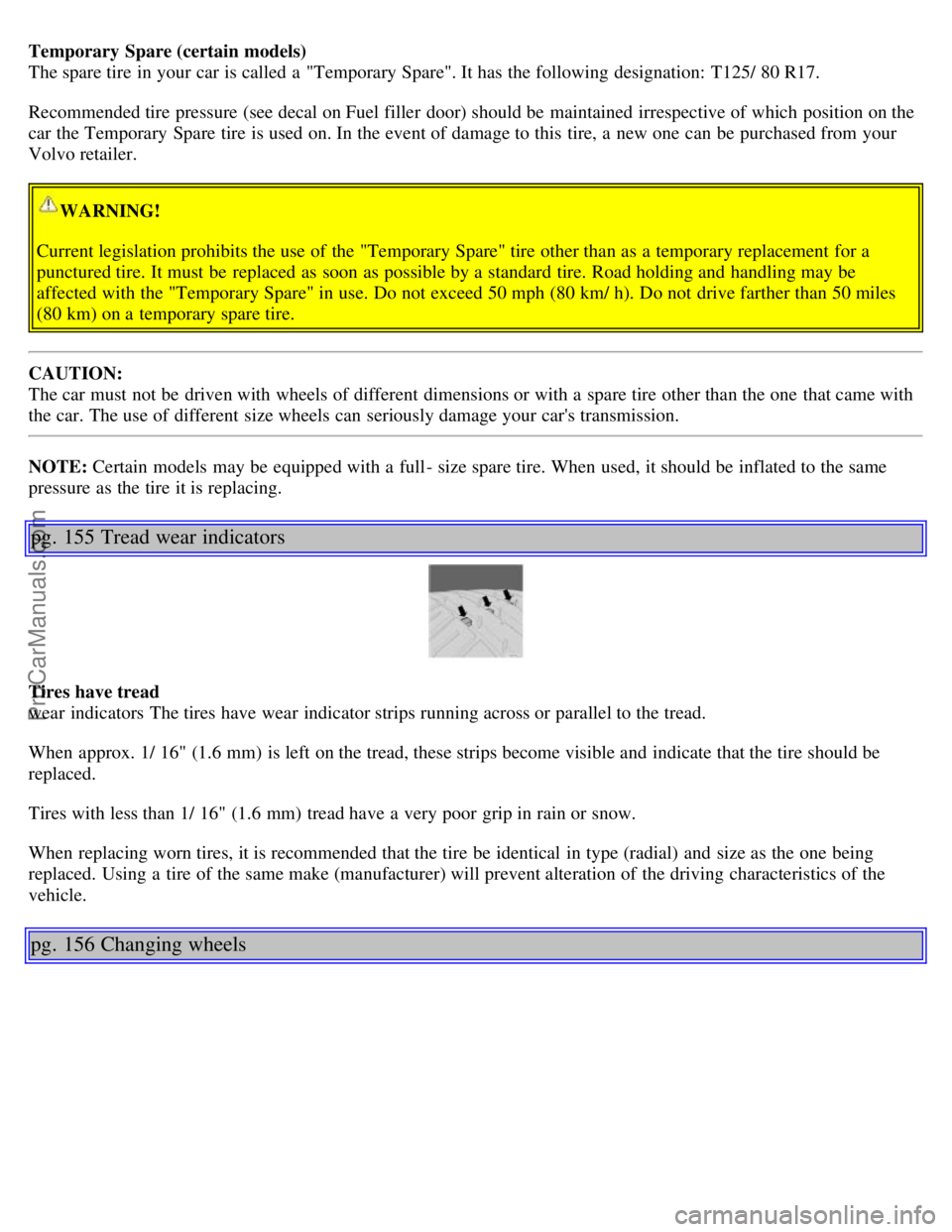
wear indicators The tires have wear indicator strips running across or parallel to the tread.
When approx. 1/ 16" (1.6 mm) is left on the tread, these strips become visible and indicate that the tire should be
replaced.
Tires with less than 1/ 16" (1.6 mm) tread have a very poor grip in rain or snow.
When replacing worn tires, it is recommended that the tire be identical in type (radial) and size as the one being
replaced. Using a tire of the same make (manufacturer) will prevent alteration of the driving characteristics of the
vehicle.
pg. 156 Changing wheels
ProCarManuals.com
Page 103 of 128

(thousand km)(12)(24)(36) (48)(60) (72)(84) (96)(108) (120)(132)(144)
EMISSION SYSTEM MAINTENANCE
Engine
Fuel line filter
1
PCV nipple (orifice)/hoses, clean I I
Battery (check charge and electrolyte level) II II II II I III
Brakes
Inspect brake pads, replace components as necessary I II II II I III
Brake fluid level
2 - check
I I I I I I
Steering/suspension
Tires
3, check pressure, wear and condition I
I II II II I III
Check power steering fluid level I I I I I I
Body
Power antenna (clean) L L L L L L
Trunk/hood, hinges and latches L L L L
Cabin air filter (see page 167
) R R R R R R
1) Replace at 105,000 miles (168,000 km)
2) Brake fluid should be changed at owner request every second year or 30,000 miles (48,000 km). The fluid
should be replaced once a year or every 15,000 miles (24,000 km) when driving under extremely hard
conditions (mountain driving, etc.).
3) Rotate tires at owner request.
The following items should be checked weekly by the driver (it takes only a few minutes):
Engine oil level, brake fluid level, radiator coolant level, operation of all lights, horns, windshield wipers, tire
pressure (all five tires), windshield washer fluid level
The following should also be carried out at regular intervals:
Washing (check all drain holes), polishing, cleaning
pg. 167 Maintenance Schedule
Air cleaner
Replace the air cleaner cartridge with a new one every 30,000 miles (48,000 km). The cartridge should be replaced
more often when driving under dirty and dusty conditions. The filter cannot be cleaned and therefore should always
be replaced with a new one.
Timing belt
For proper functioning of the vehicle and its emission control systems, the timing belt must be replaced every 105,000
miles (168,000 km). Engine damage will occur if the belt fails.
Fuel filler cap, tank and lines and
connections The effectiveness of the fuel system to contain hydrocarbons is dependent largely on a leak- free system.
Check for proper sealing of the fuel filler cap which contains "O" ring type seals. NOTE: If the fuel filler cap is not
closed tightly or if the engine is running when the car is refueled, the Malfunction Indicator Lamp (" Check Engine")
may indicate a fault. However, your vehicle's performance will not be affected. Use only Volvo original or approved
fuel filler caps.
ProCarManuals.com
Page 104 of 128

Fuel (line) filter
For proper functioning of the vehicle and its emission control systems, the fuel line filter should be replaced at
105,000 miles (168,000 km). The filter is replaced as one complete unit. Replace more frequently if contaminated fuel
is introduced into the tank (or if there is reason to suspect that this has occurred).
PCV system
The orifice nipple in the intake manifold and the filter at the end of the PCV hose in the air cleaner should be
inspected at 60,000 miles (96,000 km) and thereafter, at 30,000 mile (48,000 km) intervals.
Cabin air filter
Replace the cabin air filter with a new one at 15,000 mile (24,000 km) intervals. Volvo recommends replacing the
filter more often if the car is driven under dirty and dusty condi- tions. The filter cannot be cleaned and therefore
should always be replaced with a new one.
pg. 168 Working on your car
Note the following before you begin working on your car:
Battery
Ensure that the battery cables are correctly connected and tightened.
Never disconnect the battery when the engine is running (e. g. when replacing the battery).
Never use a fast charger to charge the battery. The battery cables should be disconnected when recharging.
The battery contains acid that is both corrosive and poisonous. It is important that the battery is handled in an
environ- mentally friendly way. Let your Volvo dealer assist you.
Hoisting the car
If a garage jack is used to lift the car, the two jack attachments points should be used. They are specially reinforced to
bear the weight of the car. A garage jack can also be placed under the front of the engine support frame. Take care not
to damage the splash guard under the engine. Ensure that the jack is positioned so that the car cannot slide off it.
Always use axle stands or similar structures.
If a two- post hoist is used to lift the car, the front and rear lift arm pads should be centered under the reinforced lift
plates on the inboard edge of the sill rail (see illustration).
WARNING!
The car ignition system has very high voltage!
The voltage in the ignition system is dangerous!
Do not touch spark plugs, ignition cables or the ignition coil when the engine is running or the ignition is switched
on!
ProCarManuals.com