2001 VOLVO S60 seats
[x] Cancel search: seatsPage 54 of 128
2 0 0 1
VOLVO S60
Interior
pg. 99 Interior
Front seats 100
Interior lighting104
Floor mats (option)105
Storage compartments106
Rear seat and trunk111
Spare wheel and tools113
pg. 100 Front seats
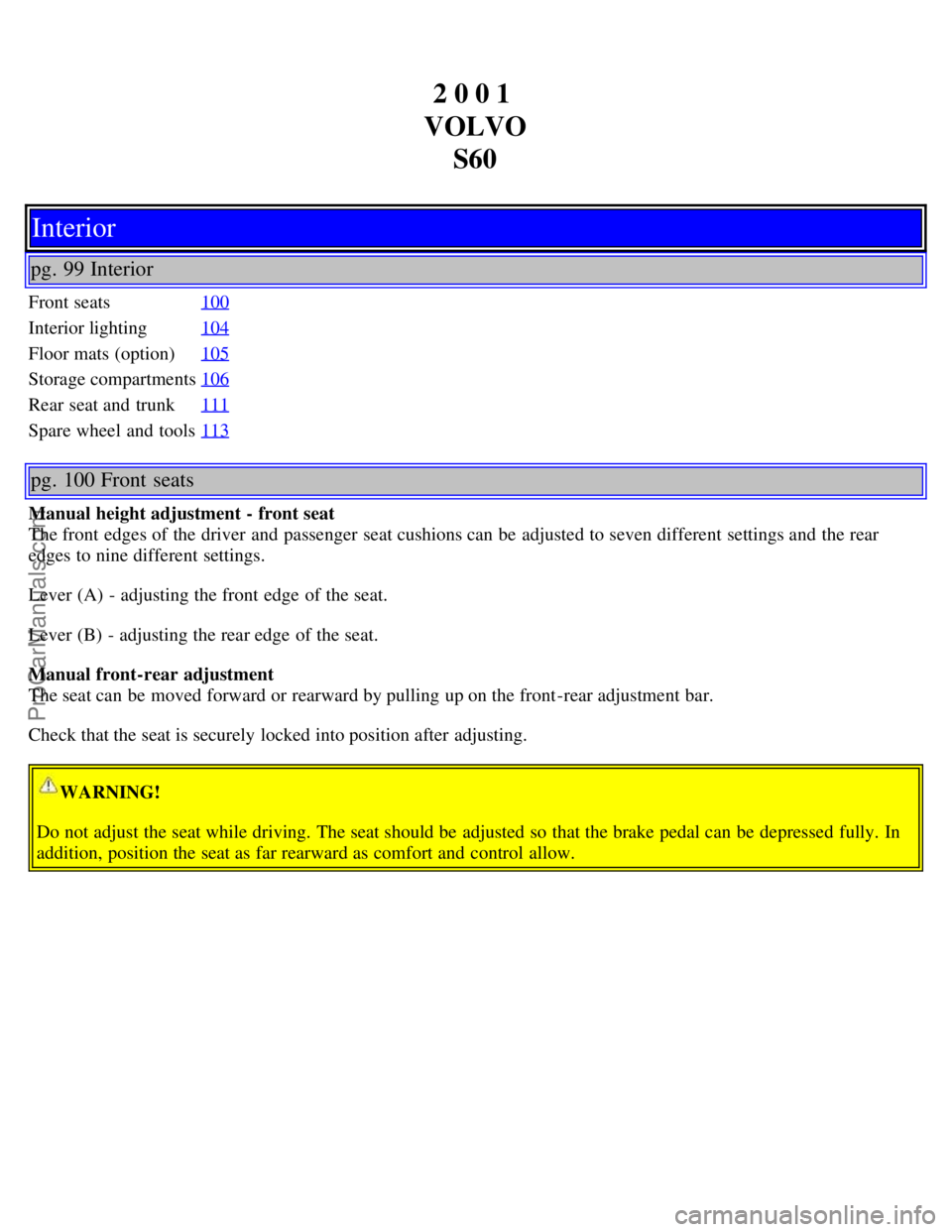
Manual height adjustment - front seat
The front edges of the driver and passenger seat cushions can be adjusted to seven different settings and the rear
edges to nine different settings.
Lever (A) - adjusting the front edge of the seat.
Lever (B) - adjusting the rear edge of the seat.
Manual front-rear adjustment
The seat can be moved forward or rearward by pulling up on the front -rear adjustment bar.
Check that the seat is securely locked into position after adjusting.
WARNING!
Do not adjust the seat while driving. The seat should be adjusted so that the brake pedal can be depressed fully. In
addition, position the seat as far rearward as comfort and control allow.
ProCarManuals.com
Page 55 of 128
pg. 101 Front seats
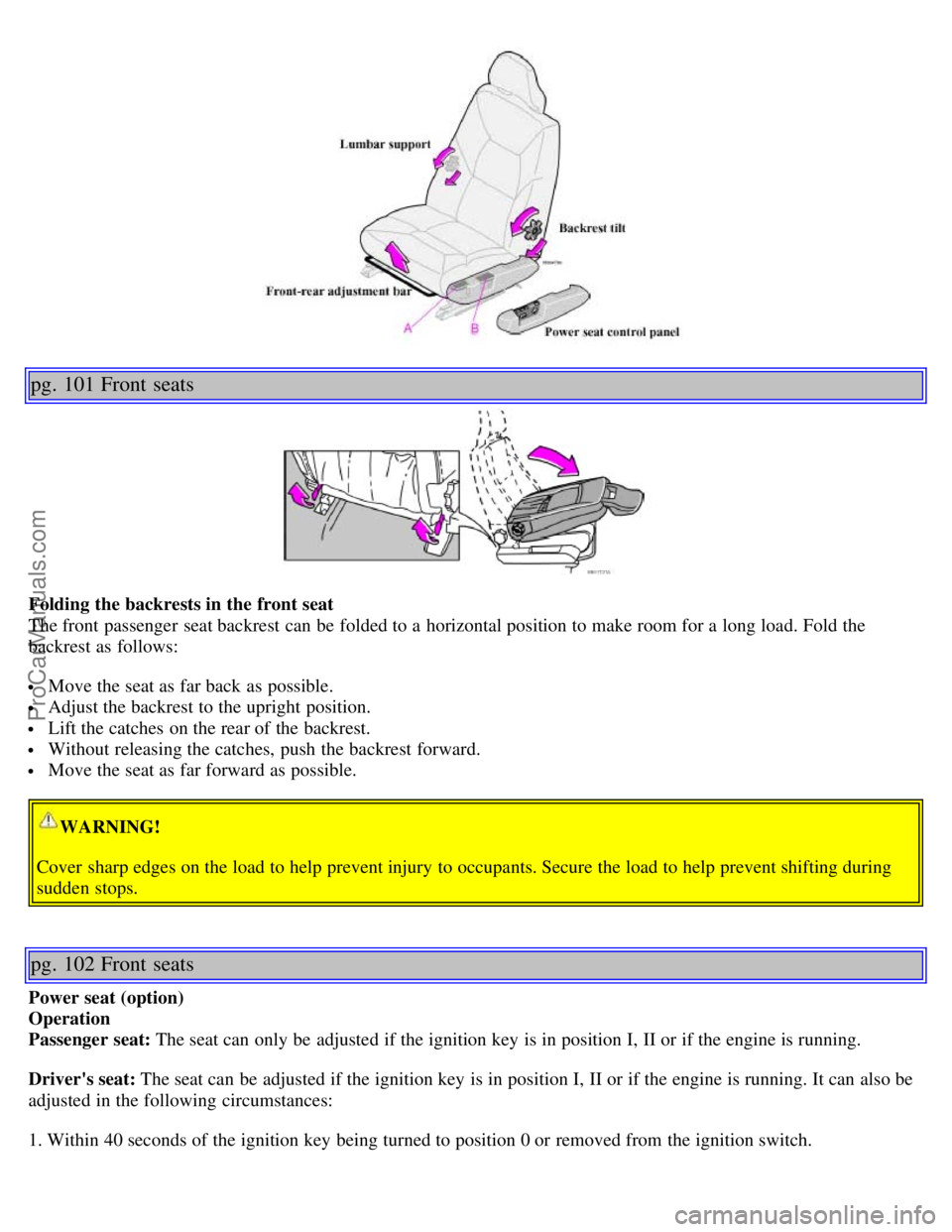
Folding the backrests in the front seat
The front passenger seat backrest can be folded to a horizontal position to make room for a long load. Fold the
backrest as follows:
Move the seat as far back as possible.
Adjust the backrest to the upright position.
Lift the catches on the rear of the backrest.
Without releasing the catches, push the backrest forward.
Move the seat as far forward as possible.
WARNING!
Cover sharp edges on the load to help prevent injury to occupants. Secure the load to help prevent shifting during
sudden stops.
pg. 102 Front seats
Power seat (option)
Operation
Passenger seat: The seat can only be adjusted if the ignition key is in position I, II or if the engine is running.
Driver's seat: The seat can be adjusted if the ignition key is in position I, II or if the engine is running. It can also be
adjusted in the following circumstances:
1. Within 40 seconds of the ignition key being turned to position 0 or removed from the ignition switch.
ProCarManuals.com
Page 56 of 128
2. After you have unlocked the driver's door with the key or remote control, the driver's seat can be adjusted during a
10 minute period if the door remains open. If the door is closed, the seat can be adjusted for 40 seconds. The ignition
key can be in position 0 or not yet inserted in the ignition switch.
Remote control
If you unlock the car with the remote control and open the driver's door, the driver's seat will adjust to the settings it
had the last time the car was locked with the same remote control.
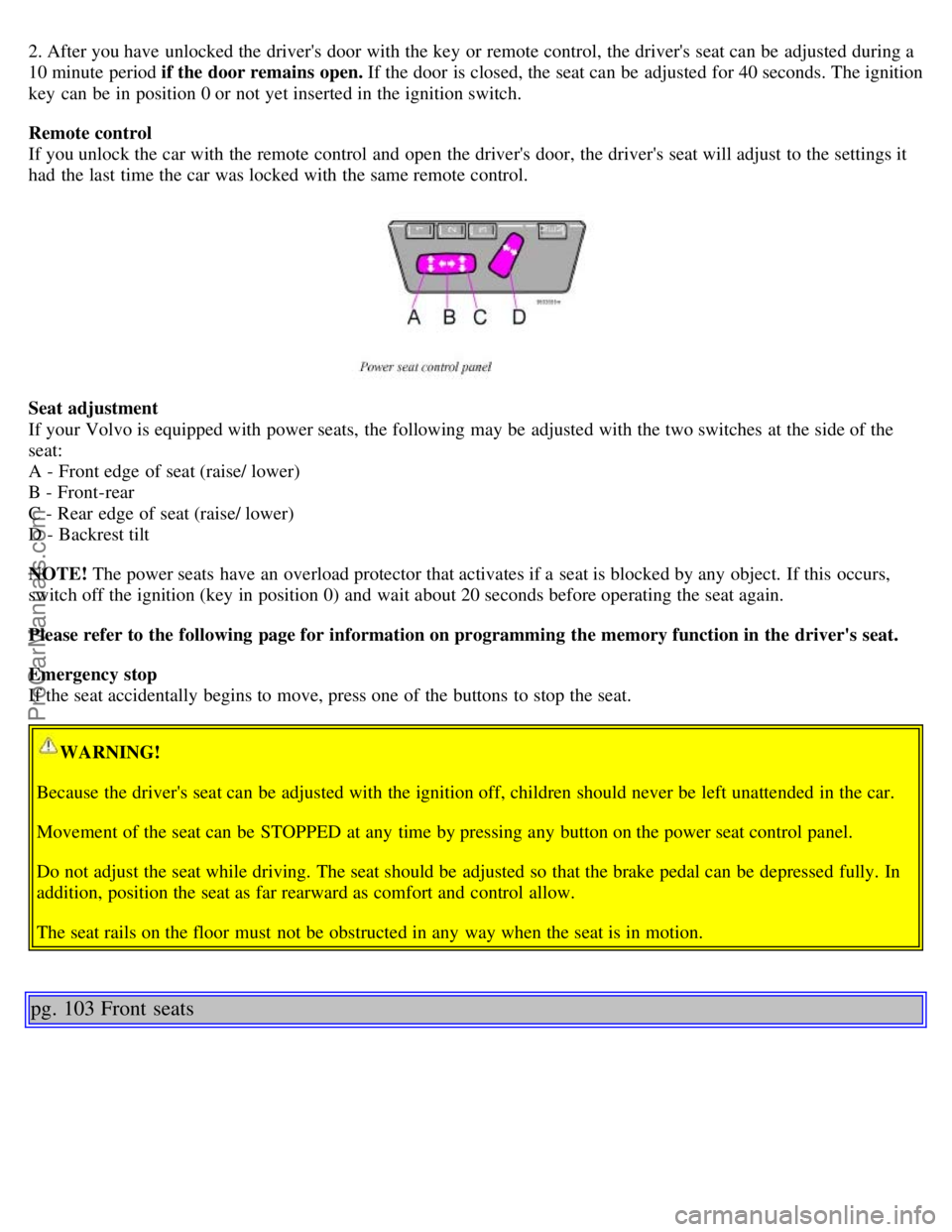
Seat adjustment
If your Volvo is equipped with power seats, the following may be adjusted with the two switches at the side of the
seat:
A - Front edge of seat (raise/ lower)
B - Front-rear
C - Rear edge of seat (raise/ lower)
D - Backrest tilt
NOTE! The power seats have an overload protector that activates if a seat is blocked by any object. If this occurs,
switch off the ignition (key in position 0) and wait about 20 seconds before operating the seat again.
Please refer to the following page for information on programming the memory function in the driver's seat.
Emergency stop
If the seat accidentally begins to move, press one of the buttons to stop the seat.
WARNING!
Because the driver's seat can be adjusted with the ignition off, children should never be left unattended in the car.
Movement of the seat can be STOPPED at any time by pressing any button on the power seat control panel.
Do not adjust the seat while driving. The seat should be adjusted so that the brake pedal can be depressed fully. In
addition, position the seat as far rearward as comfort and control allow.
The seat rails on the floor must not be obstructed in any way when the seat is in motion.
pg. 103 Front seats
ProCarManuals.com
Page 61 of 128
Pull the belt out far enough to insert the latch plate into the receptacle until a distinct click is heard. The seat belt
retractor is normally "unlocked" and you can move freely, provided that the shoulder belt is not pulled out too far. The
retractor will lock up as follows:
if the belt is pulled out rapidly
during braking and acceleration
if the vehicle is leaning excessively
when driving in turns For the seat belt to provide maximum protection in the event of an accident, it must be worn
correctly. When wearing the seat belt remember:
The belt should not be twisted or turned.
The lap belt must be positioned low on the hips (not pressing against the abdomen).
Make sure that the shoulder belt is rolled up into its retractor and that the shoulder and lap belts are taut.
Before exiting the car, check that the seat belt retracts fully after being unbuckled. If necessary, guide the belt back
into the retractor slot.
Child seats:
Please refer to page 27
for information on securing child seats with the seat belts.
pg. 11 Seat belts
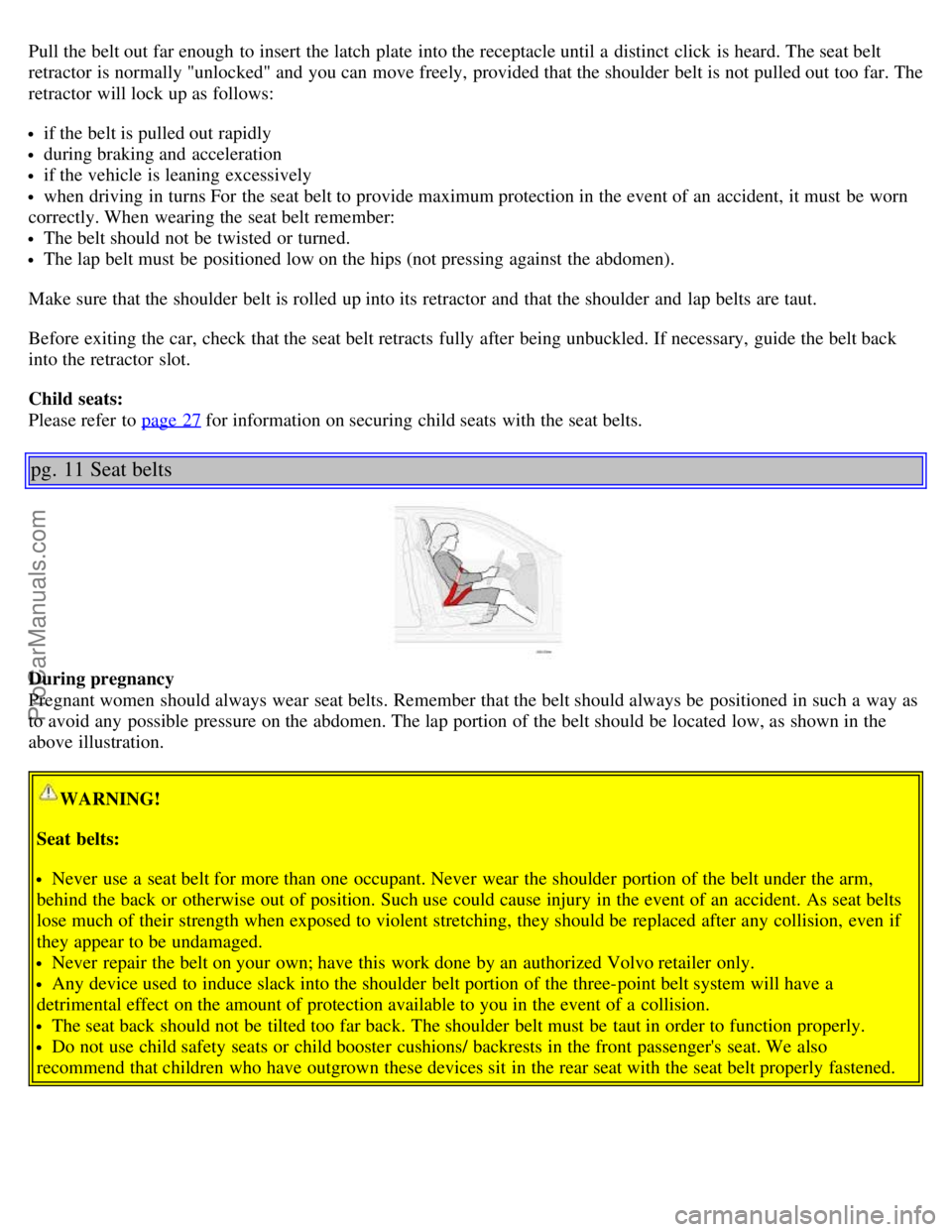
During pregnancy
Pregnant women should always wear seat belts. Remember that the belt should always be positioned in such a way as
to avoid any possible pressure on the abdomen. The lap portion of the belt should be located low, as shown in the
above illustration.
WARNING!
Seat belts:
Never use a seat belt for more than one occupant. Never wear the shoulder portion of the belt under the arm,
behind the back or otherwise out of position. Such use could cause injury in the event of an accident. As seat belts
lose much of their strength when exposed to violent stretching, they should be replaced after any collision, even if
they appear to be undamaged.
Never repair the belt on your own; have this work done by an authorized Volvo retailer only.
Any device used to induce slack into the shoulder belt portion of the three-point belt system will have a
detrimental effect on the amount of protection available to you in the event of a collision.
The seat back should not be tilted too far back. The shoulder belt must be taut in order to function properly.
Do not use child safety seats or child booster cushions/ backrests in the front passenger's seat. We also
recommend that children who have outgrown these devices sit in the rear seat with the seat belt properly fastened.
ProCarManuals.com
Page 64 of 128

release of the powder may appear as smoke- like matter. This is a normal characteristic and does not indicate fire.
NOTE: Volvo's dual- threshold, dual- stage airbags use special sensors that are integrated with the front seat buckles.
The point at which the airbag deploys is determined by whether or not the seat belt is being used, as well as the
severity of the collision. Collisions can occur where only one of the airbags deploys.
If the impact is less severe, but severe enough to present a clear injury risk, the dual- stage airbags are triggered at
just 70% of their total capacity. If the impact is more severe, the dual- stage airbags are triggered at full capacity.
WARNING!
Do not use child safety seats or child booster cushions/ backrests in the front passenger's seat. We also recommend
that occupants under 4 feet 7 inches (140 cm) in height who have outgrown these devices sit in the rear seat with the
seat belt fastened. Never drive with the airbags deployed. The fact that they hang out can impair the steering of your
car. Other safety systems can also be damaged. The smoke and dust formed when the airbags are deployed can
cause skin and eye irritation in the event of prolonged exposure.
pg. 14 Airbags (Supplemental Restraint System)
WARNING!
Children must never be allowed in the front passenger's seat. Volvo recommends that ALL occupants (adults and
children) shorter than 4 feet 7 inches (140 cm) be seated in the back seat of any vehicle with a front passenger -side
airbag. See page 28
for guidelines.
Occupants in the front passenger's seat must never sit on the edge of the seat, sit leaning toward the instrument
panel or otherwise sit out of position. The occupant's back must be as upright as comfort allows and be against the
seat back with the seat belt properly fastened.
Feet must be on the floor, e. g. not on the dash, seat or out of the window. No objects or accessory equipment, e. g.
dash covers, may be placed on, attached to, or installed near the SRS hatch (the area above the glove compartment)
or the area affected by airbag deployment (see illustration on page 12
).
There should be no loose articles, e. g. coffee cups, on the floor, seat or dash area. Never try to open the SRS cover
on the steering wheel or the passenger side dash. This should only be done by an authorized Volvo service
technician.
Failure to follow these instructions can result in injury to the vehicle occupants
Warning light in the instrument panel
A self - diagnostic system incorporated in the sensor monitors the SRS. This system does not, however, monitor the
Side Impact Protection System (SIPS) airbags. If a fault is detected, the warning light will illuminate. The light is
included in the warning/ indicator light cluster in the instrument panel. Normally, the SRS warning lamp should light
ProCarManuals.com
Page 67 of 128

The airbags are folded and located in the steering wheel hub and above the glove compartment.
Deployment: The SRS airbags are designed to deploy during certain frontal or front -angular collisions, impacts, or
decelerations, depending on the crash severity, angle, speed and object impacted. The airbags may also deploy in
certain non-frontal collisions where rapid deceleration occurs.
The airbag system includes gas generators (1) surrounded by the airbags (2) and front seat belt tensioners for both of
the front seats. To deploy the system, the sensor (3) activates the gas generators causing the airbags to be inflated with
nitrogen gas.
As the movement of the seats' occupants compresses the airbags, some of the gas is expelled at a controlled rate to
provide better cushioning. Both seat belt tensioners also deploy, minimizing any seat belt slack. The entire process,
including inflation and deflation of the airbags, takes approximately two-tenths of a second.
WARNING!
injury. Deployment occurs very quickly and with considerable force. During normal deployment and depending on
variables such as seating position, one may experience abrasions, bruises, swellings, or other injuries as a result of
airbag( s) deployment.
Never try to repair any part of the SRS or SIPS bag systems yourself. Any interference in the system could cause
malfunction and serious injury. All work on these systems should be performed by an authorized Volvo retailer.
pg. 18 Side airbags (SIPS airbags)
SIPS airbag (front seats only)
As an enhancement to the structural Side Impact Protection System built into your car, the car is also equipped with
Side Impact Protection System (SIPS) airbags. The SIPS airbag system consists of airbag modules built into the sides
of both front seat backrests, wires and gas generators/ sensor units (see illustration on next page).
The SIPS airbag system is designed to help increase occupant protection in the event of certain side impact collisions.
The SIPS airbags are designed to deploy only during certain side- impact collisions, depending on the crash severity,
angle, speed and point of impact. The airbags are not designed to deploy in all side impact situations.
ProCarManuals.com
Page 68 of 128

NOTE: SIPS airbag deployment (one airbag) occurs only on the side of the vehicle affected by the impact. The
airbags are not designed to deploy in all side impact situations.
*A SIPS airbag warning decal is also located at the end of the instrument panel on the driver's side of the car.
WARNING!
the Side Impact Protection System and the three-point seat belt system. It is not designed to deploy during collisions
from the front or rear of the car or in rollover situations.
The use of seat covers on the front seats may impede SIPS airbag deployment.
No objects, accessory equipment or stickers may be placed on, attached to or installed near, the SIPS airbag system
or in the area affected by SIPS airbag deployment (see illustration in the center column above). Never try to open or
repair any components of the SIPS airbag system. This should be done only by an authorized Volvo service
technician.
In order for the SIPS airbag to provide its best protection, both front seat occupants should sit in an upright position
with the seat belt properly fastened.
Failure to follow these instructions can result in injury to the occupants of the vehicle in the event of an accident.
pg. 19 Side airbags (SIPS airbags)
The SIPS airbag system
This system consists of a gas generator (1), the side airbags (2), and electronic sensors/ cables (3).
Contents | Top of Page
ProCarManuals.com
Page 121 of 128

Direction indicators40
Dolby Surround Pro Logic78
Door mirror defroster42
Door mirrors37
Driving economically130
DSTC (Dynamic Stability Traction Control)34 , 38
Dual - threshold airbags13
E
ECC54
Economical driving130
Electric socket38 , 45
Electrical system199
Electrically operated windows46
Engine - starting128
Engine compartment170
Engine oil171
Engine oil, capacity194
Engine specifications200
Engine oil - checking172
Environment3
F
Fan55
, 59
Federal Clean Air Act164
FIX NEXT SERVICE35
Floor mats105
Fog lamp33 , 183
Front seat - backrest101
Front seats100
Front seats - heated42
Front seats - manual adjustment100
Front seats - power102
Front seats - power(programming the memory)103
Front suspension197
Fuel2 , 126
Fuel filler cap2 , 127
Fuel filler door2 , 127
Fuel gauge30
Fuel tank, capacity194
Fuses186
G
Gasoline126
Gear position132
Geartronic135
Geartronic - kickdown136
ProCarManuals.com