2001 VOLVO S60 instrument panel
[x] Cancel search: instrument panelPage 68 of 128

NOTE: SIPS airbag deployment (one airbag) occurs only on the side of the vehicle affected by the impact. The
airbags are not designed to deploy in all side impact situations.
*A SIPS airbag warning decal is also located at the end of the instrument panel on the driver's side of the car.
WARNING!
the Side Impact Protection System and the three-point seat belt system. It is not designed to deploy during collisions
from the front or rear of the car or in rollover situations.
The use of seat covers on the front seats may impede SIPS airbag deployment.
No objects, accessory equipment or stickers may be placed on, attached to or installed near, the SIPS airbag system
or in the area affected by SIPS airbag deployment (see illustration in the center column above). Never try to open or
repair any components of the SIPS airbag system. This should be done only by an authorized Volvo service
technician.
In order for the SIPS airbag to provide its best protection, both front seat occupants should sit in an upright position
with the seat belt properly fastened.
Failure to follow these instructions can result in injury to the occupants of the vehicle in the event of an accident.
pg. 19 Side airbags (SIPS airbags)
The SIPS airbag system
This system consists of a gas generator (1), the side airbags (2), and electronic sensors/ cables (3).
Contents | Top of Page
ProCarManuals.com
Page 78 of 128

pumps deliv- ering unleaded gasoline be labelled "UNLEADED". Only these pumps have nozzles which fit your car's
filler inlet. It is unlawful to dispense leaded fuel into a vehicle labelled "unleaded gasoline only". Leaded gasoline
damages the three- way catalytic converter and the heated oxygen sensor system. Repeated use of leaded gasoline will
lessen the effectiveness of the emission control system and could result in loss of emission warranty coverage. State
and local vehicle inspection programs will make detection of misfueling easier, possibly resulting in emission test
failure for misfueled vehicles.
NOTE: Some U. S. and Canadian gasolines contain an octane enhancing additive called methyl- cyclopentadienyl
manganese tricar- bonyl (MMT). If such fuels are used, your Emission Control System performance may be affected,
and the Check Engine Light (malfunction indicator lamp) located on your instrument panel may light. If this occurs,
please return your vehicle to an authorized Volvo retailer for service.
Gasoline containing alcohol and ethers
"Oxygenated fuels"
Some fuel suppliers sell gasoline containing "oxygenates" which are usually alcohols or ethers. In some areas, state or
local laws require that the service pump be marked indicating use of alcohols or ethers. However, there are areas in
which the pumps are unmarked. If you are not sure whether there is alcohol or ethers in the gasoline you buy, check
with the service station operator. To meet seasonal air quality standards, some areas require the use of "oxygenated"
fuel.
Volvo allows the use of the following "oxygenated" fuels; however, the octane ratings listed on this page must still be
met.
Alcohol - Ethanol: Fuels containing up to 10% ethanol by volume may be used. Ethanol may also be referred to as
Ethyl alcohol, or "Gasohol".
Ethers - MTBE: Fuels containing up to 15% MTBE may be used.
pg. 127 Refueling
Fuel filler door
The fuel filler door, located on the right rear fender, is connected to your car's central locking system. The driver's
door must be unlocked before the fuel filler door can be opened.
Be sure the fuel filler door is not obstructed and is completely closed after refueling. Open the fuel filler cap slowly
during hot weather.
NOTE: During a transitional period, a small number of service stations may still have fuel nozzles that are not
compatible with the fuel filler neck on cars equipped with the evaporative control system.
Refueling
The fuel tank is designed to hold approximately 18.5 US gals (70 liters) or 21.1 US gals (80 liters) on turbo models,
ProCarManuals.com
Page 84 of 128

D (Drive)
D is the normal driving position and should be used as often as possible to help improve fuel economy. The car
should not be moving when shifting from R to the D position.
Neutral control
When the engine is idling, the gear selector is in the Drive position and the brake pedal is depressed, the
transmission will automatically switch to neutral.
The transmission will automatically return to Drive when the brake pedal is released.
This function has been added to help reduce emissions and fuel consumption.
4 (Intermediate gear)
The transmission will shift automatically between gears 4, 3, 2 or 1 from this position. The transmission cannot shift
up to (D) rive from fourth gear.
3 (Intermediate gear)
The transmission will shift automatically between gears 3, 2 and 1 from this position. The transmission cannot shift up
to fourth gear or (D) rive from third gear.
L (Low gears)
The transmission is locked in gears 1 and 2 when the selector is in this position.
NOTE: Gears 4, 3, or L can be used if you are driving in a mountainous area, towing a trailer or to increase engine
braking effect.
The transmission has a built- in limiter designed to help prevent excessive engine speeds (high rpm) when gears 4, 3
or L are selected.
pg. 134 Automatic transmission (option)
W - Winter/ Wet driving mode - enhanced vehicle traction
Mode W will only function if the gear selector is in the (D) rive position.
Press the button at the base of the gear selector to engage/ disengage this driving mode (see illustration).
When the W driving mode is engaged, this is displayed in the instrument panel (see page 30).
This mode may be selected for starting/ moving off on slippery roads.
ProCarManuals.com
Page 86 of 128

Never leave the car unattended when the engine is running. If, by mistake, the gear selector is moved from P, the
car may start moving.
R (Reverse)
Never engage R while the car is moving forward.
N (Neutral)
Neutral - no gear engaged. Use the parking brake.
D (Drive)
D is the normal driving position and should be used as often as possible to help improve fuel economy. The car
should not be moving when shifting from R to the D position.
Automatic transmission - adaptive system
The automatic transmission is controlled by an adaptive control system that constantly monitors the way in which the
transmission functions. It senses and adapts each gear shift for optimal performance. The system also monitors your
particular driving style and adapts gear shifting accordingly.
Automatic transmission - shift gate positions
You can move the gear selector freely between the (MAN) ual and (D) rive positions while driving.
Depress the button on the front of the gear selector knob to move between the R, N, D, and P positions.
pg. 136 Geartronic (option )
Manual shifting - Geartronic
You can move the gear selector freely between the (MAN) ual and (D) rive positions while driving. Gears 3, and 4
have a "lock - up" function which reduces engine speed and helps save fuel.
The currently selected gear will be displayed in the instrument panel (see page 30
).
To access the (MAN) ual shifting position from (D) rive, move the gear selector to the left to MAN.
To return to the (D) rive position from MAN, move the gear selector to the right.
While driving
If you select the (MAN) ual position while driving, the gear that was being used in the (D) rive position will also
initially be selected in (MAN) ual position.
Move the gear selector forward (toward "+") to shift to a higher gear or rearward (toward "-") to shift to a lower
gear.
If you hold the gear selector toward "-", the transmission will downshift, one gear at a time, and will utilize the
braking power of the engine. If the current speed is too high for using a lower gear, the downshift will not occur until
the speed has decreased enough to allow the lower gear to be used.
ProCarManuals.com
Page 87 of 128

If you slow down to a very low speed, the transmission will automatically shift down.
When starting in the (MAN) ual position, 3rd gear is the highest gear that may be selected.
NOTE: Kickdown does not function when the transmission is in the manual shift (Geartronic) mode.
Kickdown
Automatic shift to a lower gear (kickdown) is achieved by depressing the accelerator pedal fully and briskly. An
upshift will occur when approaching the top speed for a particular gear or by releasing the accelerator pedal slightly.
Kickdown can be used for maximum acceleration or when passing at highway speeds.
Kickdown does not function when the transmission is in the manual shift (Geartronic) mode.
W - Winter/ Wet driving mode - enhanced vehicle traction
Mode W will only function if the gear selector is in the (D) rive position.
Press the button at the base of the gear selector to engage/ disengage this driving mode (see illustration).
When the W driving mode is engaged, this is displayed in the instrument panel (see page 30).
This mode may be selected for starting/ moving off on slippery roads.
pg. 137 Brake system
BRAKE Brake circuit malfunction
If one of the brake circuits were to malfunction, the red warning light would come on, the pedal travel would increase
slightly, the pedal would feel softer, and extra pressure would be required for normal braking. If the light comes on
while driving or braking, stop immediately and check the brake fluid level in the reservoir.
WARNING!
If the fluid level is below the MIN mark in the reservoir or if a "Brake failure - Service urgent" message is
displayed in the text window: DO NOT DRIVE. Have the car towed to a Volvo retailer and have the brake system
inspected.
NOTE: When the car is at a standstill and the engine is idling, e. g. at a traffic light and the brake pedal is depressed,
the pedal may go down slightly. This is a normal function of the power- assisted brake system.
If the brake power- assist does not function
The power assist to the brakes functions only when the engine is running. When the car is moving without the engine
running, the brake pedal pressure required to stop the car is increased by 3- 4 times and the brake pedal feels stiff.
Water on brake discs and brake pads affects braking
Driving in rain and slush or passing through an automatic car wash can cause water to collect on the brake discs and
pads. This will cause a delay in braking effect when the pedal is depressed. To avoid such a delay when the brakes are
ProCarManuals.com
Page 122 of 128
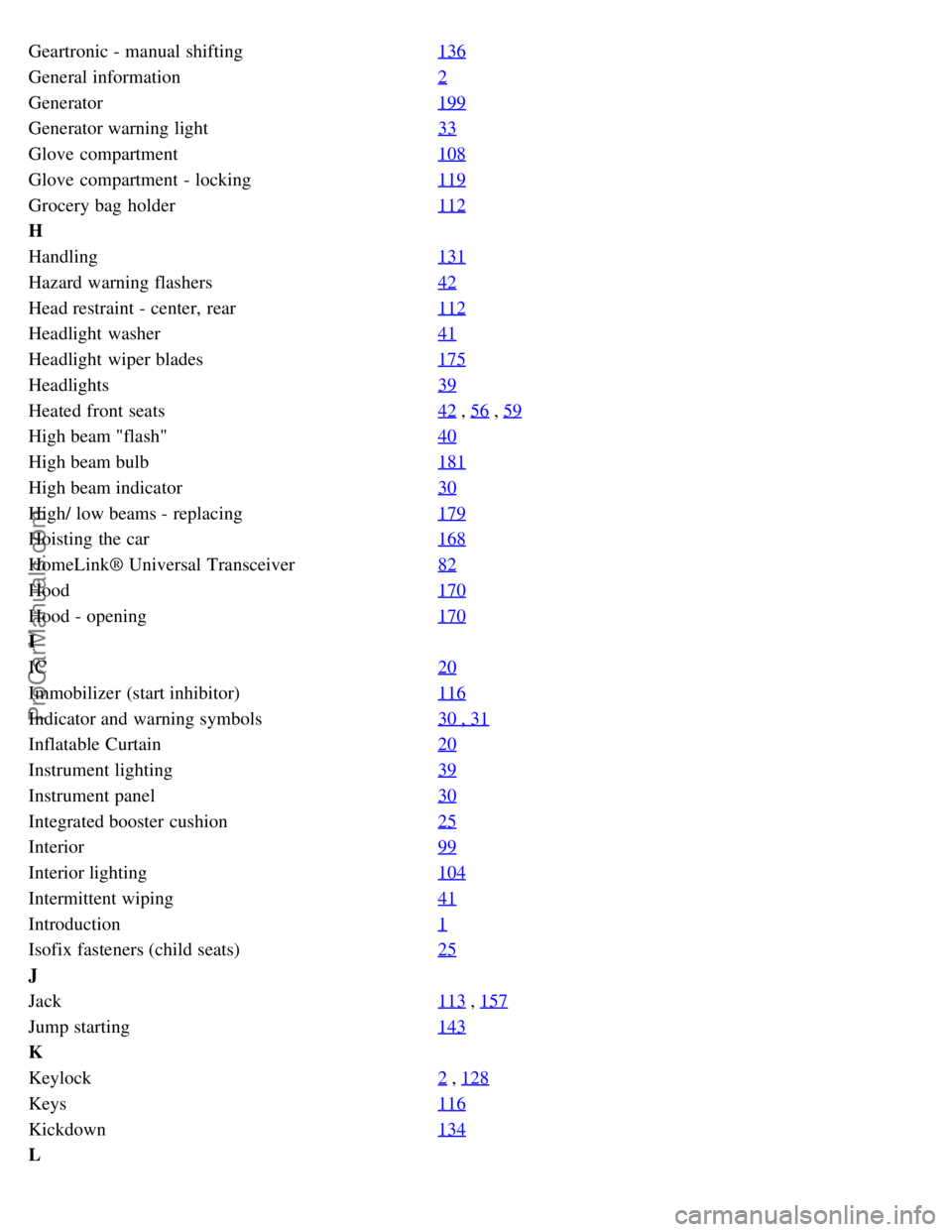
Geartronic - manual shifting136
General information2
Generator199
Generator warning light33
Glove compartment108
Glove compartment - locking119
Grocery bag holder112
H
Handling131
Hazard warning flashers42
Head restraint - center, rear112
Headlight washer41
Headlight wiper blades175
Headlights39
Heated front seats42 , 56 , 59
High beam "flash"40
High beam bulb181
High beam indicator30
High/ low beams - replacing179
Hoisting the car168
HomeLink® Universal Transceiver82
Hood170
Hood - opening170
I
IC20
Immobilizer (start inhibitor)116
Indicator and warning symbols30 , 31
Inflatable Curtain20
Instrument lighting39
Instrument panel30
Integrated booster cushion25
Interior99
Interior lighting104
Intermittent wiping41
Introduction1
Isofix fasteners (child seats)25
J
Jack113
, 157
Jump starting143
K
Keylock2
, 128
Keys116
Kickdown134
L
ProCarManuals.com