doors immediately if the key is left in the ignition switch, the car is locked using the lock button on the door and the
door is then closed. A sound from the lock will be audible at this time. Please note that this function will not unlock
the doors if the engine is running.
Immobilizer (start inhibitor)
Each of the keys supplied with your car contains a coded transmitter. The code in the key is transmitted to an antenna
in the ignition switch where it is compared to the code stored in the start inhibitor module. The car will start only with
a properly coded key.
If you misplace a key, take the other keys to an authorized Volvo retailer for reprogramming as an antitheft measure.
NOTE: This device complies with part 15 of the FCC rules. Operation is subject to the following condition: (1) This
device may not cause harmful interference, and (2) this device must accept any interference received, including
interference that may cause undesired operation.
WARNING!
If the doors are locked while driving, this may hinder rapid access to the occupants of the car in the event of an
accident. (Also see information on "Child safety locks"
pg. 117 Keys and remote controls
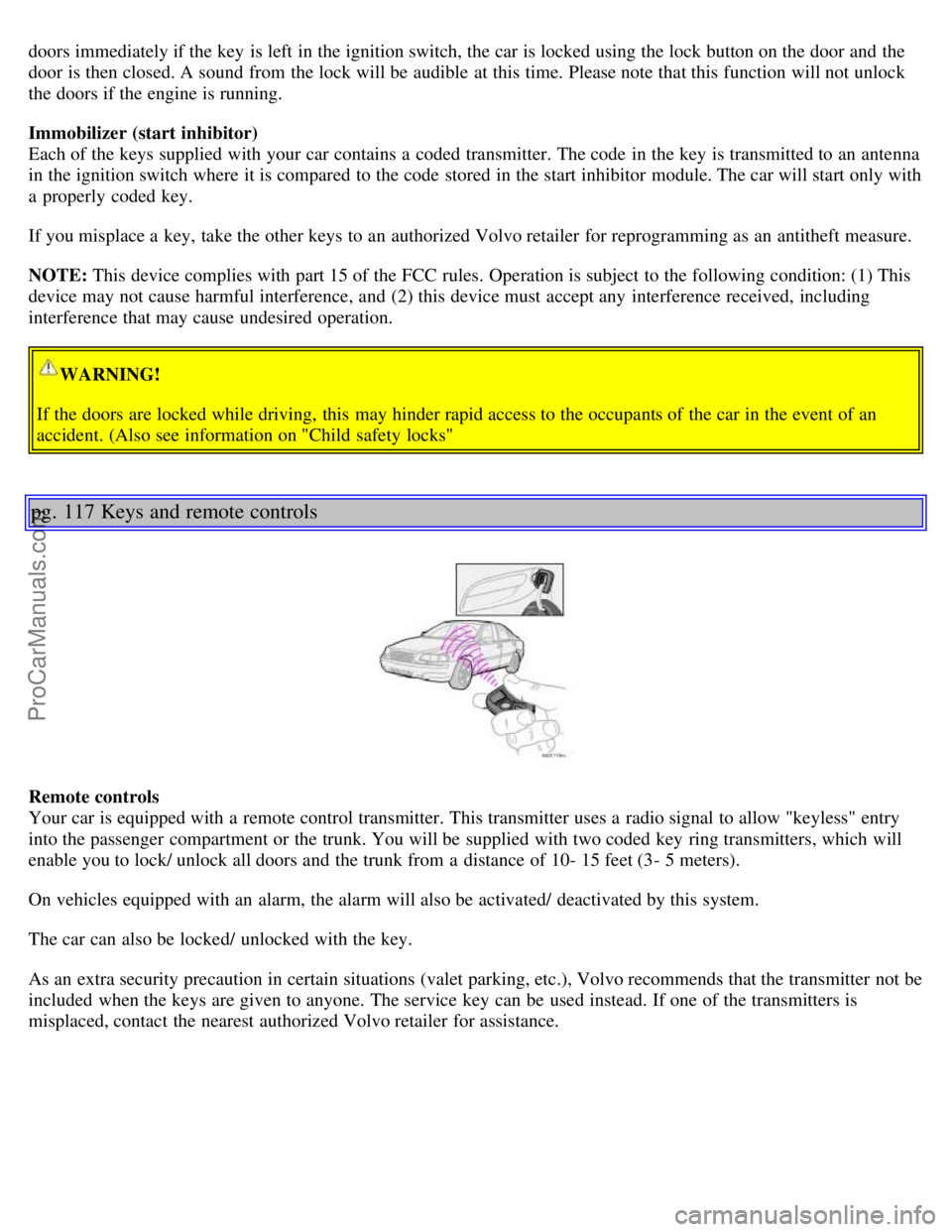
Remote controls
Your car is equipped with a remote control transmitter. This transmitter uses a radio signal to allow "keyless" entry
into the passenger compartment or the trunk. You will be supplied with two coded key ring transmitters, which will
enable you to lock/ unlock all doors and the trunk from a distance of 10- 15 feet (3- 5 meters).
On vehicles equipped with an alarm, the alarm will also be activated/ deactivated by this system.
The car can also be locked/ unlocked with the key.
As an extra security precaution in certain situations (valet parking, etc.), Volvo recommends that the transmitter not be
included when the keys are given to anyone. The service key can be used instead. If one of the transmitters is
misplaced, contact the nearest authorized Volvo retailer for assistance.
ProCarManuals.com
Changing wheels
The spare wheel is located under the carpet on the trunk floor. The jack and crank are secured in the wheel recess.
There are two jack attachment points on each side of the car (see illustration on next page). To change a wheel:
Engage the parking brake.
Put the gear selector in (P) ark (automatic transmission) or reverse (manual trans - mission).
Remove the wheel cap (where applicable) using the lug wrench in the tool kit.
With the car still on the ground, use the lug wrench to loosen the wheel bolts 1/ 2 - 1 turn. Turn the bolts
counterclockwise to loosen.
CAUTION:
The car must not be driven with wheels of different dimensions or with a spare tire other than the one that came with
the car. The use of different size wheels can seriously damage your car's transmission.
Correct tightening torque on wheel bolts must be observed. The wheel bolts should never be greased or lubricated.
The extended, chromed wheel bolts must not be used with steel rims, as they make it impos - sible to fit the hub caps.
pg. 157 Changing wheels
ProCarManuals.com
Automatic car wash
An automatic car wash is a simple and quick way of washing the car. Bear in mind, however, that an automatic car
wash can never replace a proper handwashing. During the first months of the car's life - while the paint is still curing
- we recommend that you handwash the car.
WARNING!
When the car is driven immediately after being washed, apply the brakes several times in order to remove any
moisture from the brake linings. Engine cleaning agents should not be used when the engine is warm. This
constitutes a fire risk.
Automatic washing - simple and quick
We do NOT recommend washing your car in an automatic wash during the first six months (because the paint will
not have hardened sufficiently).
An automatic wash is a simple and quick way to clean your car, but it is worth remembering that it may not be as
pg. 161 Washing and cleaning the car
thorough as when you yourself go over the car with sponge and water. Keeping the underbody clean is most
important, especially in the winter. Some automatic washers do not have facilities for washing the underbody.
Before driving into an automatic car wash, make sure that side view mirrors, auxiliary lamps, etc, are secure, and
that any antenna( s) are retracted or removed. Otherwise there is risk of the machine dislodging them.
Polishing and Waxing
Normally, polishing is not required during the first year after delivery, however, waxing may be beneficial.
Before applying polish or wax the car must be washed and dried. Tar spots can be removed with kerosene or tar
remover. Difficult spots may require a fine rubbing compound.
After polishing use liquid or paste wax.
Several commercially available products contain both polish and wax.
Waxing alone does not substitute for polishing a dull surface.
A wide range of polymer- based car waxes can be purchased today. These waxes are easy to use and produce a
long-lasting, high- gloss finish that protects thebodywork against oxidation, road dirt and fading.
Do not polish or wax your car in direct sunlight (the surface of the car should not be warmer than 113° F (45° C).
Cleaning the upholstery
The fabric can be cleaned with soapy water or a detergent. For more difficult spots caused by oil, ice cream, shoe
polish, grease, etc., use a clothing/ fabric stain remover.
The plastic in the upholstery can be cleaned with a soft cloth and mild soap solution.
Leather upholstery/ suede- like upholstery (alcanteraª) can be cleaned with a soft cloth and mild soap solution. For
more difficult spots, Volvo offers a leather care kit.
Under no circumstances should gasoline, naphtha or similar cleaning agents be used on the plastic or the leather
since these can cause damage.
Cleaning the seat belts
Clean only with lukewarm water and a mild soap solution.
Cleaning floor mats
The floor mats should be vacuumed or brushed clean regularly, especially during winter when they should be taken
out for drying. Spots on textile mats can be removed with a mild detergent.
ProCarManuals.com