2001 VOLVO S60 Rever
[x] Cancel search: ReverPage 19 of 128

Ashtrays
Volvo cars in North America do not have an ashtray in the front seat as standard equipment. If you want to have an
ashtray in the front seat, please contact your Volvo retailer.
pg. 46 Electrically operated windows
Electrically operated windows
The electrically operated windows are controlled by buttons in the arm rests. The ignition switch must be ON *
(ignition key in position I, II or the engine running) for the electrically operated windows to function.
To lower: Press down the front edge of the button to the first detent (" stop").
To raise: Lightly pull up the front edge of the button to the first detent (" stop").
* The electrically operated windows will also function after the ignition has been switched off as long as neither of
the front doors has been opened.
Auto up/ down function (front doors only):
Either front door window can be opened or closed automatically.
Auto down: Press the front part of the button as far down as possible and release it immediately. To stop the window
at any time, pull the button up.
Auto up: Pull the front part of the button up as far as possible and release it immediately. To stop the window at any
time, press the button down.
NOTE: The electrically operated windows in the front seat have an overload protecting circuit breaker which reverses
movement of the electrically operated windows to their starting points if they are obstructed in any way. There- after
the windows will operate normally again.
WARNING!
Always remove the ignition key when the vehicle is unattended.
Make sure that childrens' hands are clear before raising the windows.
Never leave children unattended in the car.
ProCarManuals.com
Page 21 of 128
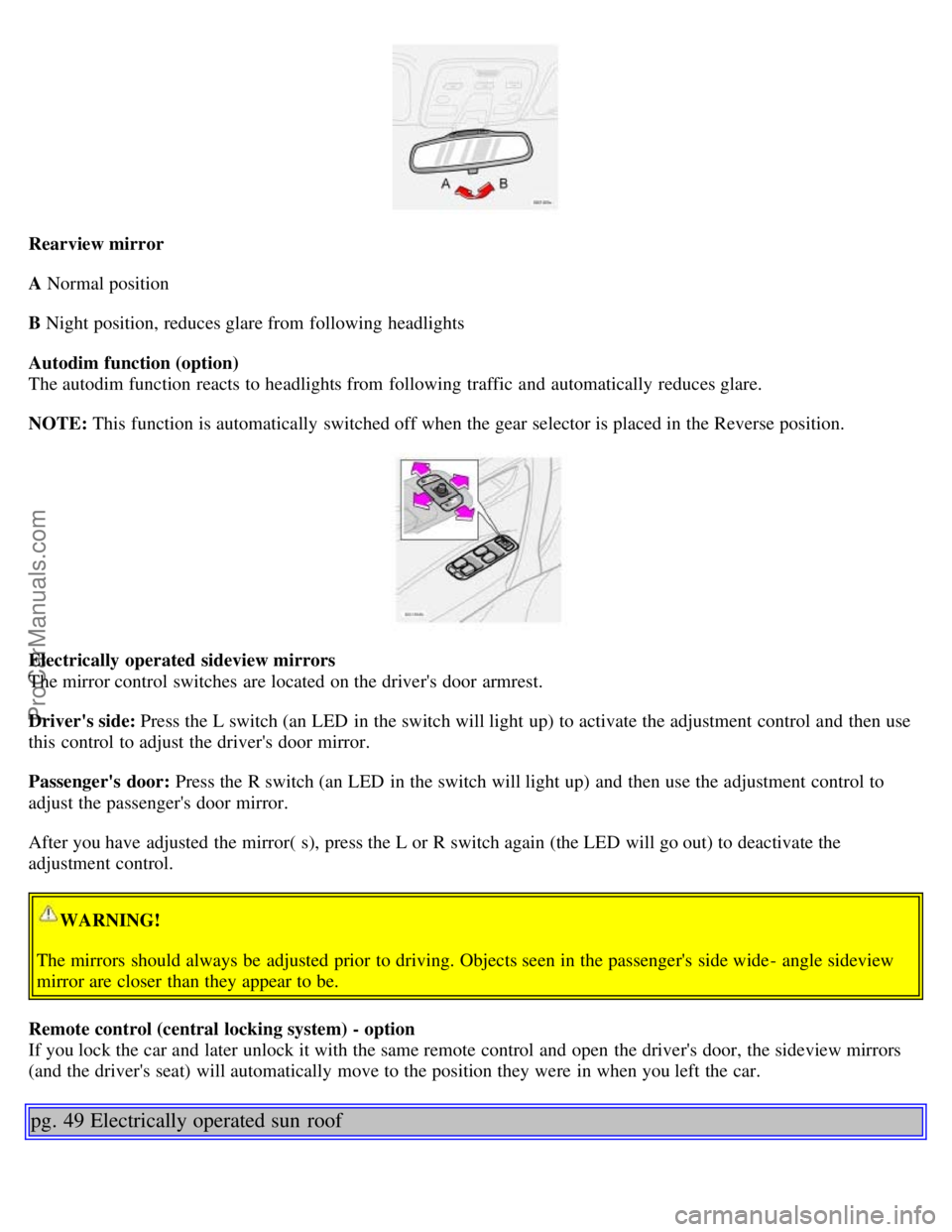
Rearview mirror
A Normal position
B Night position, reduces glare from following headlights
Autodim function (option)
The autodim function reacts to headlights from following traffic and automatically reduces glare.
NOTE: This function is automatically switched off when the gear selector is placed in the Reverse position.
Electrically operated sideview mirrors
The mirror control switches are located on the driver's door armrest.
Driver's side: Press the L switch (an LED in the switch will light up) to activate the adjustment control and then use
this control to adjust the driver's door mirror.
Passenger's door: Press the R switch (an LED in the switch will light up) and then use the adjustment control to
adjust the passenger's door mirror.
After you have adjusted the mirror( s), press the L or R switch again (the LED will go out) to deactivate the
adjustment control.
WARNING!
The mirrors should always be adjusted prior to driving. Objects seen in the passenger's side wide - angle sideview
mirror are closer than they appear to be.
Remote control (central locking system) - option
If you lock the car and later unlock it with the same remote control and open the driver's door, the sideview mirrors
(and the driver's seat) will automatically move to the position they were in when you left the car.
pg. 49 Electrically operated sun roof
ProCarManuals.com
Page 22 of 128
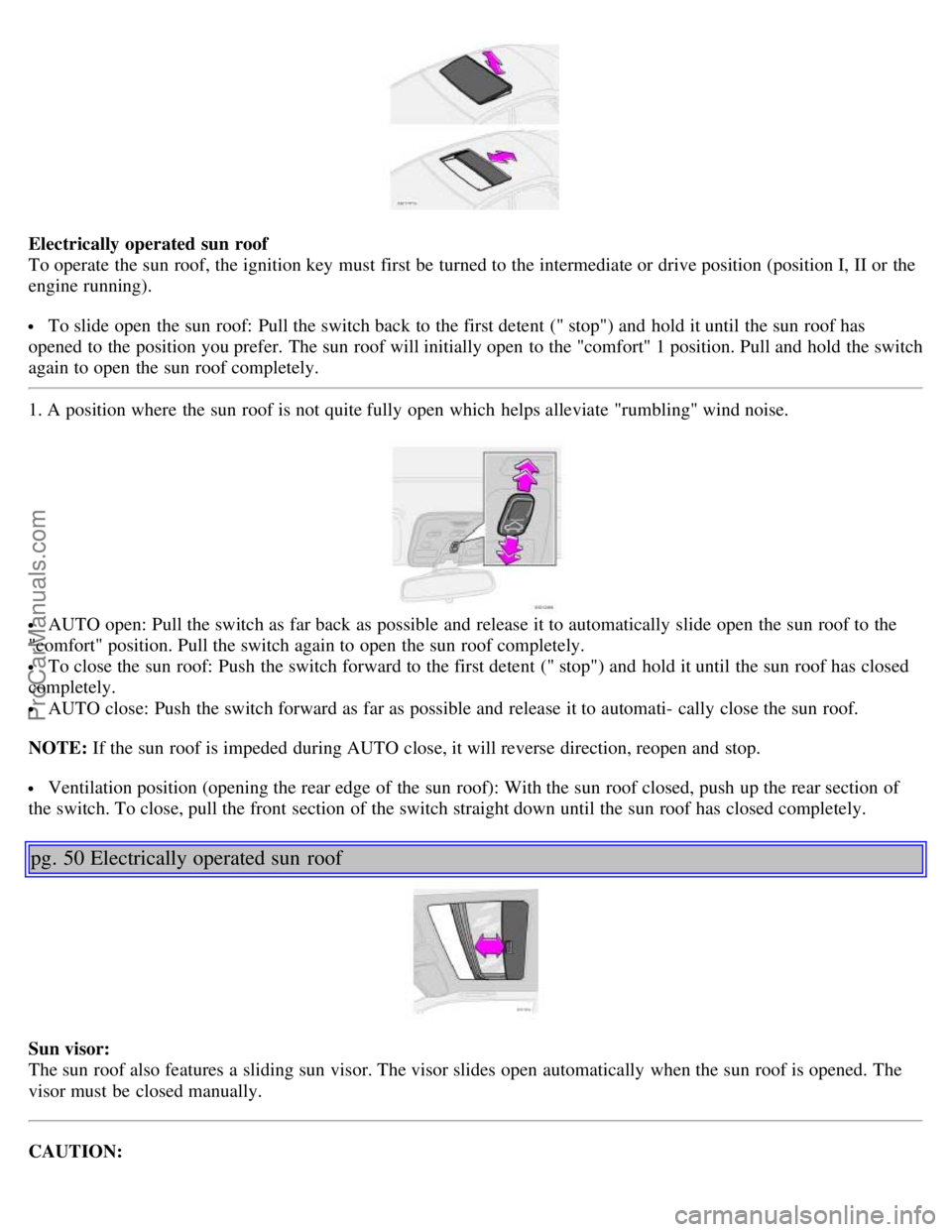
Electrically operated sun roof
To operate the sun roof, the ignition key must first be turned to the intermediate or drive position (position I, II or the
engine running).
To slide open the sun roof: Pull the switch back to the first detent (" stop") and hold it until the sun roof has
opened to the position you prefer. The sun roof will initially open to the "comfort" 1 position. Pull and hold the switch
again to open the sun roof completely.
1. A position where the sun roof is not quite fully open which helps alleviate "rumbling" wind noise.
AUTO open: Pull the switch as far back as possible and release it to automatically slide open the sun roof to the
"comfort" position. Pull the switch again to open the sun roof completely.
To close the sun roof: Push the switch forward to the first detent (" stop") and hold it until the sun roof has closed
completely.
AUTO close: Push the switch forward as far as possible and release it to automati- cally close the sun roof.
NOTE: If the sun roof is impeded during AUTO close, it will reverse direction, reopen and stop.
Ventilation position (opening the rear edge of the sun roof): With the sun roof closed, push up the rear section of
the switch. To close, pull the front section of the switch straight down until the sun roof has closed completely.
pg. 50 Electrically operated sun roof
Sun visor:
The sun roof also features a sliding sun visor. The visor slides open automatically when the sun roof is opened. The
visor must be closed manually.
CAUTION:
ProCarManuals.com
Page 53 of 128

Unscrew the spare tire and lift it out.
Return and secure everything in reverse order.
See also page 157
for more information on using the jack.
pg. 114 Spare wheel and tools
Contents | Top of Page
ProCarManuals.com
Page 83 of 128

Engaging reverse gear
Reverse gear should only be engaged from a complete stop.
CAUTION:
Be careful to avoid inadvertently engaging reverse while moving forward.
"Space ball" gear selector (option)
The shift positions for the "space ball" are the same as for the standard manual gear selector.
pg. 133 Automatic transmission (option)
Automatic transmission AW55- 50 (option)
P Park
Use this position when starting the engine or parking the car.
Never use P while the car is in motion.
The parking brake should be set whenever the car is parked.
The gear selector is mechanically locked in the P position (SHIFTLOCK). To release the gear selector from this
position, the engine must be running (or the ignition key must be in position II) and the brake pedal must be
depressed.
WARNING!
Never leave the car unattended when the engine is running. If, by mistake, the gear selector is moved from P, the
car may start moving.
R (Reverse) B Never engage R while the car is moving forward.
N (Neutral)
Neutral - no gear engaged. Use the parking brake.
ProCarManuals.com
Page 86 of 128

Never leave the car unattended when the engine is running. If, by mistake, the gear selector is moved from P, the
car may start moving.
R (Reverse)
Never engage R while the car is moving forward.
N (Neutral)
Neutral - no gear engaged. Use the parking brake.
D (Drive)
D is the normal driving position and should be used as often as possible to help improve fuel economy. The car
should not be moving when shifting from R to the D position.
Automatic transmission - adaptive system
The automatic transmission is controlled by an adaptive control system that constantly monitors the way in which the
transmission functions. It senses and adapts each gear shift for optimal performance. The system also monitors your
particular driving style and adapts gear shifting accordingly.
Automatic transmission - shift gate positions
You can move the gear selector freely between the (MAN) ual and (D) rive positions while driving.
Depress the button on the front of the gear selector knob to move between the R, N, D, and P positions.
pg. 136 Geartronic (option )
Manual shifting - Geartronic
You can move the gear selector freely between the (MAN) ual and (D) rive positions while driving. Gears 3, and 4
have a "lock - up" function which reduces engine speed and helps save fuel.
The currently selected gear will be displayed in the instrument panel (see page 30
).
To access the (MAN) ual shifting position from (D) rive, move the gear selector to the left to MAN.
To return to the (D) rive position from MAN, move the gear selector to the right.
While driving
If you select the (MAN) ual position while driving, the gear that was being used in the (D) rive position will also
initially be selected in (MAN) ual position.
Move the gear selector forward (toward "+") to shift to a higher gear or rearward (toward "-") to shift to a lower
gear.
If you hold the gear selector toward "-", the transmission will downshift, one gear at a time, and will utilize the
braking power of the engine. If the current speed is too high for using a lower gear, the downshift will not occur until
the speed has decreased enough to allow the lower gear to be used.
ProCarManuals.com
Page 94 of 128

Changing wheels
The spare wheel is located under the carpet on the trunk floor. The jack and crank are secured in the wheel recess.
There are two jack attachment points on each side of the car (see illustration on next page). To change a wheel:
Engage the parking brake.
Put the gear selector in (P) ark (automatic transmission) or reverse (manual trans - mission).
Remove the wheel cap (where applicable) using the lug wrench in the tool kit.
With the car still on the ground, use the lug wrench to loosen the wheel bolts 1/ 2 - 1 turn. Turn the bolts
counterclockwise to loosen.
CAUTION:
The car must not be driven with wheels of different dimensions or with a spare tire other than the one that came with
the car. The use of different size wheels can seriously damage your car's transmission.
Correct tightening torque on wheel bolts must be observed. The wheel bolts should never be greased or lubricated.
The extended, chromed wheel bolts must not be used with steel rims, as they make it impos - sible to fit the hub caps.
pg. 157 Changing wheels
ProCarManuals.com
Page 95 of 128
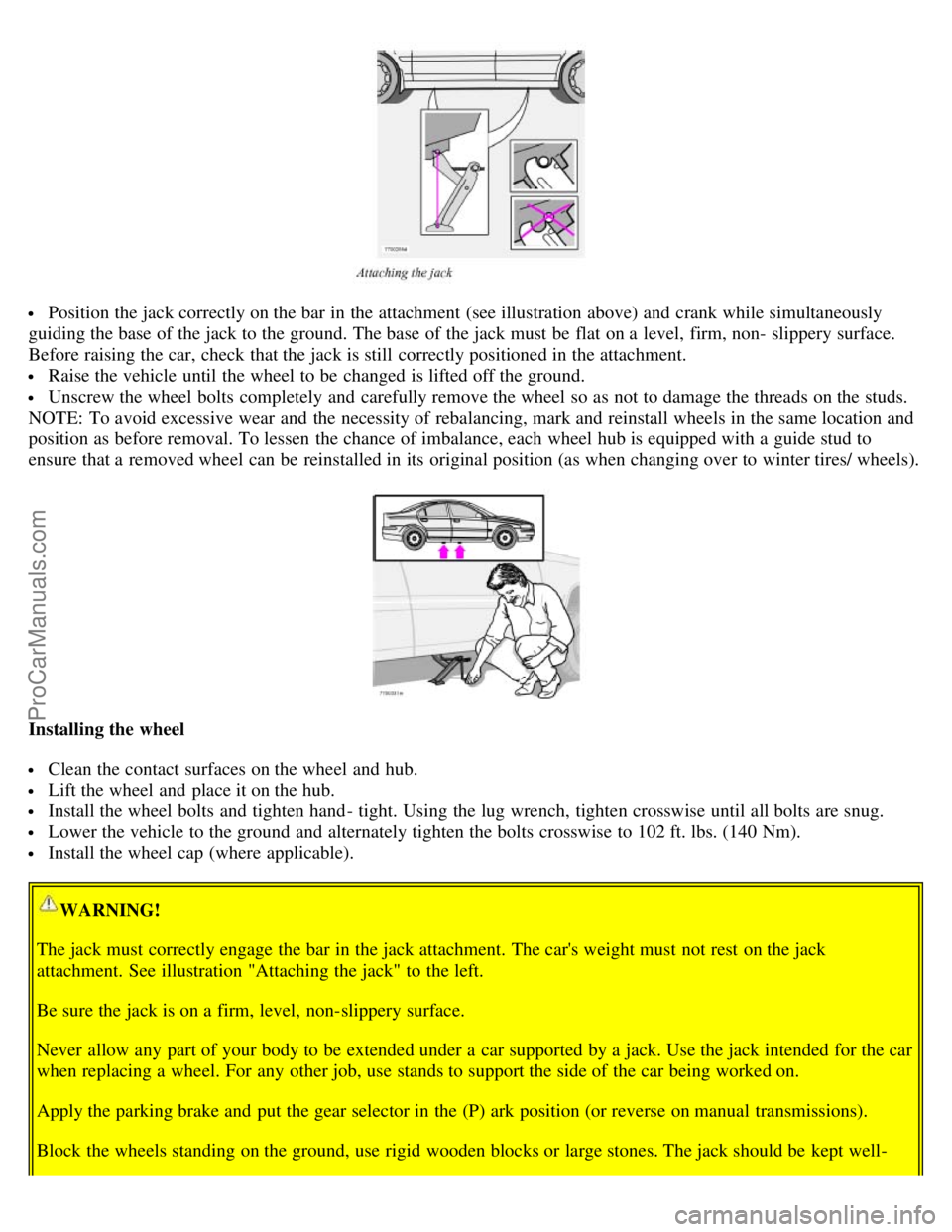
Position the jack correctly on the bar in the attachment (see illustration above) and crank while simultaneously
guiding the base of the jack to the ground. The base of the jack must be flat on a level, firm, non- slippery surface.
Before raising the car, check that the jack is still correctly positioned in the attachment.
Raise the vehicle until the wheel to be changed is lifted off the ground.
Unscrew the wheel bolts completely and carefully remove the wheel so as not to damage the threads on the studs.
NOTE: To avoid excessive wear and the necessity of rebalancing, mark and reinstall wheels in the same location and
position as before removal. To lessen the chance of imbalance, each wheel hub is equipped with a guide stud to
ensure that a removed wheel can be reinstalled in its original position (as when changing over to winter tires/ wheels).
Installing the wheel
Clean the contact surfaces on the wheel and hub.
Lift the wheel and place it on the hub.
Install the wheel bolts and tighten hand - tight. Using the lug wrench, tighten crosswise until all bolts are snug.
Lower the vehicle to the ground and alternately tighten the bolts crosswise to 102 ft. lbs. (140 Nm).
Install the wheel cap (where applicable).
WARNING!
The jack must correctly engage the bar in the jack attachment. The car's weight must not rest on the jack
attachment. See illustration "Attaching the jack" to the left.
Be sure the jack is on a firm, level, non-slippery surface.
Never allow any part of your body to be extended under a car supported by a jack. Use the jack intended for the car
when replacing a wheel. For any other job, use stands to support the side of the car being worked on.
Apply the parking brake and put the gear selector in the (P) ark position (or reverse on manual transmissions).
Block the wheels standing on the ground, use rigid wooden blocks or large stones. The jack should be kept well-
ProCarManuals.com