2001 SUZUKI GRAND VITARA electrical
[x] Cancel search: electricalPage 510 of 656

BODY ELECTRICAL SYSTEM 8-1
6F1
6F2
6G
6H
6K
7A
8
6K
7C1
7D
7E
7F
8A
8D
8E
9
10
10A
10B
SECTION 8
BODY ELECTRICAL SYSTEM
Wiring System
(Harnesses, Connectors, Fuses, Relay, Switches, Grounds, System Circuit Diagram) .......... Section 8A
Lighting System .............................................................................................................................. Section 8B
Instrumententation and Driver Information .................................................................................. Section 8C
Windows, Mirrors, Security and Locks ......................................................................................... Section 8D
Immobilizer Control System............................................................................................................Section 8F
CONTENTS
General Description .......................................... 8-3
WARNING:
For vehicles equipped with Supplemental Restraint (Air Bag) System:
Service on and around the air bag system components or wiring must be performed only by an
authorized SUZUKI dealer. Refer to “Air Bag System Components and Wiring Location View” under
“General Description” in air bag system section in order to confirm whether you are performing ser-
vice on or near the air bag system components or wiring. Please observe all WARNINGS and “Ser-
vice Precautions” under “On-Vehicle Service” in air bag system section before performing service
on or around the air bag system components or wiring. Failure to follow WARNINGS could result in
unintentional activation of the system or could render the system inoperative. Either of these two
conditions may result in severe injury.
Technical service work must be started at least 90 seconds after the ignition switch is turned to the
“LOCK” position and the negative cable is disconnected from the battery. Otherwise, the system
may be activated by reserve energy in the Sensing and Diagnostic Module (SDM).
NOTE:
For the descriptions (items) not found in this section, refer to the same section of the Service Manual
mentioned in FOREWORD of this manual.
Page 511 of 656
8-2 BODY ELECTRICAL SYSTEM
General Description
WIRE COLOR SYMBOLS
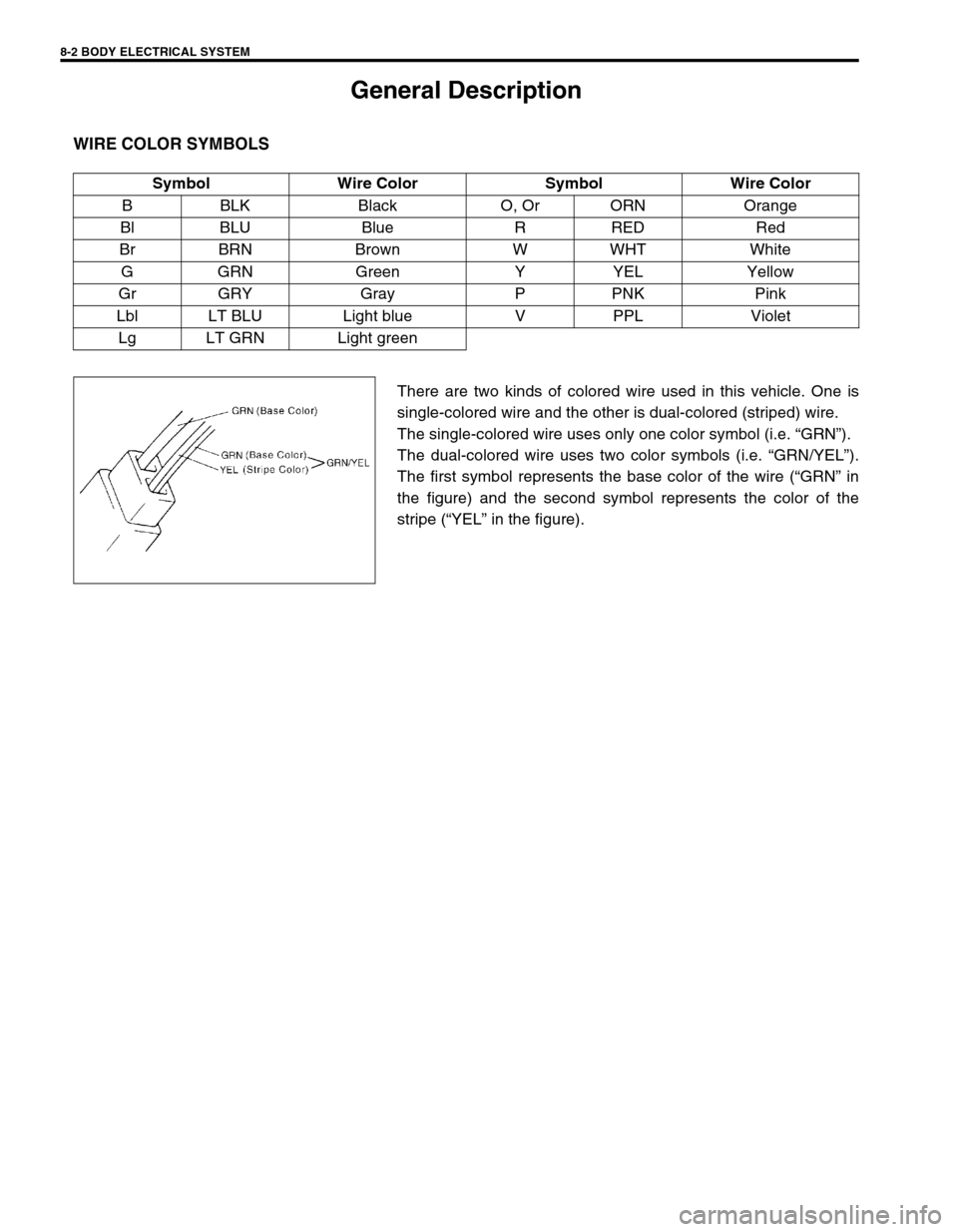
There are two kinds of colored wire used in this vehicle. One is
single-colored wire and the other is dual-colored (striped) wire.
The single-colored wire uses only one color symbol (i.e. “GRN”).
The dual-colored wire uses two color symbols (i.e. “GRN/YEL”).
The first symbol represents the base color of the wire (“GRN” in
the figure) and the second symbol represents the color of the
stripe (“YEL” in the figure). Symbol Wire Color Symbol Wire Color
B BLK Black O, Or ORN Orange
Bl BLU Blue R RED Red
Br BRN Brown W WHT White
GGRN Green Y YEL Yellow
Gr GRY Gray P PNK Pink
Lbl LT BLU Light blue V PPL Violet
Lg LT GRN Light green
Page 528 of 656

CRUISE CONTROL SYSTEM 8E-7
Note on System Circuit Inspection
Refer to “PRECAUTION FOR ELECTRICAL CIRCUIT SERVICE” in Section 0A. “RESUME/ACCEL”
switch fails to resume
preset vehicle speed
after cruise control is
cancelled.Main switch, “COAST/SET”, “RESUME/
ACCEL” and “CANCEL” switch circuits
faultyRefer to “CRUISE MAIN SWITCH,
COAT/SET, RESUME/ACCEL AND
CANCEL SWITCHES CIRCUITS
CHECK” in this section.
Actuator assembly faulty Replace actuator assembly.
Cruise control is not
cancelled even when
brake pedal is
depressed.Stop lamp switch circuit faulty Refer to “STOP LAMP SWITCH (WITH
PEDAL POSITION SWITCH) CIRCUITS
CHECK” in this section.
Actuator assembly faulty Replace actuator assembly.
Cruise control is not
cancelled even when
clutch pedal is
depressed.Clutch pedal position switch circuit faulty Refer to “CLUTCH PEDAL POSITION
SWITCH CIRCUIT CHECK” in this Sec-
tion.
Actuator assembly faulty Replace actuator assembly.
Cruise control is not
cancelled even when
selector lever is
shifted to “N” posi-
tion.Transmission range switch circuit (4 A/T
model only) faultyRefer to “TRANSMISSION RANGE
SWITCH CIRCUIT CHECK” in this sec-
tion.
Actuator assembly faulty Replace actuator assembly.
4 speed A/T gear shift-
ing is frequent
between 3rd and over-
drive when driving on
uphill road (Hunting).Throttle valve opening signal circuit faulty Refer to “THROTTLE VALVE OPENING
SIGNAL CIRCUIT CHECK” in this Sec-
tion.
Overdrive and TCC off command signal
circuit faultyRefer to “OVERDRIVE AND TCC OFF
COMMAND SIGNAL CIRCUIT CHECK”
in this section.
Actuator assembly faulty Replace actuator assembly.
4 speed A/T is not
shifted to overdrive
gear even though not
on uphill road.Throttle valve opening signal circuit faulty Refer to “THROTTLE VALVE OPENING
SIGNAL CIRCUIT CHECK” in this sec-
tion.
Overdrive and TCC off command signal
circuit faultyRefer to “OVERDRIVE AND TCC OFF
COMMAND SIGNAL CIRCUIT CHECK”
in this section.
Actuator assembly faulty Replace actuator assembly. Condition Possible Cause Correction
Page 583 of 656
10B-6 AIR BAG SYSTEM
Diagnosis
Diagnostic Trouble Code (DTC)
The AIR BAG DIAGNOSTIC SYSTEM CHECK must always be the starting point of any air bag system diagno-
sis. The AIR BAG DIAGNOSTIC SYSTEM CHECK checks for proper “AIR BAG” warning lamp operation and
checks for air bag diagnostic trouble codes (DTCs) using on-board diagnosis function or SUZUKI scan tool.
Use of Special Tool
You should be familiar with the tools listed in this section under the heading SPECIAL TOOLS. You should be
able to measure voltage and resistance. You should be familiar with proper use of a scan tool such as Air Bag
Driver/Passenger Load Tool, Connector Test Adapter Kit and the Digital Multimeter.
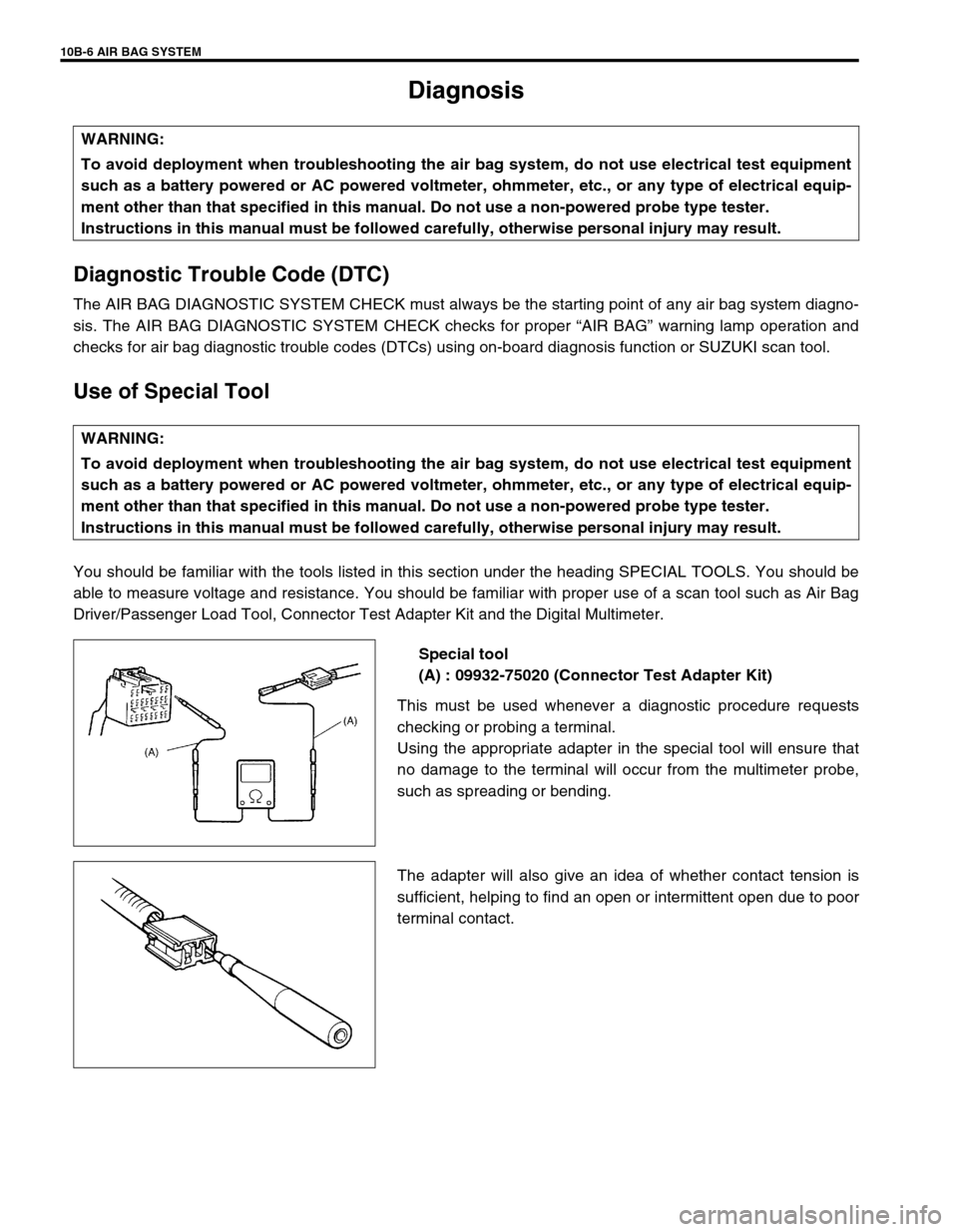
Special tool
(A) : 09932-75020 (Connector Test Adapter Kit)
This must be used whenever a diagnostic procedure requests
checking or probing a terminal.
Using the appropriate adapter in the special tool will ensure that
no damage to the terminal will occur from the multimeter probe,
such as spreading or bending.
The adapter will also give an idea of whether contact tension is
sufficient, helping to find an open or intermittent open due to poor
terminal contact. WARNING:
To avoid deployment when troubleshooting the air bag system, do not use electrical test equipment
such as a battery powered or AC powered voltmeter, ohmmeter, etc., or any type of electrical equip-
ment other than that specified in this manual. Do not use a non-powered probe type tester.
Instructions in this manual must be followed carefully, otherwise personal injury may result.
WARNING:
To avoid deployment when troubleshooting the air bag system, do not use electrical test equipment
such as a battery powered or AC powered voltmeter, ohmmeter, etc., or any type of electrical equip-
ment other than that specified in this manual. Do not use a non-powered probe type tester.
Instructions in this manual must be followed carefully, otherwise personal injury may result.
Page 584 of 656
AIR BAG SYSTEM 10B-7
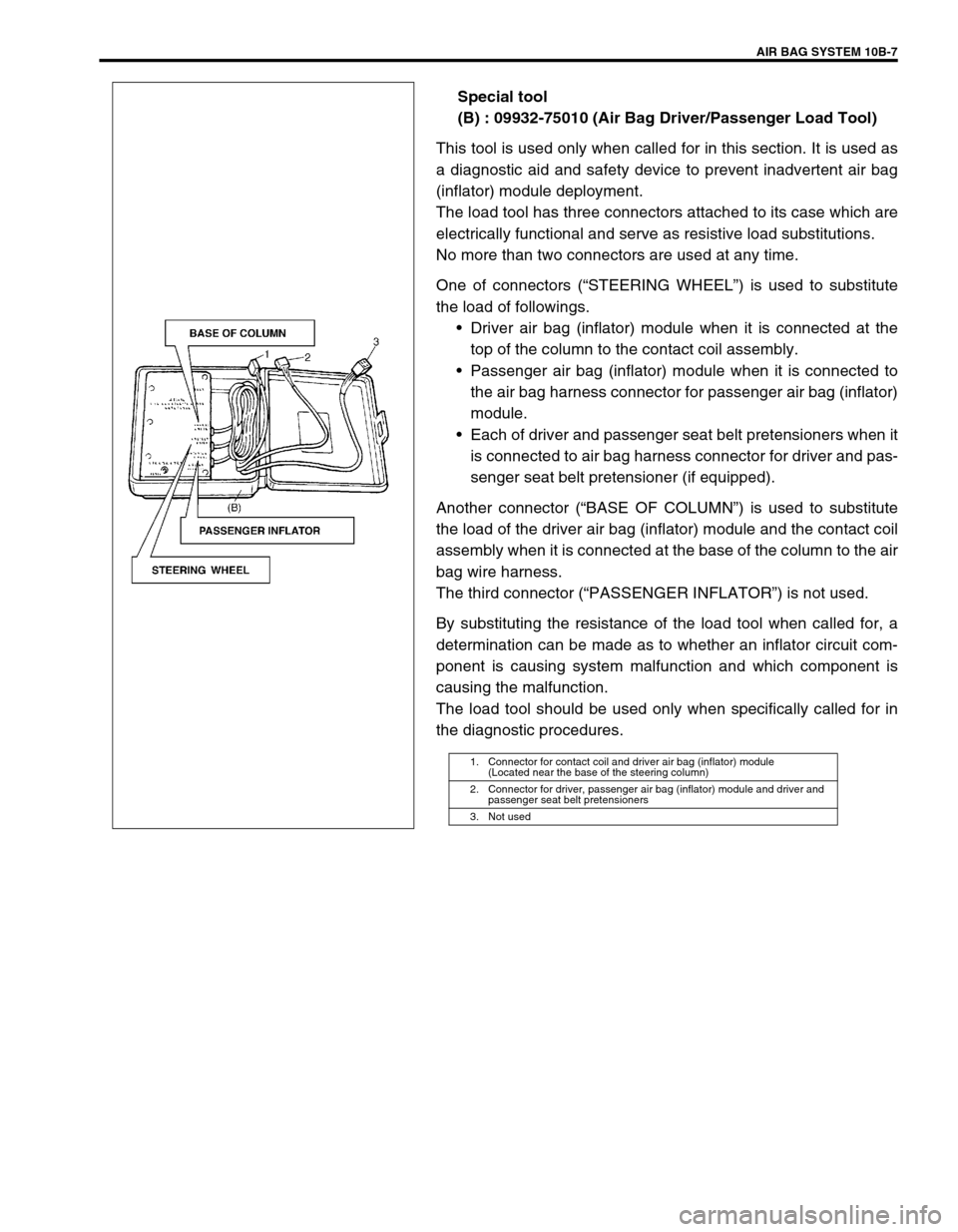
Special tool
(B) : 09932-75010 (Air Bag Driver/Passenger Load Tool)
This tool is used only when called for in this section. It is used as
a diagnostic aid and safety device to prevent inadvertent air bag
(inflator) module deployment.
The load tool has three connectors attached to its case which are
electrically functional and serve as resistive load substitutions.
No more than two connectors are used at any time.
One of connectors (“STEERING WHEEL”) is used to substitute
the load of followings.
•Driver air bag (inflator) module when it is connected at the
top of the column to the contact coil assembly.
•Passenger air bag (inflator) module when it is connected to
the air bag harness connector for passenger air bag (inflator)
module.
•Each of driver and passenger seat belt pretensioners when it
is connected to air bag harness connector for driver and pas-
senger seat belt pretensioner (if equipped).
Another connector (“BASE OF COLUMN”) is used to substitute
the load of the driver air bag (inflator) module and the contact coil
assembly when it is connected at the base of the column to the air
bag wire harness.
The third connector (“PASSENGER INFLATOR”) is not used.
By substituting the resistance of the load tool when called for, a
determination can be made as to whether an inflator circuit com-
ponent is causing system malfunction and which component is
causing the malfunction.
The load tool should be used only when specifically called for in
the diagnostic procedures.
1. Connector for contact coil and driver air bag (inflator) module
(Located near the base of the steering column)
2. Connector for driver, passenger air bag (inflator) module and driver and
passenger seat belt pretensioners
3. Not used
Page 585 of 656

10B-8 AIR BAG SYSTEM
Intermittents and Poor Connections
Most intermittents are caused by faulty electrical connections or
wiring. When a check for proper connection is requested in a
diagnostic flow table, perform careful check of suspect circuits for:
•Poor mating of connector halves, or terminals not fully
seated in the connector body (backed out).
•Dirt or corrosion on the terminals. The terminals must be
clean and free of any foreign material which could impede
proper terminal contact.
However, cleaning the terminal with a sand paper or the like
is prohibited.
•Damaged connector body, exposing the terminals to mois-
ture and dirt, as well as not maintaining proper terminal ori-
entation with the component or mating connector.
•Improperly formed or damaged terminals.
Check each connector terminal in problem circuits carefully
to ensure good contact tension by using the corresponding
mating terminal included in the connector test adapter kit
(special tool).
If contact tension is not enough, reform it to increase contact
tension or replace.
Special tool
(A) : 09932-75020 (Connector Test Adapter Kit)
•Poor terminal-to-wire connection.
Check each wire harness in problem circuits for poor con-
nection by shaking it by hand lightly. If any abnormal condi-
tion is found, change the wire harness assembly or
component parts with new ones.
•Wire insulation which is rubbed through, causing an intermit-
tent short as the bare area touches other wiring or parts of
the vehicle.
•Wire broken inside the insulation. This condition could cause
a continuity check to show a good circuit, but if only 1 or 2
strands of a multi-strand-type wire are intact, resistance
could be far too high.
If any abnormality is found, repair or replace as a wire harness
assembly.
Page 586 of 656

AIR BAG SYSTEM 10B-9
Air Bag Diagnostic System Check
The diagnostic procedures used in this section are designed to find and repair air bag system malfunctions.
To get the best results, it is important to use the diagnostic flow tables and follow the sequence listed below.
1) Perform the AIR BAG DIAGNOSTIC SYSTEM CHECK FLOW TABLE.
(The AIR BAG DIAGNOSTIC SYSTEM CHECK FLOW TABLE must be the starting point of any air bag sys-
tem diagnosis.
The AIR BAG DIAGNOSTIC SYSTEM CHECK FLOW TABLE checks for proper “AIR BAG” warning lamp
operation through “AIR BAG” warning lamp and whether air bag diagnostic trouble codes exist.)
2) Refer to the proper diagnostic table as directed by the AIR BAG DIAGNOSTIC SYSTEM CHECK FLOW
TABLE.
(The AIR BAG DIAGNOSTIC SYSTEM CHECK FLOW TABLE will lead you to the correct table to diagnose
any air bag system malfunctions. Bypassing these procedures may result in extended diagnostic time, incor-
rect diagnosis and incorrect parts replacement.)
3) Repeat the AIR BAG DIAGNOSTIC SYSTEM CHECK FLOW TABLE after any repair or diagnostic proce-
dures have been performed.
(Performing the AIR BAG DIAGNOSTIC SYSTEM CHECK FLOW TABLE after all repair or diagnostic pro-
cedures will ensure that the repair has been made correctly and that no other malfunctions exist.)
FLOW TABLE TEST DESCRIPTION
STEP 1 : Check that “AIR BAG” warning lamp lights.
STEP 2 : Check that “AIR BAG” warning lamp lights.
STEP 3 : Check diagnosis switch circuit.
STEP 4 : Check that “AIR BAG” warning lamp flashes 6 times after ignition switch is turned ON.
STEP 6 : Check that history codes are in SDM memory. (using SUZUKI scan tool)
STEP 7 : Check that history codes are in SDM memory. (using monitor coupler)
STEP 9 : Check that current code is in SDM memory. (using SUZUKI scan tool)
STEP 10 : Check that current code is in SDM memory. (using monitor coupler)WARNING:
To avoid deployment when troubleshooting the air bag system, do not use electrical test equipment
such as a battery powered or AC powered voltmeter, ohmmeter, etc., or any type of electrical equip-
ment other than that specified in this manual. Do not use a non-powered probe type tester.
Instructions in this manual must be followed carefully, otherwise personal injury may result.
CAUTION:
The order in which diagnostic trouble codes are diagnosed is very important. Failure to diagnose the
diagnostic trouble codes in the order specified may result in extended diagnostic time, incorrect diag-
nosis and incorrect parts replacement.
Page 594 of 656

AIR BAG SYSTEM 10B-17
TABLE TEST DESCRIPTION
Table A :
STEP 1 : Check “AIR BAG” fuse.
STEP 2 : Check power source circuit.
STEP 3 : Check “AIR BAG” warning lamp circuit.
Table B :
STEP 1 : Check combination meter power feed circuit.
STEP 2 : Check electrical connection check mechanism in SDM connector.
STEP 3 : Check “AIR BAG” warning lamp circuit.
STEP 4 : Check open in “AIR BAG” warning lamp circuit.
STEP 5 : Check short from “AIR BAG” warning lamp circuit to power circuit.
STEP 6 : Check “AIR BAG” bulb.
Table C and D :
STEP 1 : Check “AIR BAG” monitor coupler.
STEP 2 : Check diagnosis switch circuit for air bag system.
DIAGNOSTIC FLOW TABLE
Table A :
[A] Fig. for STEP 2/[B] Fig. for STEP 3
Special tool
(A) : 09932-75020 Step Action Yes No
1 1) Ignition switch OFF.
2) Remove and inspect “AIR BAG” fuse.
Is fuse good?Go to step 2.“BLU/RED” wire short to
ground.
After repair, replace “AIR
BAG” fuse.
2 1) Disconnect SDM connector
2) Check proper connection to SDM at termi-
nal “Q01-4”.
3) If OK then check voltage between “Q01-4”
terminal of SDM connector and body
ground with ignition switch ON.
Is it 8 V or more?Go to step 3.“BLU/RED” wire (between
“AIR BAG” fuse and SDM
connector) open “BLU/
BLK” wire (between igni-
tion switch and “AIR BAG”
fuse) open or short to
ground
3 1) Disconnect 16-pin connector from combina-
tion meter. Refer to COMBINATION
METER in SECTION 8C.
2) Check resistance between “Q01-2” termi-
nal of SDM connector and body ground.
Is circuit open?Substitute a known-good
SDM and recheck.“BLU” wire (between com-
bination meter and SDM
connector) short to
ground