2001 SAAB 9-3 service
[x] Cancel search: servicePage 160 of 260

160 Starting and drivingFuel (Gasoline Engine)Use regular unleaded gasoline rated at 87
octane or higher. It is recommended that the
gasoline meet specifications which were
developed by the American Automobile
Manufacturers Association (AAMA) and
endorsed by the Canadian Motor Vehicle
Manufacturers Association for better vehi-
cle performance and engine protection.
Gasolines meeting the AAMA specification
could provide improved driveability and
emission control system performance com-
pared to other gasolines.Canada Only
Be sure the posted octane is at least 87. If
the octane is less than 87, you may get a
heavy knocking noise when you drive. If it’s
bad enough, it can damage your engine. If
you’re using fuel rated at 87 octane or
higher and you hear heavy knocking, your
engine needs service. But don’t worry if you
hear a little pinging noise when you’re accel-
erating or driving up a hill. That’s normal,
and you don’t have to buy a higher octane
fuel to get rid of pinging. It’s the heavy, con-
stant knock that means you have a problem.
If your vehicle is certified to meet California
Emission Standards (indicated on the
underhood emission control label), it is
designed to operate on fuels that meet Cal-
ifornia specifications. If such fuels are not
available in states adopting California emis-
sions standards, your vehicle will operate
satisfactorily on fuels meeting federal spec-
ifications, but emission control system per-
formance may be affected. The malfunction
indicator lamp on your instrument panel
may turn on and/or your vehicle may fail a
smog-check test. See "Malfunction Indica-
tor Lamp" in the Index. If this occurs, return
to your authorized Saab dealer for diagno-
sis to determine the cause of failure. In the
event it is determined that the cause of the
condition is the type of fuels used, repairs
may not be covered by your warranty. Some gasolines that are not reformulated
for low emissions may contain an
octane-enhancing additive called methylcy-
clopentadienyl manganese tricarbonyl
(MMT); ask your service station operator
whether or not the fuel contains MMT. Saab
does not recommend the use of such gaso-
lines. If fuels containing MMT are used,
spark plug life may be reduced and your
emission control system performance may
be affected. The Engine malfunction
(CHECK ENGINE) light on your instrument
panel may turn on. If this occurs, return to
your authorized Saab dealer for service.
In Canada, look for the
"Auto Makers’ Choice" label
on the fuel pump.
ProCarManuals.com
Page 165 of 260

165 Starting and driving
Automatic transmission
fault indicator
If the symbol appears on the main instru-
ment panel, the system has detected a fault
in the automatic transmission or its control
module (see page 64).
This also means that the Limp-home mode
has been selected, to guard against further
damage being done to the transmission. In
this mode, the automatic transmission
starts in 4th gear, and gear changes (if nec-
essary) will have to be made manually.
It is not possible to select the SPORT or
WINTER mode when the Limp-home mode
is active.
You should have the automatic transmis-
sion checked as soon as possible by an
authorized Saab dealer.
The following gears will be engaged in the
respective selector positions when the auto-
matic transmission is in the Limp-home
mode:
Overheated transmission oilIf the transmission oil becomes overheated
while driving, the following message
appears on the SID: TRANSMISSION
OVERHEATING. In this event, stop the car
in a suitable place, switch off the engine,
open the hood and wait until the message
goes out. When driving subsequent to the
transmission oil overheating, select either
3rd gear or Drive, whichever will allow the
engine to run at 3,000 rpm and maintain the
speed of traffic or a safe speed.
The transmission oil can become very hot
when the car is driven with a heavy load; for
example, driving with a trailer on hilly roads
when the wrong gear has been selected,
resulting in many extra gear changes.
Select one of the positions 1, 2 or 3. A high
outside temperature or a defective oil cooler
can also cause the oil temperature to
increase. Contact an authorized Saab work-
shop, see also page 179.
Driving in hilly country with a heavy
loadOverheating of the automatic-transmission
fluid can occur when the car is towing a
heavy load, such as a trailer in hilly country,
with the wrong gear selected, resulting in
abnormally frequent gear changing. To
avoid the transmission oil from overheating
always drive in Normal mode, then the
adaptive gear change pattern is active.
High ambient temperatures can also
increase the temperature of the transmis-
sion fluid or the oil cooler may be faulty. As
the transmission fluid temperature
increases, its useful service life is reduced.
Contact an authorized Saab dealer (see
also page 179).TowingTowing a car with automatic transmission,
see page 187. Position R D 3 2 1
Gear Reverse 4th 4th 3rd 3rd
NOTEIf the control module has actuated the
Limp-home function for the automatic
transmission, the car will remain in 4th
gear when D is selected, making it very
sluggish. To overcome this, move the
selector lever to position 2. The transmis-
sion then starts in 3rd gear. When the car
is moving you can select position D or 3.
WARNING
Remember to use engine-braking (selec-
tor position 1, 2, or 3) to spare the brakes
when you are driving on a long or steep
downhill slope.
Brake failure can result from overheated
brakes!
ProCarManuals.com
Page 176 of 260
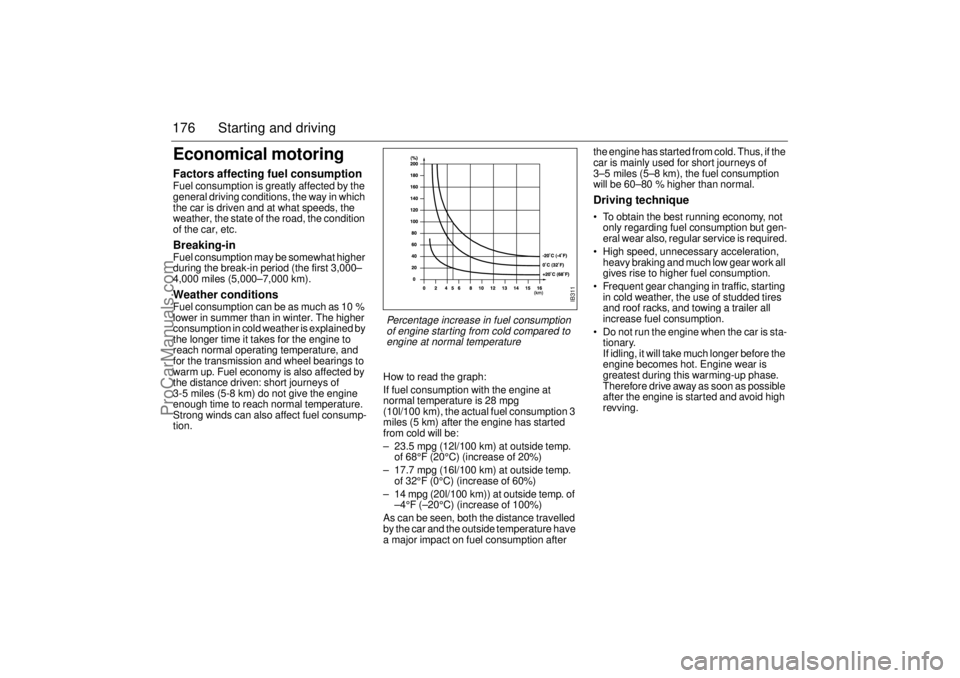
176 Starting and drivingEconomical motoringFactors affecting fuel consumption Fuel consumption is greatly affected by the
general driving conditions, the way in which
the car is driven and at what speeds, the
weather, the state of the road, the condition
of the car, etc. Breaking-in Fuel consumption may be somewhat higher
during the break-in period (the first 3,000–
4,000 miles (5,000–7,000 km). Weather conditionsFuel consumption can be as much as 10 %
lower in summer than in winter. The higher
consumption in cold weather is explained by
the longer time it takes for the engine to
reach normal operating temperature, and
for the transmission and wheel bearings to
warm up. Fuel economy is also affected by
the distance driven: short journeys of
3-5 miles (5-8 km) do not give the engine
enough time to reach normal temperature.
Strong winds can also affect fuel consump-
tion. How to read the graph:
If fuel consumption with the engine at
normal temperature is 28 mpg
(10l/100 km), the actual fuel consumption 3
miles (5 km) after the engine has started
from cold will be:
– 23.5 mpg (12l/100 km) at outside temp.
of 68°F (20°C) (increase of 20%)
– 17.7 mpg (16l/100 km) at outside temp.
of 32°F (0°C) (increase of 60%)
– 14 mpg (20l/100 km)) at outside temp. of
–4°F (–20°C) (increase of 100%)
As can be seen, both the distance travelled
by the car and the outside temperature have
a major impact on fuel consumption after the engine has started from cold. Thus, if the
car is mainly used for short journeys of
3–5 miles (5–8 km), the fuel consumption
will be 60–80 % higher than normal.
Driving technique To obtain the best running economy, not
only regarding fuel consumption but gen-
eral wear also, regular service is required.
High speed, unnecessary acceleration,
heavy braking and much low gear work all
gives rise to higher fuel consumption.
Frequent gear changing in traffic, starting
in cold weather, the use of studded tires
and roof racks, and towing a trailer all
increase fuel consumption.
Do not run the engine when the car is sta-
tionary.
If idling, it will take much longer before the
engine becomes hot. Engine wear is
greatest during this warming-up phase.
Therefore drive away as soon as possible
after the engine is started and avoid high
revving.
IB311
Percentage increase in fuel consumption
of engine starting from cold compared to
engine at normal temperature
ProCarManuals.com
Page 189 of 260

189 Starting and driving
5 Check that the jumper cables do not
have loose or missing insulation. If they
do, you could get a shock and also the
vehicles could be damaged.
Before you connect the cables, here are
some basic things you should know.
Positive (+) will go to positive (+) and
negative (-) will go to a major metal
engine part with a good ground. Do not
connect (+) to (-) or you will get a short
that could injure you or would damage
the battery and maybe other parts as
well.
6 Connect the red positive (+) cable to the
positive (+) terminal of the vehicle with
the discharged battery.
7 Do not let the other end touch metal.
Connect it to the positive (+) terminal of
the good battery. Use a remote positive
(+) terminal if the vehicle has one.
8 Now connect the black negative (-)
cable to the good battery’s negative ter-
minal.
Do not let the other end touch anything
until the next step. The other end of the
negative cable does not go to the dead
battery. It goes to a major metal part with
a good ground on the engine of the vehi-
cle with the discharged battery.9 Attach the cable at least 18 inches
(45 cm) away from the discharged bat-
tery, but not near engine parts that
move. The electrical connection is just
as good there, but the chance of sparks
getting back to the battery is much less.
10 Start the vehicle with the good battery
and run the engine for a while.
11 Try to start the vehicle with the dis-
charged battery. If it does not start after
a few tries, it probably needs service.
12 Remove the cables in reverse order to
prevent electrical shorting. Take care
that they do not touch each other or any
other metal.
WARNING
Using a match or flame of any kind near a
battery can cause battery gas to explode.
You can suffer burns or be blinded. Use a
flashlight if you need more light.
Be sure the battery has enough water.
The battery installed in your new Saab
has filler caps. Be sure the right amount
of water is there. Add distilled or boiled
water if the level is too low. If you don’t,
explosive gas could be present.
Be sure the electrolyte in the battery is not
frozen. Discharged batteries will freeze.
When connecting jumper cables to a
frozen battery, gas from the chemical
reaction inside the battery can build up
under the ice and cause an explosion.
Battery fluid contains acid that can burn
you. Do not get it on you. If you acciden-
tally get it in your eyes or on your skin,
flush the area with water and get medical
help immediately.
ProCarManuals.com
Page 194 of 260

194 Car careEngineThe engine is a transverse four-cylinder
in-line engine with twin overhead camshafts
and 16 valves.
The engine is equipped with two balance
shafts that reduce engine vibration to a min-
mimum.
The balance shafts are chain-driven and
rotate at twice the speed of the crankshaft.
They produce forces and torques that are
opposed to those generated by the pistons
and connecting rods. The effect occurs
twice in each revolution of the engine, coun-
teracting the vibration from its moving parts,
and at the same time reducing unwanted
engine noise.
The gearbox, located on the right (viewed
from the front), is integrated with the engine.
Engine familiesSaab cars imported into the United States
and Canada meet all applicable emission
control standards. The engine family and
appropriate tune-up specifications are iden-
tified on a label affixed to the left front inner
fender.
These engine families meet applicable EPA
Federal Standards, California State Stan-
dards and Canadian Federal Standards and
are equipped with the following systems:
• Sequential multiport fuel injection system.
Three way catalytic converter.
Crankcase emissions control system.
Evaporative emission system.
Emission control
systemsThe systems for controlling emissions to the
atmosphere require regular checking and
adjustment at the intervals specified in the
service program.
In addition to meeting the exhaust emission
regulations and thereby helping to keep the
environment clean, a correctly tuned engine
will also give maximum fuel economy.
ProCarManuals.com
Page 196 of 260

196 Car careEngine oilChecking the fluid level Regularly check the oil level in the engine.
Do this with the car standing on level ground
with the engine warm, 2-5 minutes after it
has been turned off. Take the dipstick out
and wipe it off with a clean rag before carry-
ing out the check.
The level must not be below the MIN mark
on the dipstick, but nor should it be above
the MAX mark. Excess engine oil could
result in abnormal oil consumption.
The distance between MIN and MAX corre-
sponds to a volume of about one quart.
When necessary, add oil of the recom-
mended grade via the dipstick pipe. Make
sure that the cap of the dipstick is screwed
on properly after the check. Oil changingThe engine oil must be changed in accor-
dance with the service program, see page
239.
Oil volume and grade, see page 247.
Oil changing should be carried out on a
warm engine. 1 Unscrew the drain plug in the bottom of
the sump and leave the oil to drain into
an oil tray or other suitable receptacle for
at least ten minutes. Take care, as the oil
may be hot.
2 After the oil has been drained, unscrew
and remove the oil filter.
3 Fit a new filter and tighten it by hand.
4 Refit the drain plug with a new washer.
5 Add new oil.
Run the engine to normal temperature and
check the oil level.
IB890
Oil filler cap and dipstick
IB891
Drain plug
ProCarManuals.com
Page 197 of 260

197 Car care
Transmission fluidManual transmissionCheck and top up the fluid in accordance
with the service program.
If original fluid cannot be obtained for top-
ping up, Dexron III (synthetic fluid) auto-
matic transmission fluid can be used. If so,
the car should be taken to an authorized
Saab dealer as soon as possible to have the
reason for low fluid level corrected and orig-
inal fluid installed.Automatic transmissionCheck the fluid level as follows:
1 Park the car on level ground and apply
the parking brake. The automatic trans-
mission fluid must be at normal running
temperature, approximately 175°F
NOTEChange of engine oil and oil filter may be
required more frequently (5000-mile
intervals (8,000 km)) if any one of the fol-
lowing conditions apply to the car:
Most trips are less than 5 to 10 miles (8
to 16 km). This is particularly important
when outside temperatures are below
freezing.
Most trips include extensive idling
(such as frequent stop-and-go driving).
Most trips are through dusty areas.
You frequenty tow a trailer or use a car-
rier on top of your vehicle.
If the vehicle is used for delivery ser-
vice, police, taxi or other commerical
applications.
WARNING
Prolonged and repeated exposure of
the skin to engine oil can cause seri-
ous skin disorders.
Avoid prolonged skin contact when-
ever possible. Wash the affected area
thoroughly with soap and water after
any contact.
Keep oil out of reach of children.
Do not touch the turbocharger or
manifold. These get very hot when the
engine has been running.
Do not spill oil on hot parts of the
engine as this could cause a fire. Used
engine oil is particularly flammable.
Protect the environment. Do not dis-
pose of oil in the ground or down a
drain. Dispose of all used oil and oil fil-
ters at an appropriate disposal facility.
+80°
MIN MAX
+80°
IB495
Oil dipstick, automatic transmission
ProCarManuals.com
Page 199 of 260

199 Car care
The corrosion-inhibiting properties of the
coolant deteriorate over time, but coolant
approved by Saab can be used for
year-round protection. Change the coolant
as specified in the service program (page
239) and use only coolant approved by
Saab – other makes may need changing
more frequently and may damage the sys-
tem.
Changing the coolant(Usually carried out as part of the Saab
original service by an authorized Saab
dealer)
1 If the engine is hot, loosen the expan-
sion-tank filler cap a little to release the
pressure. Leave the cap in place.
2 Fit a suitable piece of hose onto the
nipple of the drain cock. Let the hose dis-
charge into a receptacle under the radi-
ator and open the drain cock, which is
located on the inside of the radiator
facing the engine bay.
3 Remove the filler cap on the expansion
tank.
4 In a couple of minutes the system will be
empty. Close the drain cock.
5 Mix antifreeze and water in a suitable
container. Use only Saab-approved
coolant. 6 Add the coolant slowly to the expansion
tank. This will take about two minutes,
as the air needs time to escape.
7 Screw the expansion-tank cap on and
run the engine to normal temperature.
Top up with coolant until the level is just
under the "KALT – COLD" mark on the
tank.
8 Check the coolant again after a few days
and top up as necessary. NOTEAlways mix the antifreeze with the
appropriate volume of water before
adding it to the cooling system.
If pure antifreeze is added, the engine
could still freeze and be damaged. This is
because the antifreeze will not mix
properly with the coolant before the
thermostat has opened to allow full
circulation.
IB893
Radiator drain cock
ProCarManuals.com