Page 106 of 373
2-37
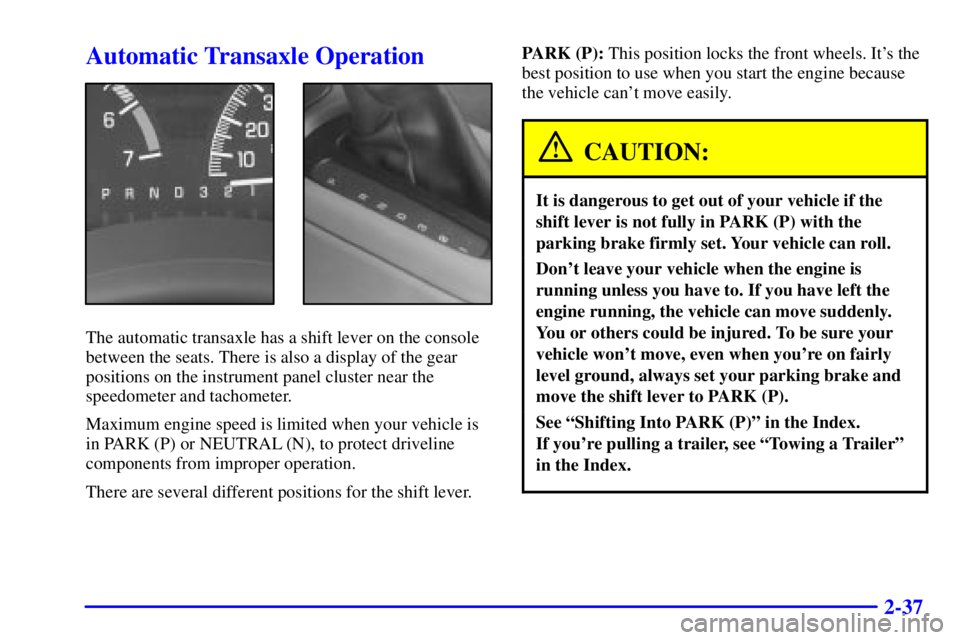
Automatic Transaxle Operation
The automatic transaxle has a shift lever on the console
between the seats. There is also a display of the gear
positions on the instrument panel cluster near the
speedometer and tachometer.
Maximum engine speed is limited when your vehicle is
in PARK (P) or NEUTRAL (N), to protect driveline
components from improper operation.
There are several different positions for the shift lever.PARK (P): This position locks the front wheels. It's the
best position to use when you start the engine because
the vehicle can't move easily.
CAUTION:
It is dangerous to get out of your vehicle if the
shift lever is not fully in PARK (P) with the
parking brake firmly set. Your vehicle can roll.
Don't leave your vehicle when the engine is
running unless you have to. If you have left the
engine running, the vehicle can move suddenly.
You or others could be injured. To be sure your
vehicle won't move, even when you're on fairly
level ground, always set your parking brake and
move the shift lever to PARK (P).
See ªShifting Into PARK (P)º in the Index.
If you're pulling a trailer, see ªTowing a Trailerº
in the Index.
Page 107 of 373

2-38
Make sure the shift lever is fully in PARK (P) before
starting the engine. The vehicle has an automatic
transaxle shift lock control system. You must fully apply
the regular brakes before you can shift from PARK (P)
when the ignition is in RUN. If you cannot shift out of
PARK (P), ease pressure on the shift lever by pushing it
all the way into PARK (P) while keeping the brake pedal
pushed down. Release the shift lever button. Then move
the shift lever out of PARK (P), being sure to press the
shift lever button. See ªShifting Out of PARK (P)º in
the Index.
REVERSE (R): Use this gear to back up.
NOTICE:
Shifting to REVERSE (R) while the vehicle is
moving forward could damage the transaxle.
Shift to REVERSE (R) only after the vehicle
is stopped.
To rock the vehicle back and forth to get out of snow,
ice or sand without damaging the transaxle, see ªStuck:
In Sand, Mud, Ice or Snowº in the Index.NEUTRAL (N): In this position, the engine doesn't
connect with the wheels. To restart when you're
already moving, use NEUTRAL (N) only. Also, use
NEUTRAL (N) when the vehicle is being towed.
CAUTION:
Shifting out of PARK (P) or NEUTRAL (N) while
your engine is ªracingº (running at high speed) is
dangerous. Unless your foot is firmly on the
brake pedal, your vehicle could move very
rapidly. You could lose control and hit people or
objects. Don't shift out of PARK (P) or
NEUTRAL (N) while your engine is racing.
NOTICE:
Damage to your transaxle caused by shifting out
of PARK (P) or NEUTRAL (N) with the engine
racing isn't covered by your warranty.
Page 108 of 373

2-39
AUTOMATIC OVERDRIVE (D): This position is
for normal driving. If you need more power for passing,
and you're:
�Going less than 35 mph (55 km/h), push the
accelerator pedal about halfway down.
�Going about 35 mph (55 km/h) or more, push the
accelerator pedal all the way down.
You'll shift down to the next gear and have more power.
NOTICE:
If the vehicle seems to start up rather slowly, or
if it seems not to shift gears as you go faster,
something may be wrong with a transaxle system
sensor. If you drive very far that way, the vehicle
can be damaged. So, if this happens, have the
vehicle serviced right away. Until then, you can
use SECOND (2) when you are driving less than
35 mph (55 km/h) and AUTOMATIC
OVERDRIVE (D) for higher speeds.
THIRD (3): This position is also used for normal
driving, but it offers more power and lower fuel
economy than AUTOMATIC OVERDRIVE (D).
Here are some times you might choose THIRD (3)
instead of AUTOMATIC OVERDRIVE (D):
�When driving on hilly, winding roads.
�When towing a trailer, so there is less shifting
between gears.
�When going down a steep hill.
Page 110 of 373
2-41
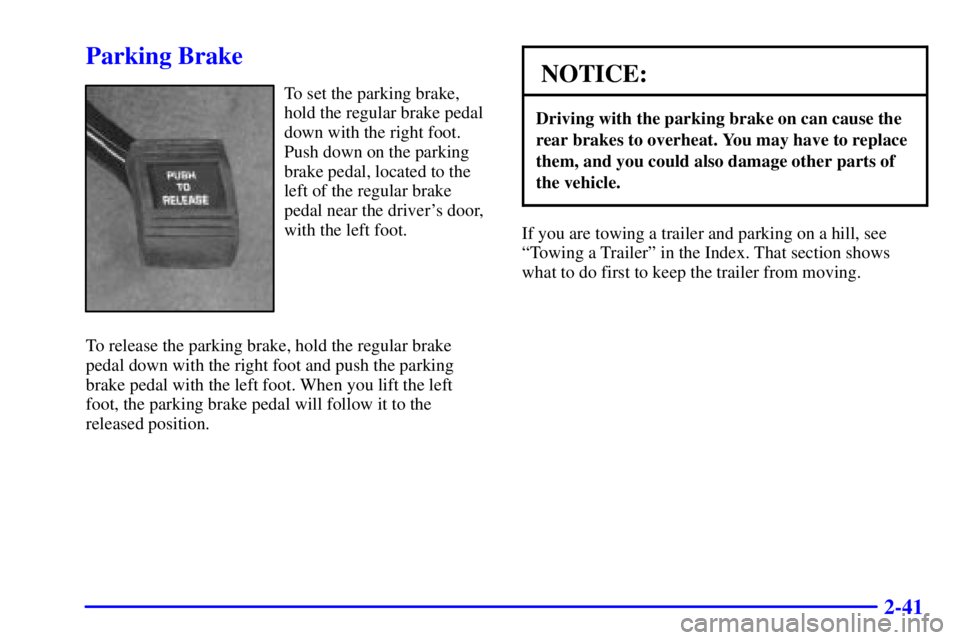
Parking Brake
To set the parking brake,
hold the regular brake pedal
down with the right foot.
Push down on the parking
brake pedal, located to the
left of the regular brake
pedal near the driver's door,
with the left foot.
To release the parking brake, hold the regular brake
pedal down with the right foot and push the parking
brake pedal with the left foot. When you lift the left
foot, the parking brake pedal will follow it to the
released position.NOTICE:
Driving with the parking brake on can cause the
rear brakes to overheat. You may have to replace
them, and you could also damage other parts of
the vehicle.
If you are towing a trailer and parking on a hill, see
ªTowing a Trailerº in the Index. That section shows
what to do first to keep the trailer from moving.
Page 111 of 373
2-42
Shifting Into PARK (P)
CAUTION:
It can be dangerous to get out of your vehicle if
the shift lever is not fully in PARK (P) with the
parking brake firmly set. Your vehicle can roll.
If you have left the engine running, the vehicle
can move suddenly. You or others could be
injured. To be sure your vehicle won't move,
even when you're on fairly level ground, use
the steps that follow. If you're pulling a trailer,
see ªTowing a Trailerº in the Index.
1. Hold the brake pedal down with your right foot and
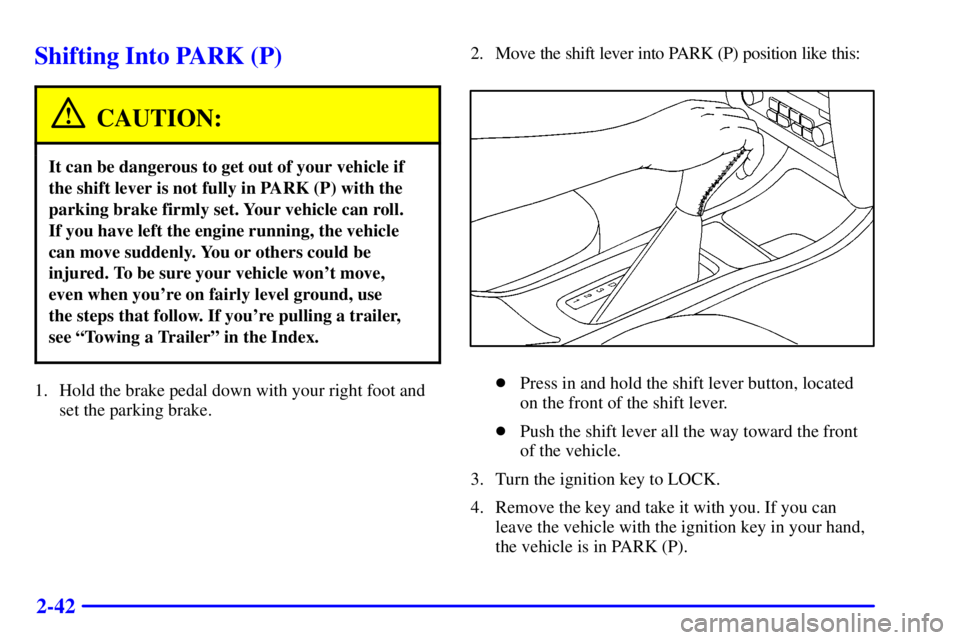
set the parking brake.2. Move the shift lever into PARK (P) position like this:�Press in and hold the shift lever button, located
on the front of the shift lever.
�Push the shift lever all the way toward the front
of the vehicle.
3. Turn the ignition key to LOCK.
4. Remove the key and take it with you. If you can
leave the vehicle with the ignition key in your hand,
the vehicle is in PARK (P).
Page 115 of 373
2-46
CAUTION:
It can be dangerous to get out of your vehicle if
the shift lever is not fully in PARK (P) with the
parking brake firmly set. Your vehicle can roll.
Don't leave your vehicle when the engine is
running unless you have to. If you've left the
engine running, the vehicle can move suddenly.
You or others could be injured. To be sure your
vehicle won't move, even when you're on fairly
level ground, always set your parking brake and
move the shift lever to PARK (P).
Follow the proper steps to be sure your vehicle won't
move. See ªShifting Into PARK (P)º in the Index.
If you are parking on a hill and if you're pulling a
trailer, also see ªTowing a Trailerº in the Index.
Horn
Press at or near the horn symbols to sound the horn.
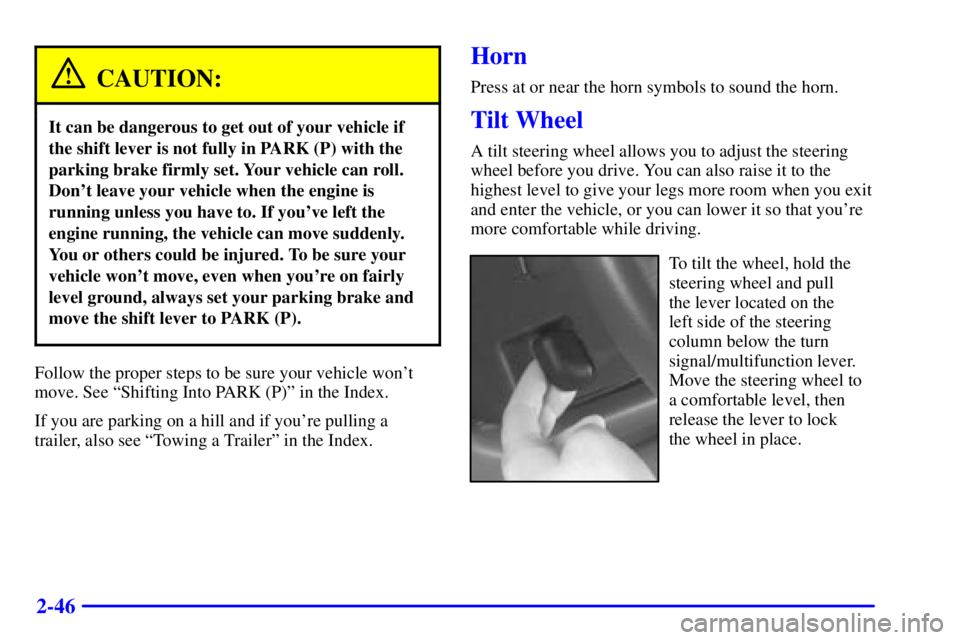
Tilt Wheel
A tilt steering wheel allows you to adjust the steering
wheel before you drive. You can also raise it to the
highest level to give your legs more room when you exit
and enter the vehicle, or you can lower it so that you're
more comfortable while driving.
To tilt the wheel, hold the
steering wheel and pull
the lever located on the
left side of the steering
column below the turn
signal/multifunction lever.
Move the steering wheel to
a comfortable level, then
release the lever to lock
the wheel in place.
Page 117 of 373

2-48
If a bulb is burned out, replace it to help avoid an
accident. If the arrows don't go on at all when you
signal a turn, check for burned
-out bulbs and then check
the fuse (see ªFuses and Circuit Breakersº in the Index).
A chime will sound if you leave the turn signal on for
more than 3/4 mile (1.2 km).
Headlamp High/Low-Beam Changer
To change the headlamps from low beam to high beam,
or high to low, pull the multifunction lever all the way
toward you. Then release it.
When the high beams
are on, a light on the
instrument panel cluster
also will be on. While
the high
-beam headlamps
are on, the fog lamps will
not be illuminated.
Flash-to-Pass Feature
When the headlamps are off, pull the lever toward you
to momentarily turn on the high beams (to signal that
you are going to pass). When you release the lever,
they will turn off and stay off.
Windshield Wipers
You control the windshield wipers by turning the band
marked WIPER on the turn signal/multifunction lever.
For a single wiping cycle, turn the band to MIST. Hold
it there until the wipers start, then let go. The wipers will
stop after one cycle. If you want more cycles, hold the
band on MIST longer.
For steady wiping at low speed, turn the band to LOW.
For high
-speed wiping, turn the band further, to HIGH.
To stop the wipers, turn the band to OFF.
You can set the wiper speed for a long or short delay
between wipes. This can be very useful in light rain or
snow. Turn the band to choose the delay time. The
closer to LOW, the shorter the delay.
Be sure to clear ice and snow from the wiper blades
before using them. If they're frozen to the windshield,
carefully loosen or thaw them. If the blades do become
damaged, get new blades or blade inserts.
Heavy snow or ice can overload the wipers. A circuit
breaker will stop them until the motor cools. Clear away
snow or ice to prevent an overload.
Page 125 of 373

2-56 Overhead Console Reading Lamps (Option)
These lamps are part of the overhead console. They will
go on when you open the doors. When the doors are
closed, push the button next to each lamp to turn
them on and off. The console also contains an open
storage bin.
Front Reading Lamps (Option)
If the vehicle has the optional sunroof, you will have
reading lamps in front of the sunroof switch. Press the
button behind each reading lamp to turn them on
and off.
Rear Assist Handle Reading
Lamps (Option)
There is a reading lamp provided in each rear assist
handle. Use the button next to each lamp to turn it
on and off.
Battery Saver
Your vehicle has a feature to help prevent you from
draining the battery in case you accidentally leave the
interior, trunk or underhood lamps on. If you leave
any of these lamps on while the ignition is in LOCK or
OFF, they will automatically turn off after 10 minutes.The lamps won't come back on again until you do
one of the following:
�Turn the ignition to RUN or ACCESSORY.
�Turn the interior lamp thumbwheel completely to the
right, then back slightly to the left.
�Open (or close and reopen) a door that is closed.
If the vehicle has less than 15 miles (25 km) on the
odometer, the battery saver will turn off the lamps after
only three minutes.
Mirrors
Adjust all the mirrors so you can see clearly when you
are sitting in a comfortable driving position.
Inside Day/Night Rearview Mirror
To reduce glare from lamps behind you, pull the lever
located in the center of the bottom of the mirror toward
you to the night position. To return the mirror back to
the day position, push the lever away from you.