Page 69 of 149

BRAKES55II-4
ABS - Anti-lock Braking System* This system improves vehicle safety by preventing the wheels from locking under emergency braking or when
braking on surfaces offering poor adhesion.
It thus also allows control of the steering to be retained. The operation of the various electronic components of the system is continuously monitored, both before and during your
journey. On switching on the ignition, the ABS lamp will light for approximately two seconds. If it stays on or lights when
driving, the ABS computer has detected a fault and has disconnected the ABS system. If the lamp lights whilst driving, it
again indicates that a fault has been detected and that the ABS system is inactive. In both situations, the normal braking
system is not affected and will continue to function as a conventional braking system without ABS. Nevertheless, to re-
establish the full safety features of the ABS system, It is recommended that the vehicle be examined by a dealer as soonas possible.
On slippery roads (loose stones, snow, ice, etc.), it is imperative to drive with caution.
* According to model or country
Protection fuses under the dashboardF12
(under the bonnet)
MF4 (with ABS)
Page 75 of 149
GEAR LEVER61II-6
Starting position
The engine can only be started
when the lever is at position P or N.
A safety device ensures that starting is impossible in the other positions.
Park Do not engage until the vehicle is completely sta-
tionary. To avoid any
movement of the vehicle when par-ked, select position Pand apply the
handbrake firmly. Check that theselector is in the Pposition to ensure
that the driving wheels are locked. When leaving the vehicle, make
absolutely certain that the PARK orP position is selected.
Automatic gearboxes - safety mea-sures:
¥ The gear lever can only be disen- gaged from position Pif the brake
pedal is pressed down.
¥ An audible warning* sounds if the gear lever is not in position P
when a door is opened. Also works with the ignition switched
off. Reverse gear Engage only when statio- nary and with the footbra-
ke firmly applied. To avoid
any transmission snatch or harsh-ness, wait several seconds before
pressing the accelerator. Neutral Do not select this position,
even momentarily, whenthe vehicle is in motion.
Warning If N is selected inadvertently when the vehicle is moving,allow the vehicle to stop beforeengaging other functions.
* According to model or country
Page 81 of 149
VENTILATION - HEATINGIII-1
66
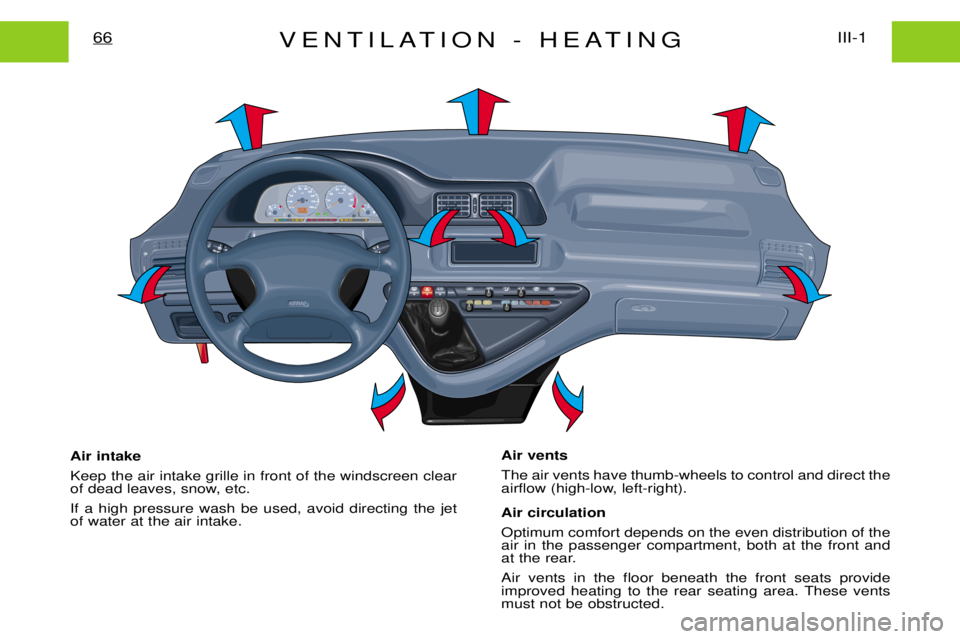
Air intake Keep the air intake grille in front of the windscreen clear
of dead leaves, snow, etc. If a high pressure wash be used, avoid directing the jet of water at the air intake. Air vents The air vents have thumb-wheels to control and direct the
airflow (high-low, left-right). Air circulation Optimum comfort depends on the even distribution of the air in the passenger compartment, both at the front and
at the rear. Air vents in the floor beneath the front seats provide
improved heating to the rear seating area. These ventsmust not be obstructed.
Page 126 of 149
CHANGING A WHEELV- 5
106
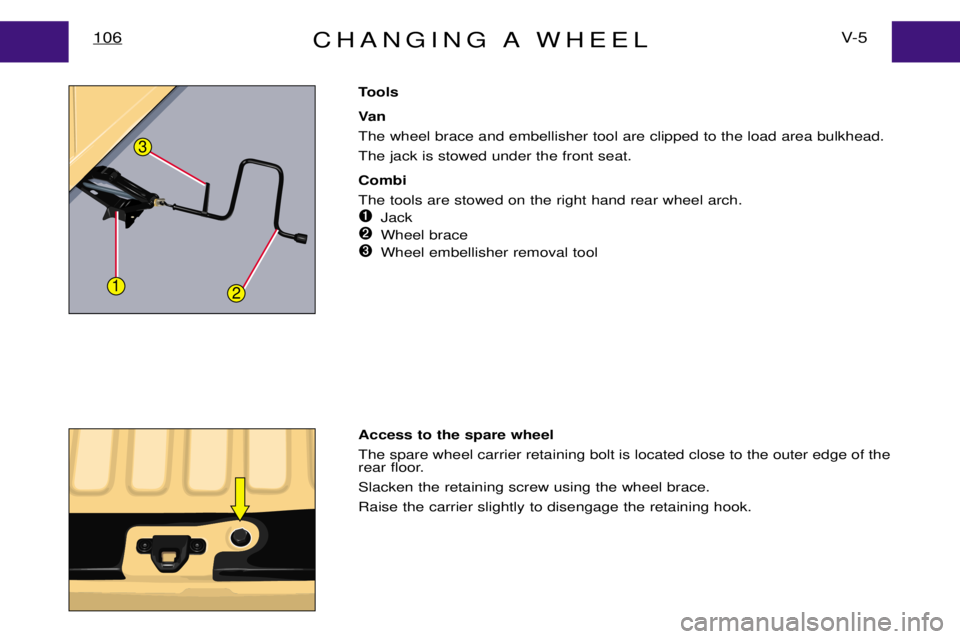
Tools
Va n The wheel brace and embellisher tool are clipped to the load area bulkhead.The jack is stowed under the front seat. Combi The tools are stowed on the right hand rear wheel arch.
�Jack
�Wheel brace
�Wheel embellisher removal tool
Access to the spare wheelThe spare wheel carrier retaining bolt is located close to the outer edge of the
rear floor. Slacken the retaining screw using the wheel brace.Raise the carrier slightly to disengage the retaining hook.
3
12
Page 127 of 149
CHANGING A WHEEL107V- 5
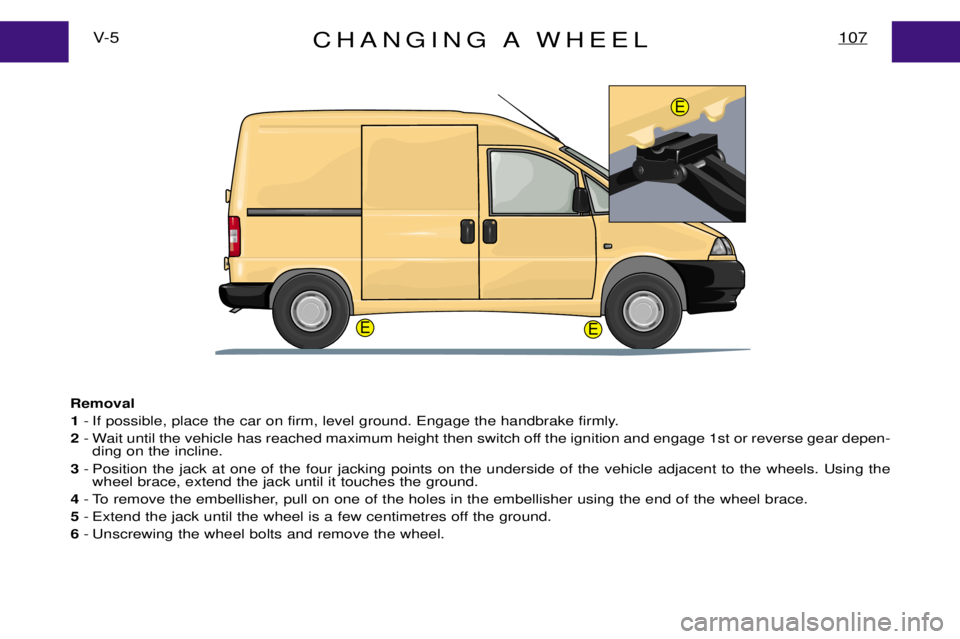
Removal1 - If possible, place the car on firm, level ground. Engage the handbrake firmly.
2 - Wait until the vehicle has reached maximum height then switch off the ignition and engage 1st or reverse gear depen-
ding on the incline.
3 - Position the jack at one of the four jacking points on the underside of the vehicle adjacent to the wheels. Using the
wheel brace, extend the jack until it touches the ground.
4 - To remove the embellisher, pull on one of the holes in the embellisher using the end of the wheel brace.
5 - Extend the jack until the wheel is a few centimetres off the ground.
6 - Unscrewing the wheel bolts and remove the wheel.
EE
E
Page 128 of 149
CHANGING A WHEELV- 5
108
WARNING
Never get under a jacked up vehicle
unless it is correctly supported by axle stands.
To refit
1 - Fit the wheel onto the hub, making sure that it is correctly positioned.
2 - Screw in the bolts but do not fully tighten them.
3 - Lower the jack and remove it.
4 - Using the wheel brace, fully tighten the wheel bolts.
5 - Refit the wheel embellisher, aligning the tyre valve aperture with the valve, then pressing it home around its circum-
ference.
6 - Refit the repaired original wheel as soon as possible.
7 - Correct the inflation section (Ç Tyres È) and have the balance checked.
Page 129 of 149
CHANGING A WHEEL109V- 5
The jack is designed specifically for your vehicle,do not use it for other applications.
Replacing the spare wheel in the carrier
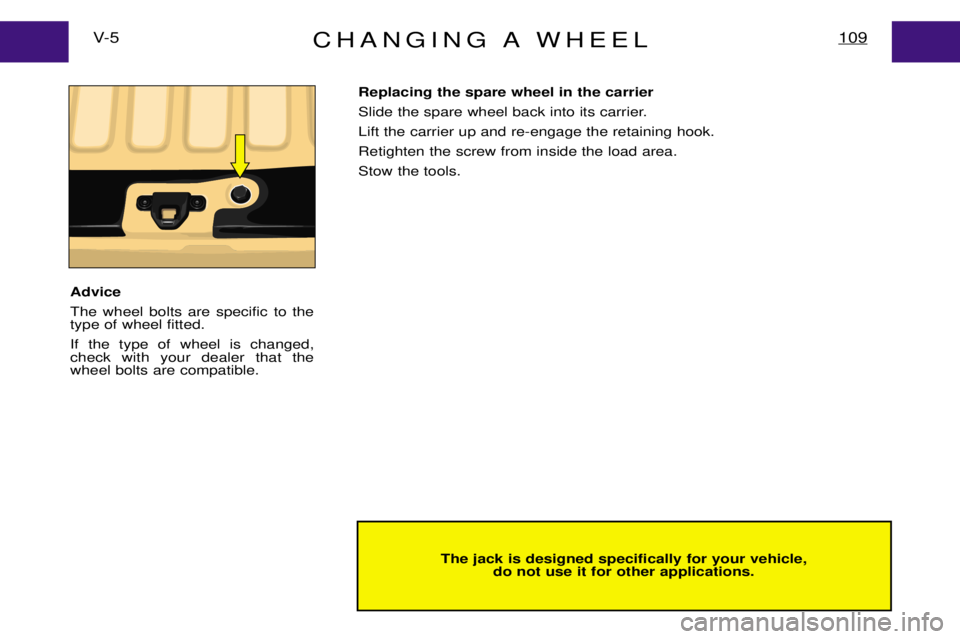
Slide the spare wheel back into its carrier.Lift the carrier up and re-engage the retaining hook.Retighten the screw from inside the load area.Stow the tools.
AdviceThe wheel bolts are specific to the type of wheel fitted. If the type of wheel is changed, check with your dealer that thewheel bolts are compatible.
Page 130 of 149
TOWING - LIFTINGV- 6
110
BEWARE
If the engine is not running,
the steering and braking systems will not be power-assisted.
Towing with the front or rear wheels lifted Use special towing equipment with a rigid bar and straps.Attach the hooks to each of the suspension arms.
Take the necessary precautions to protect the bumper and the front or rear of the vehicle.
NEVER TOW THE VEHICLE WITH THE FRONT OR REAR ENDS LIFTED AND THE WHEELS HANGING FREE. Towing with all wheels on theground
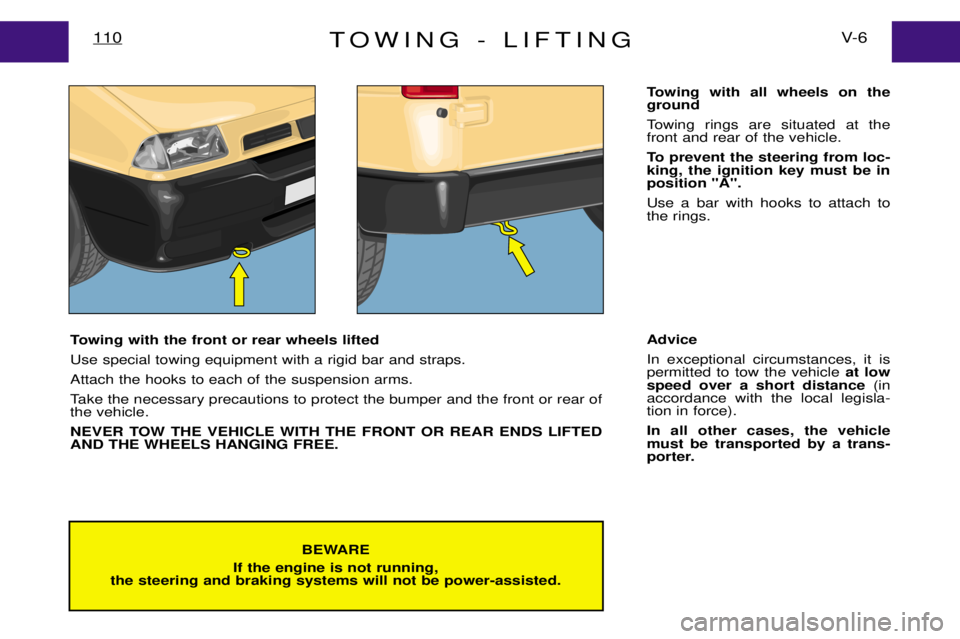
Towing rings are situated at the front and rear of the vehicle.
To prevent the steering from loc- king, the ignition key must be inposition "A". Use a bar with hooks to attach to the rings. Advice In exceptional circumstances, it is permitted to tow the vehicle
at low
speed over a short distance (in
accordance with the local legisla-tion in force). In all other cases, the vehicle must be transported by a trans-
porter.