Page 289 of 371
6-43 Wheel Alignment and Tire Balance
The wheels on your vehicle were aligned and balanced
carefully at the factory to give you the longest tire life
and best overall performance.
Scheduled wheel alignment and wheel balancing are not
needed. However, if you notice unusual tire wear or
your vehicle pulling one way or the other, the alignment
may need to be reset. If you notice your vehicle
vibrating when driving on a smooth road, your wheels
may need to be rebalanced.
Wheel Replacement
Replace any wheel that is bent, cracked, or badly rusted
or corroded. If wheel nuts keep coming loose, the
wheel, wheel bolts and wheel nuts should be replaced.
If the wheel leaks air, replace it (except some
aluminum wheels, which can sometimes be repaired).
See your dealer if any of these conditions exist.
Your dealer will know the kind of wheel you need.
Each new wheel should have the same load
-carrying
capacity, diameter, width, offset and be mounted the
same way as the one it replaces.
If you need to replace any of your wheels, wheel bolts
or wheel nuts, replace them only with new GM original
equipment parts. This way, you will be sure to have the
right wheel, wheel bolts and wheel nuts for your vehicle.
CAUTION:
Using the wrong replacement wheels, wheel bolts
or wheel nuts on your vehicle can be dangerous.
It could affect the braking and handling of your
vehicle, make your tires lose air and make you
lose control. You could have a collision in which
you or others could be injured. Always use
the correct wheel, wheel bolts and wheel nuts
for replacement.
NOTICE:
The wrong wheel can also cause problems with
bearing life, brake cooling, speedometer or
odometer calibration, headlamp aim, bumper
height, vehicle ground clearance and tire
clearance to the body and chassis.
See ªChanging a Flat Tireº in the Index for
more information.
ProCarManuals.com
Page 303 of 371
6-57
Fuse/Circuit
Breaker Usage
15 4WD Switch, Engine Controls
(VCM, PCM, Transmission)
16 Supplemental Inflatable Restraint
17 Front Wiper
18 Steering Wheel Radio Controls
19 Radio, Battery
20 Amplifier
21 HVAC I (Automatic),
HVAC Sensors (Automatic)
22 Anti
-Lock Brakes
23 Rear Wiper
24 Radio, Ignition
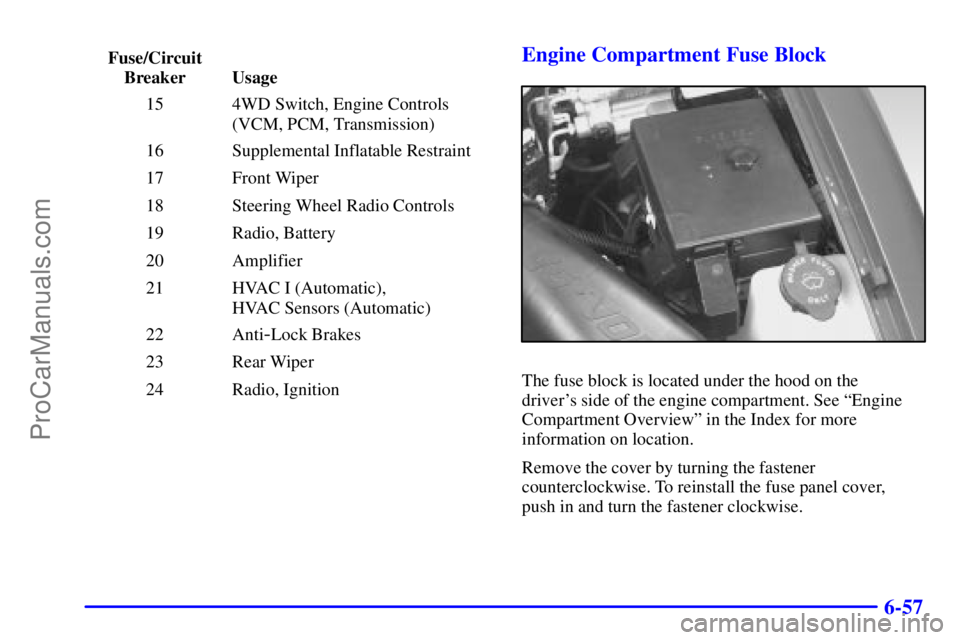
Engine Compartment Fuse Block
The fuse block is located under the hood on the
driver's side of the engine compartment. See ªEngine
Compartment Overviewº in the Index for more
information on location.
Remove the cover by turning the fastener
counterclockwise. To reinstall the fuse panel cover,
push in and turn the fastener clockwise.
ProCarManuals.com
Page 304 of 371
6-58
Name Usage
TRL TRN Trailer Left Turn
TRR TRN Trailer Right Turn
TRL B/U Trailer Back
-Up Lamps
VEH B/U Vehicle Back
-Up Lamps
RT TURN Right Turn Signal FrontName Usage
LT TURN Left Turn Signal Front
HDLP W/W Not Used
LT TRN Left Turn Signal Rear
RT TRN Right Turn Signal Rear
RR PRK Right Rear Parking Lamps
TRL PRK Trailer Parking Lamps
LT HDLP Left Headlamp
RT HDLP Right Headlamp
FR PRK Front Parking Lamps
INT BAT I/P Fuse Block Feed
ENG I Engine Sensors/Solenoids, MAF,
CAM, PURGE, VENT
ECM B Engine Control Module, Fuel
Pump Module, Oil Pressure
ABS Anti
-Lock Brake System
ECM I Engine Control Module Injectors
A/C Air Conditioning
W/W PMP Not Used
HORN Horn
ProCarManuals.com
Page 305 of 371
6-59
Name Usage
BTSI Automatic Transmission Shift
Lock Control System
B/U LP Back
-Up Lamps
IGN B Column Feed, IGN 2, 3, 4
RAP Retained Accessory Power
LD LEV Not Used
OXYSEN Oxygen Sensor
IGN E Engine
MIR/LKS Mirrors, Door Locks
FOG LP Fog Lamps
IGN A Starting and Charging IGN 1
STUD #2 Accessory Feeds, Electric Brake
PARKLP Parking Lamps
LR PRK Left Rear Parking Lamps
IGN C Starter Solenoid,
Fuel Pump, PRNDLName Usage
HTDSEAT Heated Seat
HVAC HVAC System
TRCHMSL Trailer Center High-Mounted
Stop Light
RRDFOG Rear Defogger
TBC Truck Body Computer
CRANK Clutch Switch, NSBU Switch
HAZLP Hazard Lamps
VECHMSL Vehicle Center High
Mounted Stoplamp
HTDMIR Heated Mirror
ATC Active Transfer Case
STOPLP Stoplamps
RR W/W Rear Window Wiper
ProCarManuals.com
Page 315 of 371

Short Trip/City Scheduled Maintenance
7-8
The services shown in this schedule up to 100,000 miles
(166 000 km) should be performed after 100,000 miles
(166 000 km) at the same intervals. The services shown
at 150,000 miles (240 000 km) should be performed at
the same interval after 150,000 miles (240 000 km).
See ªOwner Checks and Servicesº and ªPeriodic
Maintenance Inspectionsº following.
Footnotes
� The U.S. Environmental Protection Agency or the
California Air Resources Board has determined that the
failure to perform this maintenance item will not nullify
the emission warranty or limit recall liability prior to
the completion of the vehicle's useful life. We, however,
urge that all recommended maintenance services be
performed at the indicated intervals and the
maintenance be recorded.# Lubricate the front suspension, ball joints, steering
linkage, parking brake cable guides, propshaft splines,
universal joints and brake pedal springs.
+ A good time to check your brakes is during tire
rotation. See ªBrake System Inspectionº under
ªPeriodic Maintenance Inspectionsº in Part C of
this schedule.
** Drive axle service. See ªRecommended Fluids and
Lubricantsº in the Index for proper lubricant to use:
�Drain and refill at first oil change. At subsequent
oil changes, check fluid level and add fluid as
needed. If driving in dusty areas or towing a trailer,
drain fluid and refill every 15,000 miles (25 000 km).
�More frequent lubrication may be required for
off
-paved-road use.
ProCarManuals.com
Page 337 of 371

Long Trip/Highway Scheduled Maintenance
7-30
The services shown in this schedule up to 100,000 miles
(166 000 km) should be performed after 100,000 miles
(166 000 km) at the same intervals. The services shown
at 150,000 miles (240 000 km) should be performed at
the same interval after 150,000 miles (240 000 km).
See ªOwner Checks and Servicesº and ªPeriodic
Maintenance Inspectionsº following.
Footnotes
� The U.S. Environmental Protection Agency or the
California Air Resources Board has determined that the
failure to perform this maintenance item will not nullify
the emission warranty or limit recall liability prior to
the completion of the vehicle's useful life. We, however,
urge that all recommended maintenance services be
performed at the indicated intervals and the
maintenance be recorded.# Lubricate the front suspension, ball joints, steering
linkage, parking brake cable guides, propshaft splines,
universal joints and brake pedal springs.
+ A good time to check your brakes is during tire
rotation. See ªBrake System Inspectionº under
ªPeriodic Maintenance Inspectionsº in Part C of
this schedule.
** Drive axle service. See ªRecommended Fluids and
Lubricantsº in the Index for proper lubricant to use:
�Drain and refill at first oil change. At subsequent oil
changes, check fluid level and add fluid as needed.
ProCarManuals.com
Page 352 of 371

7-45
Starter Switch Check
CAUTION:
When you are doing this check, the vehicle could
move suddenly. If it does, you or others could be
injured. Follow the steps below.
1. Before you start, be sure you have enough room
around the vehicle.
2. Firmly apply both the parking brake and the regular
brake. See ªParking Brakeº in the Index if necessary.
NOTE: Do not use the accelerator pedal, and be
ready to turn off the engine immediately if it starts.
3. Try to start the engine in each gear. The starter
should work only in PARK (P) or NEUTRAL (N).
If the starter works in any other position, your
vehicle needs service.Automatic Transmission Shift Lock Control
System Check
CAUTION:
When you are doing this check, the vehicle could
move suddenly. If it does, you or others could be
injured. Follow the steps below.
1. Before you start, be sure you have enough room around
the vehicle. It should be parked on a level surface.
2. Firmly apply the parking brake. See ªParking Brakeº
in the Index if necessary.
NOTE: Be ready to apply the regular brake
immediately if the vehicle begins to move.
3. With the engine off, turn the key to the RUN
position, but don't start the engine. Without applying
the regular brake, try to move the shift lever out
of PARK (P) with normal effort. If the shift lever
moves out of PARK (P), your vehicle needs service.
ProCarManuals.com
Page 353 of 371

7-46
Ignition Transmission Lock Check
While parked, and with the parking brake set, try to turn
the ignition key to LOCK in each shift lever position.
�The key should turn to LOCK only when the shift
lever is in PARK (P).
�The key should come out only in LOCK.
Parking Brake and Automatic Transmission
PARK (P) Mechanism Check
CAUTION:
When you are doing this check, your vehicle
could begin to move. You or others could be
injured and property could be damaged. Make
sure there is room in front of your vehicle in case
it begins to roll. Be ready to apply the regular
brake at once should the vehicle begin to move.
Park on a fairly steep hill, with the vehicle facing
downhill. Keeping your foot on the regular brake,
set the parking brake.
�To check the parking brake's holding ability:
With the engine running and transmission in
NEUTRAL (N), slowly remove foot pressure
from the regular brake pedal. Do this until the
vehicle is held by the parking brake only.
�To check the PARK (P) mechanism's holding ability:
With the engine running, shift to PARK (P).
Then release the parking brake followed by the
regular brake.
Underbody Flushing Service
At least every spring, use plain water to flush any
corrosive materials from the underbody. Take care to
clean thoroughly any areas where mud and other debris
can collect.
ProCarManuals.com