Page 114 of 371
2-49
To reset the trip computer, press the MODE and
US/MET buttons simultaneously for at least two seconds.
All functions will be displayed briefly once the system is
reset. Reset can only be performed in the AVG ECON,
FUEL USED and AVG SPEED modes. All three modes
are reset simultaneously.
Sunglasses Storage Compartment
To open the sunglasses storage compartment in the
overhead console, press the release button. Then pull the
compartment down.
Door Storage
You will find a storage compartment on each of the
doors. Cupholders are also located on the doors.
Front Storage Area
Lift the armrest cover of the console compartment to
reveal a coinholder and additional storage. Ribs have
been provided for convenient storage of cassette tapes
and compact discs.
ProCarManuals.com
Page 130 of 371
2-65
Instrument Panel Cluster
Your instrument panel cluster is designed to let you know at a glance how your vehicle is running. You'll know
how fast you're going, about how much fuel you've used, and many other things you'll need to know to drive
safely and economically.
ProCarManuals.com
Page 137 of 371
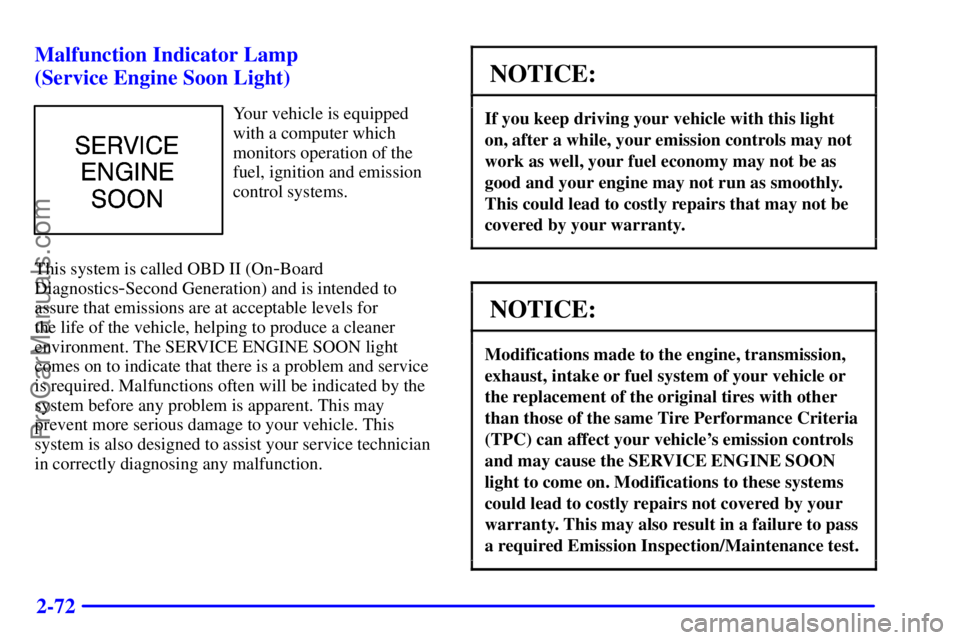
2-72 Malfunction Indicator Lamp
(Service Engine Soon Light)
Your vehicle is equipped
with a computer which
monitors operation of the
fuel, ignition and emission
control systems.
This system is called OBD II (On
-Board
Diagnostics
-Second Generation) and is intended to
assure that emissions are at acceptable levels for
the life of the vehicle, helping to produce a cleaner
environment. The SERVICE ENGINE SOON light
comes on to indicate that there is a problem and service
is required. Malfunctions often will be indicated by the
system before any problem is apparent. This may
prevent more serious damage to your vehicle. This
system is also designed to assist your service technician
in correctly diagnosing any malfunction.
NOTICE:
If you keep driving your vehicle with this light
on, after a while, your emission controls may not
work as well, your fuel economy may not be as
good and your engine may not run as smoothly.
This could lead to costly repairs that may not be
covered by your warranty.
NOTICE:
Modifications made to the engine, transmission,
exhaust, intake or fuel system of your vehicle or
the replacement of the original tires with other
than those of the same Tire Performance Criteria
(TPC) can affect your vehicle's emission controls
and may cause the SERVICE ENGINE SOON
light to come on. Modifications to these systems
could lead to costly repairs not covered by your
warranty. This may also result in a failure to pass
a required Emission Inspection/Maintenance test.
ProCarManuals.com
Page 138 of 371

2-73
This light should come on, as a check to show you it is
working, when the ignition is on and the engine is not
running. If the light doesn't come on, have it repaired.
This light will also come on during a malfunction in one
of two ways:
�Light Flashing
-- A misfire condition has been
detected. A misfire increases vehicle emissions and
may damage the emission control system on your
vehicle. Dealer or qualified service center diagnosis
and service may be required.
�Light On Steady
-- An emission control system
malfunction has been detected on your vehicle.
Dealer or qualified service center diagnosis and
service may be required.
If the Light Is Flashing
The following may prevent more serious damage to
your vehicle:
�Reducing vehicle speed.
�Avoiding hard accelerations.
�Avoiding steep uphill grades.
�If you are towing a trailer, reduce the amount of
cargo being hauled as soon as it is possible.If the light stops flashing and remains on steady, see
ªIf the Light Is On Steadyº following.
If the light continues to flash, when it is safe to do so,
stop the vehicle. Find a safe place to park your vehicle.
Turn the key off, wait at least 10 seconds and restart the
engine. If the light remains on steady, see ªIf the Light
Is On Steadyº following. If the light is still flashing,
follow the previous steps, and drive the vehicle to your
dealer or qualified service center for service.
If the Light Is On Steady
You may be able to correct the emission system
malfunction by considering the following:
Did you recently put fuel into your vehicle?
If so, reinstall the fuel cap, making sure to fully install
the cap. See ªFilling Your Tankº in the Index. The
diagnostic system can determine if the fuel cap has been
left off or improperly installed. A loose or missing fuel
cap will allow fuel to evaporate into the atmosphere.
A few driving trips with the cap properly installed
should turn the light off.
Did you just drive through a deep puddle of water?
If so, your electrical system may be wet. The condition
will usually be corrected when the electrical system
dries out. A few driving trips should turn the light off.
ProCarManuals.com
Page 139 of 371

2-74
Have you recently changed brands of fuel?
If so, be sure to fuel your vehicle with quality fuel.
See ªFuelº in the Index. Poor fuel quality will cause
your engine not to run as efficiently as designed.
You may notice this as stalling after start
-up, stalling
when you put the vehicle into gear, misfiring, hesitation
on acceleration or stumbling on acceleration. (These
conditions may go away once the engine is warmed up.)
This will be detected by the system and cause the light
to turn on.
If you experience one or more of these conditions,
change the fuel brand you use. It will require at least
one full tank of the proper fuel to turn the light off.
If none of the above steps have made the light turn off,
have your dealer or qualified service center check the
vehicle. Your dealer has the proper test equipment and
diagnostic tools to fix any mechanical or electrical
problems that may have developed.Emissions Inspection and Maintenance Programs
Some state/provincial and local governments have or may
begin programs to inspect the emission control equipment
on your vehicle. Failure to pass this inspection could
prevent you from getting a vehicle registration.
Here are some things you need to know in order to help
your vehicle pass an inspection:
Your vehicle will not pass this inspection if the
SERVICE ENGINE SOON light is on or not
working properly.
Your vehicle will not pass this inspection if the OBD
(on
-board diagnostic) system determines that critical
emission control systems have not been completely
diagnosed by the system. The vehicle would be
considered not ready for inspection. This can happen
if you have recently replaced your battery or if your
battery has run down. The diagnostic system is designed
to evaluate critical emission control systems during
normal driving. This may take several days of routine
driving. If you have done this and your vehicle still
does not pass the inspection for lack of OBD system
readiness, see your dealer or qualified service center to
prepare the vehicle for inspection.
ProCarManuals.com
Page 143 of 371
2-78 Fuel Gage
When the ignition is on,
the fuel gage tells you
about how much fuel you
have remaining.
Here are four things that some owners ask about. None
of these show a problem with your fuel gage:
�At the gas station, the gas pump shuts off before
the gage reads F (Full).
�It takes a little more or less fuel to fill up than the gage
indicated. For example, the gage may have indicated
the tank was half full, but it actually took a little more
or less than half the tank's capacity to fill the tank.
�The gage moves a little when you turn a corner or
speed up.
�The gage doesn't go back to E (Empty) when you
turn off the ignition.
Low Fuel Light
This light comes on briefly
when you start your engine.
This light comes on when the fuel tank is low on fuel.
To turn it off, add fuel to the fuel tank. See ªFuelº
in the Index.
ProCarManuals.com
Page 182 of 371

4-16 Before You Go Off-Roading
There are some things to do before you go out.
For example, be sure to have all necessary maintenance
and service work done. Check to make sure all
underbody shields (if so equipped) are properly
attached. Is there enough fuel? Is the spare tire fully
inflated? Are the fluid levels up where they should be?
What are the local laws that apply to off
-roading where
you'll be driving? If you don't know, you should check
with law enforcement people in the area. Will you be on
someone's private land? If so, be sure to get the
necessary permission.
Loading Your Vehicle for Off-Road Driving
There are some important things to remember about
how to load your vehicle.
�The heaviest things should be on the load floor and
forward of your rear axle. Put heavier items as far
forward as you can.
�Be sure the load is secured properly, so driving on
the off
-road terrain doesn't toss things around.
CAUTION:
�Cargo on the load floor piled higher than the
seatbacks can be thrown forward during a
sudden stop. You or your passengers could
be injured. Keep cargo below the top of
the seatbacks.
�Unsecured cargo on the load floor can be
tossed about when driving over rough
terrain. You or your passengers can be struck
by flying objects. Secure the cargo properly.
�Heavy loads on the roof raise the vehicle's
center of gravity, making it more likely to roll
over. You can be seriously or fatally injured if
the vehicle rolls over. Put heavy loads inside
the cargo area, not on the roof. Keep cargo
in the cargo area as far forward and low
as possible.
You'll find other important information in this manual.
See ªVehicle Loading,º ªLuggage Carrierº and ªTiresº
in the Index.
ProCarManuals.com
Page 193 of 371

4-27
CAUTION:
Driving through rushing water can be dangerous.
Deep water can sweep your vehicle downstream
and you and your passengers could drown.
If it's only shallow water, it can still wash away
the ground from under your tires, and you could
lose traction and roll the vehicle over. Don't drive
through rushing water.
See ªDriving Through Waterº in the Index for more
information on driving through water.
After Off-Road Driving
Remove any brush or debris that has collected
on the underbody, chassis or under the hood.
These accumulations can be a fire hazard.
After operation in mud or sand, have the brake linings
cleaned and checked. These substances can cause
glazing and uneven braking. Check the body structure,
steering, suspension, wheels, tires and exhaust system
for damage. Also, check the fuel lines and cooling
system for any leakage.
Your vehicle will require more frequent service due to
off
-road use. Refer to the Maintenance Schedule for
additional information.
ProCarManuals.com


