Page 196 of 340
4-29
�Tie a red cloth to your vehicle to alert police that
you've been stopped by the snow.
�Put on extra clothing or wrap a blanket around you.
If you have no blankets or extra clothing, make body
insulators from newspapers, burlap bags, rags, floor
mats
-- anything you can wrap around yourself or
tuck under your clothing to keep warm.
You can run the engine to keep warm, but be careful.
CAUTION:
Snow can trap exhaust gases under your vehicle.
This can cause deadly CO (carbon monoxide) gas
to get inside. CO could overcome you and kill
you. You can't see it or smell it, so you might not
know it is in your vehicle. Clear away snow from
around the base of your vehicle, especially any
that is blocking your exhaust pipe. And check
around again from time to time to be sure snow
doesn't collect there.
Open a window just a little on the side of the
vehicle that's away from the wind. This will help
keep CO out.
Run your engine only as long as you must. This saves
fuel. When you run the engine, make it go a little faster
than just idle. That is, push the accelerator slightly. This
uses less fuel for the heat that you get and it keeps the
battery charged. You will need a well
-charged battery to
restart the vehicle, and possibly for signaling later on
with your headlamps. Let the heater run for a while.
Page 215 of 340
5-6
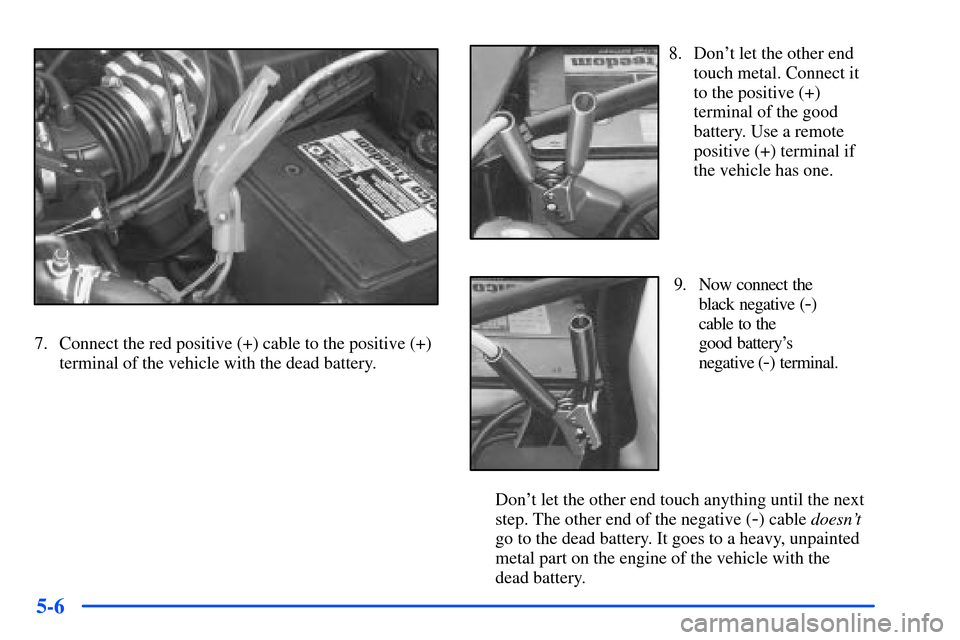
7. Connect the red positive (+) cable to the positive (+)
terminal of the vehicle with the dead battery.
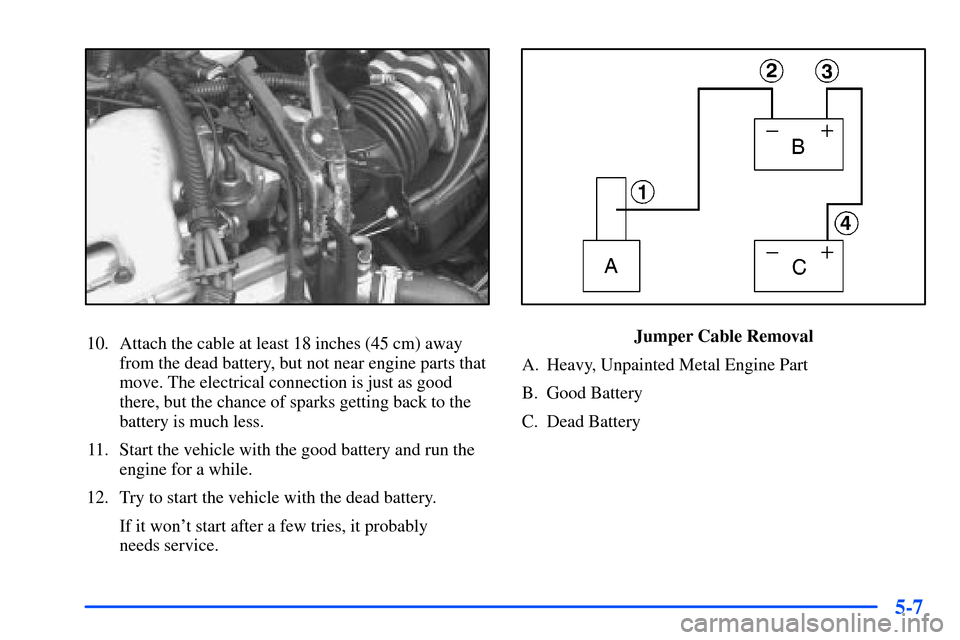
8. Don't let the other end
touch metal. Connect it
to the positive (+)
terminal of the good
battery. Use a remote
positive (+) terminal if
the vehicle has one.
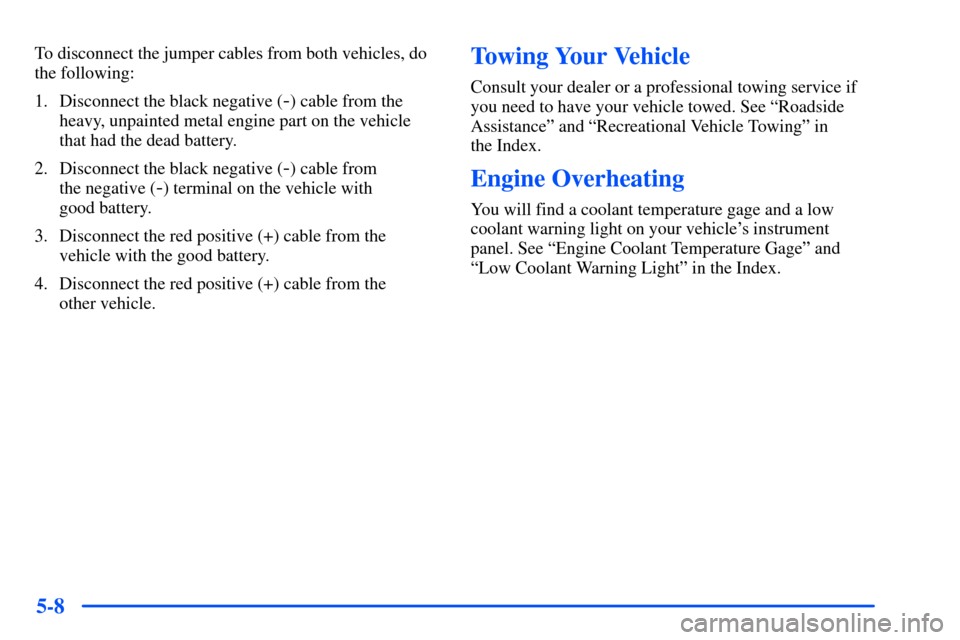
9. Now connect the
black negative (
-)
cable to the
good battery's
negative (
-) terminal.
Don't let the other end touch anything until the next
step. The other end of the negative (
-) cable doesn't
go to the dead battery. It goes to a heavy, unpainted
metal part on the engine of the vehicle with the
dead battery.
Page 216 of 340
5-7
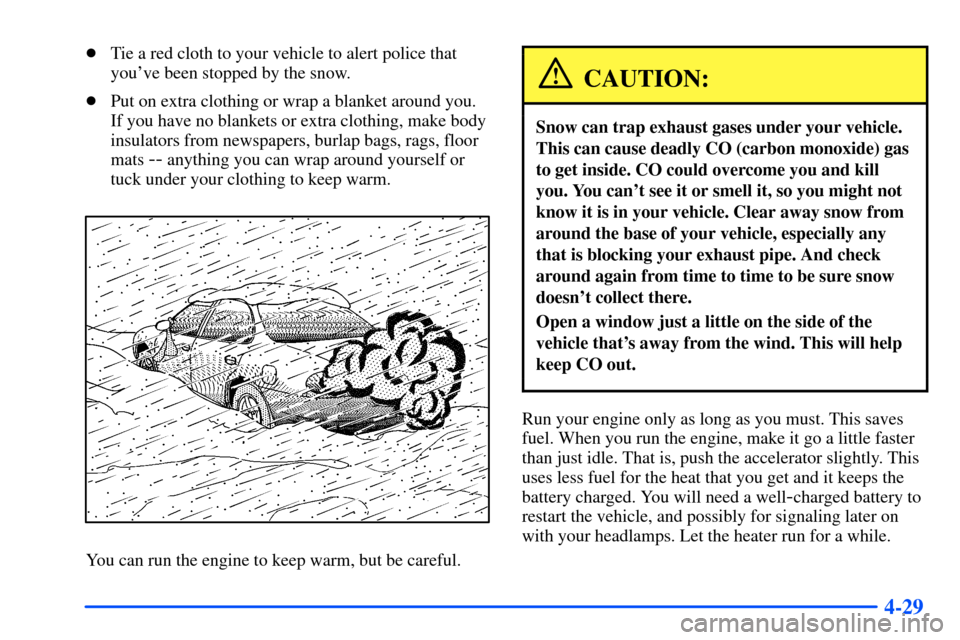
10. Attach the cable at least 18 inches (45 cm) away
from the dead battery, but not near engine parts that
move. The electrical connection is just as good
there, but the chance of sparks getting back to the
battery is much less.
11. Start the vehicle with the good battery and run the
engine for a while.
12. Try to start the vehicle with the dead battery.
If it won't start after a few tries, it probably
needs service.Jumper Cable Removal
A. Heavy, Unpainted Metal Engine Part
B. Good Battery
C. Dead Battery
Page 217 of 340
5-8
To disconnect the jumper cables from both vehicles, do
the following:
1. Disconnect the black negative (
-) cable from the
heavy, unpainted metal engine part on the vehicle
that had the dead battery.
2. Disconnect the black negative (
-) cable from
the negative (
-) terminal on the vehicle with
good battery.
3. Disconnect the red positive (+) cable from the
vehicle with the good battery.
4. Disconnect the red positive (+) cable from the
other vehicle.
Towing Your Vehicle
Consult your dealer or a professional towing service if
you need to have your vehicle towed. See ªRoadside
Assistanceº and ªRecreational Vehicle Towingº in
the Index.
Engine Overheating
You will find a coolant temperature gage and a low
coolant warning light on your vehicle's instrument
panel. See ªEngine Coolant Temperature Gageº and
ªLow Coolant Warning Lightº in the Index.