Page 33 of 340
1-21
The best way to protect the fetus is to protect the
mother. When a safety belt is worn properly, it's more
likely that the fetus won't be hurt in a crash. For
pregnant women, as for anyone, the key to making
safety belts effective is wearing them properly.
Right Front Passenger Position
To learn how to wear the right front passenger's
safety belt properly, see ªDriver Positionº earlier
in this section.
The right front passenger's safety belt works the same
way as the driver's safety belt
-- except for one thing.
If you ever pull the shoulder portion of the belt out all
the way, you will engage the child restraint locking
feature. If this happens, just let the belt go back all the
way and start again.
Supplemental Restraint System (SRS)
This part explains the Supplemental Restraint System
(SRS) or air bag system.
Your vehicle has air bags
-- one air bag for the driver
and another air bag for the right front passenger.Frontal air bags are designed to help reduce the risk of
injury from the force of an inflating air bag. But these
air bags must inflate very quickly to do their job and
comply with federal regulations.
Here are the most important things to know about the air
bag system:
CAUTION:
You can be severely injured or killed in a crash if
you aren't wearing your safety belt
-- even if you
have air bags. Wearing your safety belt during a
crash helps reduce your chance of hitting things
inside the vehicle or being ejected from it. Air
bags are designed to work with safety belts, but
don't replace them. Air bags are designed to
work only in moderate to severe crashes where
the front of your vehicle hits something.
CAUTION: (Continued)
Page 41 of 340
1-29
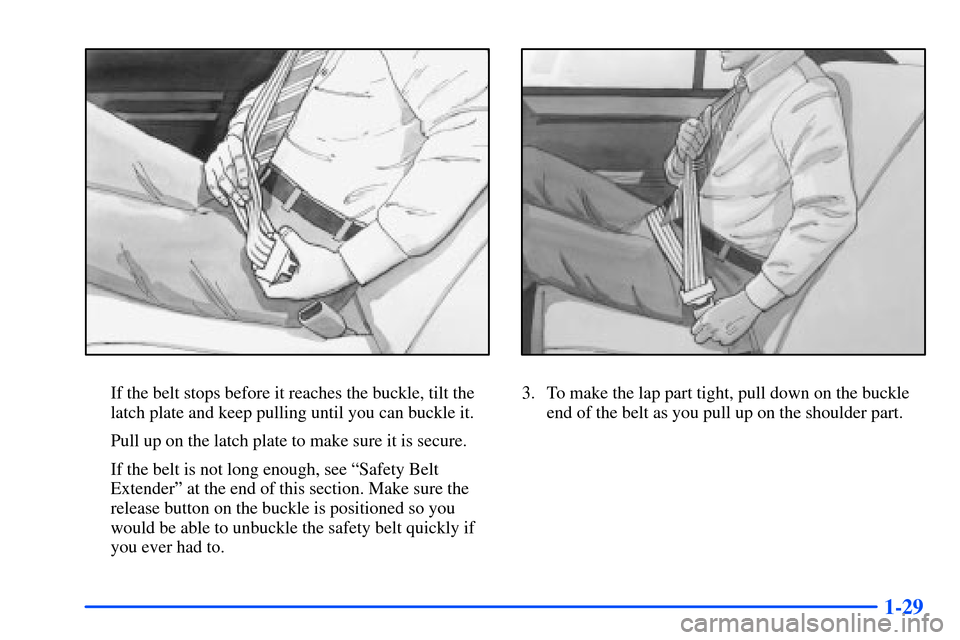
If the belt stops before it reaches the buckle, tilt the
latch plate and keep pulling until you can buckle it.
Pull up on the latch plate to make sure it is secure.
If the belt is not long enough, see ªSafety Belt
Extenderº at the end of this section. Make sure the
release button on the buckle is positioned so you
would be able to unbuckle the safety belt quickly if
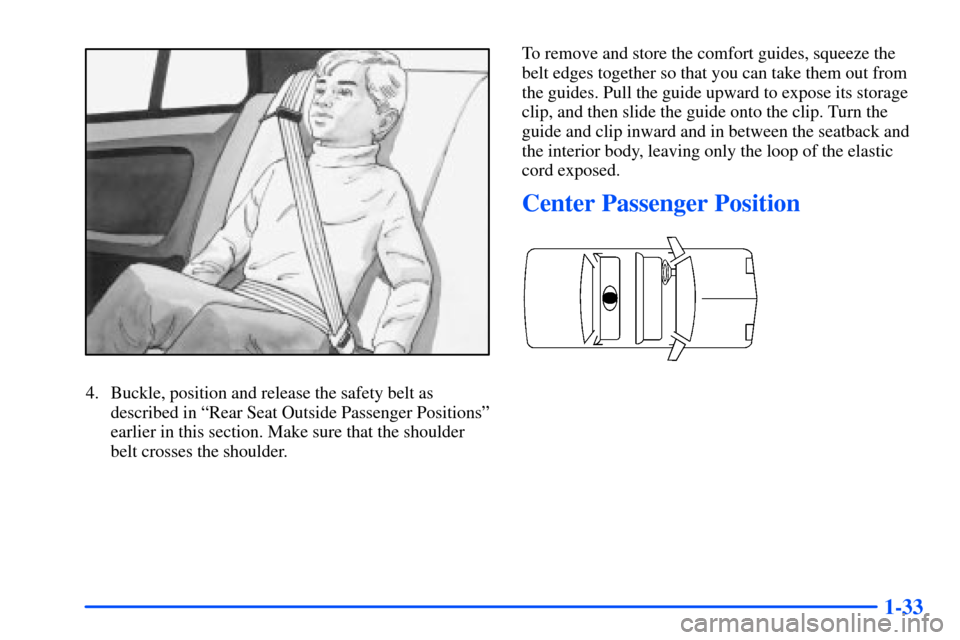
you ever had to.3. To make the lap part tight, pull down on the buckle
end of the belt as you pull up on the shoulder part.
Page 45 of 340
1-33
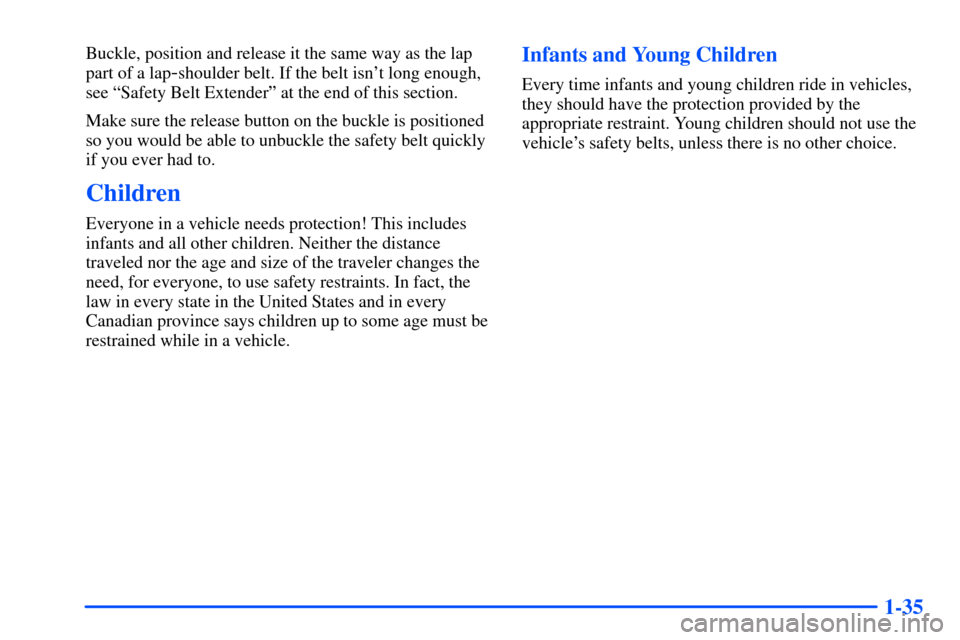
4. Buckle, position and release the safety belt as
described in ªRear Seat Outside Passenger Positionsº
earlier in this section. Make sure that the shoulder
belt crosses the shoulder.To remove and store the comfort guides, squeeze the
belt edges together so that you can take them out from
the guides. Pull the guide upward to expose its storage
clip, and then slide the guide onto the clip. Turn the
guide and clip inward and in between the seatback and
the interior body, leaving only the loop of the elastic
cord exposed.
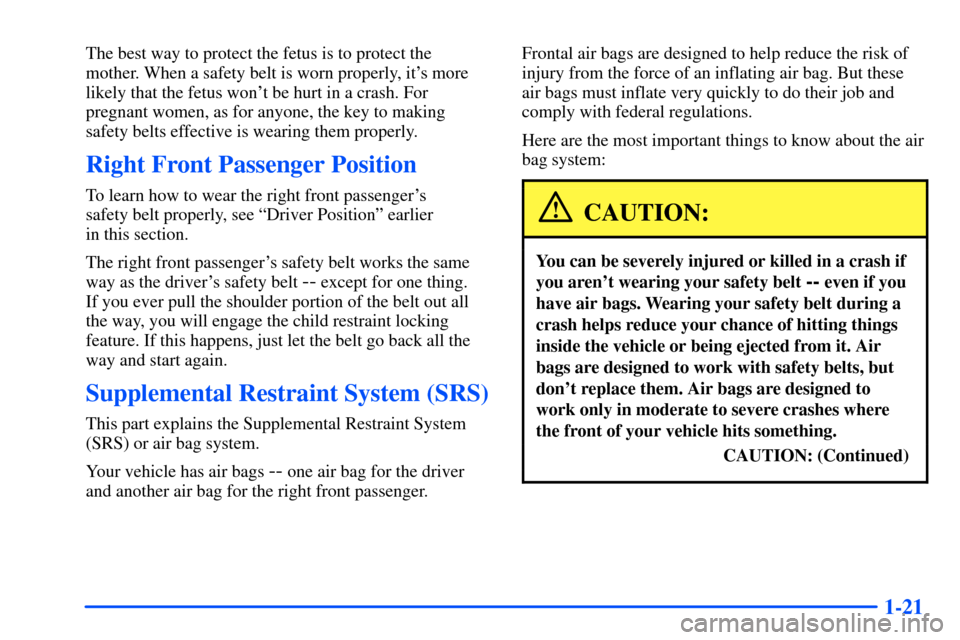
Center Passenger Position
Page 47 of 340
1-35
Buckle, position and release it the same way as the lap
part of a lap
-shoulder belt. If the belt isn't long enough,
see ªSafety Belt Extenderº at the end of this section.
Make sure the release button on the buckle is positioned
so you would be able to unbuckle the safety belt quickly
if you ever had to.
Children
Everyone in a vehicle needs protection! This includes
infants and all other children. Neither the distance
traveled nor the age and size of the traveler changes the
need, for everyone, to use safety restraints. In fact, the
law in every state in the United States and in every
Canadian province says children up to some age must be
restrained while in a vehicle.
Infants and Young Children
Every time infants and young children ride in vehicles,
they should have the protection provided by the
appropriate restraint. Young children should not use the
vehicle's safety belts, unless there is no other choice.
Page 70 of 340
1-58
Checking Your Restraint Systems
Now and then, make sure the safety belt reminder light
and all your belts, buckles, latch plates, retractors and
anchorages are working properly. Look for any other
loose or damaged safety belt system parts. If you see
anything that might keep a safety belt system from
doing its job, have it repaired.
Torn or frayed safety belts may not protect you in a
crash. They can rip apart under impact forces. If a belt
is torn or frayed, get a new one right away.
Also look for any opened or broken air bag covers, and
have them repaired or replaced. (The air bag system
does not need regular maintenance.)
Replacing Restraint System Parts
After a Crash
If you've had a crash, do you need new belts?
After a very minor collision, nothing may be necessary.
But if the belts were stretched, as they would be if worn
during a more severe crash, then you need new belts.
If belts are cut or damaged, replace them. Collision
damage also may mean you will need to have safety belt
or seat parts repaired or replaced. New parts and repairs
may be necessary even if the belt wasn't being used at
the time of the collision.
If your seat adjuster won't work after a crash, the special
part of the safety belt that goes through the seat to the
adjuster may need to be replaced.
If an air bag inflates, you'll need to replace air bag
system parts. See the part on the air bag system earlier
in this section.
Page 71 of 340

2-
2-1
Section 2 Features and Controls
Here you can learn about the many standard and optional features on your vehicle, and information on starting,
shifting and braking. Also explained are the instrument panel and the warning systems that tell you if everything is
working properly
-- and what to do if you have a problem.
2
-2 Windows
2
-4 Keys
2
-6 Door Locks
2
-11 Remote Keyless Entry System (If Equipped)
2
-16 Trunk
2
-19 Theft
2
-20 Passlock�
2-20 New Vehicle ªBreak-Inº
2
-21 Ignition Positions
2
-22 Starting Your Engine
2
-24 Engine Coolant Heater (Option)
2
-26 Automatic Transaxle Operation
2
-29 Manual Transaxle Operation
2
-31 Parking Brake
2
-32 Shifting Into PARK (P)
(Automatic Transaxle Only)
2
-34 Shifting Out of PARK (P)
(Automatic Transaxle Only)2
-34 Parking Your Vehicle/Key Removal
(Manual Transaxle Models Only)
2
-35 Parking Over Things That Burn
2
-35 Engine Exhaust
2
-36 Running Your Engine While You're Parked
(Automatic Transaxle)
2
-37 Tilt Wheel
2
-37 Turn Signal/Multifunction Lever
2
-45 Exterior Lamps
2
-47 Interior Lamps
2
-49 Mirrors
2
-50 Storage Compartments
2
-51 Ashtray and Cigarette Lighter (If Equipped)
2
-51 Sun Visors
2
-52 Accessory Power Outlet
2
-53 Sunroof (Option)
2
-54 The Instrument Panel -- Your
Information System
2
-58 Warning Lights, Gages and Indicators
Page 79 of 340
2-9
When your vehicle was shipped from the factory it was
programmed in Mode 1. To determine the current mode
or to change to a different mode, do the following:
1. Put an automatic transaxle in PARK (P) or a manual
transaxle in REVERSE (R) with the parking brake
engaged and turn the ignition to ON.
2. Press and hold the lower part of the power door lock
switch for 10 seconds. Release the switch when you
hear the chime.
3. Count the number of chimes you hear. The number
of chimes tells you which mode your vehicle is in.
You can change the mode by pressing and holding
the lower part of the power door lock switch (two
chimes for Mode 2, three chimes for Mode 3 and
four chimes for Mode 4).
4. Repeat Step 2 until you hear the number of chimes
that matches the mode you want.
The mode you selected is now set.Delayed Locking
This feature will allow the driver to delay the actual
locking of the vehicle. This feature will not operate if
the key is left in the ignition. See ªAnti
-Lockout
Protectionº later in this section.
When the lower part of the driver's power door lock
switch is pressed, with the key removed from the
ignition and the driver's door open, three chimes will
be heard. The doors will not lock. Seven seconds
after the driver's door has been closed, all of the doors
will lock and the parking lamps will flash. The horn
will also chirp if the horn chirp feature is enabled.
See ªProgrammable Horn Chirpº in the Index for
more information.
If the driver opens another door before the seven
seconds, the doors will not lock until seven seconds
after the last door is closed.
If the lower part of the power door lock switch is
pressed twice when leaving the vehicle, or the
LOCK button on the remote keyless entry transmitter
is pressed, the doors will lock immediately.
If the power door lock switch is pressed to unlock,
the doors will not lock automatically.
Page 97 of 340
2-27
Ensure the shift lever is fully in PARK (P) before
starting the engine. Your vehicle has an automatic
transaxle shift lock control system. You have to apply
your regular brake before you can shift from PARK (P)
when the ignition key is in ON. If you cannot shift out
of PARK (P), ease pressure on the shift lever and push
the shift lever all the way into PARK (P) as you
maintain brake application. Then move the shift lever
into the gear you wish. (Press the shift lever button
before moving the shift lever.) See ªShifting Out of
PARK (P)º later in this section.
REVERSE (R): Use this gear to back up.
NOTICE:
Shifting to REVERSE (R) while your vehicle is
moving forward could damage your transaxle.
Shift to REVERSE (R) only after your vehicle
is stopped.
To rock your vehicle back and forth to get out of snow,
ice or sand without damaging your transaxle, see ªStuck
In Sand, Mud, Ice or Snowº in the Index.NEUTRAL (N): In this position, your engine doesn't
connect with the wheels. To restart when you're
already moving, use NEUTRAL (N) only. Also, use
NEUTRAL (N) when your vehicle is being towed.
CAUTION:
Shifting out of PARK (P) or NEUTRAL (N) while
your engine is ªracingº (running at high speed) is
dangerous. Unless your foot is firmly on the
brake pedal, your vehicle could move very
rapidly. You could lose control and hit people or
objects. Don't shift out of PARK (P) or
NEUTRAL (N) while your engine is racing.
NOTICE:
Damage to your transaxle caused by shifting out
of PARK (P) or NEUTRAL (N) with the engine
racing isn't covered by your warranty.