Page 267 of 340
6-29
What to Add
When you do need brake fluid, use only DOT
-3 brake
fluid. Use new brake fluid from a sealed container only.
Refer to ªRecommended Fluids and Lubricantsº in the
Maintenance Schedule.
Always clean the brake fluid reservoir cap and the area
around the cap before removing it. This will help keep
dirt from entering the reservoir.
CAUTION:
With the wrong kind of fluid in your brake
system, your brakes may not work well, or they
may not even work at all. This could cause a
crash. Always use the proper brake fluid.
NOTICE:
�Using the wrong fluid can badly damage
brake system parts. For example, just a few
drops of mineral
-based oil, such as engine
oil, in your brake system can damage brake
system parts so badly that they'll have to be
replaced. Don't let someone put in the
wrong kind of fluid.
�If you spill brake fluid on your vehicle's
painted surfaces, the paint finish can be
damaged. Be careful not to spill brake fluid
on your vehicle. If you do, wash it off
immediately. See ªAppearance Careº in
the Index.
Page 269 of 340
6-31 Replacing Brake System Parts
The braking system on a vehicle is complex. Its many
parts have to be of top quality and work well together if
the vehicle is to have really good braking. Your vehicle
was designed and tested with top
-quality GM brake
parts. When you replace parts of your braking
system
-- for example, when your brake linings wear
down and you have to have new ones put in
-- be sure
you get new approved GM replacement parts. If you
don't, your brakes may no longer work properly. For
example, if someone puts in brake linings that are wrong
for your vehicle, the balance between your front and
rear brakes can change
-- for the worse. The braking
performance you've come to expect can change in many
other ways if someone puts in the wrong replacement
brake parts.
Battery
Your new vehicle comes with a maintenance free
ACDelco� battery. When it's time for a new battery, get
one that has the replacement number shown on the
original battery's label. We recommend an ACDelco
battery. See ªEngine Compartment Overviewº in the
Index for battery location.
WARNING: Battery posts, terminals and related
accessories contain lead and lead compounds, chemicals
known to the State of California to cause cancer and
reproductive harm. Wash hands after handling.
Page 278 of 340

6-40
Any time you adjust a tire's pressure, rotate your tires,
have one or more tires repaired or replaced, or when any
work is done on your vehicle where tires are removed
you'll need to reset (calibrate) the tire pressure monitor
system. You'll also need to reset the system whenever
you buy new tires and whenever the vehicle's battery
has been disconnected.
To reset (calibrate) the system:
1. Turn the ignition switch to ON (engine not running).
2. Press and release the RESET button located inside
of the driver's side instrument panel fuse block.
The CHANGE OIL light will begin to flash.
3. Press and release the RESET button again.
The CHANGE OIL light will go off, and the
LOW TIRE PRESSURE light will start flashing.
4. When the LOW TIRE PRESSURE light is flashing,
press and hold the RESET button until the
chime sounds.
If the LOW TIRE PRESSURE light doesn't go off,
repeat the procedure. If the LOW TIRE PRESSURE
light still remains on, see your dealer for service.
The system completes the calibration process
during driving.The system normally takes 15 to 20 minutes of driving in
each of three speed ranges to ªlearnº tire pressures. The
speed ranges are 15 to 40 mph (25 to 65 km/h), 40 to
65 mph (65 to 105 km/h) and above 65 mph (105 km/h).
When learning is complete, the system will alert you after
2
-8 minutes if a tire is 12 psi (83 kPa) different from the
other three tires. Detection thresholds may be higher and
detection times may be longer on rough roads, curves and
at high speeds. The system is not capable of detection at
speeds greater than 75 mph (120 km/h).
Tire Inspection and Rotation
Tires should be rotated every 6,000 to 8,000 miles
(10 000 to 13 000 km). Any time you notice unusual
wear, rotate your tires as soon as possible and check
wheel alignment. Also check for damaged tires or
wheels. See ªWhen It's Time for New Tiresº and
ªWheel Replacementº later in this section for
more information.
The purpose of regular rotation is to achieve more
uniform wear for all tires on the vehicle. The first
rotation is the most important. See ªScheduled
Maintenance Servicesº in the Index for scheduled
rotation intervals.
Page 293 of 340
6-55
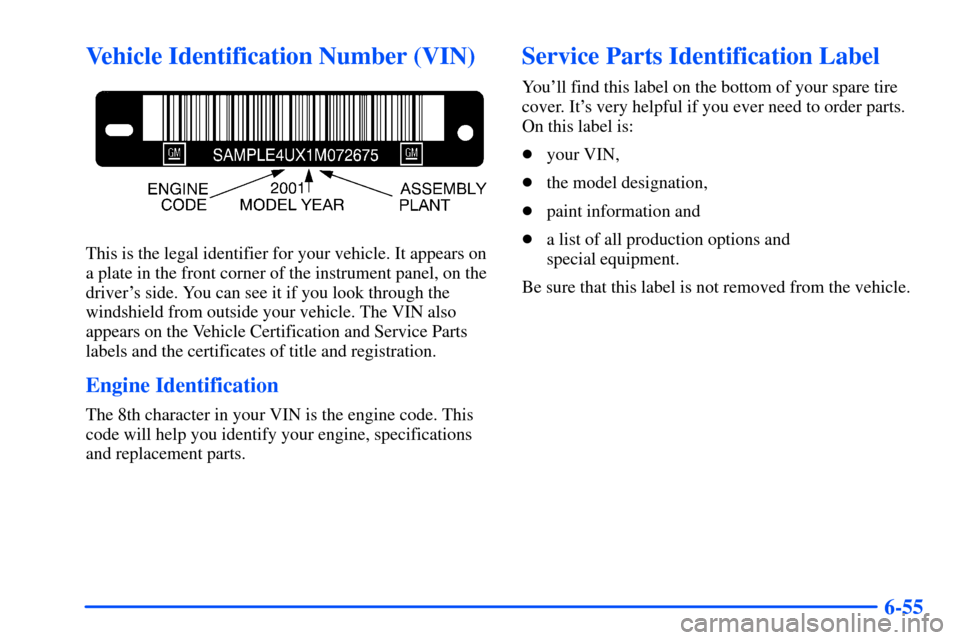
Vehicle Identification Number (VIN)
This is the legal identifier for your vehicle. It appears on
a plate in the front corner of the instrument panel, on the
driver's side. You can see it if you look through the
windshield from outside your vehicle. The VIN also
appears on the Vehicle Certification and Service Parts
labels and the certificates of title and registration.
Engine Identification
The 8th character in your VIN is the engine code. This
code will help you identify your engine, specifications
and replacement parts.
Service Parts Identification Label
You'll find this label on the bottom of your spare tire
cover. It's very helpful if you ever need to order parts.
On this label is:
�your VIN,
�the model designation,
�paint information and
�a list of all production options and
special equipment.
Be sure that this label is not removed from the vehicle.
Page 294 of 340

6-56
Electrical System
Add-On Electrical Equipment
NOTICE:
Don't add anything electrical to your vehicle
unless you check with your dealer first. Some
electrical equipment can damage your vehicle
and the damage wouldn't be covered by your
warranty. Some add
-on electrical equipment
can keep other components from working as
they should.
Your vehicle has an air bag system. Before attempting to
add anything electrical to your vehicle, see ªServicing
Your Air Bag
-Equipped Vehicleº in the Index.
Windshield Wipers
The windshield wiper motor is protected by a circuit
breaker and a fuse. If the motor overheats due to heavy
snow, etc., the wiper will stop until the motor cools. If
the overload is caused by some electrical problem, have
it fixed.
Power Windows
A circuit breaker in the fuse panel protects the power
windows. When the current load is too heavy, the circuit
breaker opens and closes, protecting the circuit until the
problem is fixed.
Fuses and Circuit Breakers
The wiring circuits in your vehicle are protected from
short circuits by a combination of fuses, circuit breakers
and fusible links. This greatly reduces the chance of
damage caused by electrical problems.
Look at the silver
-colored band inside the fuse. If the
band is broken or melted, replace the fuse. Be sure to
replace a bad fuse with a new one of the identical size
and rating.
There are three fuse blocks in your vehicle: two
instrument panel fuse blocks and the engine
compartment fuse block.
There are four spare fuses located in the left instrument
panel end cap for your use.
Instrument Panel Fuse Blocks
There are two fuse panels for your vehicle. One is
located on the driver's side of the instrument panel and
the other is located on the passenger's side.
Page 297 of 340
6-59
Engine Compartment Fuse Block
The engine compartment fuse block is located on the
driver's side of the engine compartment, near the battery.
Maxifuses Usage
1 Ignition Switch
2 Right Electrical Center
-Fog
Lamps, Radio, Body Function
Control Module, Interior Lamps
3 Left Electrical Center
-Stop
Lamps, Hazard Lamps, Body
Function Control Module, Cluster,
Climate Control System
4 Anti
-Lock Brakes
Page 300 of 340
6-62
Capacities and Specifications
All capacities are approximate. When adding, be sure
to fill to the appropriate level or as recommended in
this manual.
Capacities
Engine Crankcase
2.4L L4 Engine 4.0 quarts (3.8 L). . . . . . . . . . . . . . .
3400 V6 Engine 4.5 quarts (4.3 L). . . . . . . . . . . . . . .
Automatic Transaxle
Complete Overhaul 9.5 quarts (9.0 L). . . . . . . . . . . .
Manual Transaxle
Complete Overhaul 1.8 quarts (1.7 L). . . . . . . . . . . .
Cooling System
2.4L L4 Engine 11.3 quarts (10.7 L). . . . . . . . . . . . . .
3400 V6 Engine 13.6 quarts (12.9 L). . . . . . . . . . . . .
Refrigerant, Air ConditioningSee refrigerant . . . . .
charge label under the hood.
Fuel Tank14.3 U.S. gallons (54.1 L) . . . . . . . . . . . .
Tire Pressures, SizesSee Tire
-Loading . . . . . . . . . . .
Information label on the
rear driver's side passenger door.
Engine Specifications
See ªRecommended Fluids and Lubricantsº in the Index.
VIN Engine Code
2.4L L4 Engine T. . . . . . . . . . . . . . . . . . . . . . . . . . . .
3400 V6 Engine E. . . . . . . . . . . . . . . . . . . . . . . . . . . .
Displacement
2.4L L4 Engine 2.4 Liters. . . . . . . . . . . . . . . . . . . . . .
3400 V6 Engine 3.4 Liters. . . . . . . . . . . . . . . . . . . . . .
Firing Order
2.4L L4 Engine 1
-3-4-2 . . . . . . . . . . . . . . . . . . . . . . .
3400 V6 Engine 1
-2-3-4-5-6 . . . . . . . . . . . . . . . . . . .
Horsepower
2.4L L4 Engine 150. . . . . . . . . . . . . . . . . . . . . . . . . .
3400 V6 Engine 170. . . . . . . . . . . . . . . . . . . . . . . . . .
Wheel Nut Torque
100 lb-ft (140 N´m)
Page 301 of 340

6-63
Normal Maintenance
Replacement Parts
Engine Air Cleaner/Filter
2.4L L4 A
-1279C* . . . . . . . . . . . . . . . . . . . . . . . . . . . .
3400 V6 A
-1279C* . . . . . . . . . . . . . . . . . . . . . . . . . . .
Engine Oil Filter
2.4L L4 PF
-44* . . . . . . . . . . . . . . . . . . . . . . . . . . . . . .
3400 V6 PF
-47* . . . . . . . . . . . . . . . . . . . . . . . . . . . . .
Spark Plugs
2.4L L4�41
-942* (Platinum Plug) . . . . . . . . . . . . . . . .
Gap: 0.050 inch (1.27 mm)
3400 V6�41
-940* (Platinum Plug) . . . . . . . . . . . . . . .
Gap: 0.060 inch (1.52 mm)
PCV ValveCV892C* . . . . . . . . . . . . . . . . . . . . . . . . .
Windshield Wiper Blades
Type Shepherd's Hook. . . . . . . . . . . . . . . . . . . . . . . . .
Passenger's Side 17 inches (43 cm). . . . . . . . . . . . . . .
Driver's Side 22 inches (56 cm). . . . . . . . . . . . . . . . .
* ACDelco
� part number.
Vehicle Dimensions
Length 186.7 inches (474.2 cm). . . . . . . . . . . . . . . . .
Width 70.1 inches (178.0 cm). . . . . . . . . . . . . . . . . . .
Height 54.5 inches (138.4 cm). . . . . . . . . . . . . . . . . . .
Wheelbase 107.0 inches (271.9 cm). . . . . . . . . . . . . .
Front Tread 59.1inches (150.0 cm). . . . . . . . . . . . . . . .
Rear Tread 59.3 inches (150.7cm). . . . . . . . . . . . . . . .