Page 36 of 240
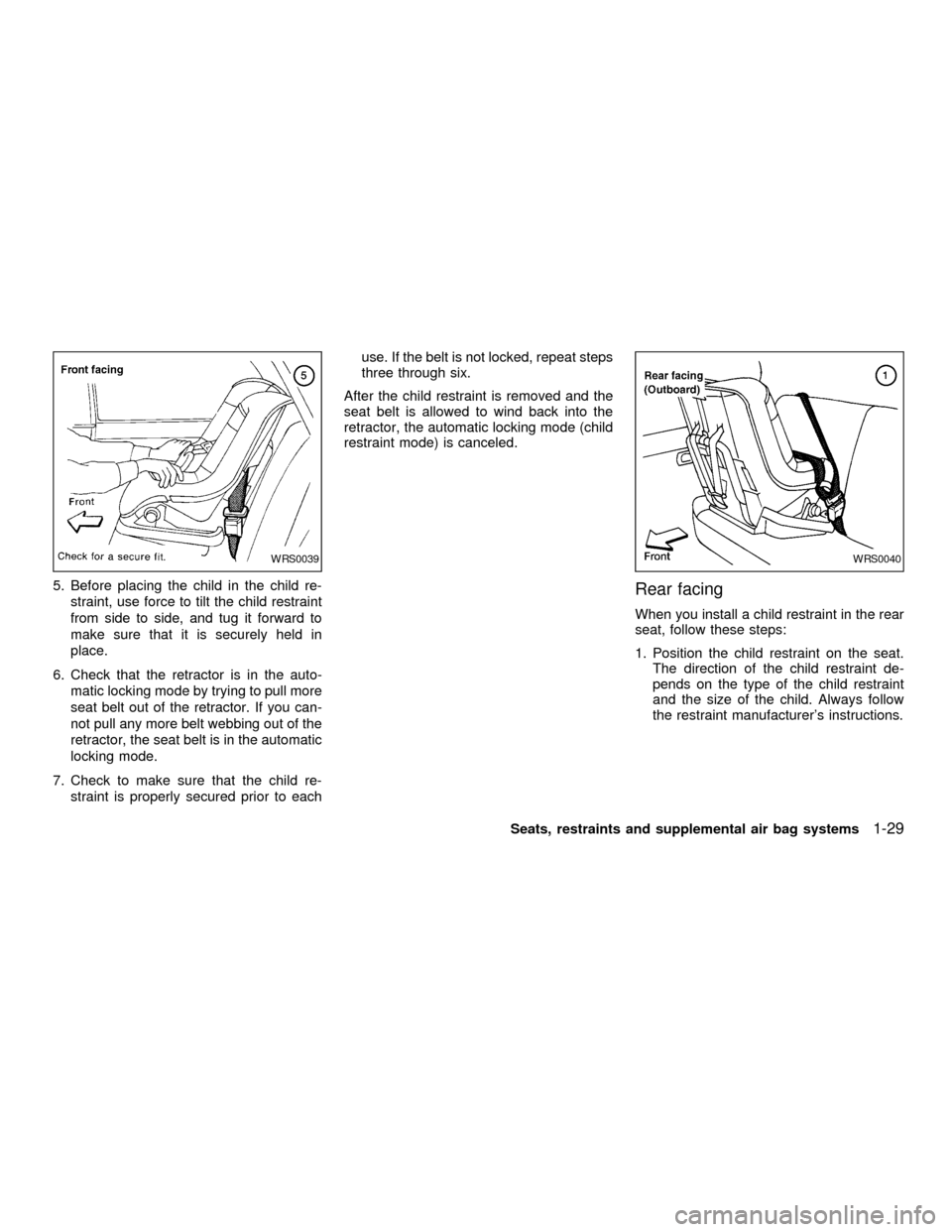
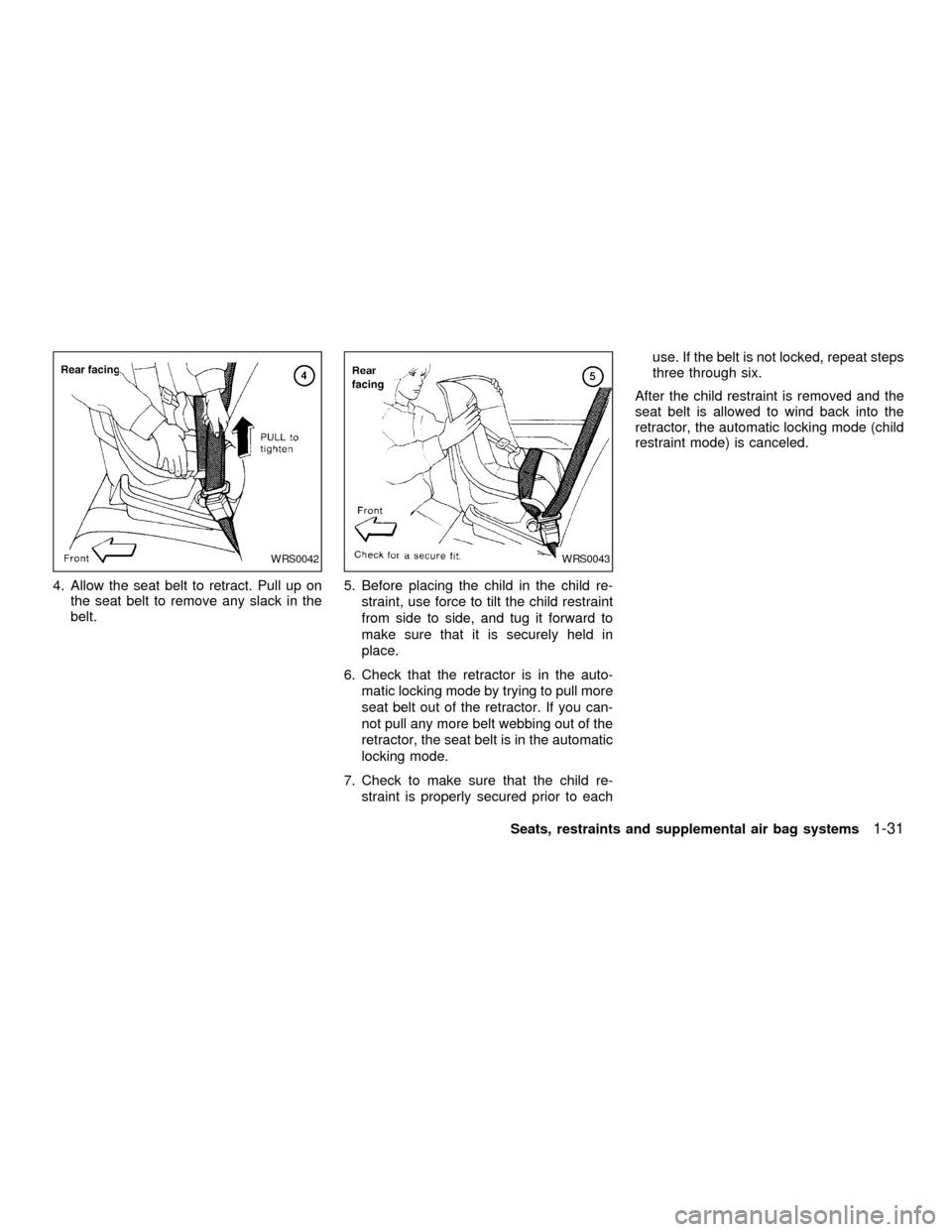
5. Before placing the child in the child re-
straint, use force to tilt the child restraint
from side to side, and tug it forward to
make sure that it is securely held in
place.
6. Check that the retractor is in the auto-
matic locking mode by trying to pull more
seat belt out of the retractor. If you can-
not pull any more belt webbing out of the
retractor, the seat belt is in the automatic
locking mode.
7. Check to make sure that the child re-
straint is properly secured prior to eachuse. If the belt is not locked, repeat steps
three through six.
After the child restraint is removed and the
seat belt is allowed to wind back into the
retractor, the automatic locking mode (child
restraint mode) is canceled.Rear facing
When you install a child restraint in the rear
seat, follow these steps:
1. Position the child restraint on the seat.
The direction of the child restraint de-
pends on the type of the child restraint
and the size of the child. Always follow
the restraint manufacturer's instructions.
WRS0039WRS0040
Seats, restraints and supplemental air bag systems1-29
ZX
Page 37 of 240
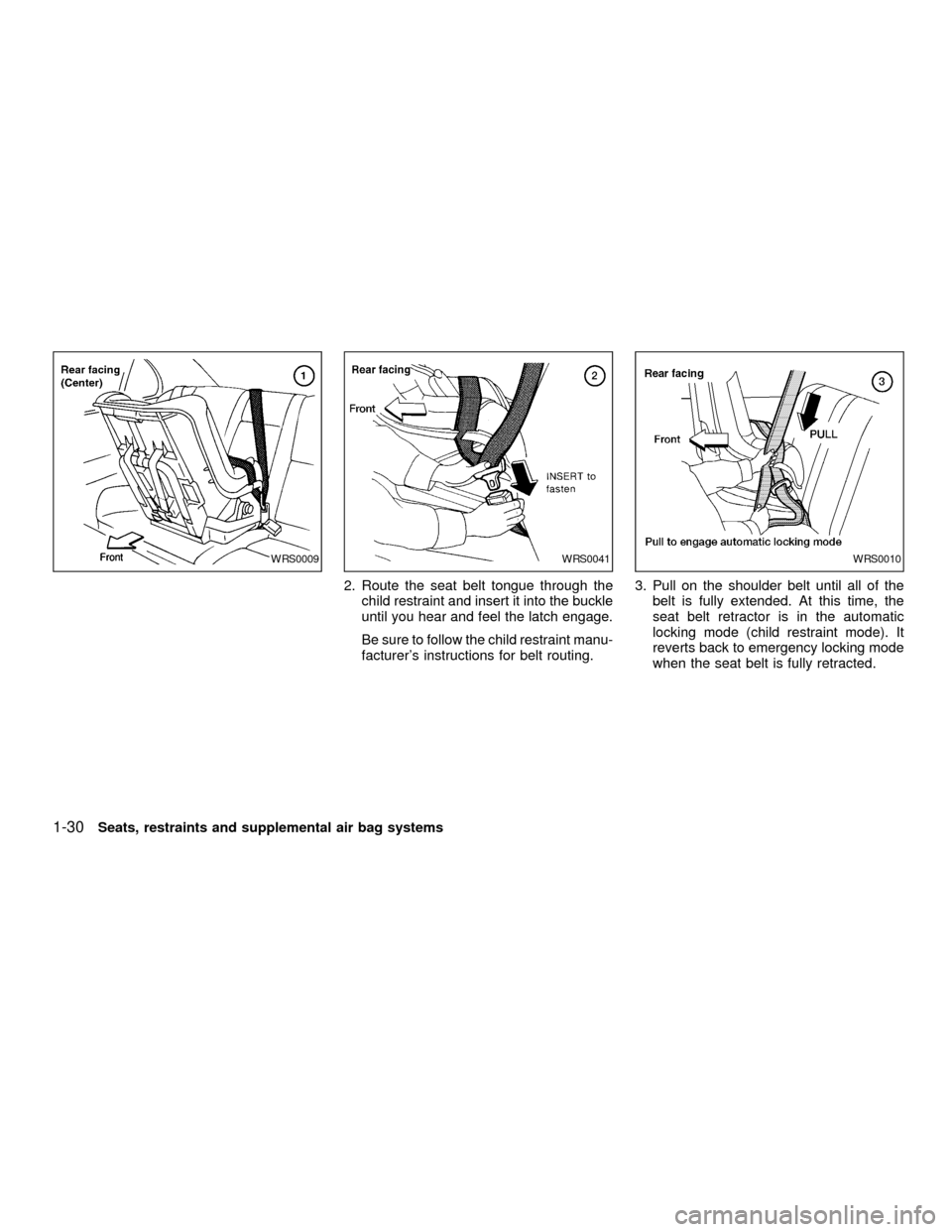
2. Route the seat belt tongue through the
child restraint and insert it into the buckle
until you hear and feel the latch engage.
Be sure to follow the child restraint manu-
facturer's instructions for belt routing.3. Pull on the shoulder belt until all of the
belt is fully extended. At this time, the
seat belt retractor is in the automatic
locking mode (child restraint mode). It
reverts back to emergency locking mode
when the seat belt is fully retracted.
WRS0009WRS0041WRS0010
1-30Seats, restraints and supplemental air bag systems
ZX
Page 38 of 240
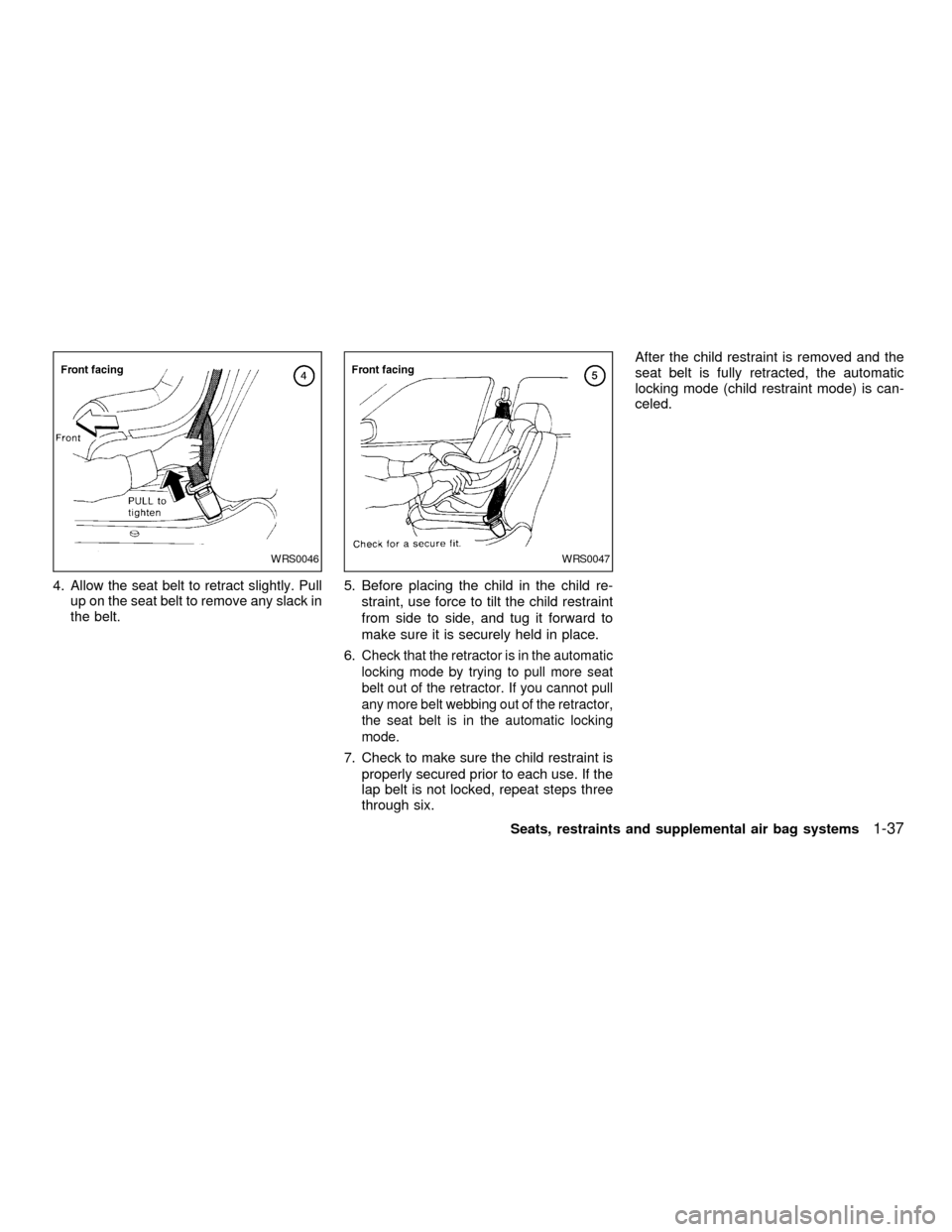
4. Allow the seat belt to retract. Pull up on
the seat belt to remove any slack in the
belt.5. Before placing the child in the child re-
straint, use force to tilt the child restraint
from side to side, and tug it forward to
make sure that it is securely held in
place.
6. Check that the retractor is in the auto-
matic locking mode by trying to pull more
seat belt out of the retractor. If you can-
not pull any more belt webbing out of the
retractor, the seat belt is in the automatic
locking mode.
7. Check to make sure that the child re-
straint is properly secured prior to eachuse. If the belt is not locked, repeat steps
three through six.
After the child restraint is removed and the
seat belt is allowed to wind back into the
retractor, the automatic locking mode (child
restraint mode) is canceled.
WRS0042WRS0043
Seats, restraints and supplemental air bag systems1-31
ZX
Page 40 of 240
cThe LATCH system anchors are de-
signed to withstand only those loads
imposed by correctly fitted child re-
straints. Under no circumstance are
they to be used for adult seat belts or
harnesses.
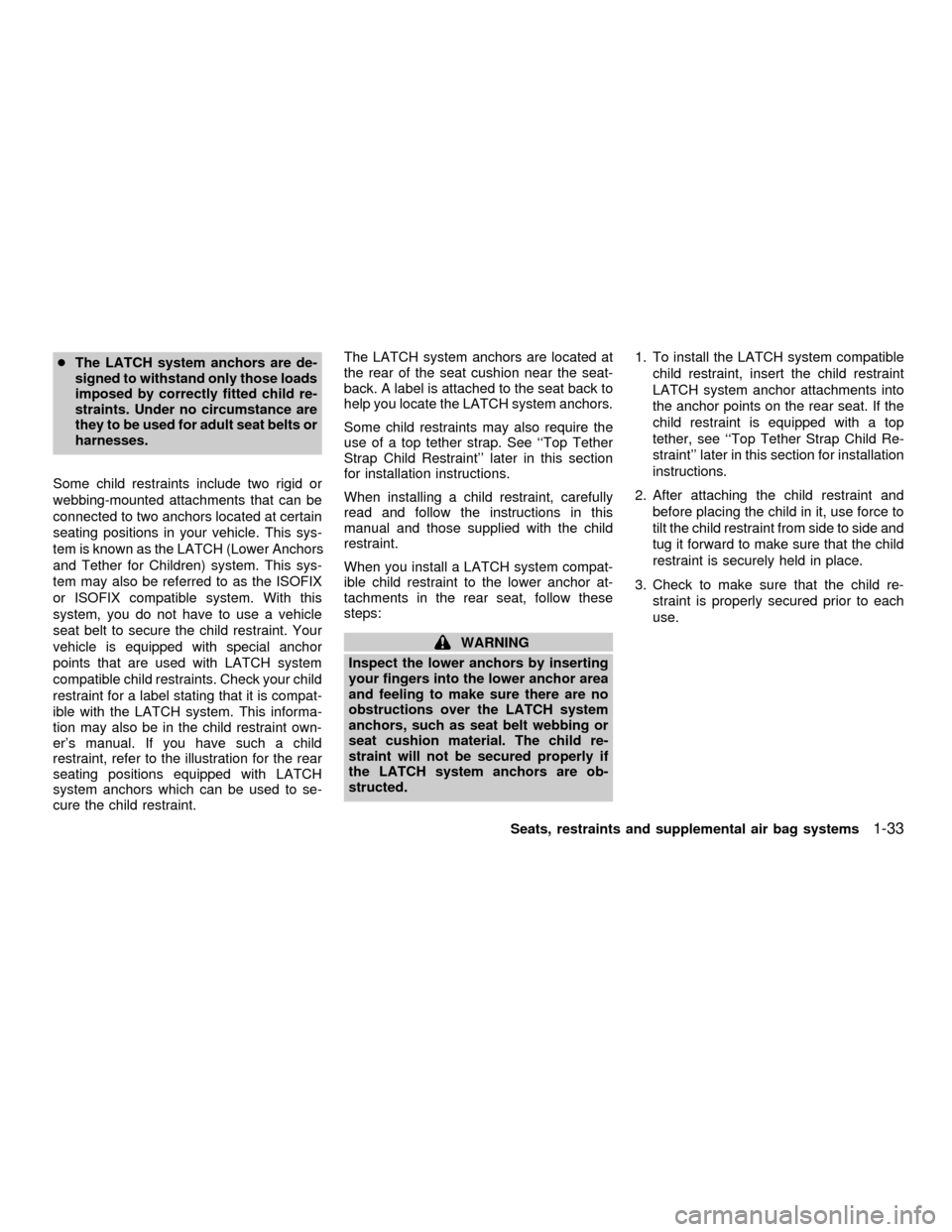
Some child restraints include two rigid or
webbing-mounted attachments that can be
connected to two anchors located at certain
seating positions in your vehicle. This sys-
tem is known as the LATCH (Lower Anchors
and Tether for Children) system. This sys-
tem may also be referred to as the ISOFIX
or ISOFIX compatible system. With this
system, you do not have to use a vehicle
seat belt to secure the child restraint. Your
vehicle is equipped with special anchor
points that are used with LATCH system
compatible child restraints. Check your child
restraint for a label stating that it is compat-
ible with the LATCH system. This informa-
tion may also be in the child restraint own-
er's manual. If you have such a child
restraint, refer to the illustration for the rear
seating positions equipped with LATCH
system anchors which can be used to se-
cure the child restraint.The LATCH system anchors are located at
the rear of the seat cushion near the seat-
back. A label is attached to the seat back to
help you locate the LATCH system anchors.
Some child restraints may also require the
use of a top tether strap. See ``Top Tether
Strap Child Restraint'' later in this section
for installation instructions.
When installing a child restraint, carefully
read and follow the instructions in this
manual and those supplied with the child
restraint.
When you install a LATCH system compat-
ible child restraint to the lower anchor at-
tachments in the rear seat, follow these
steps:
WARNING
Inspect the lower anchors by inserting
your fingers into the lower anchor area
and feeling to make sure there are no
obstructions over the LATCH system
anchors, such as seat belt webbing or
seat cushion material. The child re-
straint will not be secured properly if
the LATCH system anchors are ob-
structed.1. To install the LATCH system compatible
child restraint, insert the child restraint
LATCH system anchor attachments into
the anchor points on the rear seat. If the
child restraint is equipped with a top
tether, see ``Top Tether Strap Child Re-
straint'' later in this section for installation
instructions.
2. After attaching the child restraint and
before placing the child in it, use force to
tilt the child restraint from side to side and
tug it forward to make sure that the child
restraint is securely held in place.
3. Check to make sure that the child re-
straint is properly secured prior to each
use.
Seats, restraints and supplemental air bag systems
1-33
ZX
Page 41 of 240
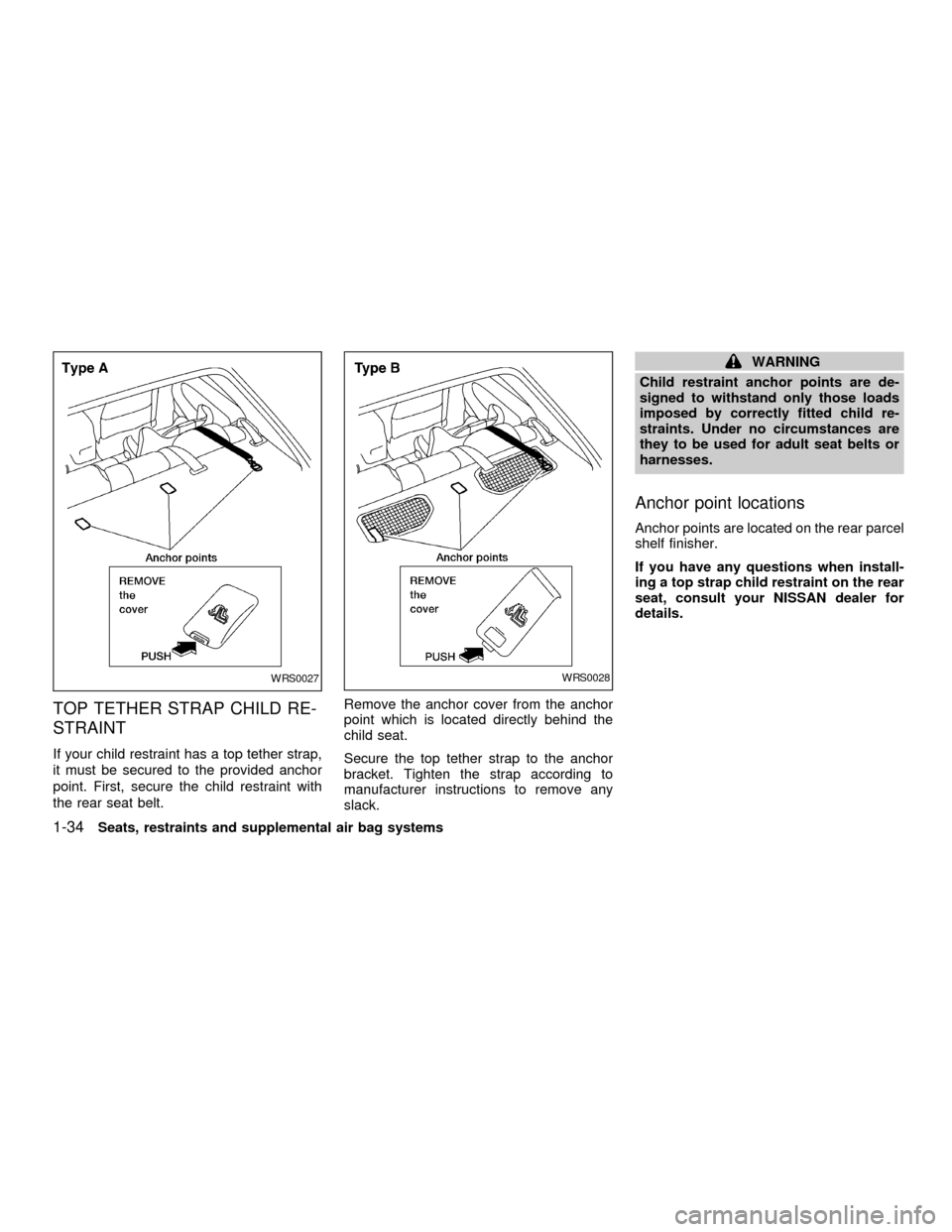
TOP TETHER STRAP CHILD RE-
STRAINT
If your child restraint has a top tether strap,
it must be secured to the provided anchor
point. First, secure the child restraint with
the rear seat belt.Remove the anchor cover from the anchor
point which is located directly behind the
child seat.
Secure the top tether strap to the anchor
bracket. Tighten the strap according to
manufacturer instructions to remove any
slack.
WARNING
Child restraint anchor points are de-
signed to withstand only those loads
imposed by correctly fitted child re-
straints. Under no circumstances are
they to be used for adult seat belts or
harnesses.
Anchor point locations
Anchor points are located on the rear parcel
shelf finisher.
If you have any questions when install-
ing a top strap child restraint on the rear
seat, consult your NISSAN dealer for
details.
WRS0027WRS0028
1-34Seats, restraints and supplemental air bag systems
ZX
Page 42 of 240
INSTALLATION ON FRONT PAS-
SENGER SEAT
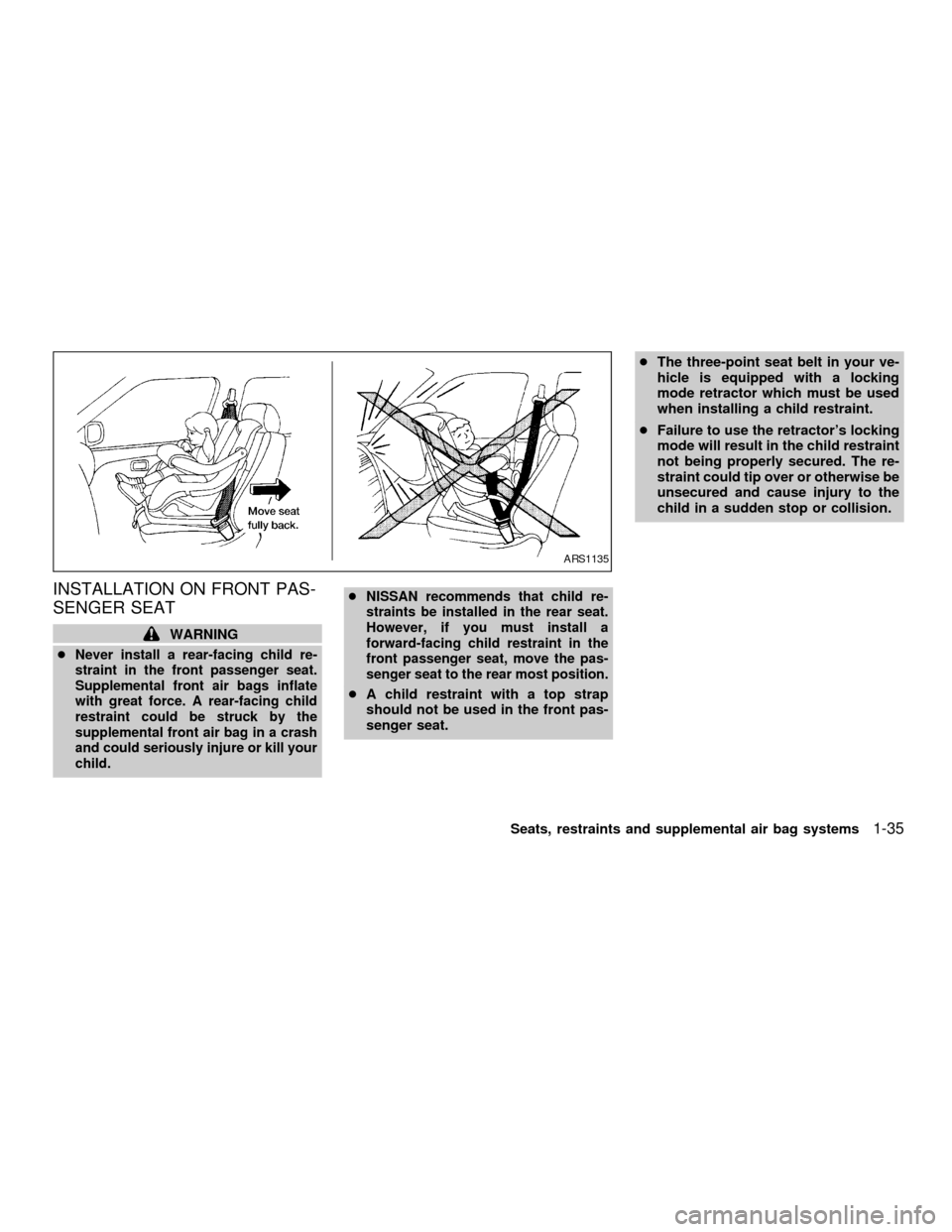
WARNING
c
Never install a rear-facing child re-
straint in the front passenger seat.
Supplemental front air bags inflate
with great force. A rear-facing child
restraint could be struck by the
supplemental front air bag in a crash
and could seriously injure or kill your
child.cNISSAN recommends that child re-
straints be installed in the rear seat.
However, if you must install a
forward-facing child restraint in the
front passenger seat, move the pas-
senger seat to the rear most position.
cA child restraint with a top strap
should not be used in the front pas-
senger seat.cThe three-point seat belt in your ve-
hicle is equipped with a locking
mode retractor which must be used
when installing a child restraint.
cFailure to use the retractor's locking
mode will result in the child restraint
not being properly secured. The re-
straint could tip over or otherwise be
unsecured and cause injury to the
child in a sudden stop or collision.
ARS1135
Seats, restraints and supplemental air bag systems1-35
ZX
Page 43 of 240
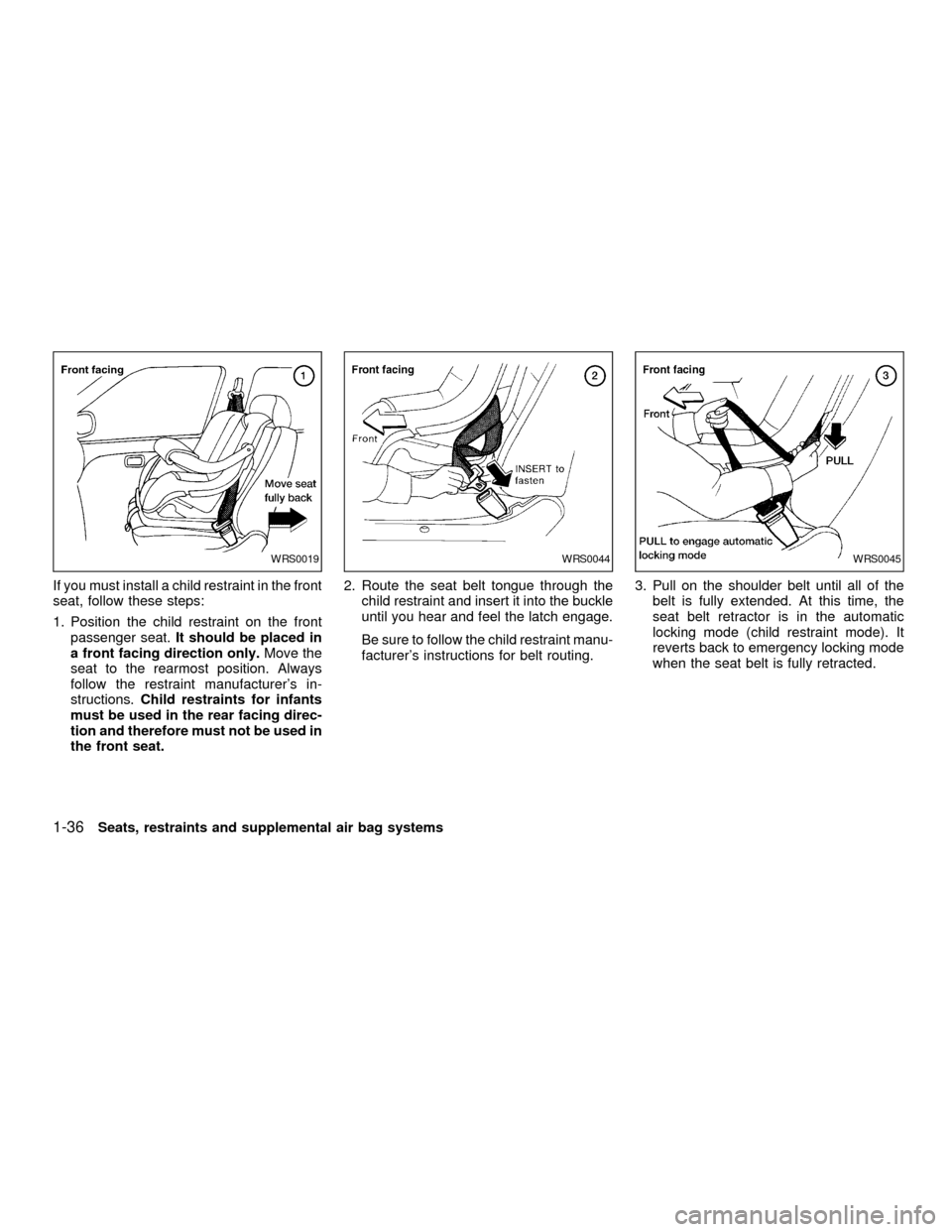
If you must install a child restraint in the front
seat, follow these steps:
1. Position the child restraint on the front
passenger seat.It should be placed in
a front facing direction only.Move the
seat to the rearmost position. Always
follow the restraint manufacturer's in-
structions.Child restraints for infants
must be used in the rear facing direc-
tion and therefore must not be used in
the front seat.2. Route the seat belt tongue through the
child restraint and insert it into the buckle
until you hear and feel the latch engage.
Be sure to follow the child restraint manu-
facturer's instructions for belt routing.3. Pull on the shoulder belt until all of the
belt is fully extended. At this time, the
seat belt retractor is in the automatic
locking mode (child restraint mode). It
reverts back to emergency locking mode
when the seat belt is fully retracted.
WRS0019WRS0044WRS0045
1-36Seats, restraints and supplemental air bag systems
ZX
Page 44 of 240
4.Allow the seat belt to retract slightly. Pull
up on the seat belt to remove any slack in
the belt.5. Before placing the child in the child re-
straint, use force to tilt the child restraint
from side to side, and tug it forward to
make sure it is securely held in place.
6.
Check that the retractor is in the automatic
locking mode by trying to pull more seat
belt out of the retractor. If you cannot pull
any more belt webbing out of the retractor,
the seat belt is in the automatic locking
mode.
7. Check to make sure the child restraint is
properly secured prior to each use. If the
lap belt is not locked, repeat steps three
through six.After the child restraint is removed and the
seat belt is fully retracted, the automatic
locking mode (child restraint mode) is can-
celed.
WRS0046WRS0047
Seats, restraints and supplemental air bag systems1-37
ZX