2001 NISSAN SENTRA Fluid
[x] Cancel search: FluidPage 175 of 240

1. Remove the battery caps with a screw-
driver as shown.2. Check the fluid level in each cell.
If it is necessary to add fluid, add only
distilled water to bring the level up to the
OK level indicator in each filler opening.
Do not overfill.
JUMP STARTING
If jump starting is necessary, see the ``In
case of emergency'' section of this owner's
manual. If the engine does not start by jump
starting, the battery may have to be re-
placed. Contact an authorized NISSAN
dealer.
WDI0020WDI0021
8-18Do-it-yourself
ZX
Page 203 of 240

has the proper distance under it when de-
pressed fully. Check the brake booster func-
tion. Be certain to keep the floor mat away
from the pedal.
Parking brake* ÐCheck that the lever has
the proper travel and confirm that your
vehicle is held securely on a fairly steep hill
with only the parking brake applied.
Automatic transmission ``P position''
mechanism ÐOn a fairly steep hill check
that your vehicle is held securely with the
selector lever in the P (Park) position with-
out applying any brakes.
Under the hood and vehicle
The maintenance items listed here should
be checked periodically, such as each time
you check the engine oil or refuel.
Additional information on the following
items with an ``*'' is found in the ``Do-it-
yourself'' section of this manual.
Windshield washer fluid* ÐCheck for
adequate fluid in the tank.
Engine oil level* ÐCheck the level after
parking the vehicle on a level surface, with
the engine off. Wait a few minutes for the oil
to drain back into the oil pan.
Brake and (if so equipped) clutch fluid
levels* ÐMake sure the brake and clutch
fluid level is between the MIN and MAX lines
on each reservoir.
Power steering fluid level* and lines Ð
Check the level when the fluid is cold, with
the engine off. Check the lines for proper
attachment, leaks, cracks, etc.
Automatic transmission fluid level* Ð
Check the level after putting the shift selec-
tor lever in P (Park) with the engine idling at
operating temperature.
Engine coolant level* ÐCheck the cool-
ant level when the engine is cold.
Radiator and hoses ÐCheck the front of
the radiator and clean off any dirt, insects,
leaves, etc., that may have accumulated.
Make sure the hoses have no cracks, de-
formation, rot or loose connections.
Engine drive belts* ÐMake sure the drive
belts are not frayed, worn, cracked or oily.
Battery* ÐCheck the fluid level in each
cell.
Exhaust system ÐMake sure there are no
cracks, holes, loose joints or supports. If the
sound of the exhaust seems unusual orthere is a smell of exhaust fumes, immedi-
ately have the exhaust system inspected by
an authorized NISSAN dealer. See the car-
bon monoxide warning in the ``Starting and
driving'' section of this manual.
Underbody ÐThe underbody is frequently
exposed to corrosive substances such as
those used on icy roads or to control dust. It
is very important to remove these sub-
stances, from the underbody, otherwise rust
may form on the floor pan, frame, fuel lines
and exhaust system. At the end of winter,
the underbody should be thoroughly flushed
with plain water, especially those areas
where mud and dirt may have accumulated.
See the ``Appearance and care'' section of
this manual.
Fluid leaks ÐCheck under the vehicle for
fuel, oil, water or other fluid leaks after the
vehicle has been parked for awhile. Water
dripping from the air conditioner after use is
normal. If you should notice any leaks or if
gasoline fumes are evident, check for the
cause and have it corrected immediately by
an authorized NISSAN dealer.
9-4Maintenance
ZX
Page 206 of 240
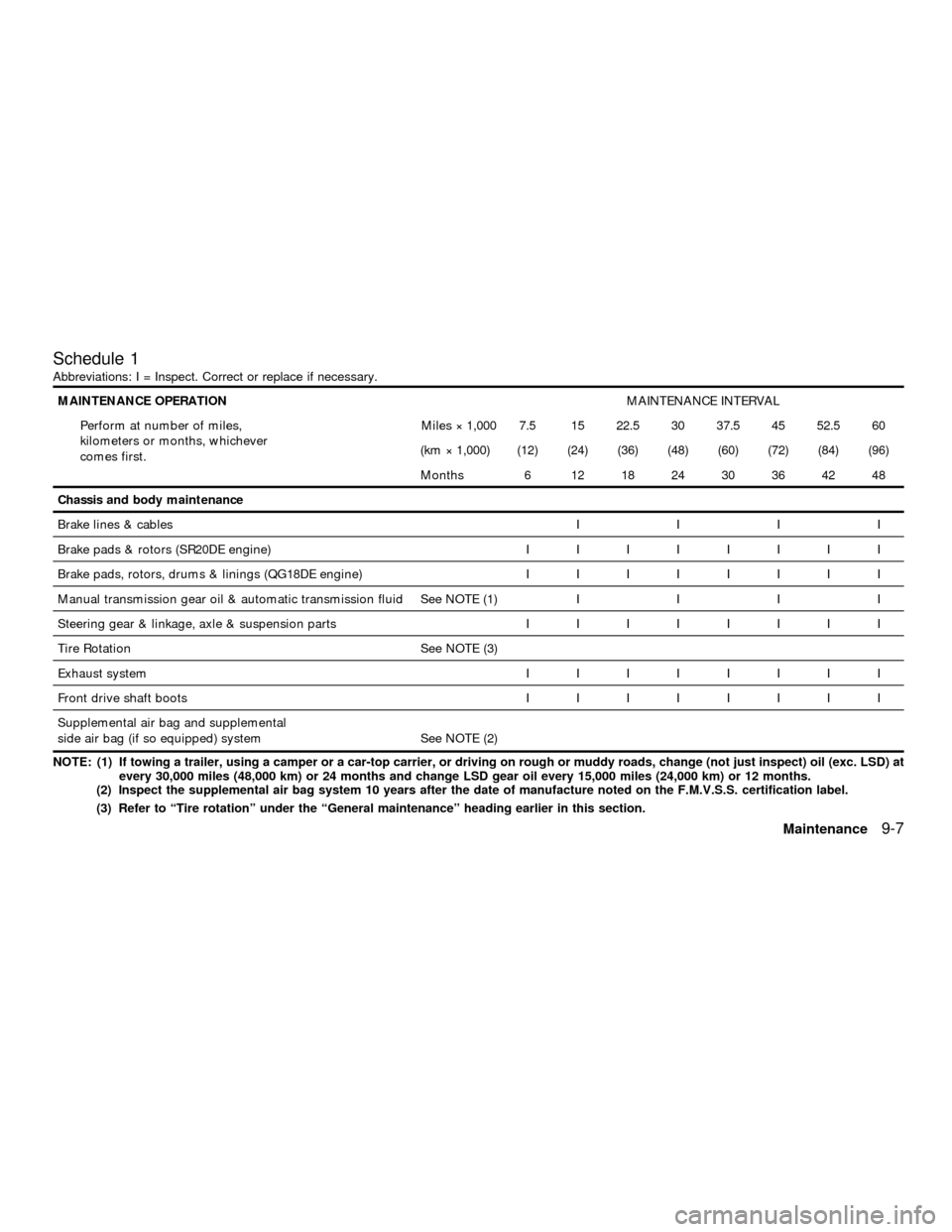
Schedule 1
Abbreviations: I = Inspect. Correct or replace if necessary.
MAINTENANCE OPERATIONMAINTENANCE INTERVAL
Perform at number of miles,
kilometers or months, whichever
comes first.Miles ý 1,000 7.5 15 22.5 30 37.5 45 52.5 60
(km ý 1,000) (12) (24) (36) (48) (60) (72) (84) (96)
Months 6 12 18 24 30 36 42 48
Chassis and body maintenance
Brake lines & cablesIIII
Brake pads & rotors (SR20DE engine)IIIIIIII
Brake pads, rotors, drums & linings (QG18DE engine)IIIIIIII
Manual transmission gear oil & automatic transmission fluid See NOTE (1)IIII
Steering gear & linkage, axle & suspension partsIIIIIIII
Tire Rotation See NOTE (3)
Exhaust systemIIIIIIII
Front drive shaft bootsIIIIIIII
Supplemental air bag and supplemental
side air bag (if so equipped) system See NOTE (2)
NOTE: (1) If towing a trailer, using a camper or a car-top carrier, or driving on rough or muddy roads, change (not just inspect) oil (exc. LSD) at
every 30,000 miles (48,000 km) or 24 months and change LSD gear oil every 15,000 miles (24,000 km) or 12 months.
(2) Inspect the supplemental air bag system 10 years after the date of manufacture noted on the F.M.V.S.S. certification label.
(3) Refer to ªTire rotationº under the ªGeneral maintenanceº heading earlier in this section.
Maintenance9-7
ZX
Page 208 of 240
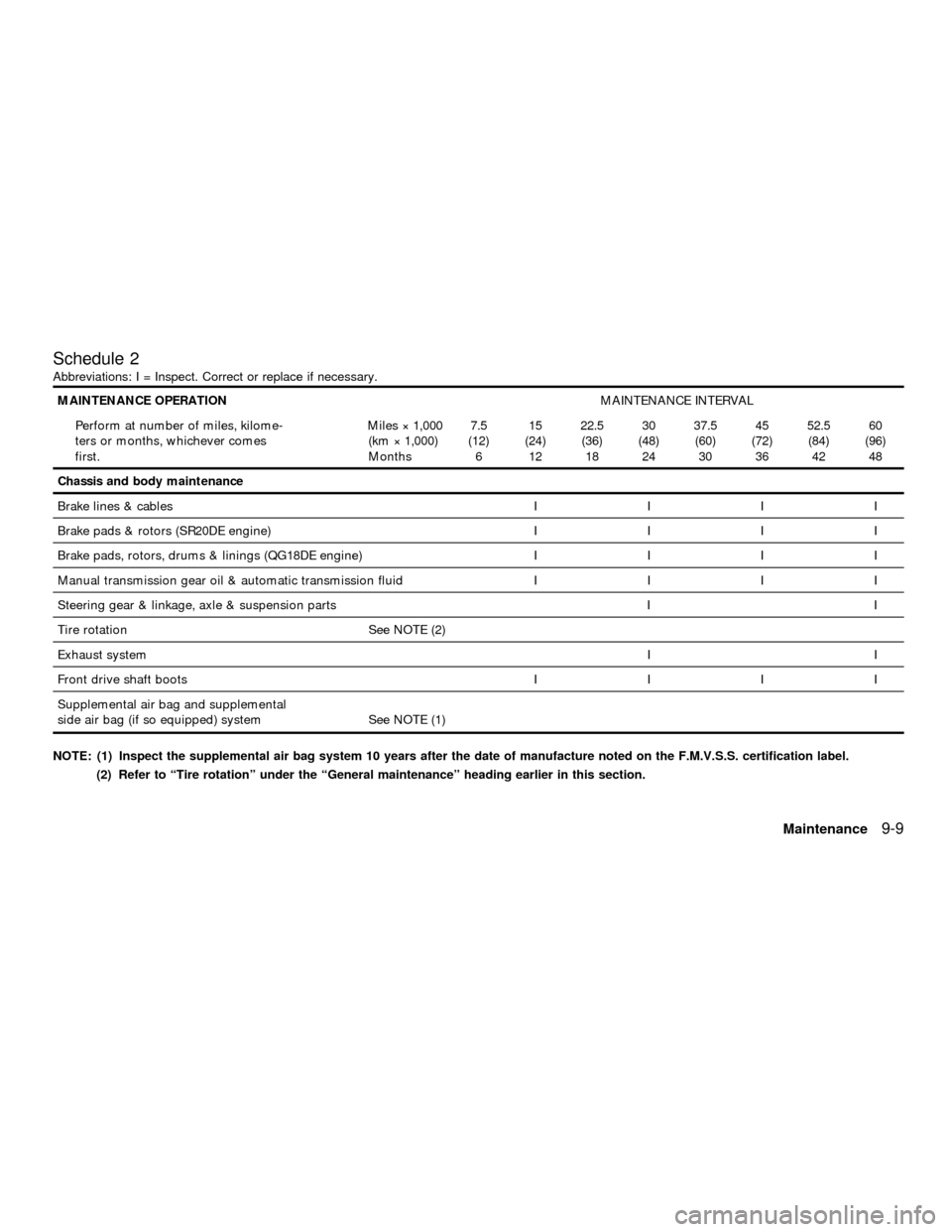
Schedule 2
Abbreviations: I = Inspect. Correct or replace if necessary.
MAINTENANCE OPERATIONMAINTENANCE INTERVAL
Perform at number of miles, kilome-
ters or months, whichever comes
first.Miles ý 1,000
(km ý 1,000)
Months7.5
(12)
615
(24)
1222.5
(36)
1830
(48)
2437.5
(60)
3045
(72)
3652.5
(84)
4260
(96)
48
Chassis and body maintenance
Brake lines & cablesIIII
Brake pads & rotors (SR20DE engine)IIII
Brake pads, rotors, drums & linings (QG18DE engine)IIII
Manual transmission gear oil & automatic transmission fluidIIII
Steering gear & linkage, axle & suspension parts I I
Tire rotation See NOTE (2)
Exhaust systemII
Front drive shaft bootsIIII
Supplemental air bag and supplemental
side air bag (if so equipped) system See NOTE (1)
NOTE: (1) Inspect the supplemental air bag system 10 years after the date of manufacture noted on the F.M.V.S.S. certification label.
(2) Refer to ªTire rotationº under the ªGeneral maintenanceº heading earlier in this section.
Maintenance9-9
ZX
Page 209 of 240

EXPLANATION OF MAINTE-
NANCE ITEMS
Additional information on the following
items with an ``*'' is found in the ``Do-it-
yourself'' section of this manual.
Emission control system maintenance
Drive belts* ÐCheck drive belts for wear,
fraying or cracking and also for proper ten-
sion. Replace any damaged drive belts.
Air cleaner filter ÐUnder normal driving
conditions, the air cleaner filter should be
replaced in accordance with the mainte-
nance schedule. However, driving the ve-
hicle in dusty areas may cause rapid clog-
ging of the element. Consequently, the
element may have to be replaced more
frequently.
EVAP vapor lines ÐCheck vapor lines and
connections for leaks, looseness or deteriora-
tion. If leaks are found, replace them.
Fuel lines ÐCheck the fuel hoses, piping
and connections for leaks, looseness or
deterioration. Replace any damaged parts.
Engine coolant* ÐDrain and flush the
cooling system.Engine oil & oil filter* ÐUnder normal
driving conditions, the engine oil and oil filter
should be replaced in accordance with the
maintenance schedule. However, under se-
vere driving conditions, they may have to be
replaced more frequently.
Spark plugs* ÐReplace with new plugs
having the correct heat range.
Intake & exhaust valve clearance Ð
Check and adjust the valve clearance.
Chassis and body maintenance
Brake lines & cables ÐCheck the brake
lines and hoses (including brake booster
vacuum hoses, connections & check valve)
and parking brake cables for proper attach-
ment, leaks, cracks, chafing, abrasion, de-
terioration, etc.
Brake pads, rotors, drums & linings Ð
Check these and the other brake compo-
nents for wear, deterioration and leaks. Un-
der severe driving conditions, they may
have to be inspected more frequently.
Manual & automatic transmission fluid*
ÐCheck the fluid level and visually inspect
for signs of leakage. Under severe drivingconditions, the fluid should be replaced at
the specified interval.
Steering gear & linkage, axle & suspen-
sion parts, and drive shaft boots Ð
Check for damage, looseness and leakage
of oil or grease. Under severe driving con-
ditions, inspection should be performed
more frequently.
Exhaust system ÐVisually check the ex-
haust pipes, muffler, and hangers for proper
attachment, leaks, cracks, chafing, abra-
sion, deterioration, etc. Under severe driv-
ing conditions, inspection should be per-
formed more frequently.
Supplemental air bag and supplemental
side air bag (if so equipped) system Ð
Check the supplemental air bag system(s)
components for proper attachment, damage,
deformities, cracks, rust, etc. Work around and
on the supplemental air bag system should be
done by an authorized NISSAN dealer.
9-10Maintenance
ZX
Page 211 of 240
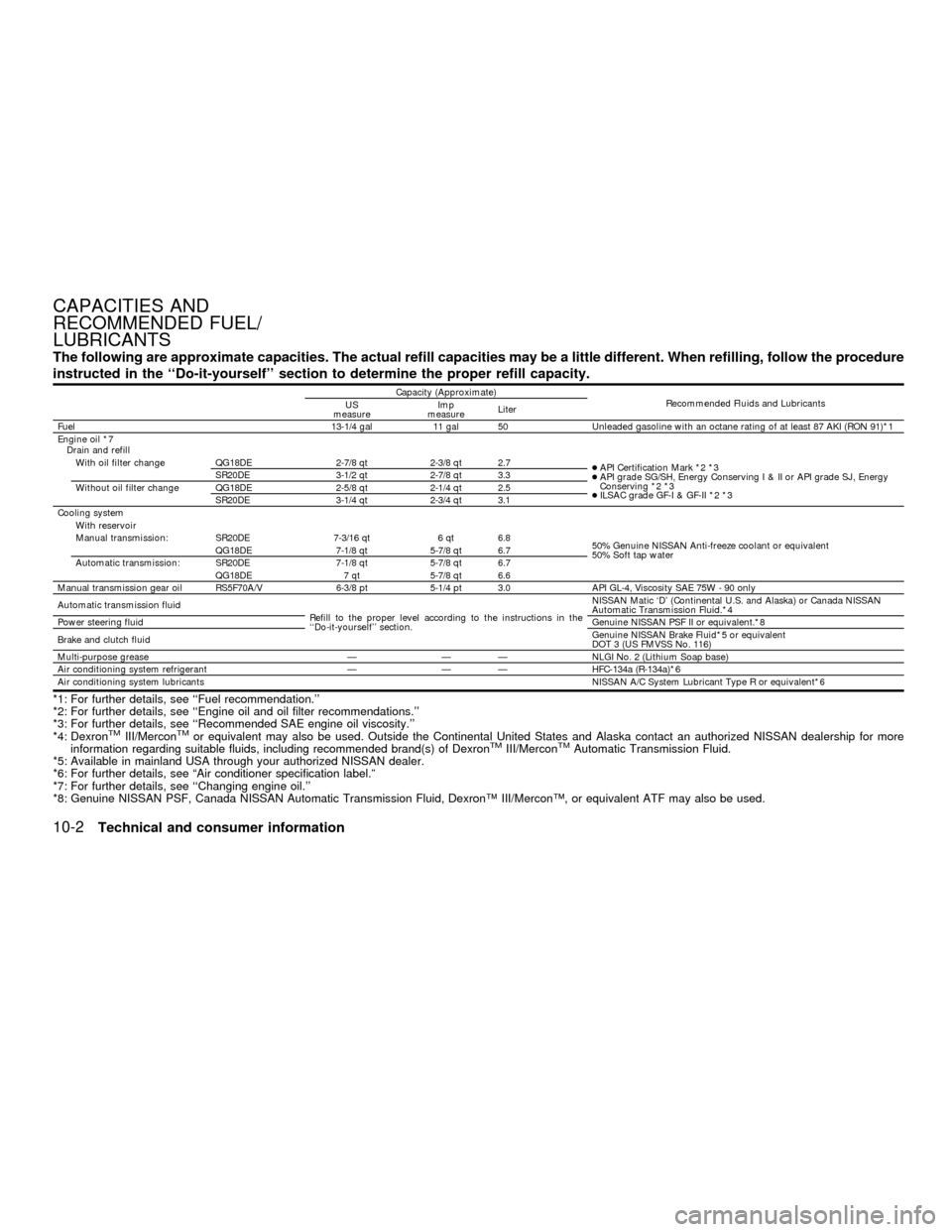
The following are approximate capacities. The actual refill capacities may be a little different. When refilling, follow the procedure
instructed in the ``Do-it-yourself'' section to determine the proper refill capacity.
Capacity (Approximate)
Recommended Fluids and Lubricants
US
measureImp
measureLiter
Fuel 13-1/4 gal 11 gal 50 Unleaded gasoline with an octane rating of at least 87 AKI (RON 91)*1
Engine oil *7
Drain and refill
With oil filter change QG18DE 2-7/8 qt 2-3/8 qt 2.7
cAPI Certification Mark *2 *3
cAPI grade SG/SH, Energy ConservingI&IIorAPIgrade SJ, Energy
Conserving *2 *3
cILSAC grade GF-I & GF-II *2 *3 SR20DE 3-1/2 qt 2-7/8 qt 3.3
Without oil filter change QG18DE 2-5/8 qt 2-1/4 qt 2.5
SR20DE 3-1/4 qt 2-3/4 qt 3.1
Cooling system
With reservoir
50% Genuine NISSAN Anti-freeze coolant or equivalent
50% Soft tap water Manual transmission: SR20DE 7-3/16 qt 6 qt 6.8
QG18DE 7-1/8 qt 5-7/8 qt 6.7
Automatic transmission: SR20DE 7-1/8 qt 5-7/8 qt 6.7
QG18DE 7 qt 5-7/8 qt 6.6
Manual transmission gear oil RS5F70A/V 6-3/8 pt 5-1/4 pt 3.0 API GL-4, Viscosity SAE 75W - 90 only
Automatic transmission fluid
Refill to the proper level according to the instructions in the
``Do-it-yourself'' section.NISSAN Matic `D' (Continental U.S. and Alaska) or Canada NISSAN
Automatic Transmission Fluid.*4
Power steering fluidGenuine NISSAN PSF II or equivalent.*8
Brake and clutch fluidGenuine NISSAN Brake Fluid*5 or equivalent
DOT 3 (US FMVSS No. 116)
Multi-purpose grease Ð Ð Ð NLGI No. 2 (Lithium Soap base)
Air conditioning system refrigerant Ð Ð Ð HFC-134a (R-134a)*6
Air conditioning system lubricantsNISSAN A/C System Lubricant Type R or equivalent*6
*1: For further details, see ``Fuel recommendation.''
*2: For further details, see ``Engine oil and oil filter recommendations.''
*3: For further details, see ``Recommended SAE engine oil viscosity.''
*4: Dexron
TMIII/MerconTMor equivalent may also be used. Outside the Continental United States and Alaska contact an authorized NISSAN dealership for more
information regarding suitable fluids, including recommended brand(s) of DexronTMIII/MerconTMAutomatic Transmission Fluid.
*5: Available in mainland USA through your authorized NISSAN dealer.
*6: For further details, see ªAir conditioner specification label.º
*7: For further details, see ``Changing engine oil.''
*8: Genuine NISSAN PSF, Canada NISSAN Automatic Transmission Fluid, DexronŸ III/MerconŸ, or equivalent ATF may also be used.
CAPACITIES AND
RECOMMENDED FUEL/
LUBRICANTS
10-2Technical and consumer information
ZX
Page 223 of 240
WARNING
cIt is extremely dangerous to ride in a
cargo area inside the vehicle. In a
collision, people riding in these ar-
eas are more likely to be seriously
injured or killed.
cDo not allow people to ride in any
area of the vehicle that is not
equipped with seats and seat belts.
c
Be sure everyone in the vehicle is in a
seat with their seat belt properly fas-
tened.
TERMS
It is important to familiarize yourself with the
following terms before loading your vehicle:
cCurb Weight (actual weight of your ve-
hicle) - vehicle weight including: standard
and optional equipment, fluids, emer-
gency tools, and spare tire assembly.
This weightdoes notinclude passen-
gers and cargo.
cGVW (Gross Vehicle Weight) - curb
weight plus the combined weight of pas-
sengers and cargo.
cGVWR (Gross Vehicle Weight Rating) -maximum total weight (load) limit speci-
fied for the vehicle.
cGAWR (Gross Axle Weight Rating) -
maximum weight (load) limit specified for
the front or rear axle.
DETERMINING VEHICLE LOAD
CAPACITY
The load capacity of this vehicle is deter-
mined by weight, not by available cargo
space. For example, a luggage rack, bike
carrier, cartop carrier or similar equipment
does not increase the load carrying capacity
of your vehicle.
To determine vehicle load capacity:
Vehicle weight can be determined by using
a commercial-grade scale, found at places
such as a truck stop, gravel quarry, grain
elevator, or a scrap metal recycling facility.
1) Determine the curb weight of your ve-
hicle.
2) Compare the curb weight amount to the
GVWR specified for your vehicle to de-
termine how much more weight your
vehicle can carry.
3) After loading (cargo and passengers),re-weigh your vehicle to determine if
either GVWR or GAWR for your vehicle
is exceeded. If GVWR is exceeded, re-
move cargo as necessary. If either the
front or rear GAWR is exceeded, shift the
load or remove cargo as necessary.
LOADING TIPS
cThe GVW must not exceed GVWR or
GAWR as specified on the F.M.V.S.S.
Certification Label.
cDo not load the front and rear axle to the
GAWR. Doing so will exceed the GVWR.
WARNING
cProperly secure all cargo to help
prevent it from sliding or shifting. Do
not place cargo higher than the seat-
backs. In a sudden stop or collision,
unsecured cargo could cause per-
sonal injury.
cDo not load your vehicle any heavier
than the GVWR or the maximum
front and rear GAWRs. If you do,
parts of your vehicle can break, or it
can change the way your vehicle
handles. This could result in loss of
control and cause personal injury.
VEHICLE LOADING
INFORMATION
10-14Technical and consumer information
ZX
Page 234 of 240
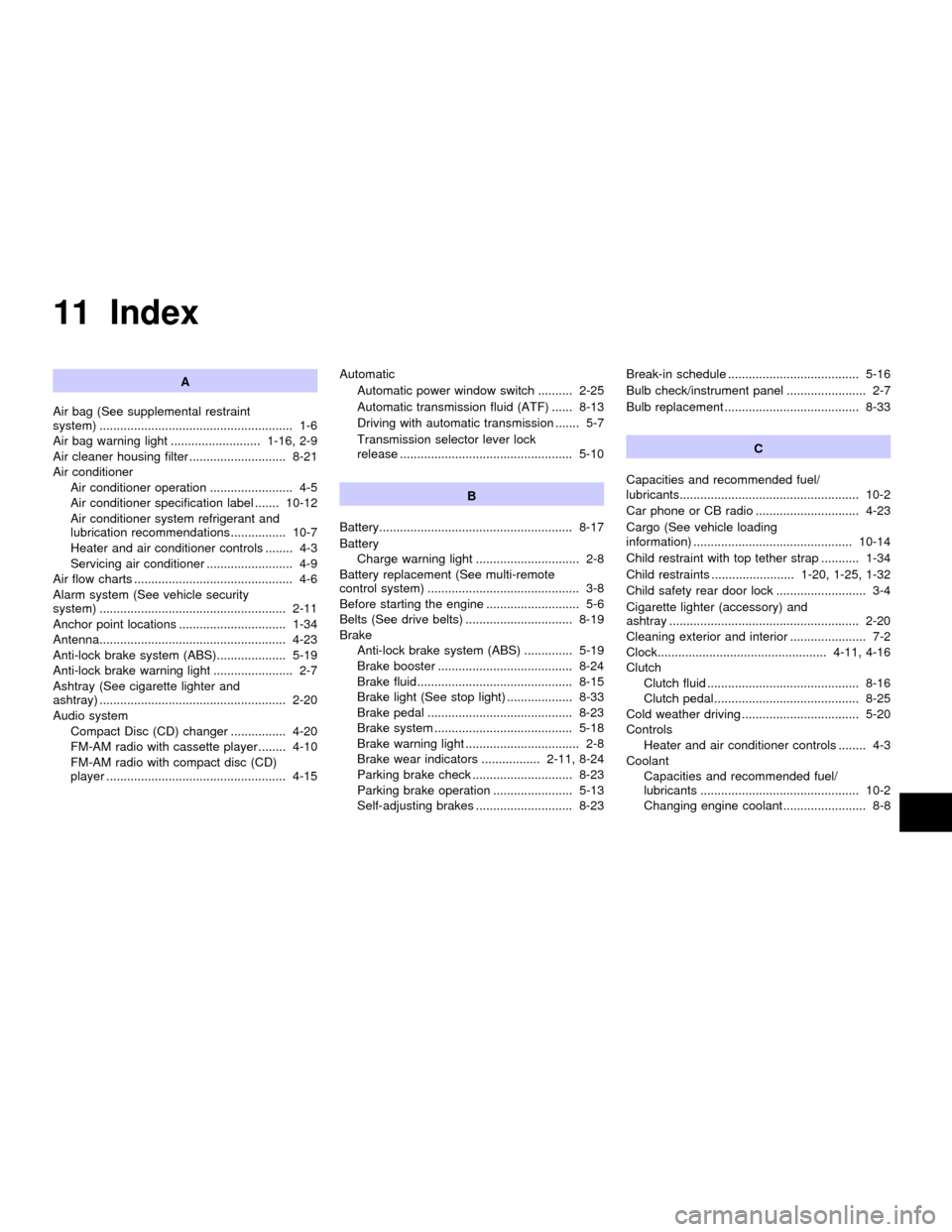
11 Index
A
Air bag (See supplemental restraint
system) ........................................................ 1-6
Air bag warning light .......................... 1-16, 2-9
Air cleaner housing filter ............................ 8-21
Air conditioner
Air conditioner operation ........................ 4-5
Air conditioner specification label ....... 10-12
Air conditioner system refrigerant and
lubrication recommendations ................ 10-7
Heater and air conditioner controls ........ 4-3
Servicing air conditioner ......................... 4-9
Air flow charts .............................................. 4-6
Alarm system (See vehicle security
system) ...................................................... 2-11
Anchor point locations ............................... 1-34
Antenna...................................................... 4-23
Anti-lock brake system (ABS).................... 5-19
Anti-lock brake warning light ....................... 2-7
Ashtray (See cigarette lighter and
ashtray) ...................................................... 2-20
Audio system
Compact Disc (CD) changer ................ 4-20
FM-AM radio with cassette player ........ 4-10
FM-AM radio with compact disc (CD)
player .................................................... 4-15Automatic
Automatic power window switch .......... 2-25
Automatic transmission fluid (ATF) ...... 8-13
Driving with automatic transmission ....... 5-7
Transmission selector lever lock
release .................................................. 5-10
B
Battery........................................................ 8-17
Battery
Charge warning light .............................. 2-8
Battery replacement (See multi-remote
control system) ............................................ 3-8
Before starting the engine ........................... 5-6
Belts (See drive belts) ............................... 8-19
Brake
Anti-lock brake system (ABS) .............. 5-19
Brake booster ....................................... 8-24
Brake fluid............................................. 8-15
Brake light (See stop light) ................... 8-33
Brake pedal .......................................... 8-23
Brake system ........................................ 5-18
Brake warning light ................................. 2-8
Brake wear indicators ................. 2-11, 8-24
Parking brake check ............................. 8-23
Parking brake operation ....................... 5-13
Self-adjusting brakes ............................ 8-23Break-in schedule ...................................... 5-16
Bulb check/instrument panel ....................... 2-7
Bulb replacement ....................................... 8-33
C
Capacities and recommended fuel/
lubricants.................................................... 10-2
Car phone or CB radio .............................. 4-23
Cargo (See vehicle loading
information) .............................................. 10-14
Child restraint with top tether strap ........... 1-34
Child restraints ........................ 1-20, 1-25, 1-32
Child safety rear door lock .......................... 3-4
Cigarette lighter (accessory) and
ashtray ....................................................... 2-20
Cleaning exterior and interior ...................... 7-2
Clock................................................. 4-11, 4-16
Clutch
Clutch fluid ............................................ 8-16
Clutch pedal.......................................... 8-25
Cold weather driving .................................. 5-20
Controls
Heater and air conditioner controls ........ 4-3
Coolant
Capacities and recommended fuel/
lubricants .............................................. 10-2
Changing engine coolant........................ 8-8
ZX