2001 MAZDA MODEL TRIBUTE 4WD brakes
[x] Cancel search: brakesPage 127 of 232

If driving through deep or standing water is unavoidable, proceed very
slowly. Never drive through water that is higher than the bottom of the
hubs (for trucks) or the bottom of the wheel rims (for cars).
Once through the water, always try the brakes. Wet brakes do not stop
the vehicle as effectively as dry brakes. Drying can be improved by
moving your vehicle slowly while applying light pressure on the brake
pedal.
Driving through deep water where the transmission vent tube is
submerged may allow water into the transmission and cause
internal transmission damage.
TRAILER TOWING
Trailer towing with your vehicle may require the use of a trailer tow
option package.
Trailer towing puts additional loads on your vehicle's engine, transaxle,
axle, brakes, tires, and suspension. For your safety and to maximize
vehicle performance, be sure to use the proper equipment while towing.
Follow these guidelines to ensure safe towing procedure:
²Stay within your vehicle's load limits.
² Thoroughly prepare your vehicle for towing. Refer to Preparing to
tow in this chapter.
² Use extra caution when driving while trailer towing. Refer to Driving
while you tow in this chapter.
² Service your vehicle more frequently if you tow a trailer. Refer to the
ªScheduled Maintenanceº section of this manual.
² Do not tow a trailer until your vehicle has been driven at least 800 km
(500 miles).
² Refer to the instructions included with towing accessories for the
proper installation and adjustment specifications.
Do not exceed the maximum loads listed on the Certification label. For
load specification terms found on the label, refer to Vehicle loadingin
this chapter. Remember to figure in the tongue load of your loaded
vehicle when figuring the total weight.
Driving
127
Page 129 of 232

Trailer brakes
Electric brakes and manual, automatic or surge-type trailer brakes are
safe if installed properly and adjusted to the manufacturer's
specifications. The trailer brakes must meet local and Federal
regulations.WARNING: Do not connect a trailer's hydraulic brake system
directly to your vehicle's brake system. Your vehicle may not
have enough braking power and your chances of having a
collision greatly increase.
The braking system of the tow vehicle is rated for operation at the
GVWR not GCWR.
Trailer lamps
Trailer lamps are required on most towed vehicles. Make sure your
trailer lamps conform to local and Federal regulations. See your
authorized Mazda dealer for proper instructions and equipment for
hooking up trailer lamps.
Driving while you tow
When towing a trailer:
² Ensure that you turn off your speed control. The speed control may
shut off automatically when you are towing on long, steep grades.
² Consult your local motor vehicle speed regulations for towing a trailer.
² Use a lower gear when towing up or down steep hills. This will
eliminate excessive downshifting and upshifting for optimum fuel
economy and transmission cooling.
² Anticipate stops and brake gradually.
Exceeding the GCWR rating may cause internal transmission
damage and void your warranty coverage.
Servicing after towing
If you tow a trailer for long distances, your vehicle will require more
frequent service intervals. Refer to the ªScheduled Maintenanceº section
for more information.
Driving
129
Page 155 of 232

INTRODUCTION
Be extremely careful to prevent injury to yourself and others and
damage to your vehicle when using this manual for inspection and
maintenance.
If you're unsure about any procedure it describes, we strongly urge you
to have a reliable and qualified service shop perform the work, preferably
an Authorized Mazda Dealer.
Factory-trained Mazda technicians and genuine Mazda parts are best for
your vehicle. Without this expertise and the parts that have been
designed and made especially for your Mazda, inadequate, incomplete,
and insufficient servicing may result in problems. This could lead to
vehicle damage or an accident and injuries.
For expert advice and quality service, consult an Authorized Mazda Dealer.
The owner should retain evidence that proper maintenance has been
performed as prescribed.
A claim against a warranty will not qualify if it results from lack of
maintenance and not from defective material or authorized Mazda
workmanship.
Any auto repair shop using parts equivalent to your Mazda's original
equipment may perform maintenance.But we recommend that it
always be done by an Authorized Mazda Dealer using genuine
Mazda parts.
SCHEDULED MAINTENANCE
Follow Schedule 1 if the vehicle is operated mainly where none of the
following conditions apply. If any do apply, follow Schedule 2.
² Repeated short trips of less than 16 kilometers (10 miles)
² Driving in dusty, sandy or wet conditions
² Driving with an extended use of brakes
² Driving in areas where salt or other corrosive materials are being used
² Driving on rough or muddy roads
² Extended periods of idling or low-speed operation
² Driving for long periods in cold temperatures or extremely humid
climates
² Towing a trailer or using a car-top carrier
NOTE:After the described period, continue to follow the described
maintenance at the recommended intervals.
Maintenance and care
155
Page 157 of 232
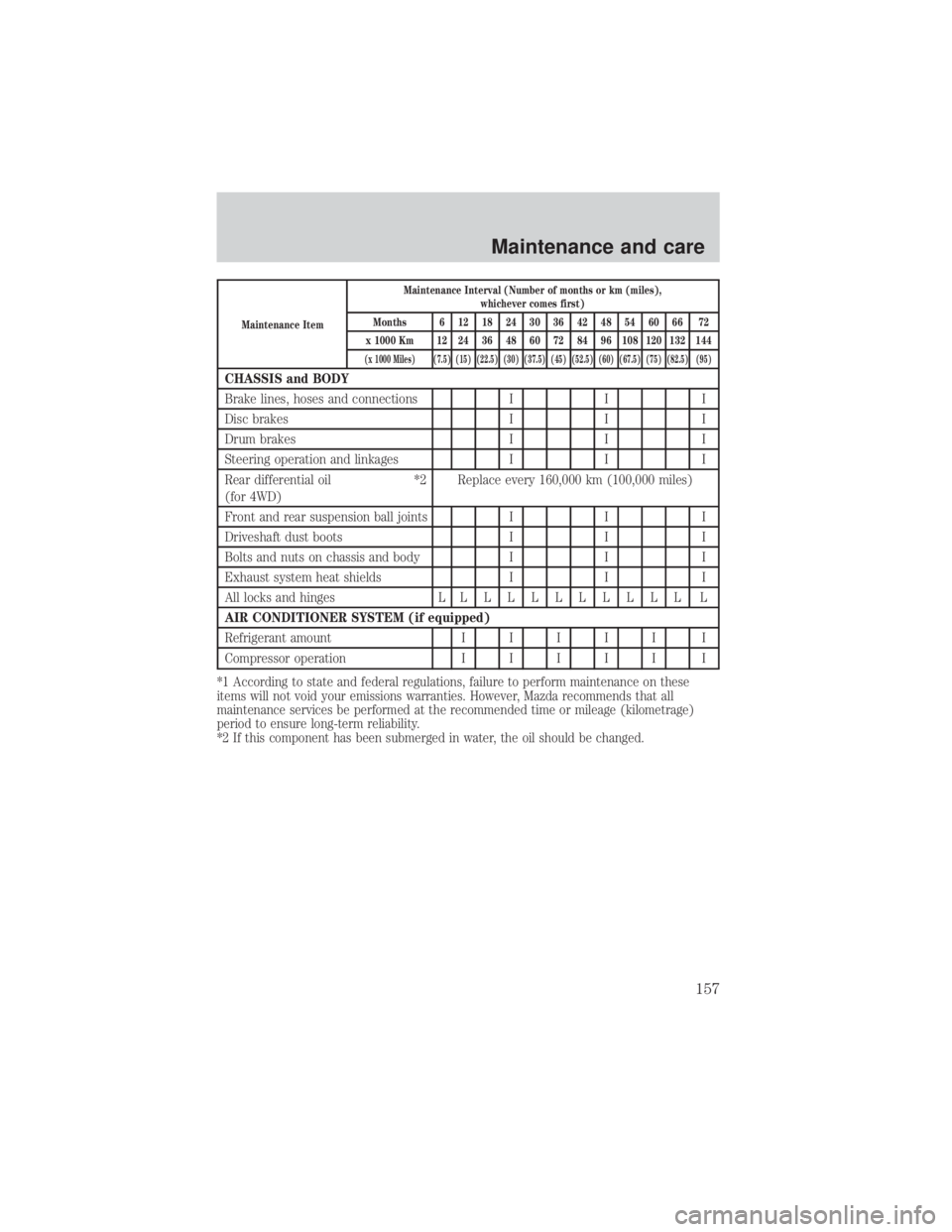
Maintenance ItemMaintenance Interval (Number of months or km (miles),
whichever comes first)
Months 6 12 18 24 30 36 42 48 54 60 66 72
x 1000 Km 12 24 36 48 60 72 84 96 108 120 132 144
(x 1000 Miles) (7.5) (15) (22.5) (30) (37.5) (45) (52.5) (60) (67.5) (75) (82.5) (95)
CHASSIS and BODY
Brake lines, hoses and connections II I
Disc brakes II I
Drum brakes II I
Steering operation and linkages II I
Rear differential oil
(for 4WD) *2 Replace every 160,000 km (100,000 miles)
Front and rear suspension ball joints II I
Driveshaft dust boots II I
Bolts and nuts on chassis and body II I
Exhaust system heat shields II I
All locks and hinges LLLLLLLLLLL L
AIR CONDITIONER SYSTEM (if equipped)
Refrigerant amount IIIII I
Compressor operation IIIII I
*1 According to state and federal regulations, failure to perform maintenance on these
items will not void your emissions warranties. However, Mazda recommends that all
maintenance services be performed at the recommended time or mileage (kilometrage)
period to ensure long-term reliability.
*2 If this component has been submerged in water, the oil should be changed.
Maintenance and care
157
Page 159 of 232
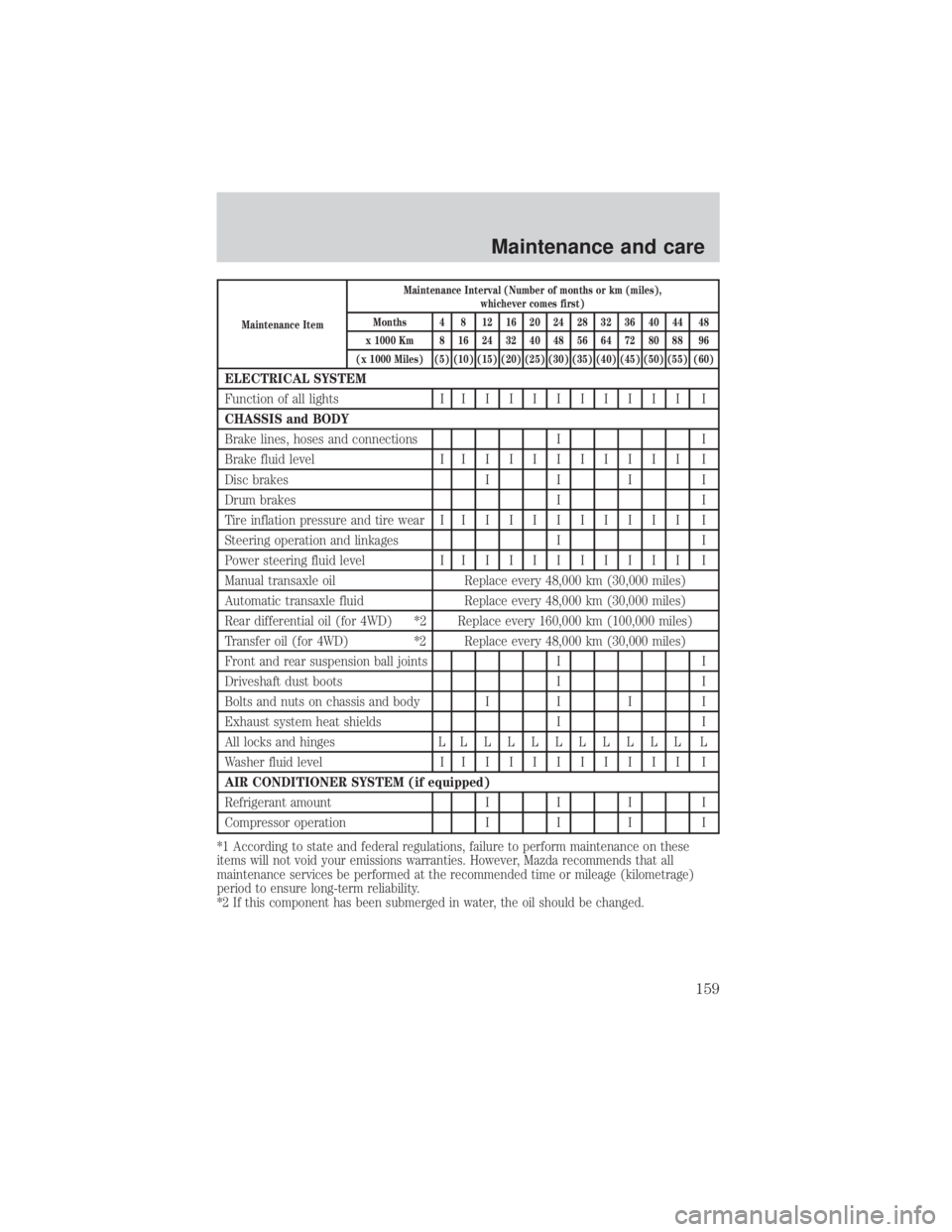
Maintenance ItemMaintenance Interval (Number of months or km (miles),
whichever comes first)
Months 4 8 12 16 20 24 28 32 36 40 44 48
x 1000 Km 8 16 24 32 40 48 56 64 72 80 88 96
(x 1000 Miles) (5) (10) (15) (20) (25) (30) (35) (40) (45) (50) (55) (60)
ELECTRICAL SYSTEM
Function of all lights IIIIIIIIIII I
CHASSIS and BODY
Brake lines, hoses and connections I I
Brake fluid level I IIIIIIIIII I
Disc brakes I I I I
Drum brakes I I
Tire inflation pressure and tire wear I IIIIIIIIII I
Steering operation and linkages I I
Power steering fluid level I IIIIIIIIII I
Manual transaxle oil Replace every 48,000 km (30,000 miles)
Automatic transaxle fluid Replace every 48,000 km (30,000 miles)
Rear differential oil (for 4WD) *2 Replace every 160,000 km (100,000 miles)
Transfer oil (for 4WD) *2 Replace every 48,000 km (30,000 miles)
Front and rear suspension ball joints I I
Driveshaft dust boots I I
Bolts and nuts on chassis and body I I I I
Exhaust system heat shields I I
All locks and hinges L LLLLLLLLLL L
Washer fluid level I IIIIIIIIII I
AIR CONDITIONER SYSTEM (if equipped)
Refrigerant amount I I I I
Compressor operation I I I I
*1 According to state and federal regulations, failure to perform maintenance on these
items will not void your emissions warranties. However, Mazda recommends that all
maintenance services be performed at the recommended time or mileage (kilometrage)
period to ensure long-term reliability.
*2 If this component has been submerged in water, the oil should be changed.
Maintenance and care
159
Page 169 of 232

BRAKE FLUID
Checking and adding brake fluid
Brake fluid should be checked and
refilled as needed. Refer to the
scheduled maintenance section for
the service interval schedules.1. Clean the reservoir cap before removal to prevent dirt or water
from entering the reservoir.
2. Visually inspect the fluid level.
3. If necessary, add brake fluid from a clean un-opened
container until the level reaches
MAX. Do not fill above this line.
4. Use only brake fluids certified to meet Mazda specifications.
Refer to Lubricant
specifications in theCapacities
and specifications chapter.
DOT 3 fluid is recommended. However, if DOT 3 is not available,
DOT 4 fluid can be used.
WARNING: Brake fluid is toxic. If brake fluid contacts the
eyes, flush eyes with running water for 15 minutes. Seek
medical attention if irritation persists. If taken internally, drink
water and induce vomiting. Seek medical attention immediately.
WARNING: If you use DOT 5 or any other brake fluid that is
not DOT 3 or DOT 4, you will cause permanent damage to your
brakes.
Maintenance and care
169
Page 170 of 232

WARNING: Do not let the fluid level in the reservoir for the
master cylinder fall below the MIN mark. If master cylinder
runs dry, this may cause the brakes to fail.
CLUTCH FLUID (MANUAL TRANSAXLE)
The clutch master cylinder and
brake master cylinder are part of
the same system; both are refillable
through the brake master cylinder
with brake fluid. For more
information on brake fluid
maintenance, refer to Brake fluidin
this chapter.
WARNING: Brake fluid is toxic. If brake fluid contacts the
eyes, flush eyes with running water for 15 minutes. Seek
medical if irritation persists. If taken internally, drink water
and induce vomiting. Seek medical attention immediately.
WINDSHIELD WASHER FLUID
Checking and adding washer fluid
Check the washer fluid whenever
you stop for fuel. The reservoir is
highlighted with a
symbol.
If the level is low, add enough fluid
to fill the reservoir. In very cold
weather, do not fill the reservoir all
the way.
Only use a washer fluid that meets Mazda specifications. Refer to
Lubricant specifications in theCapacities and specifications chapter.
Maintenance and care
170
Page 207 of 232

Any gasoline spilled on the vehicle or deposits such as bird
droppings should be washed and sponged off as soon as possible.
Deposits not removed promptly can cause damage to the vehicle's
paintwork.
Remove any exterior accessories, such as antennas, before
entering a car wash. If you have wax applied to the vehicle at a
commercial car wash, it is recommended that you clean the wiper
blades and windshield as described inCleaning the wiper blades
and windshield.
After washing, apply the brakes several times to dry them.
Underbody
Flush the complete underside of vehicle frequently. Keep body drain
holes unplugged. Inspect for road damage.
Waxing your vehicle
Waxing your vehicle on a regular basis will reduce minor scratches and
paint damage.
Wax when water stops beading on the surface. This could be every three
or four months, depending on operating conditions.
Use only carnauba or synthetic-based waxes. Use a cleaning fluid with a
clean cloth to remove any bugs before waxing your vehicle. Use tar
remover to remove any tar spots.
Avoid getting wax on the windshield, or on any surfaces which
appear coarse or bumpy. If you have wax applied at a commercial
car wash, it is recommended that you clean the wiper blades and
windshield as described in Cleaning the wiper blades and
windshield.
Repairing paint chips
Minor scratches or paint damage from road debris may be repaired with
Genuine Mazda Touch-Up Paint. Observe the application instructions on
the products.
Remove particles such as bird droppings, tree sap, insect remains, tar
spots, road salt and industrial fallout immediately.
Maintenance and care
207