2001 HONDA S2000 lock
[x] Cancel search: lockPage 31 of 276
Protectin
g Childre n
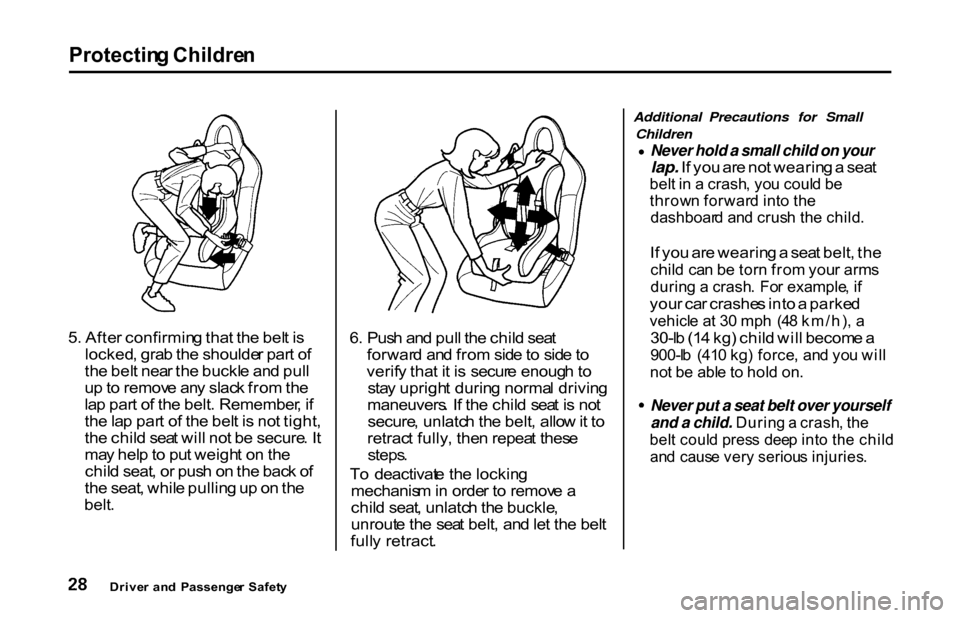
5 . Afte r confirmin g tha t th e bel t i s
locked , gra b th e shoulde r par t o f
th e bel t nea r th e buckl e an d pul l
u p to remov e an y slac k fro m th e
la p par t o f th e belt . Remember , i f
th e la p par t o f th e bel t i s no t tight ,
th e chil d sea t wil l no t b e secure . I t
ma y hel p to pu t weigh t o n th e
chil d seat , o r pus h o n th e bac k o f
th e seat , whil e pullin g u p o n th e
belt .
6
. Pus h an d pul l th e chil d sea t
forwar d an d fro m sid e to sid e to
verif y tha t i t i s secur e enoug h to
sta y uprigh t durin g norma l drivin g
maneuvers . I f th e chil d sea t i s no t
secure , unlatc h th e belt , allo w it t o
retrac t fully , the n repea t thes e
steps .
T o deactivat e th e lockin g
mechanis m in orde r t o remov e a
chil d seat , unlatc h th e buckle ,
unrout e th e sea t belt , an d le t th e bel t
full y retract . Additional Precautions for Small
Children
Never hold a small child on your
lap. I f yo u ar e no t wearin g a sea t
bel t i n a crash , yo u coul d b e
throw n forwar d int o th e
dashboar d an d crus h th e child .
I f yo u ar e wearin g a sea t belt , th e
chil d ca n b e tor n fro m you r arm s
durin g a crash . Fo r example , i f
you r ca r crashe s int o a parke d
vehicl e a t 3 0 mp h (4 8 km/h) , a
30-l b (1 4 kg ) chil d wil l becom e a
900-l b (41 0 kg ) force , an d yo u wil l
no t b e abl e t o hol d on .
Never put a seat belt over yourself
and a child. Durin g a crash , th e
bel t coul d pres s dee p int o th e chil d
an d caus e ver y seriou s injuries .
Drive r an d Passenge r Safet y
Page 36 of 276
Additiona
l Informatio n Abou t You r Sea t Belt s
Sea t Bel t Syste m Component s
You r sea t bel t syste m include s lap /
shoulde r belt s i n bot h seatin g
positions .
Th e sea t belt s ar e als o equippe d wit h
automati c sea t bel t tensioners .
Th e syste m als o include s a
ligh t o n th e instrumen t
pane l t o remin d yo u an d you r
passenge r t o faste n you r belts . I f th e
driver' s sea t bel t i s no t fastene d
befor e th e ignitio n is turne d O N (II) ,
th e ligh t wil l com e o n an d a beepe r
wil l als o sound . Th e beepe r wil l sto p
afte r a fe w seconds , bu t th e ligh t wil l
sta y o n unti l th e driver' s sea t bel t i s
fastened .
Lap/Shoulde
r Bel t
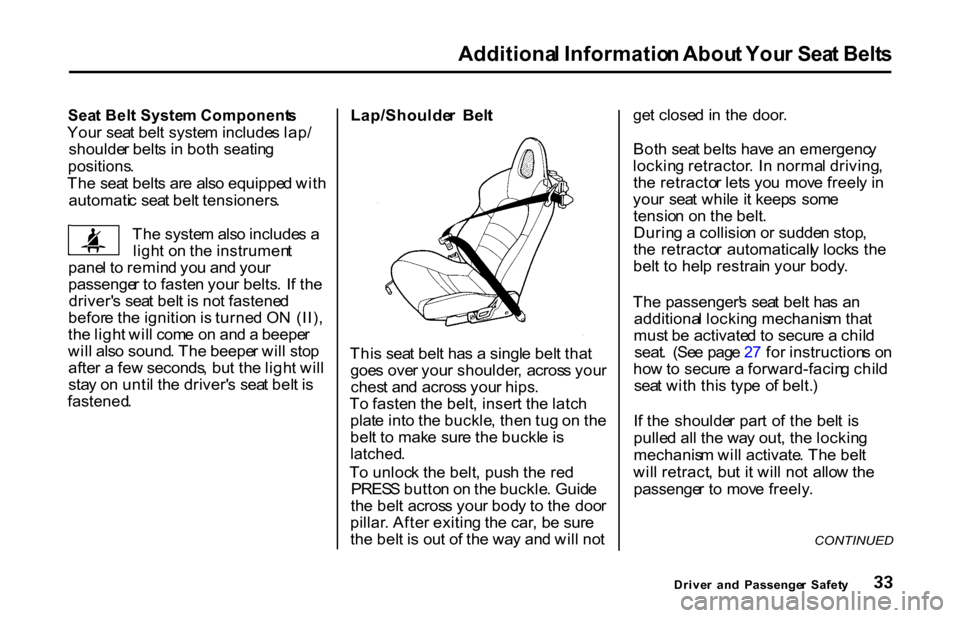
Thi s sea t bel t ha s a singl e bel t tha t
goe s ove r you r shoulder , acros s you r
ches t an d acros s you r hips .
T o faste n th e belt , inser t th e latc h
plat e int o th e buckle , the n tu g o n th e
bel t t o mak e sur e th e buckl e is
latched .
T o unloc k th e belt , pus h th e re d
PRES S butto n o n th e buckle . Guid e
th e bel t acros s you r bod y t o th e doo r
pillar . Afte r exitin g th e car , b e sur e
th e bel t i s ou t o f th e wa y an d wil l no t ge
t close d in th e door .
Bot h sea t belt s hav e a n emergenc y
lockin g retractor . I n norma l driving ,
th e retracto r let s yo u mov e freel y i n
you r sea t whil e i t keep s som e
tensio n o n th e belt .
Durin g a collisio n o r sudde n stop ,
th e retracto r automaticall y lock s th e
bel t t o hel p restrai n you r body .
Th e passenger' s sea t bel t ha s a n
additiona l lockin g mechanis m tha t
mus t b e activate d to secur e a chil d
seat . (Se e pag e 2 7 fo r instruction s o n
ho w to secur e a forward-facin g chil d
sea t wit h thi s typ e o f belt. )
I f th e shoulde r par t o f th e bel t i s
pulle d al l th e wa y out , th e lockin g
mechanis m wil l activate . Th e bel t
wil l retract , bu t i t wil l no t allo w th e
passenge r t o mov e freely .
CONTINUED
Drive r an d Passenge r Safet y
Page 37 of 276
Additiona
l Informatio n Abou t You r Sea t Belt s
T o deactivat e th e lockin g
mechanism , unlatc h th e buckl e an d
le t th e sea t bel t full y retract . T o
refaste n th e belt , pul l i t ou t onl y a s
fa r a s needed .
Se e pag e 1 5 fo r instruction s o n ho w
t o wea r th e lap/shoulde r bel t
properly . Sea
t Bel t Maintenanc e
Fo r safety , yo u shoul d chec k th e
conditio n o f you r sea t belt s regularly .
Pul l eac h bel t ou t full y an d loo k fo r
frays , cuts , burns , an d wear . Chec k
tha t th e latche s wor k smoothl y an d
tha t th e lap/shoulde r belt s retrac t
easily . An y bel t no t i n good conditio n
o r no t workin g properl y wil l no t
provid e good protectio n an d shoul d
be replace d a s soo n a s possible .
U.S. Models
Hond a provide s a lifetim e warrant y
o n sea t belts . Hond a wil l repai r o r
replac e an y sea t bel t componen t tha t
fail s t o functio n properl y durin g
norma l use . Pleas e se e you r Honda
Warranty Information booklet fo r
details .
I
f a sea t bel t i s wor n durin g a crash ,
yo u shoul d hav e you r deale r inspec t
th e belt , an d replac e it i f necessary .
A bel t tha t ha s bee n wor n durin g a
cras h ma y no t provid e th e sam e leve l
o f protectio n in a subsequen t crash .
Th e deale r shoul d als o inspec t th e
anchor s fo r damag e an d replac e
the m if needed .
Fo r informatio n o n ho w to clea n you r
sea t belts , se e pag e 20 8 .
Drive r an d Passenge r Safet y
No
t checkin g o r maintainin g
sea t belt s ca n resul t i n seriou s
injur y o r deat h i f th e sea t belt s
d o no t wor k properl y whe n
needed .
Chec k you r sea t belt s regularl y
an d hav e an y proble m
correcte d a s soo n a s possible .
Page 39 of 276

Additiona
l Informatio n Abou t You r SR S
Durin g a crash , you r sea t bel t help s
restrai n you r lowe r bod y an d torso ,
whil e th e tensione r tighten s an d
lock s th e sea t bel t t o hel p kee p yo u
i n place . You r airba g provide s a
cushio n t o hel p restrai n an d protec t
you r hea d an d chest .
Sinc e bot h airbag s us e th e sam e
sensors , bot h airbag s normall y
inflat e a t th e sam e time . However , i t
i s possibl e fo r onl y on e airba g to
inflate .
Thi s ca n occu r whe n th e severit y o f
a collisio n is a t th e margin , o r
threshold , tha t determine s whethe r
o r no t th e airbag s wil l deploy . I n
suc h cases , th e sea t bel t wil l provid e
sufficien t protection , an d th e
supplementa l protectio n offere d b y
th e airba g woul d b e minimal . Afte
r inflating , th e airbag s
immediatel y deflate , s o the y won' t
interfer e wit h th e driver' s visibility ,
o r th e abilit y t o stee r o r operat e
othe r controls .
Th e tota l tim e fo r inflatio n an d
deflatio n is approximatel y one-tent h
o f a second , s o fas t tha t mos t
occupant s ar e no t awar e tha t th e
airbag s deploye d unti l the y se e the m
lyin g in thei r laps . Afte
r a crash , yo u ma y se e wha t
look s lik e smoke. This is actuall y
powde r fro m th e airbag' s surface .
Althoug h th e powde r i s no t harmful ,
peopl e wit h respirator y problem s
ma y experienc e som e temporar y
discomfort . I f thi s occurs , ge t ou t o f
th e ca r a s soo n a s it i s saf e to d o so .
U.S. Owners
Fo r additiona l informatio n o n ho w
you r airbag s work , se e th e bookle t
title d SRS: What You Need to Know
About Airbags that cam e wit h you r
owner' s manual .
Canadian Owners
Fo r additiona l informatio n o n ho w
you r airbag s work , as k you r deale r
fo r a copy of th e bookle t title d SRS:
What You Need to Know About Airbags.
Drive r an d Passenge r Safet y
Page 44 of 276

Instrument
s an d Control s
Thi s sectio n give s informatio n abou t
th e control s an d display s tha t
contribut e t o th e dail y operatio n o f
you r Honda . Al l th e essentia l
control s ar e withi n eas y reach .
Contro
l Locations........................... . 4 2
Indicato r Lights............................... . 4 3
Gauges............................................. . 4 7
Speedometer............................... . 4 7
Selec t Button............................... . 4 7
Tachometer................................. . 4 7
Temperatur e Gauge................... . 4 7
Fue l Gauge.................................. . 4 8
Odometer..................................... . 4 8
Tri p Meter................................... . 4 8
Maintenanc e Require d
Indicator................................... . 4 9
Control s Nea r th e Steerin g
Wheel....................................... 50
Headlights................................... .
51
Daytim e Runnin g
Lights............
. 5 2
Instrumen t Pane l Brightness.... . 5 2
Tur n Signals................................ 53
Windshiel d Wipers..................... 53
Windshiel d Washers.................. 54
Steerin g Whee l Control s ............... . 5 5
Cruis e Control............................. . 5 5
Key s an d Locks............................... . 5 8
Keys............................................... 58
Immobilize r System.................... . 5 9
Ignitio n Switch............................ . 6 0 Powe
r Doo r Locks...................... . 6 2
Remot e Transmitter................... . 6 3
Trunk........................................... . 6 6
Emergenc y Trun k Opener.........
6 7
Consol e Compartments............. . 6 8
Sea t Adjustments............................ . 6 9
Powe r Windows.............................. . 7 0
Convertibl e Top.............................. . 7 2
Lowerin g th e Convertibl e Top.. . 7 2
Raisin g th e Convertibl e To p ..... . 7 5
Convertibl e To p Cover............... . 7 7
Maintenance................................ .
7 8
Hazar d Warning.............................. . 8 0
Mirrors............................................. . 8 0
Adjustin g th e Powe r Mirrors.... . 8 0
Parkin g Brake................................. . 8 1
Beverag e Holder............................. . 8 2
Accessor y Powe r Socket............... . 8 2
Audi o Panel...................................... . 8 2
Interio r Lights................................. . 8 3
Instrument s an d Control s
Page 48 of 276

Indicato
r Light s
Supplementa l Restrain t
Syste m Indicato r
Thi s indicato r light s whe n yo u tur n
th e ignitio n switc h O N (II) . I f i t
come s o n a t an y othe r time , i t
indicate s a proble m in th e
supplementa l restrain t system . Fo r
complet e information , se e pag e 37 .
Anti-loc k Brak e Syste m (ABS )
Indicato r
Thi s ligh t normall y come s o n fo r a
fe w second s whe n yo u tur n th e
ignitio n switc h O N (II) , an d whe n
yo u pus h th e STAR T button . I f thi s
ligh t come s o n a t an y othe r time ,
ther e is a proble m in th e ABS . I f thi s
happens , tak e th e ca r t o you r deale r
t o hav e it checked . Wit h th e ligh t on ,
you r ca r stil l ha s norma l brakin g
abilit y bu t n o anti-lock . Malfunctio
n Indicato r Lam
p
Se e pag e 230 .
Trunk-ope
n Indicato r
Thi s ligh t come s o n if th e trun k li d is
no t close d tightly . Door-ope
n Indicato r
Thi s ligh t come s o n i f eithe r doo r i s
no t close d tightly . Electri
c Powe r Steerin g
(EPS ) Indicato r
Thi s ligh t normall y come s o n whe n
yo u tur n th e ignitio n O N (II ) an d
goe s of f afte r th e engin e starts . I f i t
come s o n a t an y othe r time , ther e is
a proble m in th e Electri c Powe r
Steerin g system . I f thi s happens ,
sto p th e ca r i n a saf e plac e an d tur n
of f th e engine . Rese t th e syste m by
restartin g th e engine , an d watc h th e
EP S light . I f i t doe s no t g o off , o r
come s bac k o n agai n whil e driving ,
tak e th e ca r t o you r deale r t o hav e it
checked . Wit h th e ligh t on , th e EP S
i s turne d off , makin g th e ca r harde r
t o steer .
Instrument s an d Control s
SR
S
AB S
U.S
.
Canada
EP
S
Page 58 of 276
Steerin
g Whee l Control s
Cruis e Contro l
Cruis e contro l allow s yo u t o maintai n
a se t spee d abov e 2 5 mp h (4 0 km/h )
withou t keepin g you r foo t o n th e
accelerato r pedal . I t shoul d b e use d
fo r cruisin g o n straight , ope n
highways . I t i s no t recommende d fo r
condition s suc h a s cit y driving ,
windin g roads , slipper y roads , heav y
rain , o r ba d weather . Yo u shoul d
hav e ful l contro l o f th e ca r unde r
thos e conditions .
The cruise control, as it operates,
moves the accelerator pedal. You can
damage your vehicle's accelerator
mechanism by resting your foot under
the pedal and blocking the movement. Using the Cruise Control
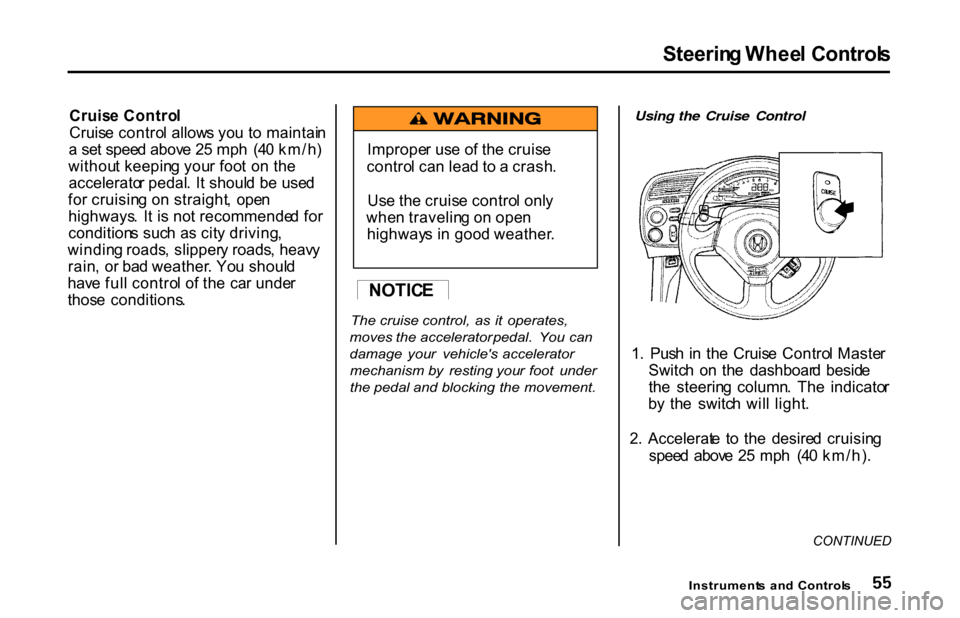
1 . Pus h i n th e Cruis e Contro l Maste r
Switc h o n th e dashboar d besid e
th e steerin g column . Th e indicato r
b y th e switc h wil l light .
2 . Accelerat e t o th e desire d cruisin g
spee d abov e 2 5 mp h (4 0 km/h) .
CONTINUED
Instrument s an d Control s
NOTIC
E
Imprope
r us e o f th e cruis e
contro l ca n lea d t o a crash .
Us e th e cruis e contro l onl y
whe n travelin g o n ope n
highway s i n goo d weather .
Page 61 of 276
Key
s an d Lock s
Key s
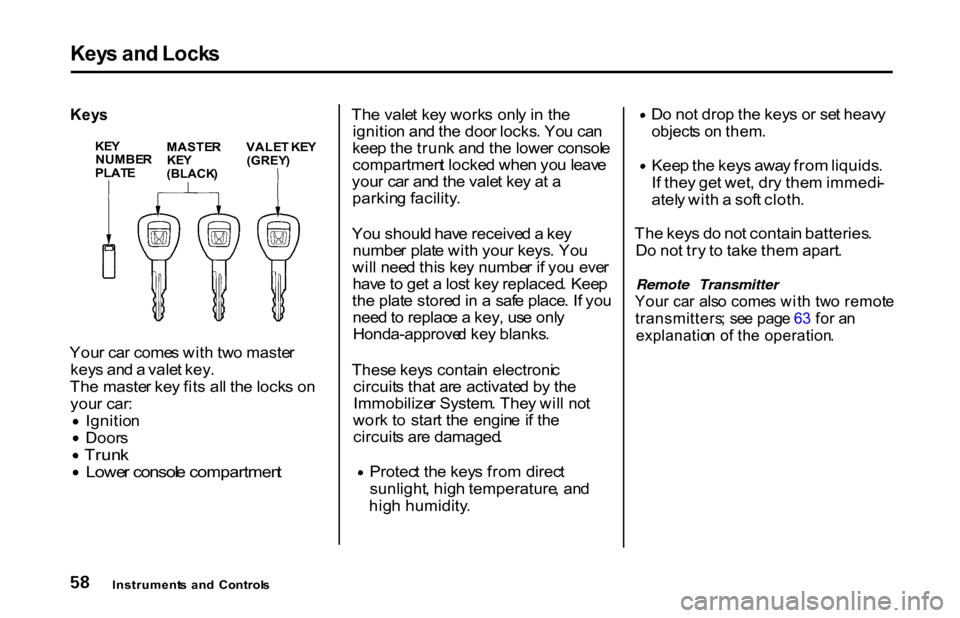
You r ca r come s wit h tw o maste r
key s an d a vale t key .
Th e maste r ke y fit s al l th e lock s o n
you r car : Ignitio
n
Door
s
Trun
k Lowe
r consol e compartmen t
Th
e vale t ke y work s onl y i n th e
ignitio n an d th e doo r locks . Yo u ca n
kee p th e trun k an d th e lowe r consol e
compartmen t locke d whe n yo u leav e
you r ca r an d th e vale t ke y a t a
parkin g facility .
Yo u shoul d hav e receive d a ke y
numbe r plat e wit h you r keys . Yo u
wil l nee d thi s ke y numbe r i f yo u eve r
hav e to ge t a los t ke y replaced . Kee p
th e plat e store d in a saf e place . I f yo u
nee d to replac e a key , us e onl y
Honda-approve d ke y blanks .
Thes e key s contai n electroni c
circuit s tha t ar e activate d b y th e
Immobilize r System . The y wil l no t
wor k t o star t th e engin e if th e
circuit s ar e damaged . Protec
t th e key s fro m direc t
sunlight , hig h temperature , an d
hig h humidity . D
o no t dro p th e key s o r se t heav y
object s o n them .
Kee
p th e key s awa y fro m liquids .
I f the y ge t wet , dr y the m immedi -
atel y wit h a sof t cloth .
Th e key s d o no t contai n batteries .
D o no t tr y t o tak e the m apart .
Remote Transmitter
You r ca r als o come s wit h tw o remot e
transmitters ; se e pag e 6 3 fo r a n
explanatio n o f th e operation .
Instrument s an d Control s
KE
Y
NUMBE R
PLAT E
MASTE
R
KE Y
(BLACK )
VALE
T KE Y
(GREY )