Page 18 of 363
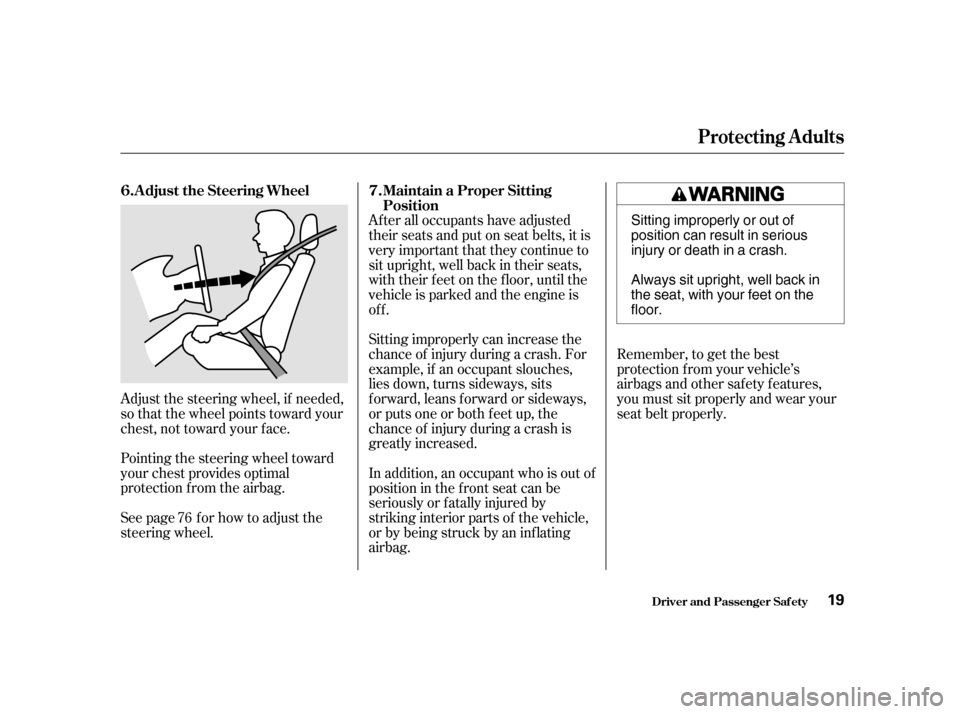
Adjust the steering wheel, if needed,
so that the wheel points toward your
chest, not toward your f ace.
Pointing the steering wheel toward
your chest provides optimal
protection f rom the airbag.
See page f or how to adjust the
steering wheel.Sitting improperly can increase the
chance of injury during a crash. For
example, if an occupant slouches,
lies down, turns sideways, sits
forward, leans forward or sideways,
or puts one or both f eet up, the
chance of injury during a crash is
greatly increased.
Remember, to get the best
protection f rom your vehicle’s
airbags and other safety features,
you must sit properly and wear your
seat belt properly.
After all occupants have adjusted
their seats and put on seat belts, it is
very important that they continue to
sit upright, well back in their seats,
with their feet on the floor, until the
vehicle is parked and the engine is
off.
In addition, an occupant who is out of
position in the f ront seat can be
seriously or f atally injured by
striking interior parts of the vehicle,
or by being struck by an inf lating
airbag.
76
Adjust the Steering Wheel Maintain a Proper Sitting
Position
6.
7.
Protecting Adults
Driver and Passenger Saf ety19
Sitting improperly or out of
position can result in serious
injury or death in a crash.
Always sit upright, well back in
the seat, with your feet on thefloor.
Page 21 of 363
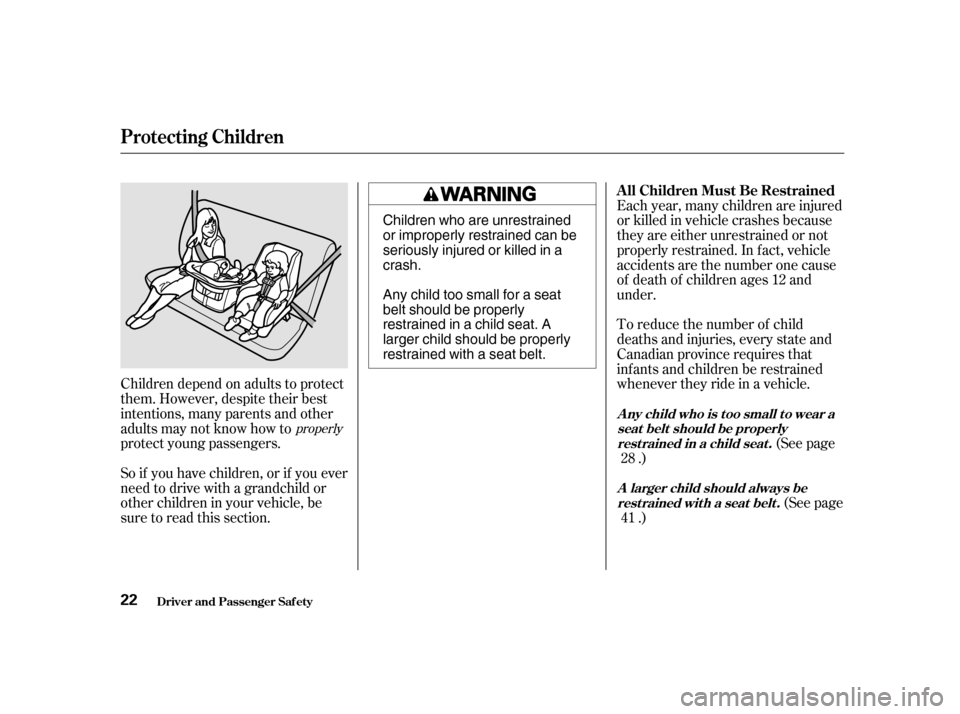
Children depend on adults to protect
them. However, despite their best
intentions, many parents and other
adults may not know how to
protect young passengers.(See page
.)
(See page
.)
So if you have children, or if you ever
need to drive with a grandchild or
other children in your vehicle, be
sure to read this section. To reduce the number of child
deaths and injuries, every state and
Canadian province requires that
inf ants and children be restrained
whenever they ride in a vehicle.
Each year, many children are injured
or killed in vehicle crashes because
they are either unrestrained or not
properly restrained. In f act, vehicle
accidents are the number one cause
of death of children ages 12 and
under.
2841
properly
All Children Must Be Restrained
Anychildwhoistoosmalltoweara seat belt should be properlyrest rained in a child seat .
A larger child should always berest rained wit h a seat belt .
Protecting Children
Driver and Passenger Saf ety
22 Children who are unrestrained
or improperly restrained can be
seriously injured or killed in acrash.
Any child too small for a seat
belt should be properly
restrained in a child seat. A
larger child should be properly
restrained with a seat belt.
Page 35 of 363
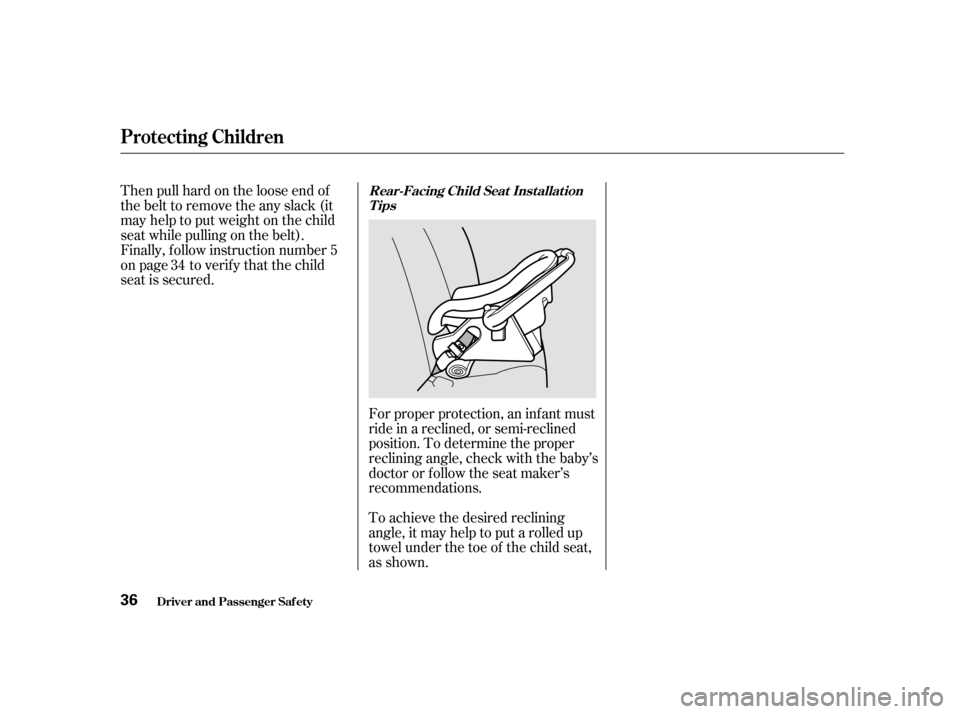
Forproperprotection,aninfantmust
ride in a reclined, or semi-reclined
position. To determine the proper
reclining angle, check with the baby’s
doctor or f ollow the seat maker’s
recommendations.
To achieve the desired reclining
angle, it may help to put a rolled up
towel under the toe of the child seat,
as shown.
Then pull hard on the loose end of
thebelttoremovetheanyslack(it
may help to put weight on the child
seat while pulling on the belt).
Finally, f ollow instruction number 5
on page to verify that the child
seat is secured.
34
Driver and Passenger Saf ety
Protecting Children
Rear-Facing Child Seat Inst allat ion Tips
36
Page 75 of 363
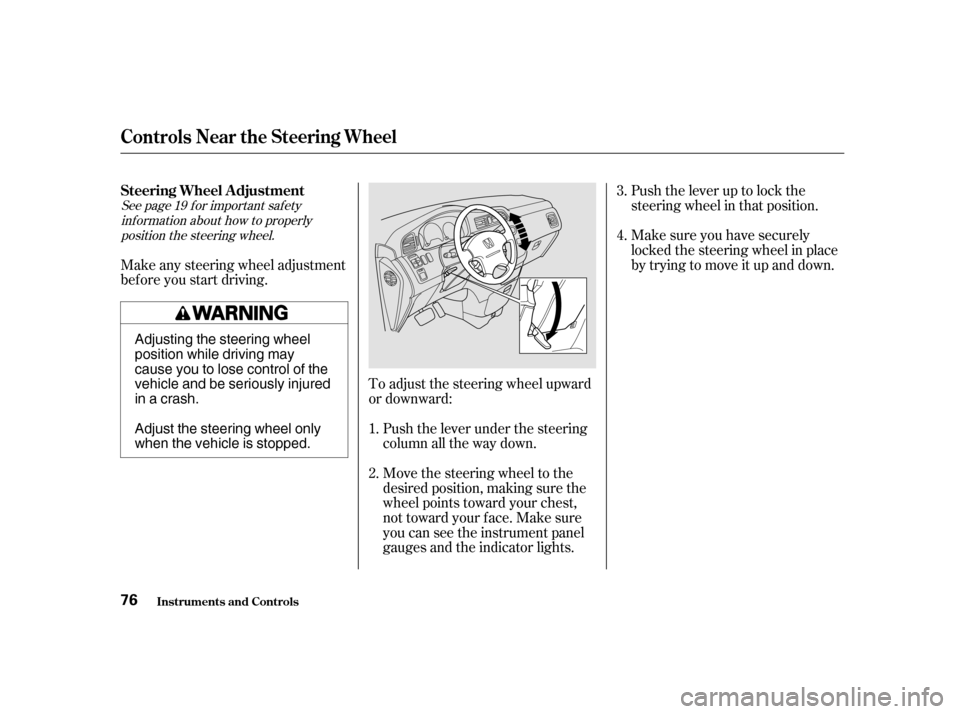
Push the lever up to lock the
steering wheel in that position.
Make sure you have securely
locked the steering wheel in place
by trying to move it up and down.
To adjust the steering wheel upward
or downward: Push the lever under the steering
column all the way down.
Move the steering wheel to the
desired position, making sure the
wheel points toward your chest,
not toward your f ace. Make sure
you can see the instrument panel
gauges and the indicator lights.
Make any steering wheel adjustment
bef ore you start driving.
3. 4.
1.2.
See page f or important saf ety inf ormation about how to properlyposition the steering wheel. 19
Controls Near the Steering Wheel
Inst rument s and Cont rols
Steering Wheel A djustment 76
Adjusting the steering wheel
position while driving may
cause you to lose control of the
vehicle and be seriously injured
inacrash.
Adjust the steering wheel only
when the vehicle is stopped.
Page 111 of 363
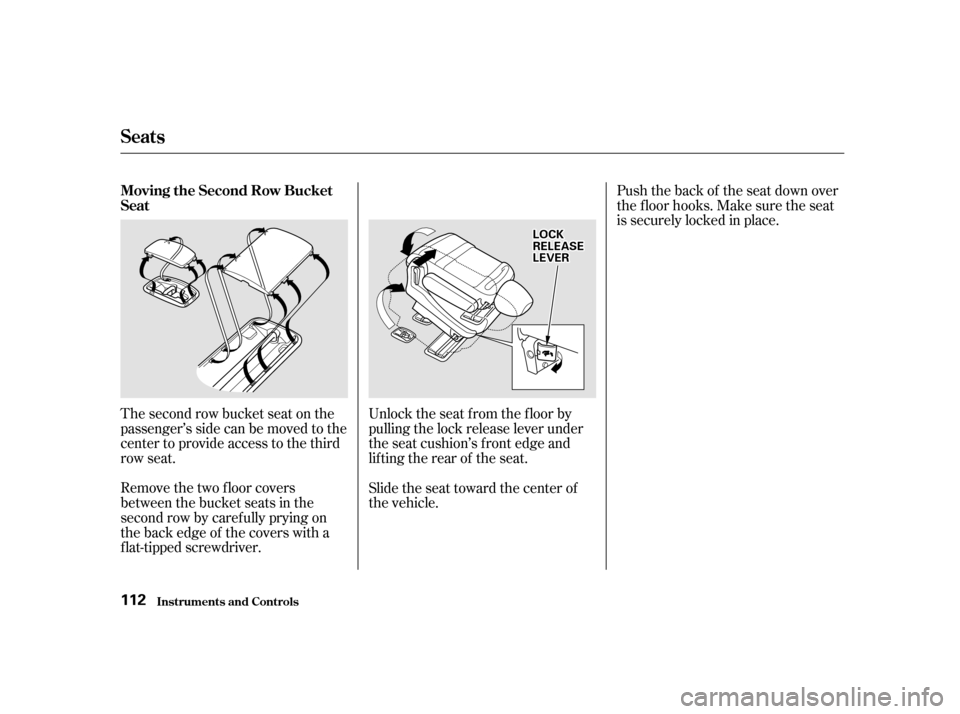
The second row bucket seat on the
passenger’s side can be moved to the
center to provide access to the third
row seat.
Remove the two floor covers
between the bucket seats in the
second row by caref ully prying on
the back edge of the covers with a
f lat-tipped screwdriver.Unlock the seat f rom the f loor by
pulling the lock release lever under
the seat cushion’s f ront edge and
lifting the rear of the seat.
Slide the seat toward the center of
the vehicle.Push the back of the seat down over
the f loor hooks. Make sure the seat
is securely locked in place.
Seats
Inst rument s and Cont rols
Moving the Second Row Bucket
Seat 112
LLOOCCKKRREELLEEAASSEELLEEVVEERR
Page 115 of 363
Make sure the center shoulder belt
is stored in the holder and the outer
shoulder belts are positioned on each
hook whenever the third seat is
f olded.
Make sure all items in the cargo area
are secured. Loose items can f ly
f orward and cause injury if you have
to brake hard. See
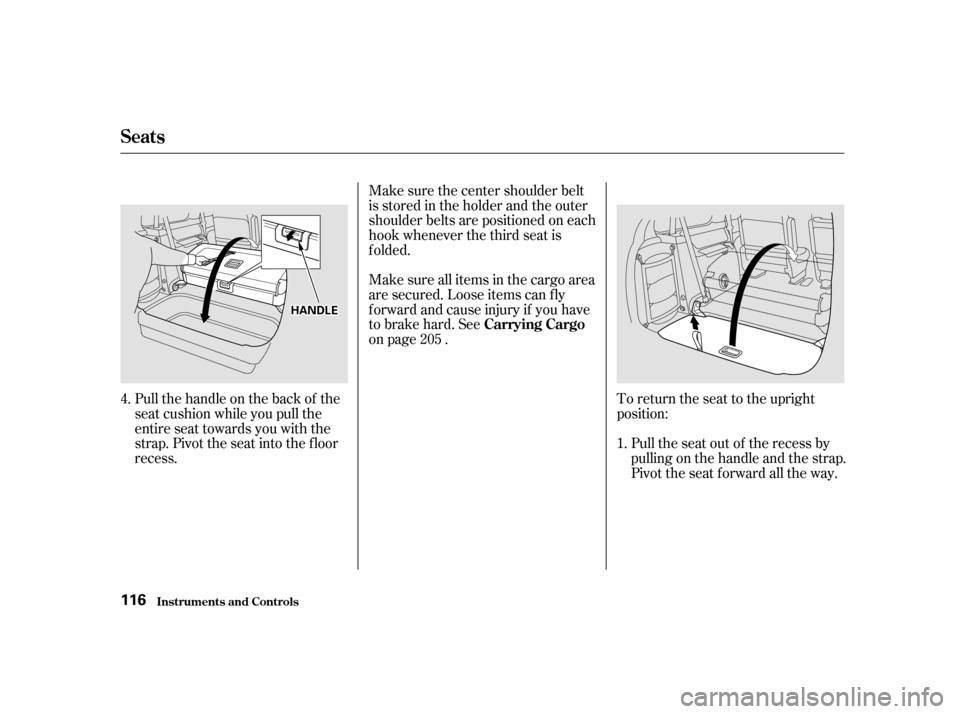
on page .To return the seat to the upright
position:Pull the seat out of the recess by
pullingonthehandleandthestrap.
Pivot the seat forward all the way.
Pull the handle on the back of the
seat cushion while you pull the
entire seat towards you with the
strap. Pivot the seat into the f loor
recess.
4.
1.
205
Carrying Cargo
Seats
Inst rument s and Cont rols
116
HHAANNDDLLEE
Page 126 of 363
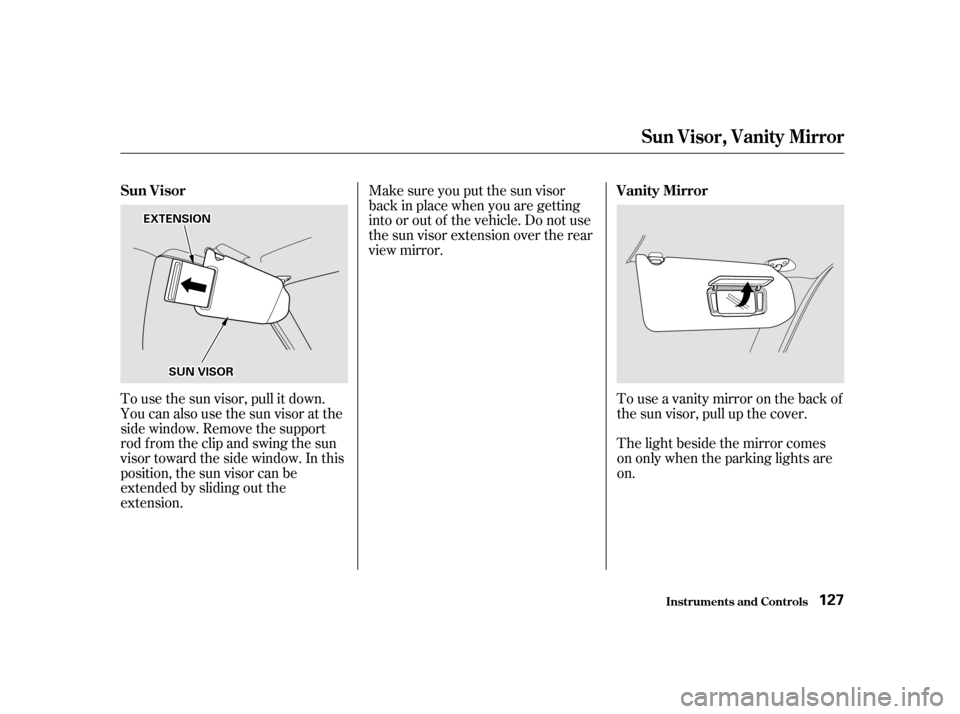
To use the sun visor, pull it down.
You can also use the sun visor at the
side window. Remove the support
rod f rom the clip and swing the sun
visor toward the side window. In this
position, the sun visor can be
extended by sliding out the
extension.Touseavanitymirroronthebackof
the sun visor, pull up the cover.
Make sure you put the sun visor
back in place when you are getting
into or out of the vehicle. Do not use
the sun visor extension over the rear
view mirror.
The light beside the mirror comes
on only when the parking lights areon.Inst rument s and Cont rols
Sun Visor, Vanit y Mirror
Sun Visor Vanity Mirror
127
SSUUNNVVIISSOORR
EEXXTTEENNSSIIOONN
Page 195 of 363

Help assure your vehicle’s f uture
reliability and perf ormance by paying
extra attention to how you drive
during the f irst 600 miles (1,000 km).
During this period:Avoid full-throttle starts and rapid
acceleration.
Avoidhardbraking.Newbrakes
need to be broken-in by moderate
use f or the f irst 200 miles (300
km). Your Honda is designed to operate
on unleaded gasoline with a pump
octane number of 86 or higher. Use
of a lower octane gasoline can cause
a persistent, heavy metallic rapping
noise in the engine that can lead to
mechanical damage.
Youshouldfollowthesesamere-
commendations with an overhauled
or exchanged engine, or when the
brakes are replaced.
We also recommend that you should
not tow a trailer during the f irst 500
miles (800 km).
We recommend gasolines containing
detergent additives that help prevent
f uel system and engine deposits.
Using gasoline containing lead will
damage your vehicle’s emissions
controls. This contributes to air
pollution.
Do not change the oil until the
recommended time or mileage
intervalshowninthemaintenance
schedule.
Break-in Period, Gasoline
Bef ore Driving
Break-in Period
Gasoline
196