2001 HONDA CR-V belt
[x] Cancel search: beltPage 37 of 326
Protectin
g Childre n
Additional Precautions for Infants Never
hold an infant on your lap.
I f yo u ar e no t wearin g a sea t bel t
i n a crash , yo u coul d b e throw n
forwar d int o th e dashboar d an d
crus h th e infant .
I f yo u ar e wearin g a sea t belt , th e
infan t ca n b e tor n fro m you r arm s
durin g a crash . Fo r example , i f
you r vehicl e crashe s int o a parke d
vehicl e a t 3 0 mp h (4 8 km/h) , a 20 -
I b ( 9 kg ) infan t wil l becom e a 600 -
I b (27 5 kg ) force , an d yo u wil l no t
b e abl e to hol d on .
Never
put a seat belt over yourself
and an infant. During a crash , th e
bel t coul d pres s dee p int o th e
infan t an d caus e ver y seriou s
injuries . Protectin
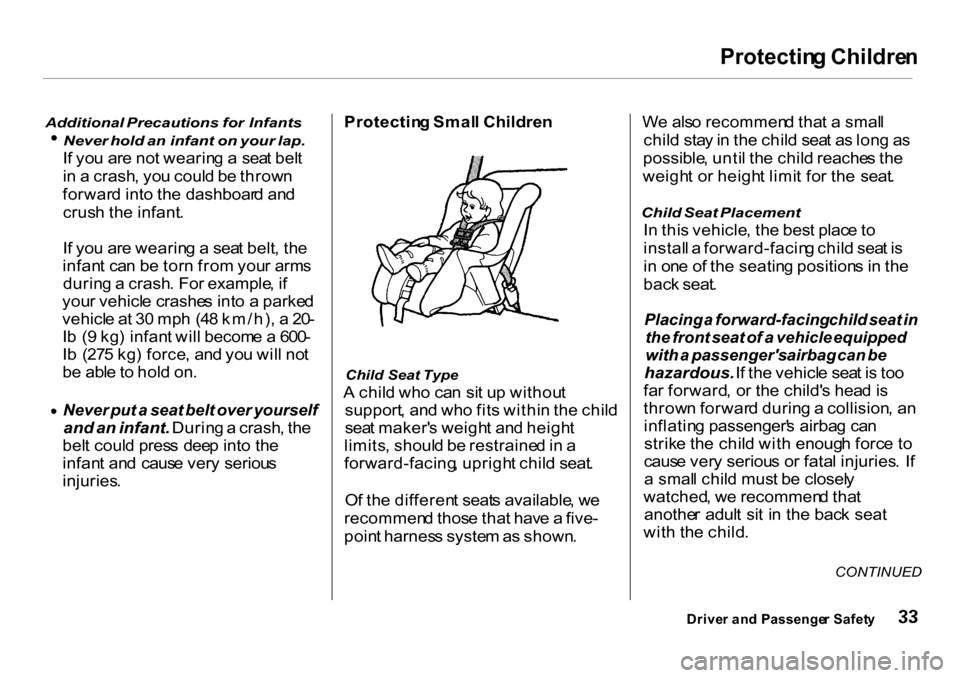
g Smal l Children
Child Seat Type
A chil d wh o ca n si t u p withou t
support , an d wh o fit s withi n th e chil d
sea t maker' s weigh t an d heigh t
limits , shoul d b e restraine d in a
forward-facing , uprigh t chil d seat .
O f th e differen t seat s available , w e
recommen d thos e tha t hav e a five -
poin t harnes s syste m as shown . W
e als o recommen d tha t a smal l
chil d sta y in th e chil d sea t a s lon g a s
possible , unti l th e chil d reache s th e
weigh t o r heigh t limi t fo r th e seat .
Child Seat Placement
I n thi s vehicle , th e bes t plac e to
instal l a forward-facin g chil d sea t i s
i n on e o f th e seatin g position s in th e
bac k seat .
Placing a forward-facing child seat in
the front seat of a vehicle equipped
with a passenger's airbag can be
hazardous. If th e vehicl e sea t i s to o
fa r forward , o r th e child' s hea d is
throw n forwar d durin g a collision , a n
inflatin g passenger' s airba g ca n
strik e th e chil d wit h enoug h forc e t o
caus e ver y seriou s o r fata l injuries . I f
a smal l chil d mus t b e closel y
watched , w e recommen d tha t
anothe r adul t si t i n th e bac k seat
wit h th e child .
Drive r an d Passenge r Safet y
CONTINUED
Page 38 of 326
Protectin
g Childre n
I f i t i s necessar y t o pu t a forward -
facin g chil d sea t i n th e front , move
th e vehicl e sea t a s fa r t o th e rea r a s
possible , b e sur e th e chil d seat is
firml y secure d to th e vehicle , an d
tha t th e chil d is properl y strapped in
th e seat .
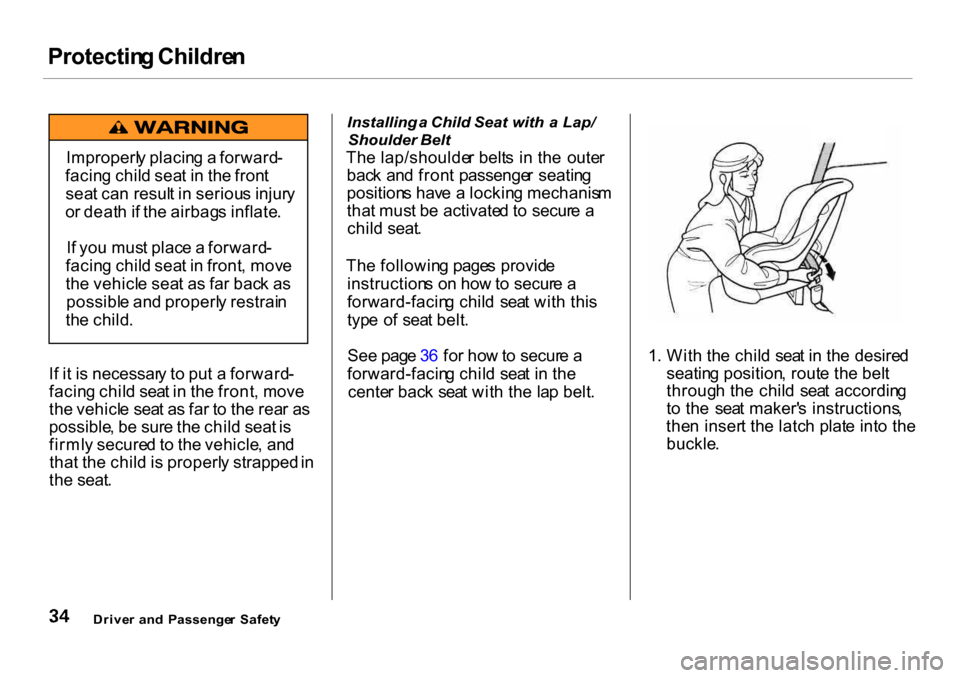
Installing
a Child Seat with a Lap/
Shoulder Belt
Th e lap/shoulde r belt s i n th e oute r
bac k an d fron t passenge r seatin g
position s hav e a lockin g mechanis m
tha t mus t b e activate d t o secur e a
chil d seat .
Th e followin g page s provid e
instruction s o n ho w to secur e a
forward-facin g chil d sea t wit h thi s
typ e o f sea t belt .
See pag e 3 6 fo r ho w to secur e a
forward-facin g chil d sea t i n th e
cente r bac k sea t wit h th e la p belt . 1
. Wit h th e chil d sea t i n th e desire dseating position , rout e th e bel t
throug h th e chil d sea t accordin g
t o th e sea t maker' s instructions ,
the n inser t th e latc h plat e int o th e
buckle .
Drive r an d
Passenge
r Safet y
Improperl
y placin g a forward -
facin g chil d sea t i n th e fron t
sea t ca n resul t i n seriou s injur y
o r deat h if th e airbag s inflate .
I f yo u mus t plac e a forward -
facin g chil d sea t i n front , mov e
th e vehicl e sea t a s fa r bac k a s
possibl e an d properl y restrai n
th e child .
Page 39 of 326
Protectin
g Childre n
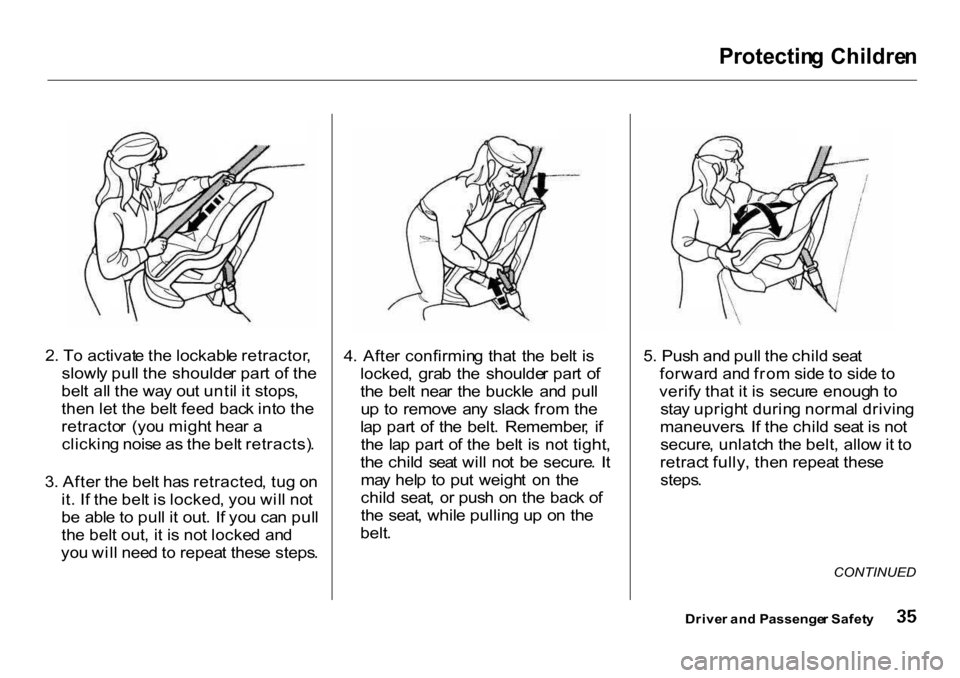
2 . T o activat e th e lockabl e retractor ,
slowl y pul l th e shoulde r par t o f th e
bel t al l th e wa y ou t unti l i t stops ,
the n le t th e bel t fee d bac k int o th e
retracto r (yo u migh t hea r a
clickin g nois e a s th e bel t retracts) .
3 . Afte r th e bel t ha s retracted , tu g o n
it . I f th e bel t i s locked , yo u wil l no t
b e abl e t o pul l i t out . I f yo u ca n pul l
th e bel t out , i t i s no t locke d an d
yo u wil l nee d to repea t thes e steps .4
. Afte r confirmin g tha t th e bel t i s
locked , gra b th e shoulde r par t o f
th e bel t nea r th e buckl e an d pul l
u p t o remov e an y slac k fro m th e
la p par t o f th e belt . Remember , i f
th e la p par t o f th e bel t i s no t tight ,
th e chil d sea t wil l no t b e secure . I t
ma y hel p t o pu t weigh t o n th e
chil d seat , o r pus h o n th e bac k o f
th e seat , whil e pullin g u p o n th e
belt . 5
. Pus h an d pul l th e chil d sea t
forwar d an d fro m sid e to sid e to
verif y tha t i t i s secur e enoug h t o
sta y uprigh t durin g norma l drivin g
maneuvers . I f th e chil d sea t i s no t
secure , unlatc h th e belt , allo w it t o
retrac t fully , the n repea t thes e
steps .
CONTINUED
Drive r an d Passenge r Safet y
Page 40 of 326
Protectin
g Childre n
T o deactivate the lockin g
mechanis m in orde r t o remov e a
chil d seat , unlatc h th e buckle ,
unrout e th e seat belt , an d le t th e bel t
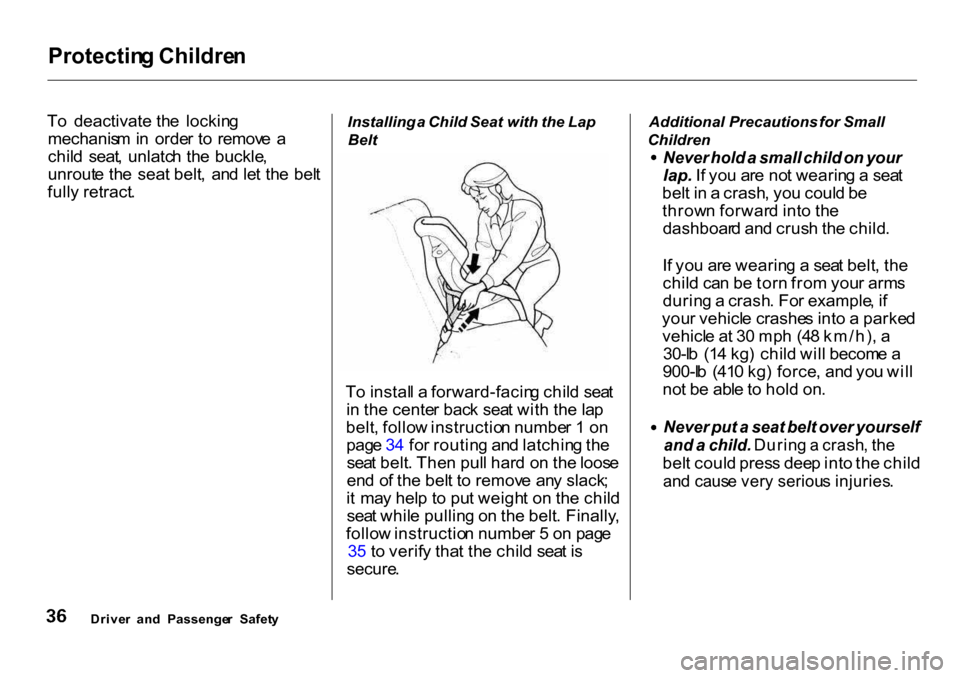
full y retract . Installing
a Child Seat with the Lap
Belt
T o instal l a forward-facin g chil d sea t
i n th e cente r bac k sea t wit h th e la p
belt , follo w instructio n numbe r 1 o n
pag e 3 4 fo r routin g an d latchin g th e
sea t belt . The n pul l har d o n th e loos e
en d o f th e bel t t o remov e an y slack ;
i t ma y hel p t o pu t weigh t o n th e chil d
sea t whil e pullin g o n th e belt . Finally ,
follo w instructio n numbe r 5 o n pag e
3 5 to verif y tha t th e chil d sea t i s
secure .
Additional
Precautions for Small
Children
Never hold a small child on your
lap. If yo u ar e no t wearin g a sea t
bel t i n a crash , yo u coul d b e
throw n forwar d int o th e
dashboar d an d crus h th e child .
I f yo u ar e wearin g a sea t belt , th e
chil d ca n b e tor n fro m you r arm s
durin g a crash . Fo r example , i f
you r vehicl e crashe s int o a parke d
vehicl e a t 3 0 mp h (4 8 km/h) , a
30-l b (1 4 kg ) chil d wil l becom e a
900-l b (41 0 kg ) force , an d yo u wil l
no t b e abl e to hol d on .
Never
put a seat belt over yourself
and a child. During a crash , th e
bel t coul d pres s dee p int o th e chil d
an d caus e ver y seriou s injuries .
Drive r an d Passenge r Safet y
Page 41 of 326
Protectin
g Childre n
Protectin g Large r Childre n
Whe n a chil d reache s th e
recommende d weigh t o r heigh t limi t
fo r a forward-facin g chil d seat , th e
chil d shoul d si t i n on e o f th e oute r
bac k seat s an d wea r a lap/shoulde r
belt . A lap/shoulde r bel t provide s
bette r protectio n tha n a la p belt .
I f a chil d is to o shor t fo r th e shoulde r
par t o f th e bel t t o properl y fit , w e
recommen d tha t th e chil d us e a
booste r sea t unti l th e chil d is tal l
enoug h t o us e th e sea t bel t withou t a
booster .
Th e followin g pages give
instruction s o n ho w to chec k prope r
sea t bel t fit , wha t kin d o f booste r
sea t t o us e if on e is needed , an d
importan t precaution s fo r a chil d
wh o mus t si t i n th e fron t seat .
Checking
Seat Belt Fit
T o determin e i f a lap/shoulde r bel t
properl y fit s a child , hav e th e chil d
pu t o n th e sea t belt . Follo w th e
instruction s o n pag e 1 5 . The n chec k
ho w th e bel t fits .
CONTINUED
Drive r an d Passenge r Safet y
Allowin
g a large r chil d to si t
improperl y in th e fron t sea t ca n
resul t i n injur y o r deat h if th e
airbag s inflate .
I f a large r chil d mus t si t i n front ,
mak e sur e th e chil d move s th e
sea t a s fa r bac k a s possibl e
an d wear s th e sea t bel t properly .
Page 42 of 326
Protectin
g Childre n
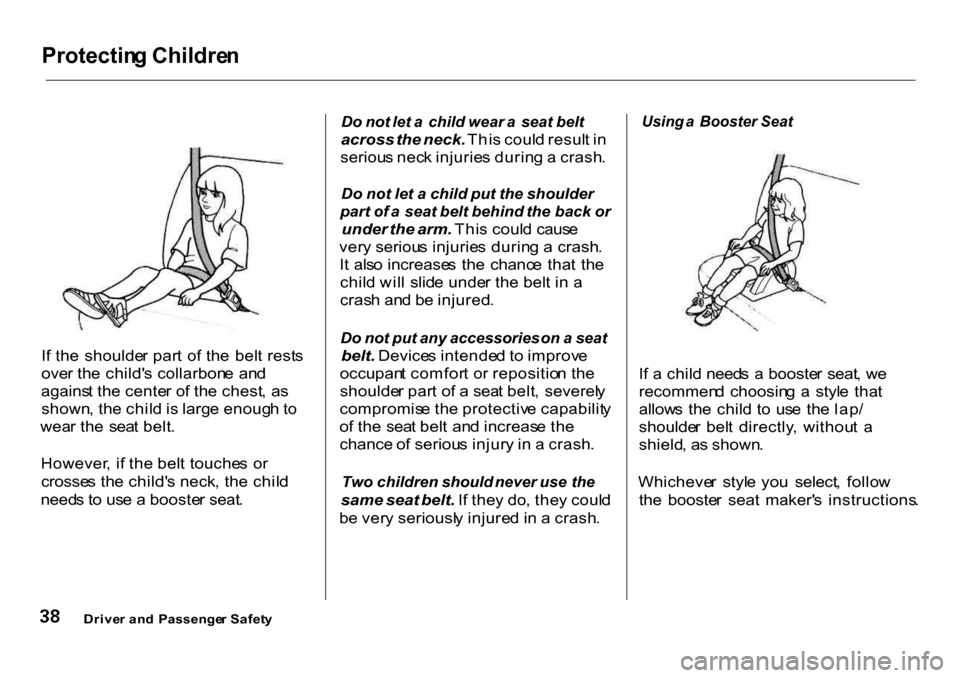
I f th e shoulde r par t o f th e bel t rest s
ove r th e child' s collarbon e an d
agains t th e cente r o f th e chest , a s
shown , th e chil d is larg e enoug h t o
wea r th e sea t belt .
However , i f th e bel t touche s o r
crosse s th e child' s neck , th e chil d
need s t o us e a booste r seat .
Do
not let a child wear a seat belt
across the neck. This coul d resul t i n
seriou s nec k injurie s durin g a crash .
Do not let a child put the shoulder
part of a seat belt behind the back or
under the arm. This coul d caus e
ver y seriou s injurie s durin g a crash .
I t als o increase s th e chanc e tha t th e
chil d wil l slid e unde r th e bel t i n a
cras h an d b e injured .
Do not put any accessories on a seat
belt. Device s intende d t o improv e
occupan t comfor t o r repositio n th e
shoulde r par t o f a sea t belt , severel y
compromis e th e protectiv e capabilit y
o f th e sea t bel t an d increas e th e
chance of seriou s injur y i n a crash .
Two children should never use the
same seat belt. If the y do , the y coul d
b e ver y seriousl y injure d in a crash .
Using
a Booster Seat
I f a chil d need s a booste r seat , w e
recommen d choosin g a styl e tha t
allow s th e chil d t o us e th e lap /
shoulde r bel t directly , withou t a
shield , a s shown .
Whicheve r styl e yo u select , follo w
th e booste r seat maker' s instructions .
Drive r an d Passenge r Safet y
Page 44 of 326

Protectin
g Childre n
I f yo u decid e tha t a chil d ca n safel y
rid e u p front , b e sur e to : Carefull
y rea d th e owner' s manua l
an d mak e sur e yo u understan d al l
sea t bel t instruction s an d al l safet y
information .
Mov e th e vehicl e sea t t o th e rear -
mos t position .Hav
e th e chil d si t u p straight , bac k
agains t th e seat , an d fee t o n o r
nea r th e floor .
Chec k tha t th e child' s sea t bel t i s
properl y positione d an d secured .
Supervis e th e child . Eve n matur e
childre n sometime s nee d to b e
reminde d to faste n th e sea t belt s
o r si t properly . Usin
g Chil d Seat s wit h Tether s
You r Hond a ha s thre e attachmen t
point s fo r securin g a tether-styl e
chil d sea t t o th e vehicle . Sinc
e a tethe r ca n provid e additiona l
security , w e recommen d usin g a
tethe r wheneve r on e is require d o r
available .
Drive r an d Passenge r Safet y
Page 46 of 326
Additiona
l Informatio n Abou t You r Sea t Belt s
Sea t Bel t Syste m Component s
You r sea t bel t syste m include s lap /
shoulde r belt s i n th e fron t seat s an d
th e oute r bac k seats , an d a la p bel t i n
th e cente r bac k seat .
Th e sea t bel t syste m als o
include s a ligh t o n th e
instrumen t pane l t o remin d yo u an d
you r passenger s t o faste n you r belts .
I f th e driver' s sea t bel t i s no t
fastene d befor e th e ignitio n i s turne d
O N (II) , th e ligh t wil l com e o n an d a
beepe r wil l als o sound . Th e beepe r
wil l sto p afte r a fe w seconds , bu t th e
ligh t wil l sta y o n unti l th e driver' s
sea t bel t i s fastened . Lap/Shoulde
r Bel t
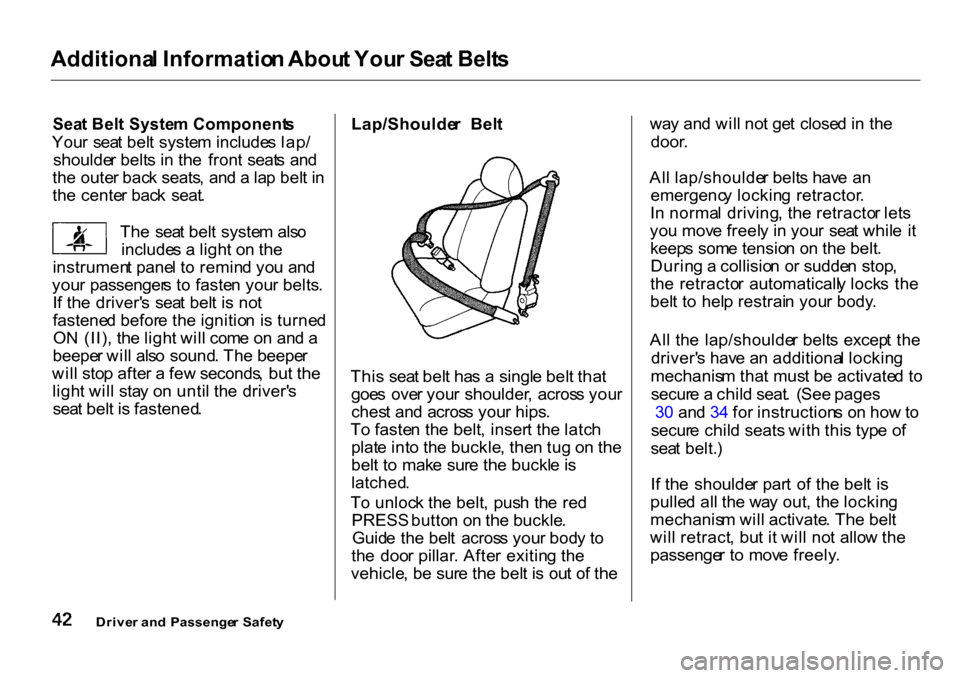
Thi s sea t bel t ha s a singl e bel t tha t
goe s ove r you r shoulder , acros s you r
ches t an d acros s you r hips .
T o faste n th e belt , inser t th e latc h
plat e int o th e buckle , the n tu g o n th e
bel t t o mak e sur e th e buckl e is
latched .
T o unloc k th e belt , pus h th e re d
PRESS button o n th e buckle .
Guid e th e bel t acros s you r bod y t o
th e doo r pillar . Afte r exitin g th e
vehicle , b e sur e th e bel t i s ou t o f th e wa
y an d wil l no t ge t close d in th e
door .
Al l lap/shoulde r belt s hav e a n
emergenc y lockin g retractor .
I n norma l driving , th e retracto r let s
yo u mov e freel y i n you r sea t whil e i t
keep s som e tensio n o n th e belt .
Durin g a collisio n o r sudde n stop ,
th e retracto r automaticall y lock s th e
bel t t o hel p restrai n you r body .
Al l th e lap/shoulde r belt s excep t th e
driver' s hav e a n additiona l lockin g
mechanis m tha t mus t b e activate d t o
secur e a chil d seat . ( See pages
3 0 an d 3 4 fo r instruction s o n ho w to
secur e chil d seats with thi s typ e o f
sea t belt. )
If th e shoulde r par t of the bel t is
pulle d al l th e wa y out , th e lockin g
mechanis m wil l activate . Th e bel t
wil l retract , bu t i t wil l no t allo w th e
passenge r t o mov e freely .
Drive r an d Passenge r Safet y