Page 278 of 319

�Î�Î
�Î�ÎSlow down by shif ting to a lower
gear, and pull to the side of the road
when it is saf e. Because of the
longer distance needed to stop, it is
hazardous to drive the car. You
should have it towed, and repaired as
soon as possible. (See
on page .)
If you must drive the car a short
distance in this condition, drive
slowly and cautiously.
If it comes on at any other time, it
indicates a problem with the car’s
brake system. In most cases, the
problem is a low f luid level in the
brake f luid reservoir. Press lightly on
the brake pedal to see if it f eels
normal. If it does, check the brake
f luid level the next time you stop at a
service station (see page ). If the
fluid level is low, take the car to your
dealer and have the brake system
inspected f or leaks or worn brake
pads.
However, if the brake pedal does not
f eel normal, you should take
immediate action. Because of the
brake system’s dual-circuit design, a
problem in one part of the system
will still give you braking at two
wheels. You will f eel the brake pedal
go down much f arther bef ore the car
begins to slow down, and you will
have to press harder on the pedal.
The distance needed to stop will be
much longer.
The Brake System Indicator
normallycomesonwhenyouturn
the ignition switch ON (II). It is a
reminder to check the parking brake.
It comes on and stays lit if you do not
f ully release the parking brake.
218
286Emergency
Towing
Brake System Indicator
T aking Care of t he Unexpect ed 279
UU..SS..iinnddiiccaattoorrsshhoowwnn
BBRRAAKKEESSYYSSTTEEMMIINNDDIICCAATTOORR
Page 281 of 319
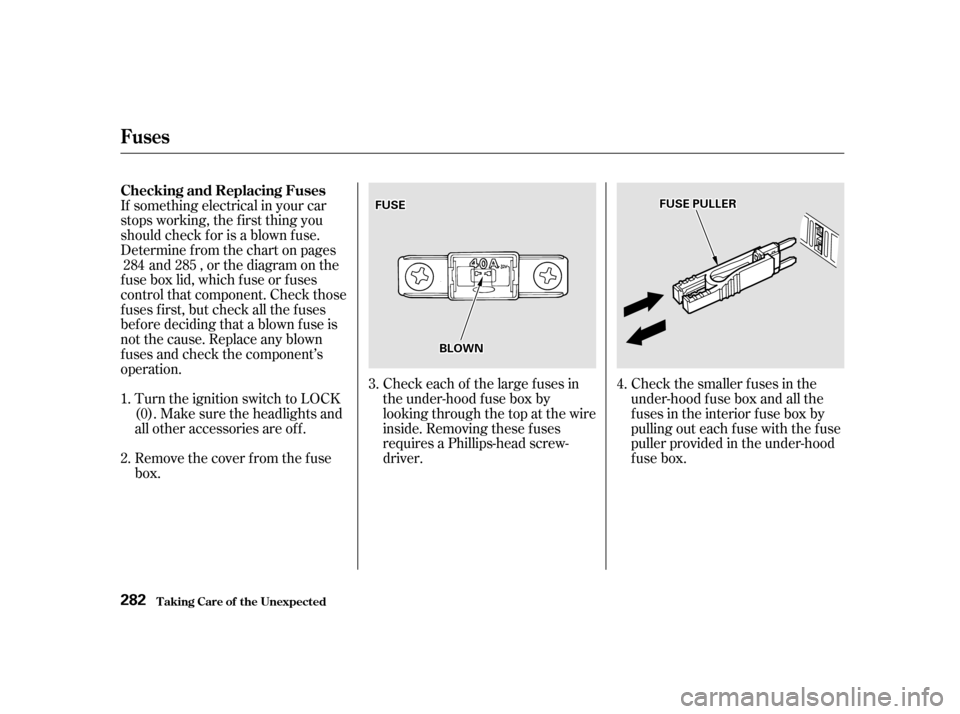
If something electrical in your car
stops working, the f irst thing you
should check f or is a blown f use.
Determine f rom the chart on pagesand , or the diagram on the
fuse box lid, which fuse or fuses
control that component. Check those
f uses f irst, but check all the f uses
bef ore deciding that a blown f use is
not the cause. Replace any blown
f uses and check the component’s
operation.
Turn the ignition switch to LOCK
(0). Make sure the headlights and
all other accessories are off.
Remove the cover f rom the f use
box. Check each of the large f uses in
the under-hood f use box by
looking through the top at the wire
inside. Removing these f uses
requires a Phillips-head screw-
driver.
Check the smaller f uses in the
under-hood f use box and all the
fuses in the interior fuse box by
pulling out each f use with the f use
puller provided in the under-hood
fuse box.
3.
1. 2. 4.
284 285
Checking and Replacing Fuses
Fuses
T aking Care of t he Unexpect ed
282
FFUUSSEE
BBLLOOWWNN
FFUUSSEEPPUULLLLEERR
Page 286 of 319
If you decide to tow your car with all
f our wheels on the ground, make
sure you use a properly-designed and
attached tow bar. Prepare the car for
towing as described above, and leave
the ignition switch in Accessory (I)
so the steering wheel does not lock.
Make sure the radio and any items
plugged into the accessory power
socket are turned of f so they do not
rundownthebattery.
With the f ront wheels on the ground,
it is best to tow the car no farther
than 50 miles (80 km), and keep the
speedbelow35mph(55km/h).
If your car is equipped with a f ront
spoiler, remove it bef ore towing so it
is not damaged.
Emergency T owing
T aking Care of t he Unexpect ed
287
Trying to lif t or tow your car by the
bumpers will cause serious damage.
The bumpers are not designed to
support the car’s weight.
The steering system can be damaged if
the steering wheel is locked. Leave the
ignition switch in Accessory (I), and
make sure the steering wheel turns
f reely bef ore you begin towing.
Page 295 of 319

Some conventional gasolines are
being blended with alcohol or an
ether compound. These gasolines
are collectively ref erred to as
oxygenated f uels. To meet clean air
standards, some areas of the United
States and Canada use oxygenated
f uels to help reduce emissions.
If you use an oxygenated f uel, be
sure it is unleaded and meets the
minimum octane rating requirement.
Bef ore using an oxygenated f uel, try
to conf irm the f uel’s contents. Some
states/provinces require this
informationtobepostedonthepump.If you notice any undesirable
operating symptoms, try another
service station or switch to another
brand of gasoline.
Fuel system damage or perf ormance
problems resulting f rom the use of
an oxygenated f uel containing more
than the percentages of oxygenates
given above are not covered under
warranty.
(ethyl or grain alcohol)
You may use gasoline containing up
to 10 percent ethanol by volume.
Gasoline containing ethanol may be
marketed under the name ‘‘Gasohol.’’
The f ollowing are the U.S. EPA and
Canadian CGSB approved
percentages of oxygenates:
(Methyl Tertiary Butyl
Ether)
You may use gasoline containing up
to 15 percent MTBE by volume.
(methyl or wood
alcohol)
Your vehicle was not designed to use
fuel that contains methanol.
Methanol can corrode metal parts in
the fuel system, and also damage
plastic and rubber components. This
damage would not be covered by
your warranties.
T echnical Inf ormation
Oxygenated Fuels
ET HA NOL
MT BE
MET HA NOL
296
Page 313 of 319

...............
Gas Mileage, Improving . 166
..........................................
Gasohol . 296
.........................................
Gasoline . 160
...............
Fuel Reserve Indicator . 63
...........................................
Gauge . 67
................
Octane Requirement . 160
........................
Tank, Filling the . 161
................
Gas Station Procedures . 161
Gauges
...
Engine Coolant Temperature . 68
...............................................
Fuel . 67
...............................
Speedometer . 66
.................................
Tachometer . 66
Gearshif t Lever Positions ..........
Automatic Transmission . 179
5-speed Manual
.........................
Transmission . 176
..............................
Glass Cleaning . 258
......................................
Glove Box . 100
.............
Halogen Headlight Bulbs . 243
..............
Hazard Warning Flashers . 74 Headlights
............
Daytime Running Lights . 71
..................
High Beam Indicator . 63
........................
Reminder Beeper . 70
........
Replacing Halogen Bulbs . 243
...................................
Turning on . 70
..............................
Head Restraints . 92
.....................
Heating and Cooling . 106
.............
High Altitude, Starting at . 175
.................
High-Low Beam Switch . 70
..............
High-mount Brake Light . 247
....................................
Hood Latch . 222
.......................
Hood, Opening the . 162
..................................................
Horn . 69
...........................
Hydraulic Clutch . 219
.................................
Hydroplaning . 189
........................
Jacking up the Car . 263
.......................................
Jack, Tire . 263
................................
Jump Starting . 270
..................................................
Keys . 79
...
Identif ication Number, Vehicle . 290
Ignition
..............................................
Keys . 79
...........................................
Switch . 82
............
Timing Control System . 299
.........
Important Safety Precautions . 6 Indicators, Instrument
.............................................
Panel . 59
...............................
Inf ant Restraint . 30
Inf ant Seats
.......................
Lower Anchorage . 42
..........
Tether Anchorage Points . 41
...................
Inf lation, Proper Tire . 234
..................
High Speed Driving . 235
.........................
Normal Driving . 235
...................................
Inside Mirror . 98
.............................
Inspection, Tire . 236
........................
Instrument Panel . 2, 58
........
Instrument Panel Brightness . 71
...........................
Interior Cleaning . 256
...............................
Interior Lights . 104
........................................
Introduction . i
Index
G H IJ
K
IV