Page 198 of 319

�µ�µ
�Ø �Ø �Ø �Ø�Ø�Ø �Ø �Ø�Ø�Ø�Ø�Ø �Ø �Ø�Ø�Ø�Ø�Ø�Ø�Ø �Ø
�Ì �Ì
�Î
CONT INUED
Maint enance199
U.S. Owners
Canadian Owners
AB C D EF
Service at the indicated distance or time, whichever comes first.
Refer to page to determine which schedule to use.Use the Maintenance Schedule for Severe Conditions.
Do items in A.
Do items in A, B.
Do items in A, E.
DoitemsinA,B,C.
Do items in A.
DoitemsinA,B,D,E.
Do items in A.
DoitemsinA,B,C.
DoitemsinA,E,F.
Do items in A, B.
Do items in A.Replace transmission fluid (MT, AT).
DoitemsinA,B,C,D,E.
Do items in A.
Do items in A, B.
Do items in A, E.
DoitemsinA,B,C.
Do items in A. Replace transmission fluid (AT).
DoitemsinA,B,D,E. Replace engine oil and filter.
Inspect front and rear brakes.
Rotate tires (follow pattern on page 237 ).
Lubricate all hinges, locks, and latches with
multipurpose grease.
Inspect tie rod ends, steering gear box and boots.
Inspect suspension components.
Inspect driveshaft boots.
Check parking brake adjustment.
Inspect brake hoses and lines (including ABS).
Check all fluid levels, condition of fluids, and check
for leaks.
Inspect cooling system hoses and connections.
Inspect exhaust system.
Inspect fuel lines and connections.
Check all lights.
Inspect the underbody.
Inspect and adjust drive belts.
Replace air conditioning filter .
Replace air cleaner element every 15,000 mi/
24,000 km (independent of time).
Replace brake fluid every 3 years (independent ofmileage).
5,000 mil/8,000 km/6 mos
10,000 mil/16,000 km/1 yr
15,000 mil/24,000 km/1-½ yrs
20,000 mil/32,000 km/1 yr
25,000 mil/40,000 km/2 yrs
30,000 mil/48,000 km/2 yrs
35,000 mil/56,000 km/2-½ yrs
40,000 mil/64,000 km/2 yrs
45,000 mil/72,000 km/3 yrs
50,000 mil/80,000 km/3 yrs
55,000 mil/88,000 km/3-½ yrs
60,000 mil/96,000 km/3 yrs
65,000 mil/104,000 km/4 yrs
70,000 mil/112,000 km/4 yrs
75,000 mil/120,000 km/4-½ yrs
80,000 mil/128,000 km/4 yrs
85,000 mil/136,000 km/5 yrs
90,000 mil/144,000 km/5 yrs
194
1
Maintenance Schedule for Severe Conditions (listed by distance/time)
Page 199 of 319

�Ø �Ø �Ø �Ø �Ø�Ø�Ì�Î �Ì �Î �Î �Ì
Maint enance
200 See timing belt on page to determine need for replacement.
Check engine oil and coolant at each fuel stop.
Check and adjust valve clearance, cold engine, only if noisy. See information on maintenance and emissions warranty, last
column, page .
See Air Conditioning Filter on page for replacement
information under special driving conditions.
NOTE: 1: 2:
: 231
233
195
95,000 mi/152,000 km/5-½ yrs
100,000 mi/160,000 km/5 yrs
105,000 mi/168,000 km/6 yrs
110,000 mi/176,000 km
110,000 mi/176,000 km/6 yrs
110,000 mi/176,000 km/7 yrs
115,000 mi/184,000 km/6-½ yrs
120,000 mi/192,000 km/6 yrs
120,000 mi/192,000 km/10 yrs Do items in A.
DoitemsinA,B,C.
DoitemsinA,E,F
Inspect valve clearance, cold engine.
Replace spark plugs.
Do items in A, B. Replace timing belt , inspect water pump.
Inspect idle speed.
Do items in A. Replace transmission fluid (MT, AT).
DoitemsinA,B,C,D,E. Replace engine coolant. 2
Maintenance Schedule for Severe Conditions (listed by distance/time)
Page 229 of 319
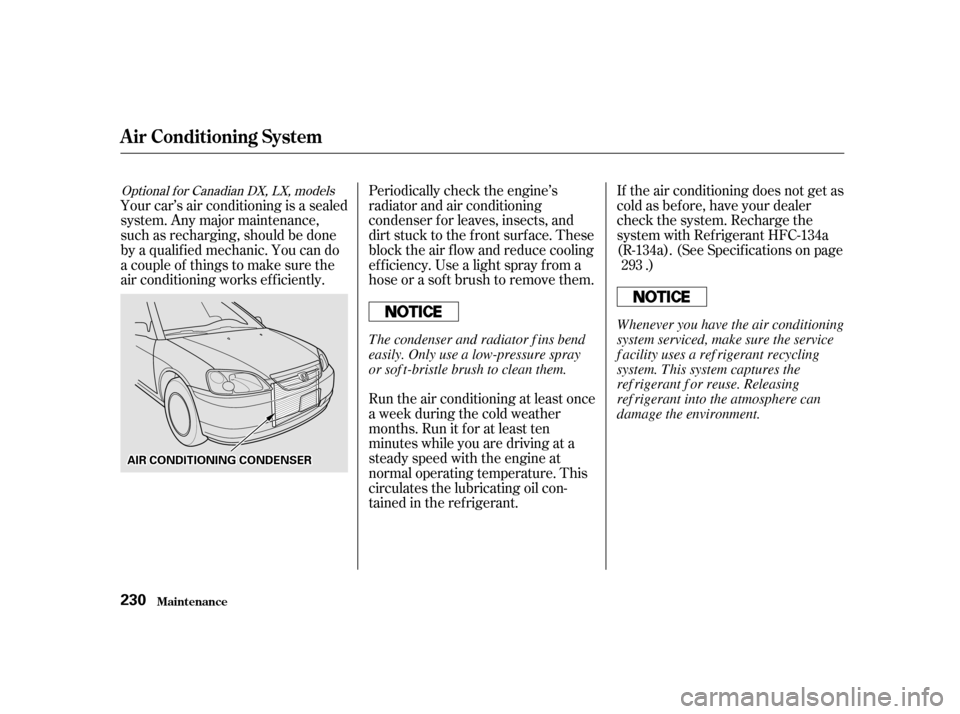
Periodically check the engine’s
radiator and air conditioning
condenser f or leaves, insects, and
dirt stuck to the f ront surf ace. These
block the air f low and reduce cooling
ef f iciency. Use a light spray f rom a
hose or a sof t brush to remove them.If the air conditioning does not get as
cold as before, have your dealer
check the system. Recharge the
system with Ref rigerant HFC-134a
(R-134a). (See Specif ications on page
.)
Run the air conditioning at least once
a week during the cold weather
months. Run it f or at least ten
minutes while you are driving at a
steady speed with the engine at
normal operating temperature. This
circulates the lubricating oil con-
tained in the ref rigerant.
Your car’s air conditioning is a sealed
system. Any major maintenance,
such as recharging, should be done
by a qualif ied mechanic. You can do
a couple of things to make sure the
air conditioning works ef f iciently.
293Optional for Canadian DX, LX, models
A ir Condit ioning Syst em
Maint enance
230
AAIIRRCCOONNDDIITTIIOONNIINNGGCCOONNDDEENNSSEERR Whenever you have the air conditioning
system serviced, make sure the service
f acility uses a ref rigerant recycling
system. This system captures the
ref rigerant f or reuse. Releasing
ref rigerant into the atmosphere can
damage the environment.
The condenser and radiator f ins bend
easily. Only use a low-pressure spray
or sof t-bristle brush to clean them.
Page 230 of 319
The air conditioning f ilter removes
pollen and dust that is brought in
f rom the outside through the heating
andcoolingsystem.To replace it:
This f ilter should be replaced every
30,000 miles (48,000 km) under
normal conditions. It should be
replaced every 15,000 miles (24,000
km) if you drive primarily in urban
areas that have high concentrations
of soot in the air f rom industry and
diesel-powered vehicles. Replace it
more of ten if air f low f rom the
heating and cooling system becomes
less than usual.
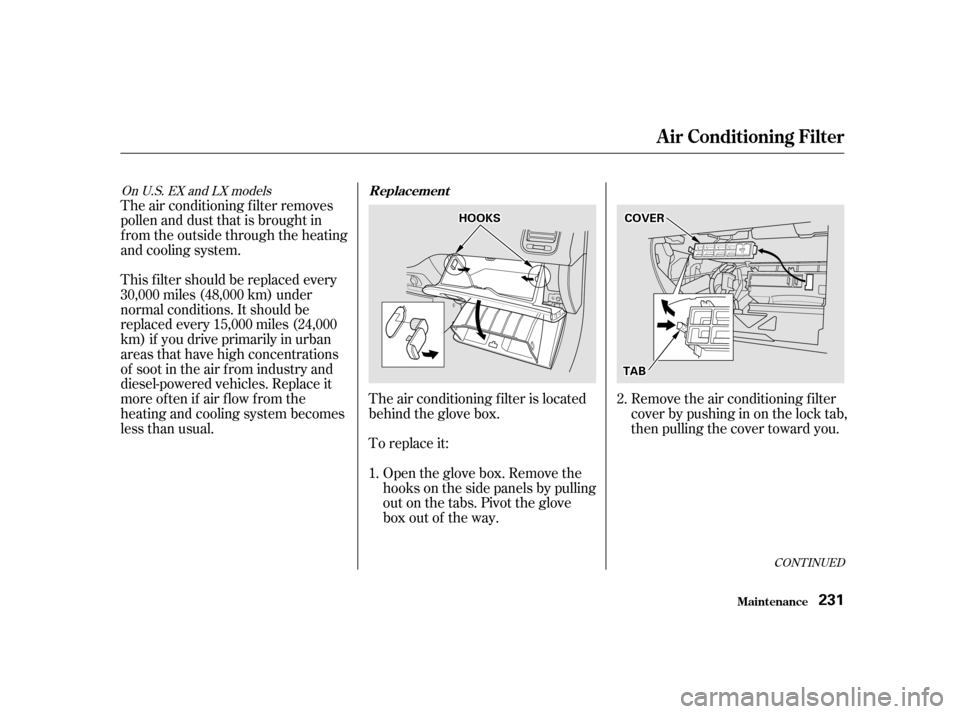
The air conditioning f ilter is located
behind the glove box.
Open the glove box. Remove the
hooks on the side panels by pulling
out on the tabs. Pivot the glove
box out of the way. Remove the air conditioning f ilter
cover by pushing in on the lock tab,
then pulling the cover toward you.
1. 2.
CONT INUED
On U.S. EX and LX models
Maint enance
Replacement
A ir Condit ioning Filt er
231
HHOOOOKKSS
TTAABB
CCOOVVEERR
Page 231 of 319
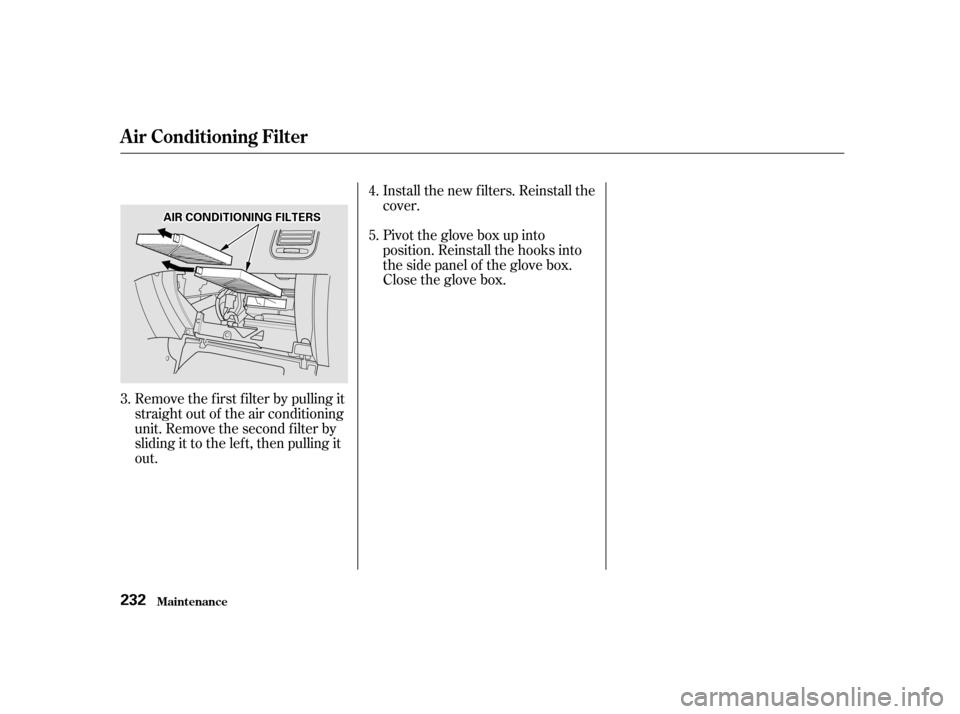
Remove the f irst f ilter by pulling it
straight out of the air conditioning
unit. Remove the second f ilter by
sliding it to the lef t, then pulling it
out.Install the new f ilters. Reinstall the
cover.
Pivot the glove box up into
position. Reinstall the hooks into
thesidepanelof theglovebox.
Close the glove box.
3. 4. 5.
Maint enance
A ir Condit ioning Filt er
232
AAIIRRCCOONNDDIITTIIOONNIINNGGFFIILLTTEERRSS
Page 233 of 319

We recommend that you visually
check your tires every day. If you
think a tire might be low, check it
immediately with a tire gauge.
To saf ely operate your car, your tires
must be the proper type and size, in
good condition with adequate tread,
and correctly inf lated. The f ollowing
pages give more detailed inf ormation
on how and when to check air
pressure, how to inspect your tires
for damage and wear, and what to do
when your tires need to be replaced.
Keeping the tires properly inf lated
provides the best combination of
handling, tread lif e and riding
comf ort. Underinf lated tires wear
unevenly, adversely af f ect handling
and f uel economy, and are more
likely to f ail f rom being overheated.
Overinf lated tires can make your car
ride more harshly, are more prone to
damage f rom road hazards, and wear
unevenly.
Use a gauge to measure the air
pressure at least once a month. Even
tires that are in good condition may
lose one to two psi (10 to 20 kPa, 0.1
to 0.2 kgf /cm ) per month.
Remember to check the spare tire at
thesametimeyoucheckallthe
other tires.Check the pressure in the tires when
they are cold. This means the car
has been parked f or at least three
hours. If you have to drive the car
bef ore checking the tire pressure,
the tires can still be considered
‘‘cold’’ if you drive less than 1 mile
(1.6 km).
If you check the pressure when the
tires are hot (the car has been driven
several miles), you will see readings
4 to 6 psi (30 to 40 kPa, 0.3 to 0.4
kgf /cm ) higher than the cold
reading. This is normal. Do not let
air out to match the specified cold
pressure. The tire will be
underinf lated.
Inf lation
Tires
Maint enance
234
Using tires that are excessively
worn or improperly inflated can
cause a crash in which you can
be seriously hurt or killed.
Follow all instructions in this
owner’s manual regarding tire
inflation and maintenance.
Page 235 of 319
Every time you check inf lation, you
should also examine the tires f or
damage, f oreign objects, and wear.
Youshouldlookfor:Bumps or bulges in the tread or
side of the tire. Replace the tire if
youfindeitherof theseconditions.
Excessive tread wear. In addition to proper inf lation,
correct wheel alignment helps to
decrease tire wear. If you f ind a tire
is worn unevenly, have your dealer
check the wheel alignment.
Cuts, splits, or cracks in the side
of the tire. Replace the tire if you
can see f abric or cord. The tires were properly balanced by
the factory. They may need to be
rebalanced at some time bef ore they
are worn out. Have your dealer
check the tires if you f eel a consis-
tent vibration while driving. A tire
should always be rebalanced if it is
removed f rom the wheel f or repair.
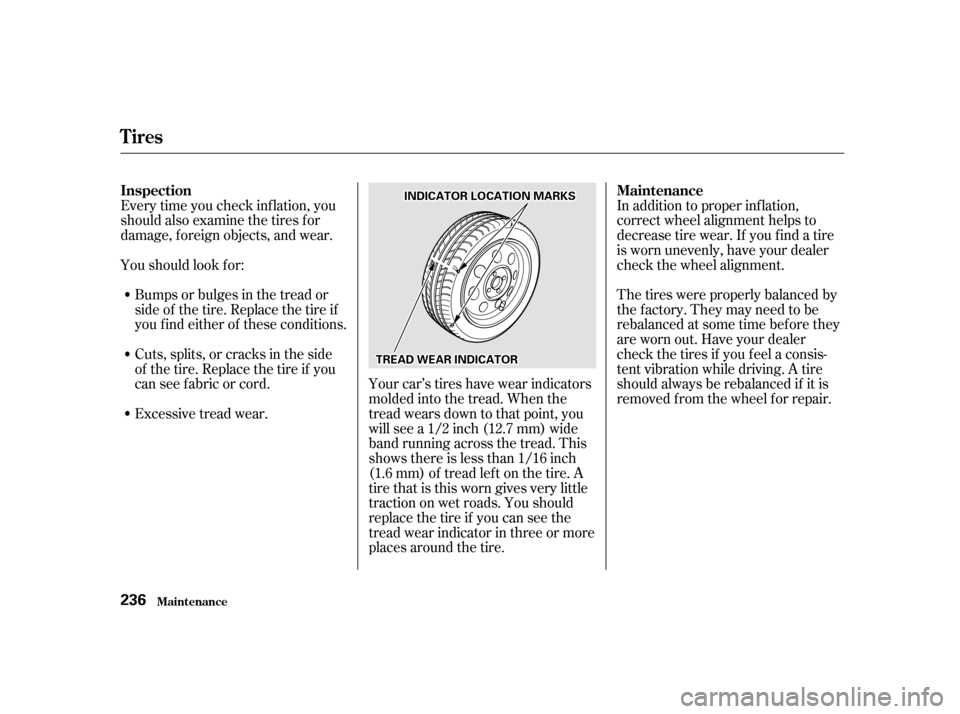
Your car’s tires have wear indicators
molded into the tread. When the
tread wears down to that point, you
will see a 1/2 inch (12.7 mm) wide
band running across the tread. This
shows there is less than 1/16 inch
(1.6 mm) of tread lef t on the tire. A
tire that is this worn gives very little
traction on wet roads. You should
replace the tire if you can see the
tread wear indicator in three or more
places around the tire.
Inspection
Maintenance
Tires
Maint enance
236
IINNDDIICCAATTOORRLLOOCCAATTIIOONNMMAARRKKSS
TTRREEAADDWWEEAARRIINNDDIICCAATTOORR
Page 278 of 319

�Î�Î
�Î�ÎSlow down by shif ting to a lower
gear, and pull to the side of the road
when it is saf e. Because of the
longer distance needed to stop, it is
hazardous to drive the car. You
should have it towed, and repaired as
soon as possible. (See
on page .)
If you must drive the car a short
distance in this condition, drive
slowly and cautiously.
If it comes on at any other time, it
indicates a problem with the car’s
brake system. In most cases, the
problem is a low f luid level in the
brake f luid reservoir. Press lightly on
the brake pedal to see if it f eels
normal. If it does, check the brake
f luid level the next time you stop at a
service station (see page ). If the
fluid level is low, take the car to your
dealer and have the brake system
inspected f or leaks or worn brake
pads.
However, if the brake pedal does not
f eel normal, you should take
immediate action. Because of the
brake system’s dual-circuit design, a
problem in one part of the system
will still give you braking at two
wheels. You will f eel the brake pedal
go down much f arther bef ore the car
begins to slow down, and you will
have to press harder on the pedal.
The distance needed to stop will be
much longer.
The Brake System Indicator
normallycomesonwhenyouturn
the ignition switch ON (II). It is a
reminder to check the parking brake.
It comes on and stays lit if you do not
f ully release the parking brake.
218
286Emergency
Towing
Brake System Indicator
T aking Care of t he Unexpect ed 279
UU..SS..iinnddiiccaattoorrsshhoowwnn
BBRRAAKKEESSYYSSTTEEMMIINNDDIICCAATTOORR