Page 106 of 394
2-19
Engine Coolant Heater (If Equipped)
In very cold weather,
0�F (
-18�C) or
colder, the engine
coolant heater can
help. You'll get easier
starting and better fuel
economy during
engine warm
-up.
Usually, the coolant heater should be plugged in a
minimum of four hours prior to starting your vehicle.
To Use the Engine Coolant Heater
1. Turn off the engine.
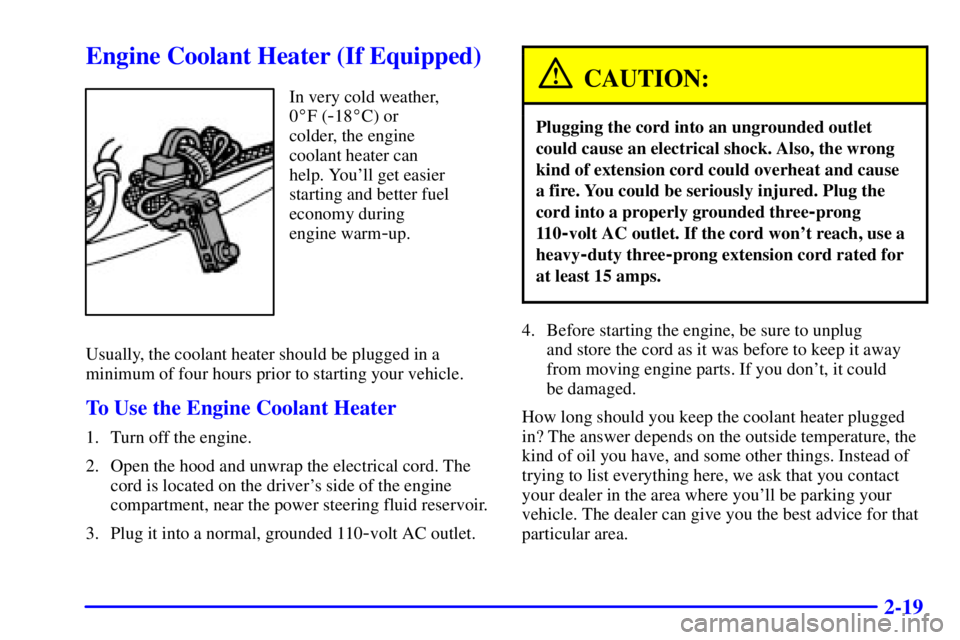
2. Open the hood and unwrap the electrical cord. The
cord is located on the driver's side of the engine
compartment, near the power steering fluid reservoir.
3. Plug it into a normal, grounded 110
-volt AC outlet.
CAUTION:
Plugging the cord into an ungrounded outlet
could cause an electrical shock. Also, the wrong
kind of extension cord could overheat and cause
a fire. You could be seriously injured. Plug the
cord into a properly grounded three
-prong
11 0
-volt AC outlet. If the cord won't reach, use a
heavy
-duty three-prong extension cord rated for
at least 15 amps.
4. Before starting the engine, be sure to unplug
and store the cord as it was before to keep it away
from moving engine parts. If you don't, it could
be damaged.
How long should you keep the coolant heater plugged
in? The answer depends on the outside temperature, the
kind of oil you have, and some other things. Instead of
trying to list everything here, we ask that you contact
your dealer in the area where you'll be parking your
vehicle. The dealer can give you the best advice for that
particular area.
Page 117 of 394
2-30
Locking Rear Axle
Your locking rear axle can give you additional traction
on snow, mud, ice, sand or gravel. It works like a
standard axle most of the time, but when one of the rear
wheels has no traction and the other does, this feature
will allow the wheel with traction to move the vehicle.
All-Wheel Drive
With this feature, engine power is sent to all four wheels
when extra traction is needed.
This is like four
-wheel drive, but there is no separate
lever or switch to engage or disengage the front axle.
It is fully automatic, and adjusts itself as needed for
road conditions.
Horn
To sound the horn, press the center pad on the
steering wheel.
Tilt Wheel
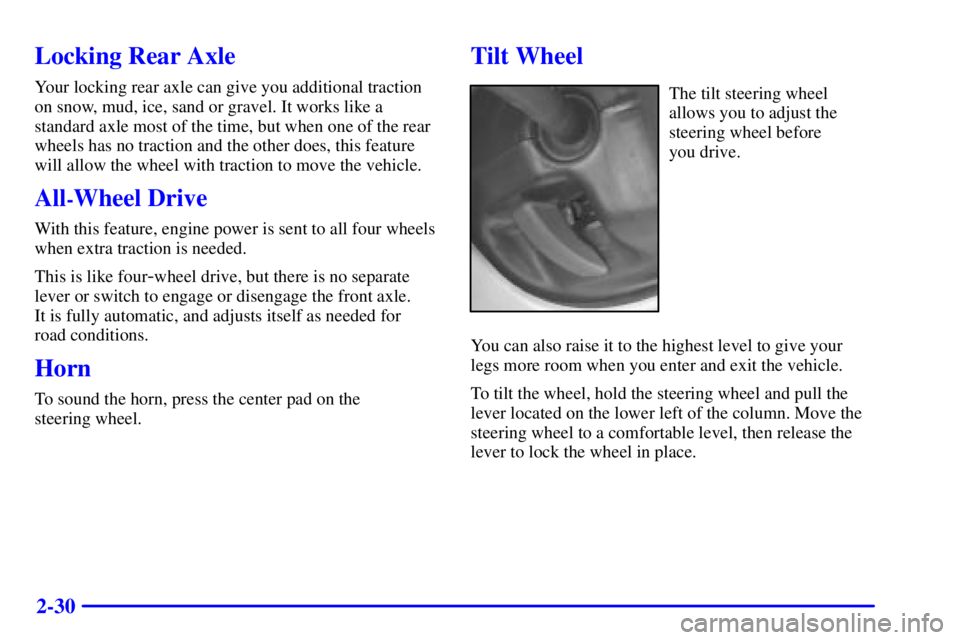
The tilt steering wheel
allows you to adjust the
steering wheel before
you drive.
You can also raise it to the highest level to give your
legs more room when you enter and exit the vehicle.
To tilt the wheel, hold the steering wheel and pull the
lever located on the lower left of the column. Move the
steering wheel to a comfortable level, then release the
lever to lock the wheel in place.
Page 150 of 394
2-63
The main components of your instrument panel are the following:
A. Dome Lamp Override Switch
B. Lamp Controls
C. Air Outlets
D. Storage Compartment
E. Multifunction Lever
F. Instrument Panel Cluster
G. Shift Lever
H. Tow/Haul Switch
I. Audio System
J. Comfort Control System
K. Instrument Panel Fuse BlockL. Hood Release
M. Audio Steering Wheel Controls
N. Center Instrument Panel Utility Block
O. Tilt Lever
P. Parking Brake Release
Q. Secondary Information Center (SIC)
R. Rear Window Defogger Switch
S. Compact Disc Changer
T. Ashtray
U. Accessory Power Outlet
V. Glovebox
Page 210 of 394

4-9
Remember: Anti-lock doesn't change the time you need
to get your foot up to the brake pedal or always decrease
stopping distance. If you get too close to the vehicle in
front of you, you won't have time to apply your brakes
if that vehicle suddenly slows or stops. Always leave
enough room up ahead to stop, even though you have
anti
-lock brakes.
Using Anti
-Lock
Don't pump the brakes. Just hold the brake pedal down
firmly and let anti
-lock work for you. You may feel the
brakes vibrate, or you may notice some noise, but this
is normal.
Braking in Emergencies
With anti-lock, you can steer and brake at the same
time. In many emergencies, steering can help you more
than even the very best braking.
Steering
Power Steering
If you lose power steering assist because the engine
stops or the system is not functioning, you can steer
but it will take much more effort.
Speed-Sensitive Steering
This system varies the amount of steering effort
proportionate to your vehicle speed. Steering is easier
at lower speeds for maneuvering and parking ease.
As your vehicle speed increases, the steering effort
also increases. At highway speeds, the amount of
steering effort is increased.
Steering Tips
Driving on Curves
It's important to take curves at a reasonable speed.
A lot of the ªdriver lost controlº accidents mentioned
on the news happen on curves. Here's why:
Experienced driver or beginner, each of us is subject to
the same laws of physics when driving on curves. The
traction of the tires against the road surface makes it
possible for the vehicle to change its path when you turn
the front wheels. If there's no traction, inertia will keep
the vehicle going in the same direction. If you've ever
tried to steer a vehicle on wet ice, you'll understand this.
The traction you can get in a curve depends on the
condition of your tires and the road surface, the angle
at which the curve is banked, and your speed.
While you're in a curve, speed is the one factor you
can control.
Page 221 of 394
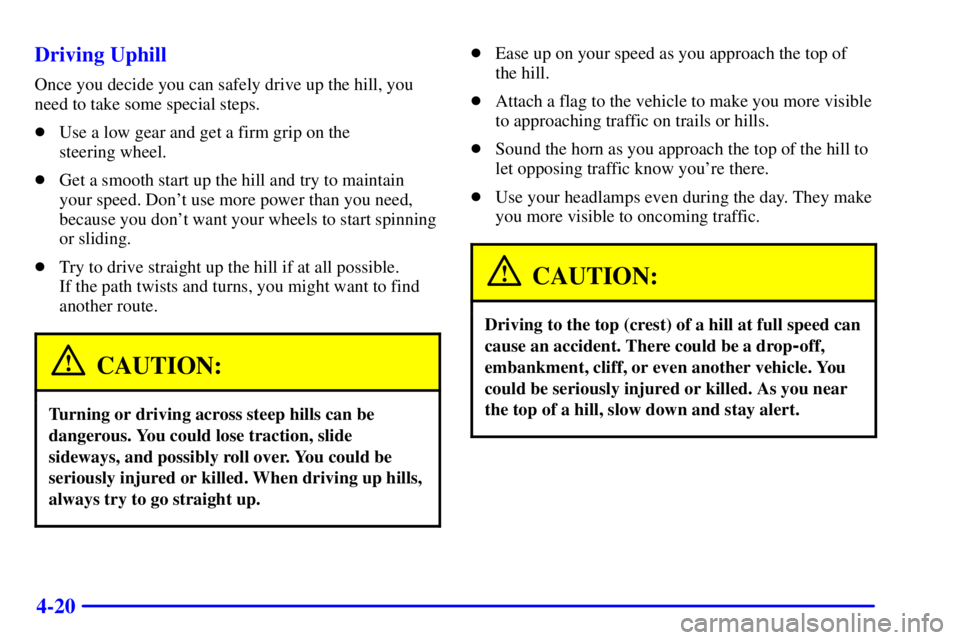
4-20 Driving Uphill
Once you decide you can safely drive up the hill, you
need to take some special steps.
�Use a low gear and get a firm grip on the
steering wheel.
�Get a smooth start up the hill and try to maintain
your speed. Don't use more power than you need,
because you don't want your wheels to start spinning
or sliding.
�Try to drive straight up the hill if at all possible.
If the path twists and turns, you might want to find
another route.
CAUTION:
Turning or driving across steep hills can be
dangerous. You could lose traction, slide
sideways, and possibly roll over. You could be
seriously injured or killed. When driving up hills,
always try to go straight up.
�Ease up on your speed as you approach the top of
the hill.
�Attach a flag to the vehicle to make you more visible
to approaching traffic on trails or hills.
�Sound the horn as you approach the top of the hill to
let opposing traffic know you're there.
�Use your headlamps even during the day. They make
you more visible to oncoming traffic.
CAUTION:
Driving to the top (crest) of a hill at full speed can
cause an accident. There could be a drop
-off,
embankment, cliff, or even another vehicle. You
could be seriously injured or killed. As you near
the top of a hill, slow down and stay alert.
Page 289 of 394

6-
6-1
Section 6 Service and Appearance Care
Here you will find information about the care of your vehicle. This section begins with service and fuel information,
and then it shows how to check important fluid and lubricant levels. There is also technical information about your
vehicle, and a part devoted to its appearance care.
6
-2 Service
6
-3 Fuel
6
-5 Fuels in Foreign Countries
6
-5 Filling Your Tank
6
-7 Filling a Portable Fuel Container
6
-8 Checking Things Under the Hood
6
-10 Engine Oil
6
-15 Engine Air Cleaner/Filter
6
-17 Passenger Compartment Air Filter
6
-17 Automatic Transmission Fluid
6
-21 Rear Axle
6
-21 All-Wheel Drive
6
-24 Engine Coolant
6
-27 Coolant Surge Tank Pressure Cap
6
-28 Power Steering Fluid6
-29 Windshield Washer Fluid
6
-30 Brakes
6
-34 Battery
6
-35 Bulb Replacement
6
-39 Windshield Wiper Blade Replacement
6
-40 Tires
6
-48 Appearance Care
6
-49 Cleaning the Inside of Your Vehicle
6
-52 Cleaning the Outside of Your Vehicle
6
-56 GM Vehicle Care/Appearance Materials
6
-57 Vehicle Identification Number (VIN)
6
-58 Electrical System
6
-66 Replacement Bulbs
6
-66 Capacities and Specifications
6
-67 Normal Maintenance Replacement Parts
Page 297 of 394
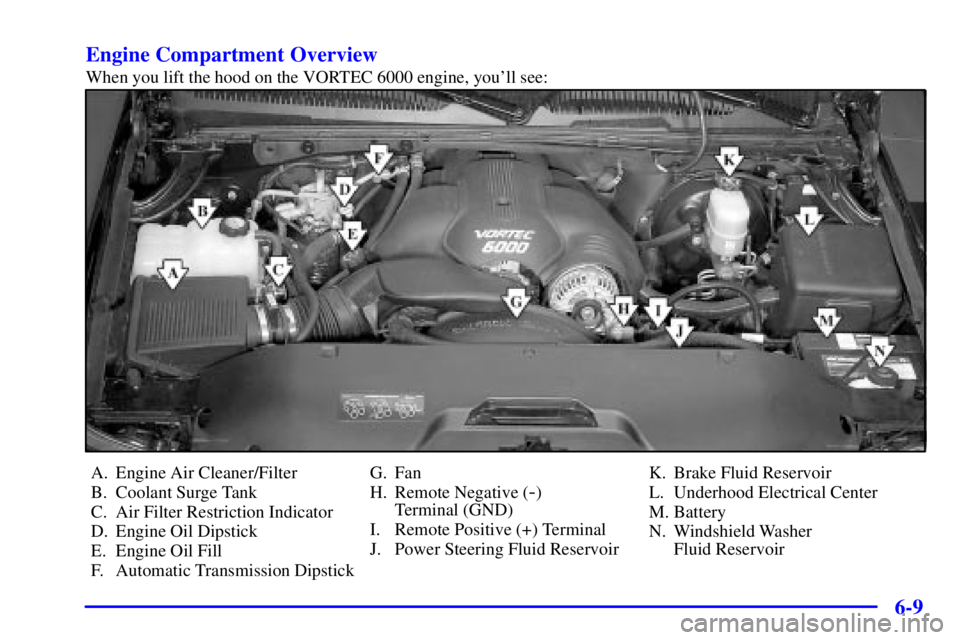
6-9 Engine Compartment Overview
When you lift the hood on the VORTEC 6000 engine, you'll see:
A. Engine Air Cleaner/Filter
B. Coolant Surge Tank
C. Air Filter Restriction Indicator
D. Engine Oil Dipstick
E. Engine Oil Fill
F. Automatic Transmission DipstickG. Fan
H. Remote Negative (
-)
Terminal (GND)
I. Remote Positive (+) Terminal
J. Power Steering Fluid ReservoirK. Brake Fluid Reservoir
L. Underhood Electrical Center
M. Battery
N. Windshield Washer
Fluid Reservoir
Page 316 of 394
6-28
Power Steering FluidWhen to Check Power Steering Fluid
It is not necessary to regularly check power steering
fluid unless you suspect there is a leak in the system or
you hear an unusual noise. A fluid loss in this system
could indicate a problem. Have the system inspected
and repaired.
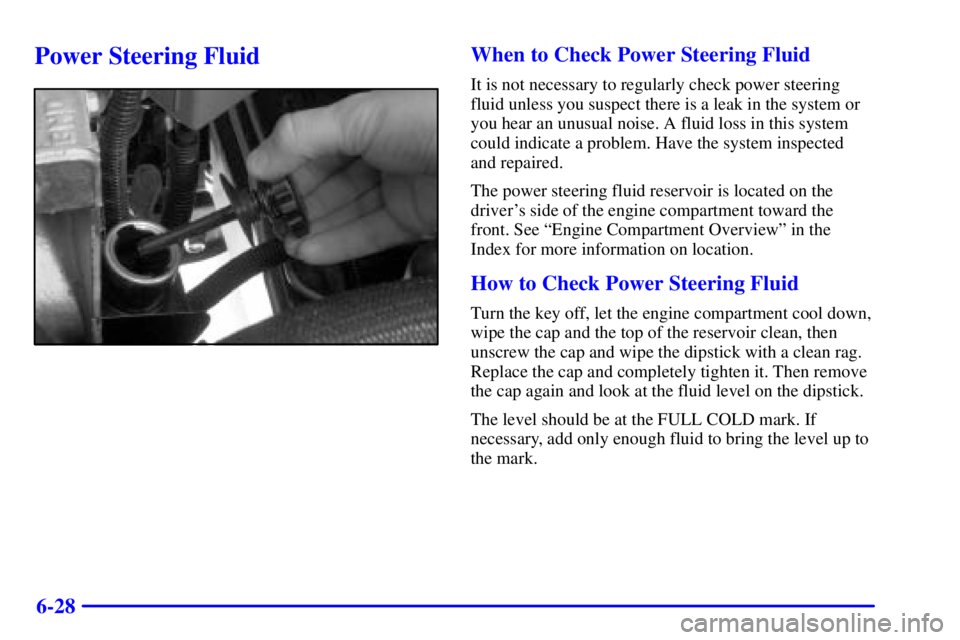
The power steering fluid reservoir is located on the
driver's side of the engine compartment toward the
front. See ªEngine Compartment Overviewº in the
Index for more information on location.
How to Check Power Steering Fluid
Turn the key off, let the engine compartment cool down,
wipe the cap and the top of the reservoir clean, then
unscrew the cap and wipe the dipstick with a clean rag.
Replace the cap and completely tighten it. Then remove
the cap again and look at the fluid level on the dipstick.
The level should be at the FULL COLD mark. If
necessary, add only enough fluid to bring the level up to
the mark.