Page 262 of 394
5-8
2. Disconnect the black negative (-) cable from
the negative (
-) terminal on the vehicle with the
good battery.
3. Disconnect the red positive (+) cable from the
vehicle with the good battery.
4. Disconnect the red positive (+) cable from the
other vehicle.
Towing Your Vehicle
Consult your dealer or a professional towing service if
you need to have your vehicle towed. See ªRoadside
Assistanceº and ªRecreational Vehicle Towingº in
the Index.
Engine Overheating
You will find a coolant temperature gage on your
vehicle's instrument panel. See ªEngine Coolant
Temperature Gageº in the Index. In addition, you will
find a LOW COOLANT, CHECK COOLANT TEMP,
ENGINE OVERHEATED and a REDUCED ENGINE
POWER message in the message center on the
instrument panel. See ªMessage Centerº in the Index.
Overheated Engine Protection
Operating Mode
Should an overheated engine condition exist and the
REDUCED ENGINE POWER message is displayed, an
overheat protection mode which alternates firing groups
of cylinders helps prevent engine damage. In this mode,
you will notice a loss in power and engine performance.
This operating mode allows your vehicle to be driven to
a safe place in an emergency. Towing a trailer in the
overheat protection mode should be avoided.
NOTICE:
After driving in the overheated engine protection
operating mode, to avoid engine damage, allow
the engine to cool before attempting any repair.
The engine oil will be severely degraded. Repair
the cause of coolant loss, change the oil and reset
the oil life system. Repair the cause of coolant
loss and change the oil. See ªEngine Oilº in
the Index.
Page 263 of 394
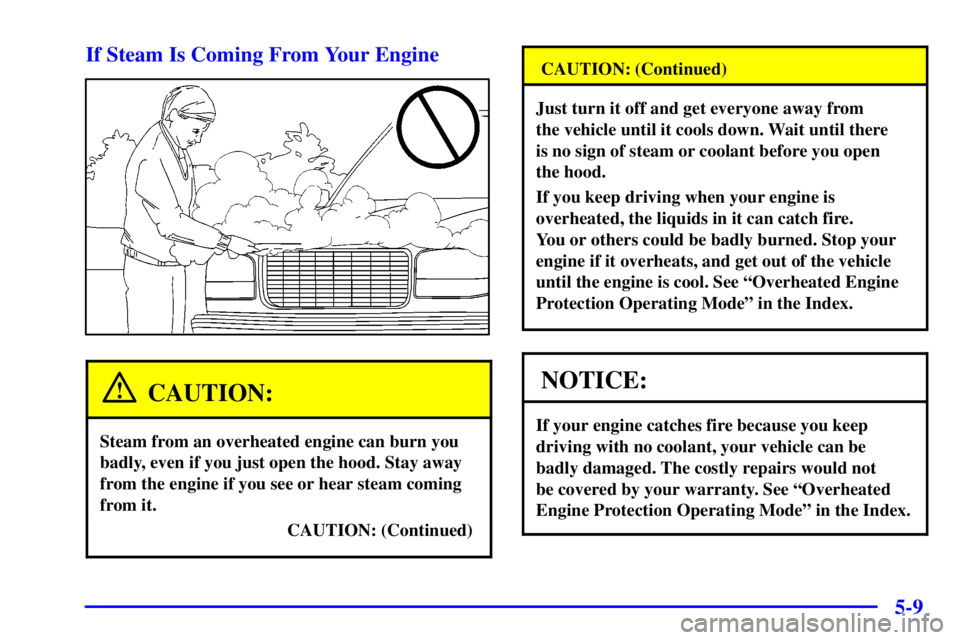
5-9 If Steam Is Coming From Your Engine
CAUTION:
Steam from an overheated engine can burn you
badly, even if you just open the hood. Stay away
from the engine if you see or hear steam coming
from it.
CAUTION: (Continued)
CAUTION: (Continued)
Just turn it off and get everyone away from
the vehicle until it cools down. Wait until there
is no sign of steam or coolant before you open
the hood.
If you keep driving when your engine is
overheated, the liquids in it can catch fire.
You or others could be badly burned. Stop your
engine if it overheats, and get out of the vehicle
until the engine is cool. See ªOverheated Engine
Protection Operating Modeº in the Index.
NOTICE:
If your engine catches fire because you keep
driving with no coolant, your vehicle can be
badly damaged. The costly repairs would not
be covered by your warranty. See ªOverheated
Engine Protection Operating Modeº in the Index.
Page 265 of 394
5-11
Cooling System
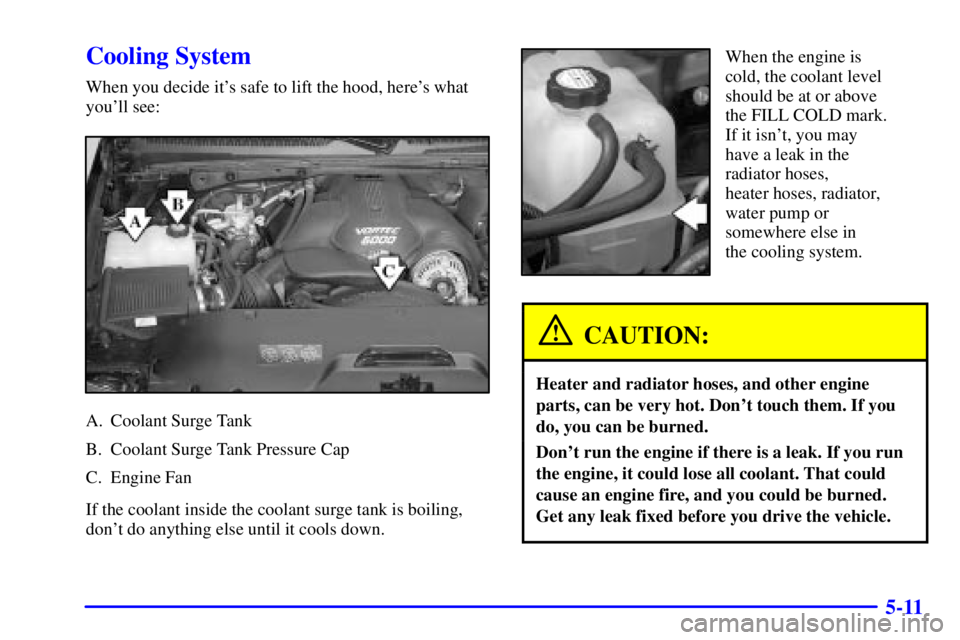
When you decide it's safe to lift the hood, here's what
you'll see:
A. Coolant Surge Tank
B. Coolant Surge Tank Pressure Cap
C. Engine Fan
If the coolant inside the coolant surge tank is boiling,
don't do anything else until it cools down.
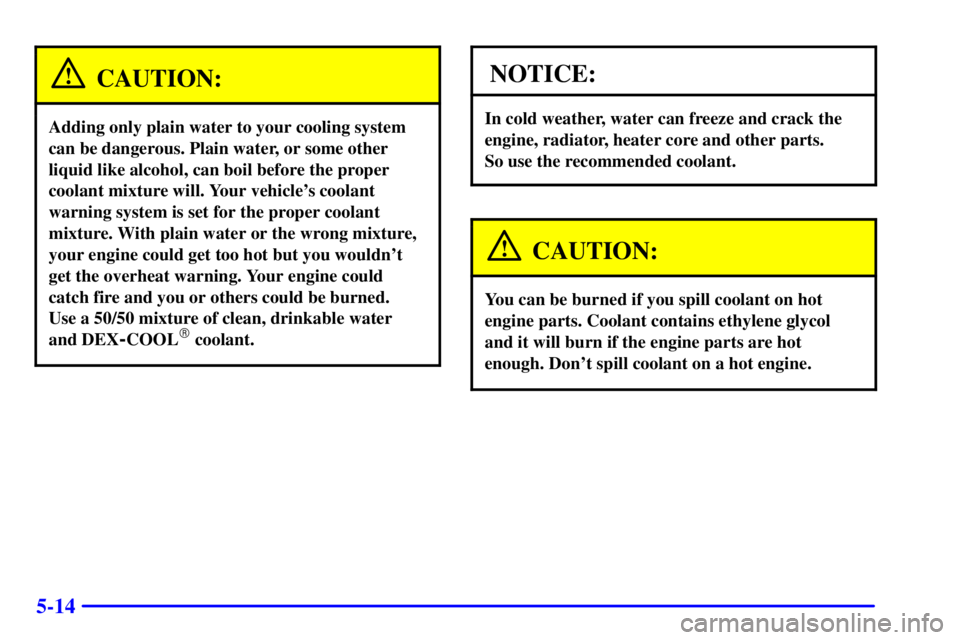
When the engine is
cold, the coolant level
should be at or above
the FILL COLD mark.
If it isn't, you may
have a leak in the
radiator hoses,
heater hoses, radiator,
water pump or
somewhere else in
the cooling system.
CAUTION:
Heater and radiator hoses, and other engine
parts, can be very hot. Don't touch them. If you
do, you can be burned.
Don't run the engine if there is a leak. If you run
the engine, it could lose all coolant. That could
cause an engine fire, and you could be burned.
Get any leak fixed before you drive the vehicle.
Page 266 of 394
5-12
NOTICE:
Engine damage from running your engine
without coolant isn't covered by your warranty.
See ªOverheated Engine Protection Operating
Modeº in the Index.
NOTICE:
When adding coolant, it is important that you
use only DEX
-COOL� (silicate-free) coolant.
If coolant other than DEX-COOL is added to
the system, premature engine, heater core or
radiator corrosion may result. In addition, the
engine coolant will require change sooner
-- at
30,000 miles (50 000 km) or 24 months,
whichever occurs first. Damage caused by the
use of coolant other than DEX
-COOL� is not
covered by your new vehicle warranty.
If there seems to be no leak, start the engine again.
See if the engine cooling fan speed increases when idle
speed is doubled by pushing the accelerator pedal down.
If it doesn't, your vehicle needs service. Turn off
the engine.
How to Add Coolant to the Coolant
Surge Tank
If you haven't found a problem yet, but the
coolant level isn't at or above the FILL COLD mark,
add a 50/50 mixture of clean, drinkable water and
DEX
-COOL� coolant at the coolant surge tank,
but be sure the cooling system, including the
coolant surge tank pressure cap, is cool before you
do it. See ªEngine Coolantº in the Index for
more information.
Page 268 of 394
5-14
CAUTION:
Adding only plain water to your cooling system
can be dangerous. Plain water, or some other
liquid like alcohol, can boil before the proper
coolant mixture will. Your vehicle's coolant
warning system is set for the proper coolant
mixture. With plain water or the wrong mixture,
your engine could get too hot but you wouldn't
get the overheat warning. Your engine could
catch fire and you or others could be burned.
Use a 50/50 mixture of clean, drinkable water
and DEX
-COOL� coolant.
NOTICE:
In cold weather, water can freeze and crack the
engine, radiator, heater core and other parts.
So use the recommended coolant.
CAUTION:
You can be burned if you spill coolant on hot
engine parts. Coolant contains ethylene glycol
and it will burn if the engine parts are hot
enough. Don't spill coolant on a hot engine.
Page 270 of 394
5-16
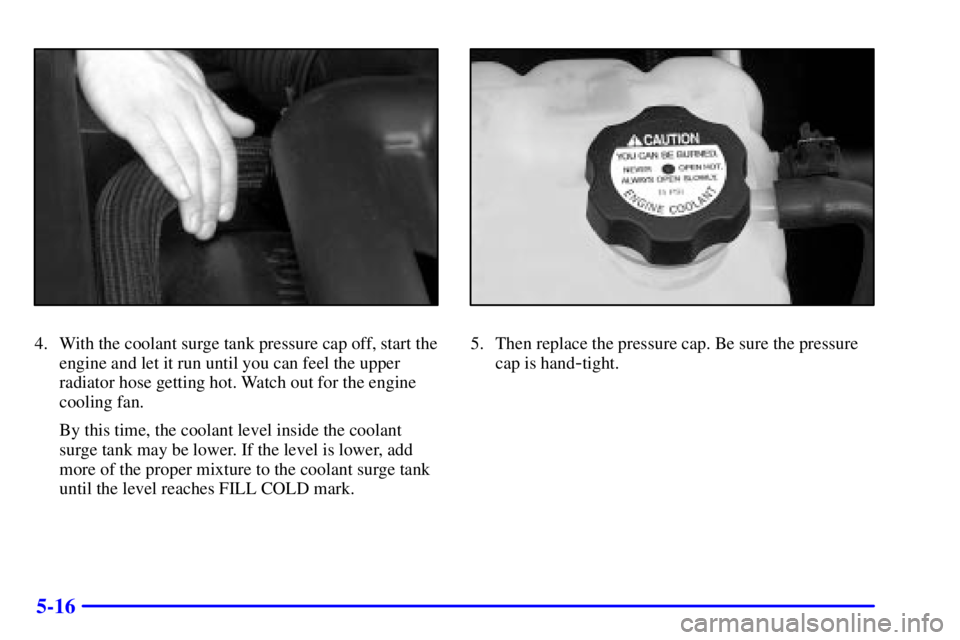
4. With the coolant surge tank pressure cap off, start the
engine and let it run until you can feel the upper
radiator hose getting hot. Watch out for the engine
cooling fan.
By this time, the coolant level inside the coolant
surge tank may be lower. If the level is lower, add
more of the proper mixture to the coolant surge tank
until the level reaches FILL COLD mark.5. Then replace the pressure cap. Be sure the pressure
cap is hand
-tight.
Page 289 of 394

6-
6-1
Section 6 Service and Appearance Care
Here you will find information about the care of your vehicle. This section begins with service and fuel information,
and then it shows how to check important fluid and lubricant levels. There is also technical information about your
vehicle, and a part devoted to its appearance care.
6
-2 Service
6
-3 Fuel
6
-5 Fuels in Foreign Countries
6
-5 Filling Your Tank
6
-7 Filling a Portable Fuel Container
6
-8 Checking Things Under the Hood
6
-10 Engine Oil
6
-15 Engine Air Cleaner/Filter
6
-17 Passenger Compartment Air Filter
6
-17 Automatic Transmission Fluid
6
-21 Rear Axle
6
-21 All-Wheel Drive
6
-24 Engine Coolant
6
-27 Coolant Surge Tank Pressure Cap
6
-28 Power Steering Fluid6
-29 Windshield Washer Fluid
6
-30 Brakes
6
-34 Battery
6
-35 Bulb Replacement
6
-39 Windshield Wiper Blade Replacement
6
-40 Tires
6
-48 Appearance Care
6
-49 Cleaning the Inside of Your Vehicle
6
-52 Cleaning the Outside of Your Vehicle
6
-56 GM Vehicle Care/Appearance Materials
6
-57 Vehicle Identification Number (VIN)
6
-58 Electrical System
6
-66 Replacement Bulbs
6
-66 Capacities and Specifications
6
-67 Normal Maintenance Replacement Parts
Page 296 of 394
6-8
Checking Things Under the Hood
CAUTION:
Things that burn can get on hot engine parts and
start a fire. These include liquids like fuel, oil,
coolant, brake fluid, windshield washer and other
fluids, and plastic or rubber. You or others could
be burned. Be careful not to drop or spill things
that will burn onto a hot engine.
Hood Release
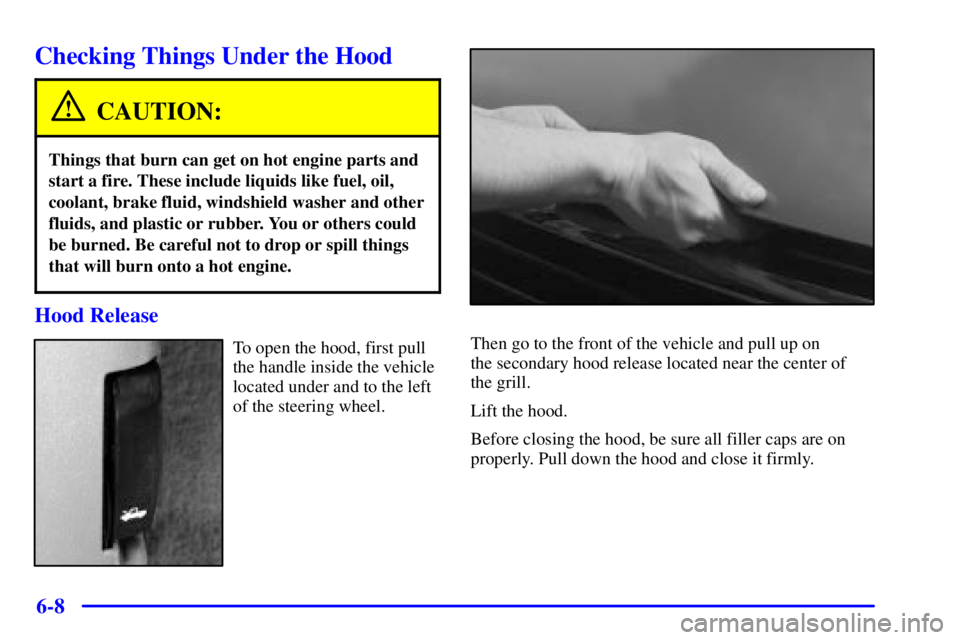
To open the hood, first pull
the handle inside the vehicle
located under and to the left
of the steering wheel.Then go to the front of the vehicle and pull up on
the secondary hood release located near the center of
the grill.
Lift the hood.
Before closing the hood, be sure all filler caps are on
properly. Pull down the hood and close it firmly.