Page 122 of 448

2-54
To idle your vehicle with the automatic headlamp
system off, set the parking brake while the ignition is
off. Then start your vehicle. The automatic headlamp
system will stay off until you release the parking brake.
As with any vehicle, you should turn on the regular
headlamp system when you need it.
You may be able to turn off your automatic headlamp
system. See ªDaytime Running Lamps (DRL)º later
in this section for more information
Lamps On Reminder
A reminder chime will sound when your headlamps or
parking lamps are manually turned on, the driver's
door is opened and your ignition is in OFF, LOCK or
ACCESSORY. To turn the chime off, turn the knob all
the way to the left or turn the instrument panel dimmer
down to the fully dimmed position. In the automatic
mode, the headlamps turn off once the ignition key is
in OFF.
Daytime Running Lamps
Daytime Running Lamps (DRL) can make it easier
for others to see the front of your vehicle during
the day. DRL can be helpful in many different
driving conditions, but they can be especially helpful
in the short periods after dawn and before sunset.
Fully functional daytime running lights are required
on all vehicles first sold in Canada.
The DRL system will make your headlamps come on at
reduced brightness when the following conditions are met:
�The ignition is on,
�the headlamp switch is in automatic headlamp mode,
�the sensor detects daytime light,
�an automatic transmission is not in PARK (P), and
�the parking brake is released.
When the DRL are on, only your headlamps will be on.
The taillamps, sidemarker and other lamps won't be on.
The instrument panel won't be lit up either.
When it begins to get dark, the headlamps will
automatically switch from DRL to the regular headlamps.
ProCarManuals.com
Page 123 of 448
2-55
The DRL system on some vehicles may turn off
temporarily while the turn signals are activated.
To idle an automatic transmission vehicle with the
DRL off, put the transmission in PARK (P). To idle a
manual transmission vehicle with the DRL off, set the
parking brake. The DRL will stay off until you shift out
of PARK (P) or release the parking brake.
The following does not apply to vehicles sold in Canada.
When necessary, you may turn off the automatic
headlamp system and the Daytime Running Lamps
(DRL) feature by following the steps below:
1. Turn the ignition to RUN.
2. Press the DOME OVERRIDE button four times
within six seconds. After the fourth press of the
button, a chime will sound informing you that the
system is off. The system will revert back to the
automatic on mode when the ignition is turned to
OFF and then to RUN again.
3. To return to the automatic mode, push the DOME
OVERRIDE button four times within six seconds
(a chime will sound), or turn the ignition to OFF
and then to RUN again.
As with any vehicle, you should turn on the regular
headlamp system when you need it.Fog Lamps (If Equipped)
Use your fog lamps for better vision in foggy or misty
conditions. Your parking lamps must be on for your
fog lamps to work.
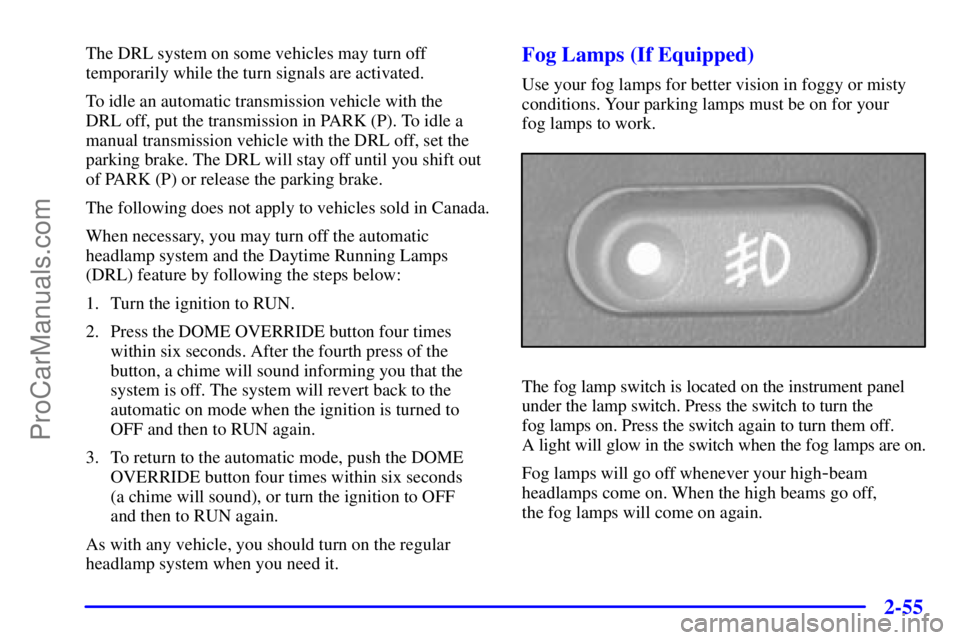
The fog lamp switch is located on the instrument panel
under the lamp switch. Press the switch to turn the
fog lamps on. Press the switch again to turn them off.
A light will glow in the switch when the fog lamps are on.
Fog lamps will go off whenever your high
-beam
headlamps come on. When the high beams go off,
the fog lamps will come on again.
ProCarManuals.com
Page 154 of 448
2-86
Instrument Panel Cluster
Your instrument panel cluster is designed to let you know at a glance how your vehicle is running. You'll know how fast
you're going, about how much fuel you've used, and many other things you'll need to know to drive safely and economically.
Standard Automatic Transmission Cluster, Canada similar
ProCarManuals.com
Page 155 of 448
2-87
Optional Automatic Transmission Cluster, Canada similar
ProCarManuals.com
Page 258 of 448

4-42 Two-Wheel Drive Vehicles and Vehicles
with the Electronic Shift Transfer Case
Tw o-wheel-drive vehicles and vehicles with the
Electronic Shift Transfer Case should not be towed
with all four wheels on the ground. These transmissions
have no provisions for internal lubrication while being
towed. To properly tow these vehicles, they should be
placed on a platform trailer with all four wheels off the
ground. Towing with all four wheels on the ground
should be avoided.
In rare cases when it's unavoidable and your vehicle
has to be towed with all four wheels on the ground,
the propeller shaft to axle yoke orientation should be
marked and the propeller shaft removed following
the applicable service manual removal/installation
procedure. See ªService and Owner Publicationsº in
the Index.
Dust or dirt can enter the back of the transmission
through the opening created by removing the propeller
shaft if proper protection is not provided. Also, check
the transmission fluid level before driving the vehicle.
Four-Wheel-Drive Vehicles
(Automatic Transfer Case)
Use the following procedure to correctly tow your
vehicle on all four wheels:
1. Firmly set the parking brake.
2. Place the transmission in PARK (P).
3. Securely attach the vehicle being towed to the
tow vehicle.
ProCarManuals.com
Page 259 of 448
4-43
4. With the engine running, shift the transfer case to
NEUTRAL. See ªFour
-Wheel Driveº in the Index
for the proper procedure to select the NEUTRAL
position for your vehicle.
CAUTION:
Shifting the transfer case into NEUTRAL can
cause your vehicle to roll even if the transmission
is in PARK (P), for an automatic transmission,
or if your vehicle is in gear, for a manual
transmission. You or others could be injured.
Make sure the parking brake is firmly set
before you shift the transfer case into NEUTRAL.
See ªFour
-Wheel Drive (Automatic Transfer Case)º
in the Index.
5. Release the parking brake only after the vehicle
being towed is firmly attached to the towing vehicle.
6. Turn the ignition to OFF. The OFF position unlocks
the steering column and reduces battery drain.
Unlocking the steering column will allow the proper
movement of the front wheels and tires during towing.
Loading Your Vehicle
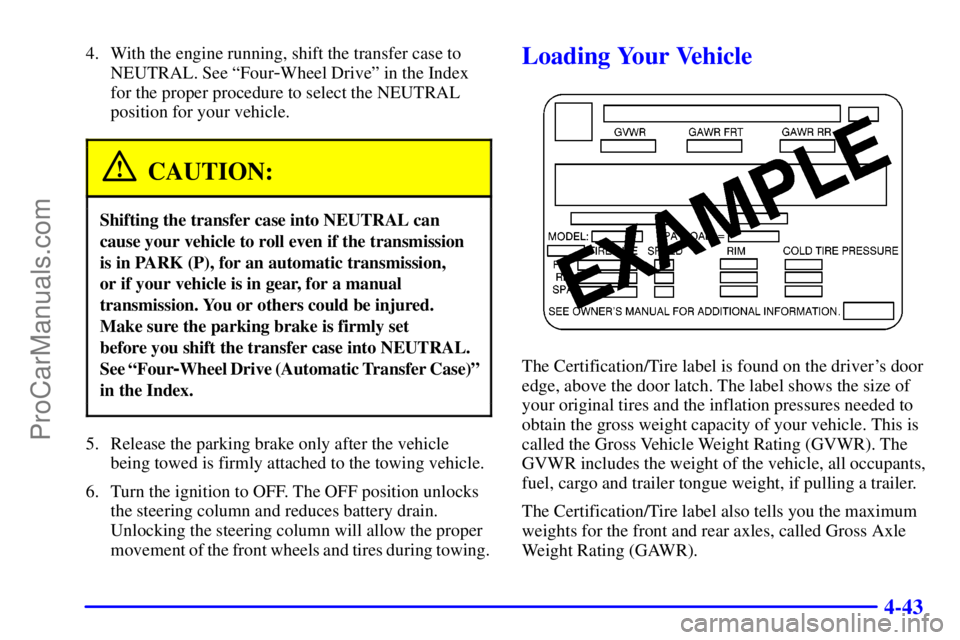
The Certification/Tire label is found on the driver's door
edge, above the door latch. The label shows the size of
your original tires and the inflation pressures needed to
obtain the gross weight capacity of your vehicle. This is
called the Gross Vehicle Weight Rating (GVWR). The
GVWR includes the weight of the vehicle, all occupants,
fuel, cargo and trailer tongue weight, if pulling a trailer.
The Certification/Tire label also tells you the maximum
weights for the front and rear axles, called Gross Axle
Weight Rating (GAWR).
ProCarManuals.com
Page 264 of 448

4-48 If You Do Decide To Pull A Trailer
If you do, here are some important points:
�There are many different laws, including speed limit
restrictions, having to do with trailering. Make sure
your rig will be legal, not only where you live but
also where you'll be driving. A good source for this
information can be state or provincial police.
�Consider using a sway control if your trailer will
weigh 2,000 lbs. (900 kg) or less. You should always
use a sway control if your trailer will weigh more
than 2,000 lbs. (900 kg). You can ask a hitch dealer
about sway controls.
�Don't tow a trailer at all during the first 500 miles
(800 km) your new vehicle is driven. Your engine,
axle or other parts could be damaged.�Then, during the first 500 miles (800 km) that you
tow a trailer, don't drive over 50 mph (80 km/h) and
don't make starts at full throttle. This helps your
engine and other parts of your vehicle wear in at the
heavier loads.
�If you have an automatic transmission, you can
use THIRD (3) (or, as you need to, a lower gear)
when towing a trailer. Operating your vehicle in
THIRD (3) when towing a trailer will minimize heat
buildup and extend the life of your transmission.
If you have a manual transmission and you are
towing a trailer, it's better not to use FIFTH (5) gear.
Just drive in FOURTH (4) gear (or, as you need to,
a lower gear). See ªTow/Haul Modeº in the Index.
Three important considerations have to do with weight:
�the weight of the trailer,
�the weight of the trailer tongue
�and the weight on your vehicle's tires.
ProCarManuals.com
Page 265 of 448

4-49
Tow/Haul Mode (V6 Engine, Automatic
Transmission Equipped Models) (If Equipped)
The tow/haul mode is a feature that assists when pulling
a heavy trailer. The purpose of the tow/haul mode is to
do the following:
�Reduce the frequency of shifts when pulling a
heavy trailer,
�provide the same shift feel when pulling a heavy
trailer as when the vehicle is unloaded, and
�reduce the need to change throttle position when
pulling a heavy trailer.
This feature is turned on or off by pressing a button
on the floor console or the shift knob. When the feature
is on, a light located on the instrument panel cluster
will illuminate to indicate that the tow/haul mode has
been selected.
See ªTow/haul Mode Lightº in the Index. The tow/haul
mode is automatically turned off each time the vehicle
is started.The tow/haul mode is most effective when the vehicle
and trailer combined weight is at least 75% of the Gross
Vehicle Weight Rating (GVWR) and the maximum
trailer weight rating for the vehicle. See ªGross Vehicle
Weight Ratingº and ªTrailer Weightº in the Index.
The tow/haul mode for hauling a heavy trailer is most
useful under the following conditions:
�When driving through hilly terrain at speeds
below 55 mph (88 km/h),
�when driving in low speed or stop and go traffic
below 55 mph (88 km/h), and
�when driving in parking lots.
Use the tow/haul mode instead of the previous
recommendation to shift to THIRD (3) gear to improve
fuel economy at highway speeds and shift performance
at lower speeds. Operating in the tow/haul mode when
not pulling a heavy trailer will not cause damage to the
vehicle, but you may experience reduced fuel economy
and undesirable performance from the engine and
transmission. The tow/haul mode should be used
only when pulling a heavy trailer.
ProCarManuals.com