Page 238 of 448

4-22
�As you are backing down the hill, put your left hand
on the steering wheel at the 12 o'clock position.
This way, you'll be able to tell if your wheels are
straight and maneuver as you back down. It's best
that you back down the hill with your wheels straight
rather than in the left or right direction. Turning the
wheel too far to the left or right will increase the
possibility of a rollover.
Here are some things you must not do if you stall, or are
about to stall, when going up a hill.
�Never attempt to prevent a stall by shifting into
NEUTRAL (N) (or depressing the clutch, if you
have a manual transmission) to ªrev
-upº the
engine and regain forward momentum. This won't
work. Your vehicle will roll backwards very quickly
and you could go out of control.
Instead, apply the regular brake to stop the
vehicle. Then apply the parking brake. Shift to
REVERSE (R), release the parking brake, and
slowly back straight down.�Never attempt to turn around if you are about to
stall when going up a hill. If the hill is steep enough
to stall your vehicle, it's steep enough to cause you
to roll over if you turn around. If you can't make it
up the hill, you must back straight down the hill.
Q:Suppose, after stalling, I try to back down
the hill and decide I just can't do it.
What should I do?
A:Set the parking brake, put your transmission
in PARK (P) (or the manual transmission in
FIRST (1)) and turn off the engine. Leave the
vehicle and go get some help. Exit on the uphill
side and stay clear of the path the vehicle would
take if it rolled downhill. Do not shift the transfer
case to NEUTRAL when you leave the vehicle.
Leave it in some gear.
ProCarManuals.com
Page 255 of 448

4-39
What's the worst time for this? ªWet ice.º Very cold
snow or ice can be slick and hard to drive on. But wet
ice can be even more trouble because it may offer the
least traction of all. You can get wet ice when it's about
freezing (32�F; 0�C) and freezing rain begins to fall.
Try to avoid driving on wet ice until salt and sand crews
can get there.Whatever the condition
-- smooth ice, packed, blowing
or loose snow
-- drive with caution.
Accelerate gently. Try not to break the fragile traction.
If you accelerate too fast, the drive wheels will spin and
polish the surface under the tires even more.
Your anti
-lock brakes improve your vehicle's stability
when you make a hard stop on a slippery road. Even
though you have an anti
-lock braking system, you'll
want to begin stopping sooner than you would on dry
pavement. See ªAnti
-Lockº in the Index.
�Allow greater following distance on any
slippery road.
�Watch for slippery spots. The road might be fine
until you hit a spot that's covered with ice. On an
otherwise clear road, ice patches may appear in
shaded areas where the sun can't reach: around
clumps of trees, behind buildings or under bridges.
Sometimes the surface of a curve or an overpass
may remain icy when the surrounding roads are
clear. If you see a patch of ice ahead of you,
brake before you are on it. Try not to brake while
you're actually on the ice, and avoid sudden
steering maneuvers.
ProCarManuals.com
Page 257 of 448

4-41
CAUTION:
Snow can trap exhaust gases under your vehicle.
This can cause deadly CO (carbon monoxide) gas
to get inside. CO could overcome you and kill
you. You can't see it or smell it, so you might not
know it is in your vehicle. Clear away snow from
around the base of your vehicle, especially any
that is blocking your exhaust pipe. And check
around again from time to time to be sure snow
doesn't collect there.
Open a window just a little on the side of the
vehicle that's away from the wind. This will
help keep CO out.
Run your engine only as long as you must. This saves
fuel. When you run the engine, make it go a little faster
than just idle. That is, push the accelerator slightly. This
uses less fuel for the heat that you get and it keeps the
battery charged. You will need a well
-charged battery to
restart the vehicle, and possibly for signaling later on
with your headlamps. Let the heater run for a while.Then, shut the engine off and close the window almost
all the way to preserve the heat. Start the engine again
and repeat this only when you feel really uncomfortable
from the cold. But do it as little as possible. Preserve the
fuel as long as you can. To help keep warm, you can get
out of the vehicle and do some fairly vigorous exercises
every half hour or so until help comes.
Recreational Vehicle Towing
There may be times when you want to tow your vehicle
behind another vehicle for use at your destination.
Be sure to use the proper towing equipment designed
for recreational vehicle towing. Follow the instructions
for the towing equipment.
When towing your vehicle, turn the ignition to OFF.
To prevent your battery from draining while towing,
remove the RDO BATT and CLSTR fuses from the
instrument panel fuse block. Be sure to replace the fuses
when you reach your destination. See ªFuses and Circuit
Breakersº in the Index.
ProCarManuals.com
Page 259 of 448
4-43
4. With the engine running, shift the transfer case to
NEUTRAL. See ªFour
-Wheel Driveº in the Index
for the proper procedure to select the NEUTRAL
position for your vehicle.
CAUTION:
Shifting the transfer case into NEUTRAL can
cause your vehicle to roll even if the transmission
is in PARK (P), for an automatic transmission,
or if your vehicle is in gear, for a manual
transmission. You or others could be injured.
Make sure the parking brake is firmly set
before you shift the transfer case into NEUTRAL.
See ªFour
-Wheel Drive (Automatic Transfer Case)º
in the Index.
5. Release the parking brake only after the vehicle
being towed is firmly attached to the towing vehicle.
6. Turn the ignition to OFF. The OFF position unlocks
the steering column and reduces battery drain.
Unlocking the steering column will allow the proper
movement of the front wheels and tires during towing.
Loading Your Vehicle
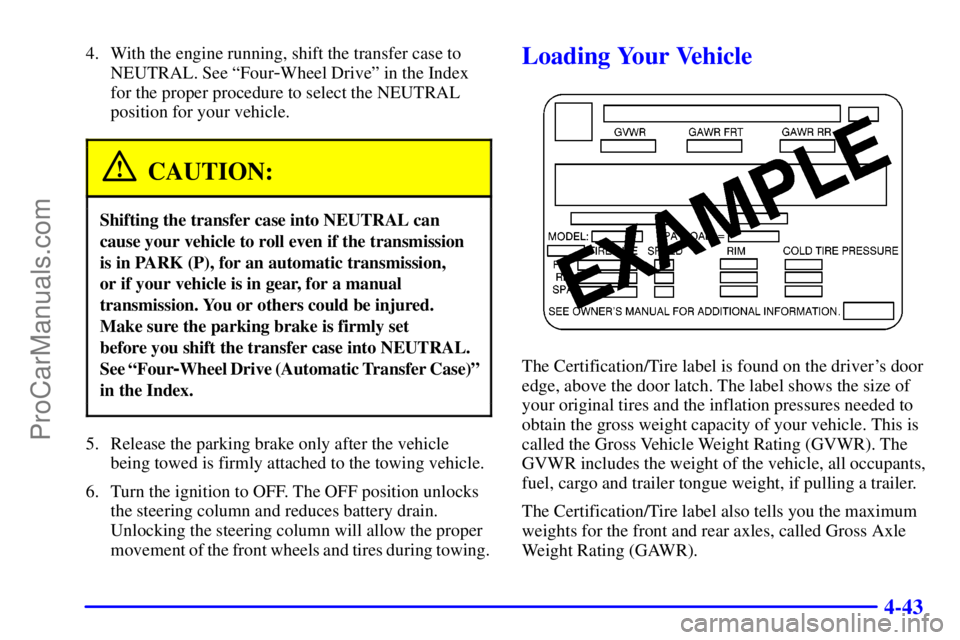
The Certification/Tire label is found on the driver's door
edge, above the door latch. The label shows the size of
your original tires and the inflation pressures needed to
obtain the gross weight capacity of your vehicle. This is
called the Gross Vehicle Weight Rating (GVWR). The
GVWR includes the weight of the vehicle, all occupants,
fuel, cargo and trailer tongue weight, if pulling a trailer.
The Certification/Tire label also tells you the maximum
weights for the front and rear axles, called Gross Axle
Weight Rating (GAWR).
ProCarManuals.com
Page 262 of 448
4-46
The compressor should operate for brief periods of time.
If the sound continues for an extended period of time,
your vehicle needs service. To keep your battery from
being drained, you may want to remove the LD LEV
fuse in the engine compartment fuse block until you
can get your vehicle serviced (see ªFuses and Circuit
Breakersº in the Index).
Using heavier suspension components to get added
durability might not change your weight ratings. Ask
your dealer to help you load your vehicle the right way.
Add-On Equipment
When you carry removable items, you may need to put a
limit on how many people you carry inside your vehicle.
Be sure to weigh your vehicle before you buy and install
the new equipment.
NOTICE:
Your warranty doesn't cover parts or components
that fail because of overloading.
Towing a Trailer
CAUTION:
If you don't use the correct equipment and drive
properly, you can lose control when you pull a
trailer. For example, if the trailer is too heavy,
the brakes may not work well
-- or even at all.
You and your passengers could be seriously
injured. Pull a trailer only if you have followed
all the steps in this section. Ask your dealer for
advice and information about towing a trailer
with your vehicle.
ProCarManuals.com
Page 274 of 448

4-58 Trailer Wiring Harness
The light-duty trailer wiring is a six-wire harness
assembly. The optional heavy
-duty trailer wiring is an
eight
-wire harness assembly. The harnesses are stored
under the vehicle, along the passenger
-side frame
crossmember on two
-door vehicles or on the driver's
side corner frame rear crossmember on four
-door
vehicles. The heavy
-duty trailer wiring is fused in the
engine compartment fuse block. See ªFuses and Circuit
Breakersº in the Index. Both harnesses have no
connector and should be wired by a qualified
electrical technician. The technician can use the
following color code chart when connecting the
wiring harness to your trailer.�Dark Blue: Use for electric trailer brakes or auxiliary
wiring (eight
-wire harness only).
�Red: Use for battery charging; it connects to the
starter solenoid (eight
-wire harness only).
�Light Green: Back
-up lamps.
�Brown: Taillamps and parking lamps.
�Yellow: Left stoplamp and turn signal.
�Dark Green: Right stoplamp and turn signal.
�White: Ground wire.
�Light Blue: Auxiliary stoplamp.
Securely attach the harness to the trailer, then tape or
strap it to your vehicle's frame rail. Be sure you leave it
loose enough so the wiring doesn't bend or break,
but not so loose that it drags on the ground. Store the
harness in its original place. Wrap the harness together
and tie it neatly so it won't be damaged.
ProCarManuals.com
Page 288 of 448
5-14 How to Add Coolant to the Radiator
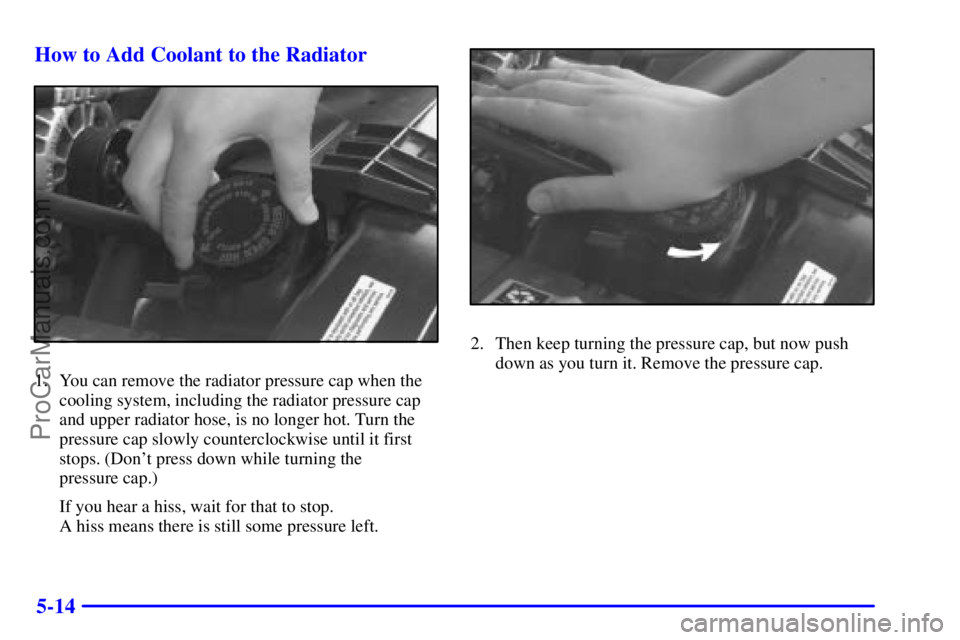
1. You can remove the radiator pressure cap when the
cooling system, including the radiator pressure cap
and upper radiator hose, is no longer hot. Turn the
pressure cap slowly counterclockwise until it first
stops. (Don't press down while turning the
pressure cap.)
If you hear a hiss, wait for that to stop.
A hiss means there is still some pressure left.
2. Then keep turning the pressure cap, but now push
down as you turn it. Remove the pressure cap.
ProCarManuals.com
Page 292 of 448
5-18
Changing a Flat Tire
If a tire goes flat, avoid further tire and wheel damage
by driving slowly to a level place. Turn on your hazard
warning flashers.
CAUTION:
Changing a tire can cause an injury. The vehicle
can slip off the jack and roll over you or other
people. You and they could be badly injured.
Find a level place to change your tire. To help
prevent the vehicle from moving:
1. Set the parking brake firmly.
2. Put an automatic transmission shift lever in
PARK (P) or shift a manual transmission
to FIRST (1) or REVERSE (R).
3. If you have a four
-wheel-drive vehicle,
be sure the transfer case is in a drive
gear
-- not in NEUTRAL.
CAUTION: (Continued)
CAUTION: (Continued)
4. Turn off the engine.
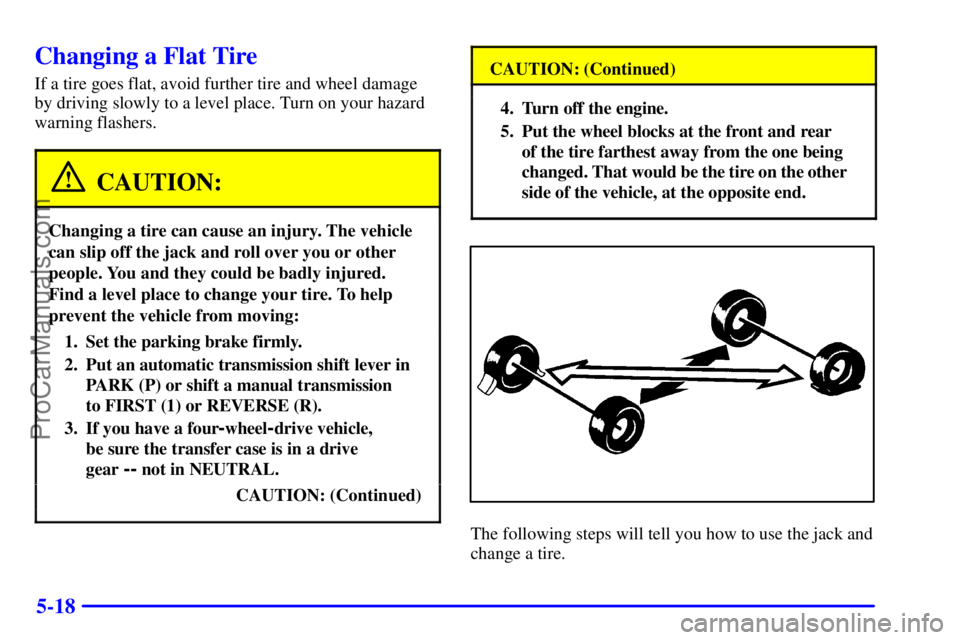
5. Put the wheel blocks at the front and rear
of the tire farthest away from the one being
changed. That would be the tire on the other
side of the vehicle, at the opposite end.
The following steps will tell you how to use the jack and
change a tire.
ProCarManuals.com