2001 FORD WINDSTAR trailer
[x] Cancel search: trailerPage 222 of 288

5. If the fluid is low, add fluid in small amounts, continuously checking
the level until it reaches the correct operating range. Be sure to put the
cap back on the reservoir.
TRANSMISSION FLUID
Checking automatic transmission fluid
Refer to your scheduled maintenance guide for scheduled intervals for
fluid checks and changes. Your transaxle does not consume fluid.
However, the fluid level should be checked if the transaxle is not working
properly, i.e., if the transaxle slips or shifts slowly or if you notice some
sign of fluid leakage.
Automatic transmission fluid expands when warmed. To obtain an
accurate fluid check, drive the vehicle until it is warmed up
(approximately 30 km [20 miles]). If your vehicle has been
operated for an extended period at high speeds, in city traffic
during hot weather or pulling a trailer, the vehicle should be
turned off for about 30 minutes to allow fluid to cool before
checking.
1. Drive the vehicle 30 km (20 miles) or until it reaches normal operating
temperature.
2. Park the vehicle on a level surface and engage the parking brake.
3. With the parking brake engaged and your foot on the brake pedal,
start the engine and move the gearshift lever through all of the gear
ranges. Allow sufficient time for each gear to engage.
4. Latch the gearshift lever in P (Park) and leave the engine running.
5. Remove the dipstick, wiping it clean with a clean, dry lint free rag. If
necessary, refer toIdentifying components in the engine compartment
in this chapter for the location of the dipstick.
6. Install the dipstick making sure it is fully seated in the filler tube.
7. Remove the dipstick and inspect the fluid level. The fluid should be in
the designated areas for normal operating temperature.
Low fluid level
Do not drive the vehicle if the fluid
level is at the bottom of the dipstick
and the outside temperatures are
above 10ÉC (50ÉF).
DON’T ADD IF IN CROSSHATCH AREA--CHECH WHEN HOT-IDLING
Maintenance and care
222
Page 233 of 288
initial adjustment is completed after driving over 65 km/h (40 mph) for
15 to 20 minutes.
This system may not function properly under the following conditions:
²Uneven tread wear.
²Driving on loose or low traction surfaces such as gravel, snow or slush.
²Using tire chains
²Initial tire pressures out of specified range.
²Two or more under inflated tires.
²Sudden loss of tire pressure.
²Vehicle speeds less than 30 km/h (20 mph), greater than 120 km/h (70
mph) or driving duration less than 10 miles.
²Transporting a heavy load or towing a trailer.
The low tire warning feature can be turned off by your dealer.
Checking the tire pressure
²Use an accurate tire pressure gauge.
²Check the tire pressure when tires are cold, after the vehicle has been
parked for at least one hour or has been driven less than 5 km (3
miles).
²Adjust tire pressure to recommended specifications found on the
Certification Label.
Improperly inflated tires can affect vehicle handling and can fail
suddenly, possibly resulting in loss of vehicle control.
Tire rotation
Because your vehicle's tires perform different jobs, they often wear
differently. To make sure your tires wear evenly and last longer, rotate
them as indicated in the scheduled maintenance guide. If you notice that
the tires wear unevenly, have them checked.
Maintenance and care
233
Page 243 of 288
²Use recommended engine oil. Refer toLubricant Specifications.
²Perform all regularly scheduled maintenance items. Follow the
recommended maintenance schedule and owner maintenance checks
found in your vehicle scheduled maintenance guide.
Conditions
²Heavily loading a vehicle or towing a trailer may reduce fuel economy
at any speed.
²Carrying unnecessary weight may reduce fuel economy (approximately
0.4 km/L [1 mpg] is lost for every 180 kg [400 lb] of weight carried).
²Adding certain accessories to your vehicle (for example bug
deflectors, rollbars/light bars, running boards, ski/luggage racks) may
reduce fuel economy.
²Using fuel blended with alcohol may lower fuel economy.
²Fuel economy may decrease with lower temperatures during the first
12±16 km (8±10 miles) of driving.
²Driving on flat terrain offers improved fuel economy as compared to
driving on hilly terrain.
²Transmissions give their best fuel economy when operated in the top
cruise gear and with steady pressure on the gas pedal.
²Close windows for high speed driving.
EPA window sticker
Every new vehicle should have the EPA window sticker. Contact your
dealer if the window sticker is not supplied with your vehicle. The EPA
window sticker should be your guide for the fuel economy comparisons
with other vehicles.
It is important to note the box in the lower left corner of the window
sticker. These numbers represent the Range of L/100 km (MPG)
expected on the vehicle under optimum conditions. Your fuel economy
may vary depending upon the method of operation and conditions.
EMISSION CONTROL SYSTEM
Your vehicle is equipped with various emission control components and a
catalytic converter which will enable your vehicle to comply with
applicable exhaust emission standards. To make sure that the catalytic
converter and other emission control components continue to work
properly:
Maintenance and care
243
Page 262 of 288
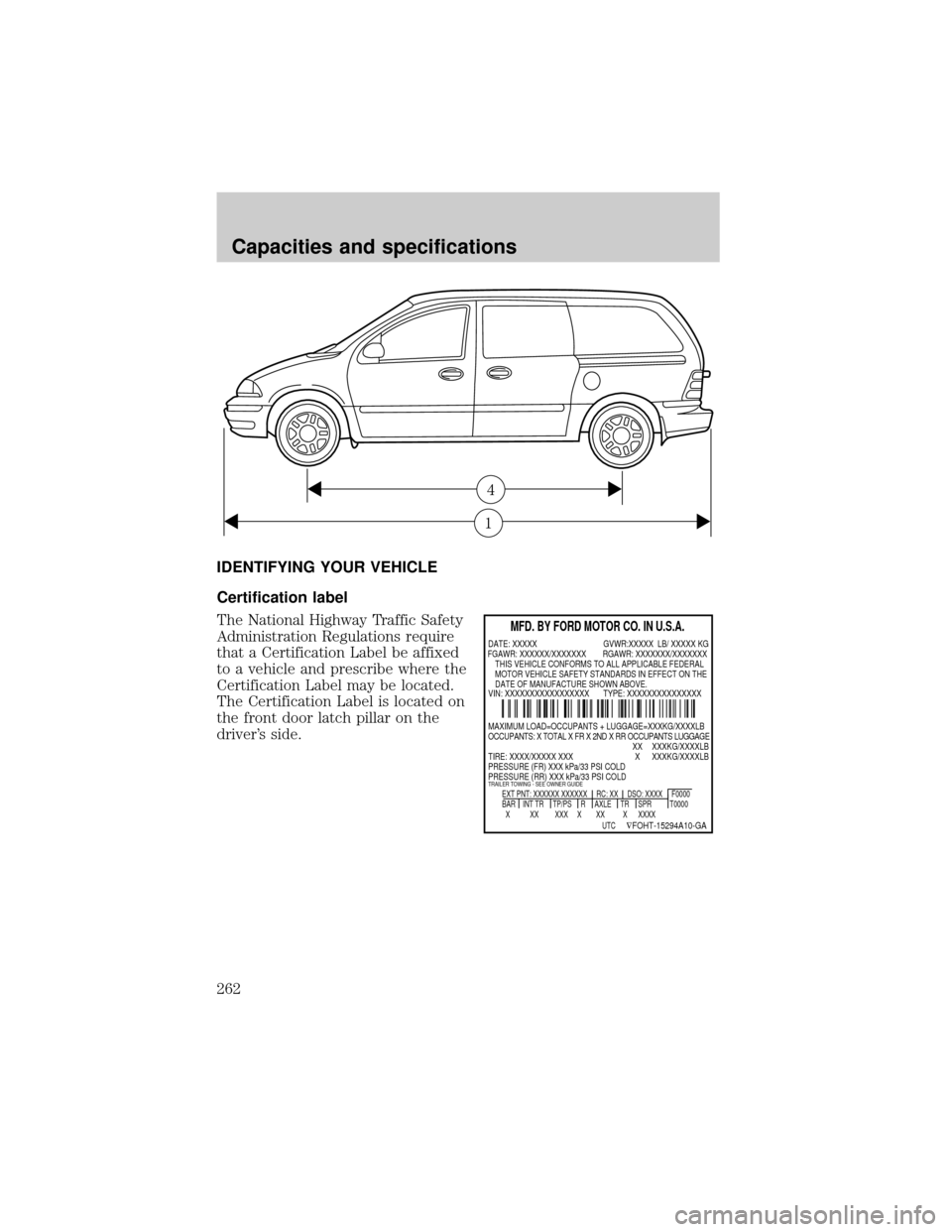
IDENTIFYING YOUR VEHICLE
Certification label
The National Highway Traffic Safety
Administration Regulations require
that a Certification Label be affixed
to a vehicle and prescribe where the
Certification Label may be located.
The Certification Label is located on
the front door latch pillar on the
driver's side.
1
4
MFD. BY FORD MOTOR CO. IN U.S.A.
EXT PNT: XXXXXX XXXXXX RC: XX DSO: XXXX F0000
BAR INT TR TP/PS R AXLE TR SPR T0000
X XX XXX X XX X XXXX
UTC
ÑFOHT-15294A10-GA
MAXIMUM LOAD=OCCUPANTS + LUGGAGE=XXXKG/XXXXLB
OCCUPANTS: X TOTAL X FR X 2ND X RR OCCUPANTS LUGGAGE
XX XXXKG/XXXXLB
TIRE: XXXX/XXXXX XXX X XXXKG/XXXXLB
PRESSURE (FR) XXX kPa/33 PSI COLD
PRESSURE (RR) XXX kPa/33 PSI COLD
TRAILER TOWING - SEE OWNER GUIDE
DATE: XXXXX GVWR:XXXXX LB/ XXXXX KG
VIN: XXXXXXXXXXXXXXXXX TYPE: XXXXXXXXXXXXXXX FGAWR: XXXXXX/XXXXXXX RGAWR: XXXXXXX/XXXXXXX
THIS VEHICLE CONFORMS TO ALL APPLICABLE FEDERAL
MOTOR VEHICLE SAFETY STANDARDS IN EFFECT ON THE
DATE OF MANUFACTURE SHOWN ABOVE.
Capacities and specifications
262
Page 274 of 288

Luggage/cargo basket
Raised cross bars (roof rack)
Soft luggage cover
Trailer hitch (Class II)
Trailer hitch bars and balls
Trailer hitch mount bike carrier
Trailer hitch wiring adaptor
Video entertainment system
Protection and appearance equipment
Cargo liners, interior
Carpet floor mats
Cleaners, waxes and polishes
Door edge guards
Flat splash guards
Front end covers (full and mini)
Hood deflectors
Locking gas cap
Lubricants and oils
Molded splash guards
Molded vinyl floor mats
Rear air deflector
Side window deflectors
Touch-up paint
Underbody security lighting
Universal floor mats
Customer assistance
274
Page 282 of 288

Load limits .................................178
GAWR ......................................178
GVWR ......................................178
trailer towing ..........................178
Locks
autolock ...................................110
childproof ..................................88
Lubricant specifications ...259, 261
Lumbar support, seats .............122
M
Message center ...........................17
english/metric button ...............18
system check button ................18
warning messages .....................19
Mirrors .........................................90
automatic dimming rearview
mirror ........................................89
cleaning ...................................254
fold away ...................................87
heated ........................................87
programmable memory ..........109
side view mirrors (power) .......86
Motorcraft parts ................240, 257
O
Octane rating ............................239
Odometer .....................................16
Oil (see Engine oil) ..................211
Overdrive .............................83, 174
P
Panic alarm feature,
remote entry system ................106
Parking brake ............................168Parts (see Motorcraft parts) ....257
Passenger Occupant
Classification Sensor .................132
Pedals (see Power
adjustable foot pedals) ...............78
Power adjustable foot pedals .....78
Power distribution box
(see Fuses) ...............................192
Power door locks ................88, 110
Power steering ..........................173
fluid, checking and adding ....221
fluid, refill capacity ................258
fluid, specifications .........259, 261
R
Radio ............................................39
Relays ........................................187
Remote entry system .......102, 106
illuminated entry ......28, 107, 110
locking/
unlocking doors ..............103±105
panic alarm .............................106
replacement/additional
transmitters .............................108
replacing the batteries ...........107
Reverse sensing system .............75
Roof rack ...................................184
S
Safety belts (see Safety
restraints) ....14, 131, 134±137, 139
Safety defects, reporting ..........277
Safety
restraints ...........131, 134±137, 139
belt minder .............................140
Index
282
Page 283 of 288

cleaning the
safety belts ......................143, 256
extension assembly ................139
for adults .........................135±137
for children .....................151±152
lap belt ....................................138
Occupant Classification
Sensor ......................................132
warning light and
chime ...............9, 13±14, 139±140
Safety seats for children ..........153
Seat belts
(see Safety restraints) .............131
Seats ..........................................119
child safety seats ....................153
cleaning ...........................256±257
memory seat .............89, 109, 122
SecuriLock passive
anti-theft system ...............113±115
Servicing your vehicle ..............208
Spark plugs,
specifications .....................257, 261
Specification chart,
lubricants ...........................259, 261
Speed control ..............................79
Speedometer ...............................15
Starting your vehicle ........163, 165
jump starting ..........................202
Steering wheel
tilting .........................................84T
Tachometer .................................15
Tires ...........................196, 230±232
changing ..................196±197, 199
checking the pressure ............233
replacing ..................................234
rotating ....................................233
snow tires and chains ............235
tire grades ...............................231
treadwear ................................231
Towing .......................................180
recreational towing .................183
trailer towing ..........................180
wrecker ....................................207
Traction control ..................78, 169
active light ..................................8
off light ........................................9
Transaxle
automatic operation ...............173
fluid, refill capacities ..............258
lubricant specifications ..........261
Transmission
fluid, checking and adding
(automatic) .............................222
lubricant specifications ..........259
Trip odometer .............................16
Turn signal ........................9, 14, 82
V
Vehicle dimensions ...................261
Vehicle Identification Number
(VIN) ..........................................263
Vehicle loading ..........................178
Ventilating your vehicle ...........166
Index
283